Showing posts with label Jesus. Show all posts

Thursday, January 10, 2019

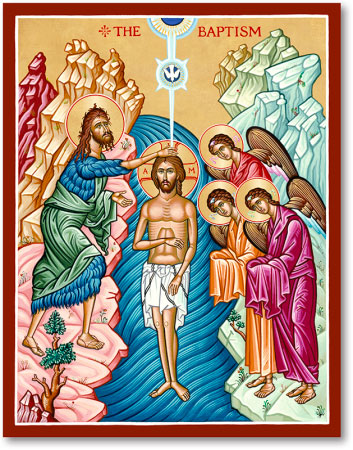
John Baptizes Jesus

Baptism of Christ
It came to pass in those days that Jesus came from Nazareth of Galilee, and was baptized by John in the Jordan. And immediately, coming up from the water, He saw the heavens parting and the Spirit descending upon Him like a dove. Then a voice came from heaven, “You are My beloved Son, in whom I am well pleased” (Mark 1:9-11).

John is in the wilderness preaching a baptism of repentance. He is Elijah, who was foretold, who would prepare the way of the Lord. The people flock to him, to hear his message, to be baptized by him, to confess their sins. The religious leaders also go out to see John. They are concerned. This man is causing a disturbance. He is upsetting the structure. They ask him to give an account. Just who are you? He confesses plainly that he is not the Christ who was to come: There comes One after me who is mightier than I, whose sandal strap I am not worthy to stoop down and loose. I indeed baptized you with water, but He will baptize you with the Holy Spirit.[1] John’s entire purpose is not to gain notoriety for himself. It is not to build up his own ministry. His purpose is to point to Jesus, the fulfillment of God’s promised redemption.

As John continues preaching repentance and baptizing, Jesus comes to him. Jesus tells John that he must baptize Jesus. John is taken aback. I should be baptized by You! Jesus explains. It is to fulfill all righteousness. John relents. He doesn’t understand what Jesus is doing, but he obeys. Jesus is baptized by John in the Jordan. As Jesus comes up out of the river, God the Spirit descends upon Him. The heavens open. John sees and hears the manifestation of the Triune God. God the Father declares His pleasure with, and approval of Jesus, God the Son.

But why does the sinless Son of God need to be baptized with John’s baptism of repentance? Jesus knew no sin, after all. Jesus is Israel, reduced to one. On the eighth day after His birth, Jesus was circumcised according to the Law. He was brought into the covenant, as all those circumcised before him were. Now, in John’s baptism, Jesus identifies Himself with mankind. He takes responsibility for mankind’s sin. By submitting to John’s baptism, Jesus deliberately took our place as His Father had sent Him to do.[2] It was here that God the Father made Him who knew no sin to become sin for us, that we might become the righteousness of God.[3] Immediately after His baptism, Jesus will be driven into the wilderness by the Spirit. Jesus, Israel reduced to one, will be tempted by Satan. A second Exodus and wilderness wandering. Israel was hard-hearted and unfaithful. Jesus remains faithful. He will put right what Israel got wrong. He will resist the temptation of Satan. Being the sinless Savior, God in human flesh, Jesus will go to the cross. He will die as a transgressor, accursed, hung on the tree, that is the cross, the pure and spotless sacrifice for the sins of the world; He will raise to life again on the third day, the victor over sin, death, and the devil. His journey begins here with His baptism by John.


[1] Mark 1:7-8
[2] Wicke, Harold E. Mark. St. Louis, MO: Concordia Publishing House, 2004.
[3] 2 Corinthians 5:21

Monday, September 17, 2018

Jesus is Better

In that He says, “A new covenant,” He has made the first obsolete. Now what is becoming obsolete and growing old is ready to vanish away (Hebrews 8:13).

The Mosaic covenant is obsolete. It is finished. It is over and done with. The author of Hebrews spends a lot of time emphasizing that point. Or, to say it positively, Jesus is better. Jesus is better than the Mosaic covenant. Jesus is better than Moses. Jesus is better than the angels. Jesus is better than the earthly high priest and the rites and services of the temple. Jesus is better. This is the over-arching point of the book of Hebrews: Jesus is better, so don’t return to the things which He made obsolete; this brings us back to the Mosaic covenant, which the author addresses in chapter eight.

If God knew, since He is God, that the covenant He was making with Israel through Moses would become obsolete, why make it? It seems like a bunch of unnecessary maneuvering for nothing. It’s confusing. Let’s spend a couple thousand years paying extra attention to this law; let’s ingrain it into every aspect of our society, and then abandon it one day. That seems like it should be pretty easy, right? Then the words of Romans 9:20 put me in my proper place: But who are you, O man, to talk back to God? Shall what is formed say to Him who formed it, “Why have you made me like this?”

No, God does what He does for His own reasons, and it is not our place to criticize, or even to understand. In terms of the Mosaic covenant, it’s purpose was not to be a permanent solution to man’s problem of sin and death. The Mosaic covenant was intended to show man his sin, and his need to be rescued, and it was intended to set apart the children of Israel from the nations of the world. It was to mark them as holy and special, and to refine them, until out of them would come the only permanent solution to sin, death, and the devil, Jesus. God wanted to set apart the Israelites, so He gave them different laws, rules, and customs than all the other nations. Specific and unique rules for their clothing; Specific and unique rules for cutting their beards; Specific and unique rules for what they could eat; Specific and unique rules for how they were to worship Yahweh.

We run into two equal and opposite errors, concerning the Mosaic covenant. The first one goes like this: If God prescribed all these specific rules for how to act, dress, eat, and worship, we had better get to doing them. God means what He says, after all. From this, you get things like the Hebrew Roots Movement, and a bunch of people who say they are Christians trying to please God and justify themselves by how well they keep the Law of Moses. They are Pharisees. The second one hits closer to home with me: the Mosaic covenant s obsolete, you say? I’ve been set free from my slavery to sin by the atoning death of Christ, you say? Delightful! Now I can do whatever I want. No more stuffy and outmoded moral restraints for me. All things are lawful for me, because Christ has made the Law obsolete! Anyone who tells me differently is a Pharisee… This is called antinomianism. Both of these errors are deadly.

So what are we to make of the Mosaic covenant? We are to make of it what God tells us through scripture. We are to understand that in the Law, the Mosaic covenant, there are three types of laws: 1) the moral law, 2) the ceremonial law, and 3) the civil law. The moral law tells man his duty toward God. It is written on the human heart from creation. This is how Cain knew it was sinful for him to murder his brother Abel, even before the Law was formally written down. It is how we know, before anyone tells us, that we are idolators, murderers, liars, thieves, and adulterers. It is how we know that we, despite all the things we do to look righteous before men, or to try and justify ourselves before God, don’t measure up to God’s standard. We have sinned against Him by our thoughts, words, and deeds, by what we have done, and by what we have left undone. We have not loved God with our whole hearts; we have not loved our neighbors as ourselves. The ceremonial law told the Israelites how they were supposed to worship Yahweh, from how to construct the tabernacle and implement the elaborate system of animal sacrifices, down to the clothing and movements of the high priest and his attendants. The civil law regulated how the Israelites where to act toward each other, as well as toward other nations, in accordance with the moral law.

In good Lutheran fashion we ask, “What does this mean?” It means that all human beings, since man’s fall into sin, have a responsibility to keep the moral law, which God gave to Moses on Mt. Sinai, engraved by the finger of God into tablets of stone, which we call the 10 Commandments. This moral law was written on man’s heart from the beginning, and codified by God on Mt. Sinai. The ceremonial law and the civil law, however were given specifically to the nation of Israel, and for a different and specific purpose. That purpose was to set them apart from all the pagan nations of the world, and to mark them as His chosen people, from whom mankind’s savior would arise. The ceremonial and civil laws were shadows of the things to come. They are the symbols, fulfilled in Christ. The tabernacle, and later the temple, and all the worship of the sacrificial system of the Mosaic covenant points to Christ. It is fulfilled in Christ. It is made obsolete in Christ. This is the reason we can eat shellfish, and trim our beards. It’s the reason that sins like homosexuality are still sinful (because we’re still responsible for the moral law), but we are able to disregard the punishment prescribed in the civil law of Israel (because we’re not responsible for the civil law) which commanded that homosexuals (and various other offenders against the law) be put to death.

That is the point of Hebrews. All the sacrifices that ever were performed were imperfect types and shadows of Christ’s perfect atoning sacrifices for sin on the cross; it was perfect, therefore there is no need to repeat it. We fail to keep the Law. Christ has kept it. He is righteous and gives us His righteousness. In fact, Jesus, who knew no sin, became sin for us so that we might become the righteousness of God by the grace of God through faith in Christ. He needs only to deliver this gift to us. He does that in the preaching of His word. He does that when, according to His promise, we bring people, old and young, infant and adult, to the baptismal font, and they are joined to Christ and His death and resurrection by water and the word; where they are saved through baptism and their sins are washed away. He delivers it to us in the Supper, the eating and drinking of Christ’s own body and blood, for the forgiveness of our sins, with the bread and wine. The Mosaic covenant is obsolete. We have something better which will never pass away; we have Jesus, and His death, and His resurrection. And, because He lives, we also shall live.

Thursday, July 26, 2018

Victory over the Amalekites

Now Amalek came and fought with Israel in Rephidim. And Moses said to Joshua, “Choose us some men and go out, fight with Amalek. Tomorrow I will stand on the top of the hill with the rod of God in my hand.” So Joshua did as Moses said to him, and fought with Amalek. And Moses, Aaron, and Hur went up to the top of the hill. And so it was, when Moses held up his hand, that Israel prevailed; and when he let down his hand, Amalek prevailed. But Moses’ hands became heavy; so they took a stone and put it under him, and he sat on it. And Aaron and Hur supported his hands, one on one side, and the other on the other side; and his hands were steady until the going down of the sun. So Joshua defeated Amalek and his people with the edge of the sword. Then the Lord said to Moses, “Write this for a memorial in the book and recount it in the hearing of Joshua, that I will utterly blot out the remembrance of Amalek from under heaven.” And Moses built an altar and called its name, The-Lord-Is-My-Banner; for he said, “Because the Lord has sworn: the Lord will have war with Amalek from generation to generation” (Exodus 17:8-16).

The People of Israel are rescued by Yahweh in spite of their constant rebellion. He brought them out of Egypt by His mighty hand; they can claim no part in making Pharaoh let them go. Yahweh defeated the Egyptians in the Red Sea when pursued Israel; it could not be claimed that their escape and the Egyptian’s defeat came about by the force of their arms. God provided food for the children of Israel in the wilderness; no one could claim that Israel was self-sufficient. In fact, they ran out of provisions. They complained to Moses and longed for the rather romanticized life they had in Egypt, where they sat around pots full of meat. God provided them water from a most unlikely source when they had no water to drink. They dug no well; they found no stream. They complained. Yahweh, through the working of Moses, gives the children of Israel water to drink, gushing forth from a rock. This was not dead water from a stagnant pool that would make them sick and die, but living water, flowing forth from the rock that Moses was told by God to strike. And that rock, St. Paul tells us, was Christ.[1] Being struck by the rod of the Law, Christ provides living water to refresh and nourish His people in the dead and dry wilderness.

Now Amalek, descendent of Esau, came and fought with Israel at Rephidim. Now they must defeat the enemy themselves. Moses sends Joshua. “Choose us some men and go out, fight with Amalek. Tomorrow I will stand on the top of the hill with the rod of God in my hand,” Moses says. He will pray; the mediator making intercession for his people to Yahweh. The people may be fighting a battle but it is Yahweh who wins it for them. Moses stands on the hill, arms outstretched in prayer. When Moses held up his hand, Israel prevailed; when he let down his hand Amalek prevailed. The Israelites were fighting, but Yahweh was the source of their strength and victory.

So Joshua defeated Amalek and his people with the edge of the sword. Here we see another shadow of Christ: Joshua, who will eventually succeed Moses as the leader of Israel. Moses will give them the Law and show them their sin. Joshua, or Yeshua, which is anglicized as Jesus, will do what Moses cannot do. Joshua will lead Israel across the Jordan into the Promised Land. He will defeat Israel’s enemies with the edge of the sword. Christ, the Joshua who is the fulfillment of this shadow, has defeated Israel’s enemies, once and for all, on the cross; He has purchased and won us from sin, death, and the devil with His holy, precious blood, and by His innocent suffering and death on the cross. He rose from the dead on the third day, having conquered death and the grave, and ascended into heaven. He will come again with glory, to judge the living and the dead. In righteousness He judges and makes war. John describes Him in Revelation:

His eyes were like a flame of fire, and on His head were many crowns. He had a name written that no one knows except Himself. He was clothed in a robe dipped in blood, and His name is called the Word of God. And the armies in heaven, clothed in fine linen, white and clean, followed Him on white horses. Now out of His mouth goes a sharp sword, that with it He should strike the nations. And He Himself will rule them with a rod of iron. He Himself treads the winepress of the fierceness and wrath of Almighty God. And He has on His robe and on His thigh a name written: King of Kings and Lord of Lords (Revelation 19:11-16).

We have been rescued by God’s might hand from our slavery to sin. Though we were by our nature children of wrath, God loved us. Even when we were dead in our transgressions, God made us alive together with Christ, by His grace.[2] Even though we continue to rebel against Him by our sinful thoughts, words, and deeds, He grants us repentance and faith through His means of Word and Sacrament. If we say we have no sin, we deceive ourselves, and the truth is not in us. But if we confess our sins, God, who is faithful and just, will forgive our sins and cleanse us from all unrighteousness. We Christians are the Israel of God, wandering in the wilderness, making our way to the Promised Land. We are following the true Joshua, Jesus Christ. We have been enlisted into His army. We have been washed clean from our sin, not by passing through the Red Sea, but in the waters of Holy Baptism[3]. We have been given robes of clean, fine linen. And we must be strong in the Lord and the power of His might, not our own. And though we must fight in the wilderness, we must know that it is by Christ’s work on the cross, not our own working, that our enemies of sin and death have been defeated. We must put on the whole armor of God so that we may be able to stand against the wiles of the devil; that we may be able to withstand in the evil day, and having done all, to stand. We gird our waist with truth, which is God’s Word of Law and Gospel; we put on the breastplate of righteousness, which is a righteousness that comes from Christ and is not our own; we shoe our feet with the preparation of the gospel of peace; we take the shield of faith, the helmet of salvation, and the sword of the Spirit, which is the Word of God;[4] a sword which is sharp enough to pierce even to the division of soul and spirit, and of joints and marrow, and is a discerner of thoughts and intents of the heart.[5] And we pray in the Spirit on all occasions with all kinds of prayers and requests, being alert and praying always for all the saints, our brothers and sisters in Christ.[6]


[1] 1 Corinthians 10:4
[2] Ephesians 2:3-5
[3] Ephesians 5:26; Titus 3:5-8 1 Peter 3:18-21
[4] Ephesians 6:14-17
[5] Hebrews 4:12
[6] Ephesians 6:18

Thursday, April 26, 2018

Jesus and the Religious Leaders

The Pharisees heard the crowd murmuring these things concerning Him, and the Pharisees and the chief priests sent officers to take Him. Then Jesus said to them, “I shall be with you a little while longer, and then I go to Him who sent Me. You will seek Me and not find Me, and where I am you cannot come.” Then the Jews said among themselves, “Where does He intend to go that we shall not find Him? Does He intend to go to the Dispersion among the Greeks and teach the Greeks? What is this thing that He said, ‘You will seek Me and not find Me, and where I am you cannot come’?” (John 7:32-36)

The more Jesus teaches, the more the people marvel. How does this man know letters having never studied? Jesus explains to them as He did before: My doctrine is not mine, but His who sent me. Jesus is simply doing the work His Father has sent Him to do. He is simply teaching the things His Father has given Him to teach. Or, put another way, Jesus is saying the words the Father has given Him to say. If the Jews had really believed in God, they would have recognized that Jesus’ teaching came from God. But they didn’t believe. As Jesus does and says the things given to Him by God, His Father, so the Jews, Jesus will later explain, do and say the things of their father, the devil.[1]

The people continue to argue over who Jesus is. Some of them from Jerusalem wonder if He is not the one whom the leaders seek to kill. They see Him speaking boldly in the temple. They muse that perhaps the leaders believe Jesus is the Christ after all. Is their inaction against Jesus their endorsement of Him? Surely, if this man were not the Christ, the leaders would put a stop to His public teaching. After all, He does not teach as the other rabbis, but as one with authority.[2] He makes Himself equal with God.[3]

This is probably only said mockingly, of course. The people have a strange theology. It was Jewish tradition that the Messiah would appear suddenly, and no one would know from where He came.[4] The people thought they knew Jesus. He was the son of Joseph and Mary. He was born in Nazareth, that one-horse town out of which nothing good comes.[5] This would certainly disqualify Him, in their minds, from being the Christ. Nevertheless, this discussion begins to worry the Jewish leaders and they again seek to kill Him. Jesus, however, cries out in the temple: You both know Me, and you know where I am from; and I have not come of Myself, but He who sent Me is true, whom you do not know.

Jesus tell the people that, yes, they know Him in an earthly sense; they do not know The One who sent Him. They may know that He lived in Nazareth, but they do not understand that He is the Son of God, sent by His Father to vanquish sin, death, and the devil. The Jews eventually get worried enough by the murmuring of the people to send officers to arrest Jesus. They are unsuccessful because, as Jesus said previously, His time had not yet come. I shall be with you a little while longer and then I go to Him who sent me. You will seek me and not find Me, and where I am you cannot come. They surmise that Jesus intends to escape, and go to teach the Jews who live among the Gentiles. These people, who have eyes but cannot see, and ears but cannot hear, continue to judge Jesus using earthly standards.[6] Jesus is telling them that soon He will die, and rise and go to His Father in heaven. Since they reject Him, they cannot follow Him where He goes.

Following Jesus’ example, we say the words given to us to say. We confess that Christ died for our sins, that He was buried, and that He rose again from the dead. And, when He had overcome the sharpness of death, He opened the kingdom of heaven to all believers. He sits at the right hand of God, in the glory of the Father. We believe that He shall come to be our Judge. The teaching is not our own, but comes from Jesus, the Christ, the one by whom we are sent. We believe, teach, and confess that which we are given, because the one who gave it is true.[7]


[1] John 8:37-47
[2] Matthew 7:28-29; Mark 1:21-22
[3] John 5:17-18
[4] Baumler, Gary P. People's Bible Commentary: John. Saint Louis, MO: Concordia Publishing House, 2005.
[5] John 1:45-46
[6] Jeremiah 5:21; Mark 8:18
[7] John 7:28; Romans 3:4

Friday, April 20, 2018

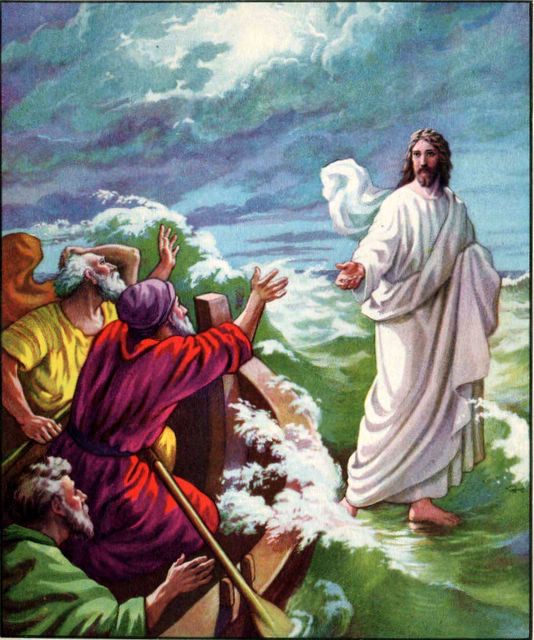
Jesus Walks on the Sea

Therefore when Jesus perceived that they were about to come and take Him by force to make Him king, He departed again to the mountain by Himself alone. Now when evening came, His disciples went down to the sea, got into the boat, and went over the sea toward Capernaum. And it was already dark, and Jesus had not come to them. Then the sea arose because a great wind was blowing. So when they had rowed about three or four miles, they saw Jesus walking on the sea and drawing near the boat; and they were afraid. But He said to them, “It is I; do not be afraid.” Then they willingly received Him into the boat, and immediately the boat was at the land where they were going (John 6:15-21).

The disciples cross the sea in a boat without Jesus. Jesus crosses the sea by miraculous means. He walks across the water. He comes near the disciples and they are frightened. One of the Evangelists records that they thought Jesus was a ghost.[1] But this is not ghost. It is a flesh and bone Jesus doing something that should not be possible. He speaks to the disciples to calm and reassure them. The NKJV[2] gives us, “It is I; do not be afraid.” The Greek is more telling. Literally translated, what Jesus said was, “I am. Do not be afraid.”[3] Jesus refers to Himself this way several times, and in significant situations. Theologians sometimes call these the “I AM statements”. At various times, Jesus says: I am the bread of life; I am the light of the world; I am the door; I am the Good Shepherd; I am the resurrection and the life. This passage doesn’t record one of those statements previously mentioned; Jesus uses this scandalous way of referring to Himself at other times too, like in this instance of walking on the sea.

Another famous time He used I AM to refer to Himself was also recorded by John. Jesus speaks to the Pharisees. They argue with Him about whether or not they are sons of Abraham (No, Jesus says they are sons of Satan) and whether or not they are slaves (Yes, Jesus says they are slaves to sin). At the climax of their interaction, Jesus says, “Most assuredly I say to you, before Abraham was, I AM.”[4] At this they were incited to murder Jesus but He, miraculously, passed by though the midst of them. Why such an uproar over Jesus’ grammar? Were the Pharisees such sticklers for proper Greek that an improper conjugation could earn you a rock to the face? No. In making the I AM statements, Jesus was claiming to be the Great I AM: YAHWEH, the God of Abraham, Isaac, and Jacob, in person, and in the flesh. That was a super big deal to the Jews.

When Moses fled to Midian after murdering the Egyptian, he tended sheep for his father-in-law. One day, while tending the sheep on Mt. Horeb, the Angel of the Lord appeared to Moses in a flame of fire from the midst of a bush. From this burning bush, the Second Person of the Trinity in His pre-incarnate form spoke to Moses: Come now, therefore, and I will send you to Pharaoh, that you may bring my people, the children of Israel, out of Egypt.[5] Moses tries to get out of doing this. His first tactic is to say that the Israelites won’t listen to him because he doesn’t know God’s name, and won’t be able to tell them when they ask. God’s reply: “I AM WHO I AM.” And He said, “Thus shall you say to the children of Israel, ‘I AM has sent me to you.’”[6] By applying God’s name to Himself, Jesus expressed the eternity of His being and His oneness with God the Father.

After arriving at the other shore, Jesus would declare to the people, “I am the bread of life. He who comes to Me shall never hunger, and he who believes in Me shall never thirst.”[7] Jesus left the previous day because the people wanted to make him king by force. Now He speaks to the crowds who seek Him, not because they believe, but because they ate of the loaves and were filled.[8] They see in Jesus a miracle worker who will give them all their earthly wants. They fear, love, and trust their bellies, just as we do. Jesus wants to give them the true bread from heaven - Himself, literally, His flesh. For the bread of God is He who comes down from heaven and gives life to the world.[9] Jesus is I AM in the flesh. He is, literally, Immanuel, which is translated, “God with us.”[10] He has come to save His people from their sins by giving His flesh.


[1] Matthew 14:26
[2] New King James Version
[3] Brown, Robert K., and Philip Wesley Comfort, trans. The New Greek-English Interlinear New Testament: A New Interlinear Translation of the Greek New Testament, United Bible Societies Fourth, Corrected Edition with the New Revised Standard Version, New Testament. Edited by J. D. Douglas. Wheaton, IL: Tyndale House Publishers, 1993.
[4] John 8:58
[5] Exodus 3:10
[6] Exodus 3:13-14
[7] John 6:35
[8] John 6:26
[9] John 6:32-33
[10] Matthew 1:23

Friday, January 12, 2018

Satan Tempts Jesus; Jesus Begins His Ministry

Temptation of Christ on the Mountain - Duccio
Immediately the Spirit drove Him into the wilderness. And He was there in the wilderness forty days, tempted by Satan, and was with the wild beasts; and the angels ministered to Him. Now after John was put in prison, Jesus came to Galilee, preaching the gospel of the kingdom of God, and saying, “The time is fulfilled, and the kingdom of God is at hand. Repent, and believe in the gospel” (Mark 1:12-14).

The way has been prepared by John the Baptist. The one who has come in the spirit and power of Elijah[1] has preached and baptized repentance in the wilderness. The message has been sent and received. All the land, Mark writes, went out to him, confessing their sins and being baptized. Jesus comes to be baptized. But why? John hesitates; Jesus reassures. It is to fulfill all righteousness.[2] John obeys. Jesus, the sinless one, God in human flesh, is baptized by John. He who has no sin identifies with sinful mankind and becomes sin.[3] The Father sends His Spirit to Jesus in the form of a dove. The Father claims and acknowledges His Son, putting His stamp of approval on the work Jesus is doing. The Father is well pleased.

Into the wilderness now; Jesus is driven by the Spirit. Forty days Jesus wanders in the wilderness, fasting and praying. He is in the desolate places among the wild beasts. Satan, the accuser, comes to tempt Him. Jesus is walking the path of God’s people. He is Israel. Jesus is putting right what God’s people have gotten so wrong since that business so long ago in the garden with the forbidden fruit. Jesus wanders but is not lost. He is tempted but does not sin. He rebukes the Devil with the words of Holy Scripture. Satan is driven back by God’s Word; the angels minister to Jesus.[4]

Jesus is God’s people, Israel, reduced down to one. He is the promised Seed over whom Abraham rejoiced.[5] Jesus has entered the covenant through circumcision.[6] He has identified with God’s people and assumed the responsibility for their sins in John’s baptism. He has corrected Israel’s sinful missteps through His own exodus. And, He begins His proclamation of the Good News, a ministry which will ultimately end with Christ’s victory over sin, death, and the devil, by His perfect sacrifice for sin - His crucifixion, death, resurrection, and ascension. We who are baptized into Christ are baptized into His death, and we will also, therefore, take part in His resurrection.[7] Through baptism, we take part in Christ, and are thus made part of Israel. Wild olive shoots, we are grafted into the True Vine by the grace of God, through the gift of faith, created in us through the Word.[8] There is room enough for all in Christ. The time is fulfilled! The Kingdom of God is at hand! Repent, and believe the Gospel!


[1] Luke 1:17
[2] Matthew 3:13-15
[3] 2 Corinthians 5:21
[4] Matthew 4:1-11
[5] Galatians 3:16; John 8:58
[6] Genesis 17:10-14; Luke 2:21
[7] Romans 6:1-11
[8] John 15:1-8; Ephesians 2:1-10

Friday, July 31, 2015

God Made Them Male and Female

And Jesus said to them, “Because of your hardness of heart he wrote you this commandment [regarding divorce]. But from the beginning of creation, ‘God made them male and female.’ Therefore a man shall leave his father and mother and hold fast to his wife, and the two shall become one flesh.’ So they are no longer two but one flesh. What therefore God has joined together, let not man separate” (Mark 10:5-9).

Supporters of same-sex marriage took quite the arrogant victory lap on social media last month when the Supreme Court handed down their decision legalizing same-sex marriage in all 50 states. Two major focuses of the assault seemed to be 1) Christians shouldn’t judge homosexuals because their holy book tells them not to judge, and 2) Christians are just haters and homophobes, because Jesus never said anything about homosexuality. In a previous article I examined one of the memes prevalent in my Facebook news feed, which I referred to collectively as the “Judge not…” meme. This article will focus on a rather irritating, though clever, little meme featuring Stephen Colbert, which asserts that Jesus never had anything to say about homosexuality.

Fellow Christians, I hate to admit it, but Jesus never said the word, “Homosexual.” He never explicitly said anywhere in the New Testament, “Don’t go around having sexual intercourse with other people who are the same sex as you.” I’ve searched the New Testament front to back and still can’t find a passage where Jesus denounces legislation legalizing gay marriage. I guess that the “marriage equality” crowd has got us on this one, and we need to fall into line with the rest of main-line liberal Protestantism, and a big chunk of American Evangelicalism.

Before we go painting #LoveWins on our LCMS churches in rainbow colors and ordaining transgender pastors, perhaps we should go back and take one last look at the things Jesus did say regarding marriage, men, and women. After all, just because the word “homosexual” wasn’t uttered by Jesus, doesn’t necessarily mean that he condones the lifestyle. If that were the proper method for interpreting the Scriptures, we could do away with the doctrine of the Trinity, as that word is also MIA from the pages of the Bible.

When asked by the Pharisees about divorce, Jesus appeals to the beginning of creation. He points out to them that, “God made them male and female,” a fact which was obvious to his audience. Jesus is saying here, however, that the estate of marriage was intended by God from the beginning to be comprised of a man and a woman. It is the natural created order. Or, if you are a Darwinian Naturalist, it is the natural law produced through “millions” of years of “evolution.”

In this passage, Jesus defines what marriage is, and his definition makes it clear that gender is essential to it. He doesn’t have to continue on and say, “But God did not make them male and male; neither did He make them female and female, nor male and female and female, or…” All other combinations are excluded by the example which Jesus gives. Societies can pass laws legalizing whatever type of relationships they wish, but no human law can negate the natural law God has built into his creation. God made them male and female and, for this reason a man leaves his father and his mother and becomes “one flesh” with his wife.

But what about polygamy in the Bible? What about adultery? Jesus can’t mean that marriage is supposed to be exclusively between one man and one woman, because the Bible is full of polygamy, adultery, and all other manner of what up-tight confessional types call “sin.” Yes, the Bible does record many instances of polygamy. I am well aware of Abraham and Solomon. The Bible also records many murders, thefts, and other felonies, but this does not mean that God is giving mankind Carte Blanche to commit these acts. The Bible records that Cain murdered Abel, yet we don’t call for the legalization of murder because it’s “in the Bible.” The Bible records David’s adultery with Bathsheba, yet we do not claim that it is sanctioning such behavior by us in the present day. The Bible isn’t even sanctioning such behavior by the people about whom it reports, contrary to what the liberal Bible scholars and social activists would have people believe. God specifically judges the actions of David, Solomon, and many others by commanding, “You shall not murder,” and “You shall not commit adultery.” Likewise, the Bible records at least one instance of homosexual behavior in the story of Lot and the destruction of Sodom and Gomorrah. Genesis 18 and 19 recounts the destruction of Sodom because of its wickedness:

Then the LORD said, “Because the outcry against Sodom and Gomorrah is great and their sin is very grave, I will go down to see whether they have done altogether according to the outcry that has come to me. And if not, I will know,” (Genesis 18:20-21).

What was the sin of Sodom? Homosexual lust.

But before they [the two angels] lay down, the men of the city, the men of Sodom, both young and old, all the people to the last man, surrounded the house. And they called to Lot, “Where are the men who came to you tonight? Bring them out to us, that we may know them,” (Genesis 19:4-5).

Lot’s plan to avert the assault of the townspeople on his angelic visitors was less than noble. He offers his daughters to the crowd as a substitute, perhaps rationalizing that heterosexual rape of his virgin daughters would be less wicked than the homosexual rape of guests under the protection of his roof. Yet, no one in their right mind would suggest that the Bible condones fathers handing their daughters over to be raped. Nevertheless it’s recorded in the Bible. 

Those passages about Sodom and Gomorrah are from the Old Testament though! They don’t apply, and that still doesn’t negate the fact that Jesus never said anything condemning homosexuality. Checkmate! Well, not so fast…

In the passage cited above Jesus quotes the Old Testament, specifically Genesis 2:24, by which he calls to mind the passage read at many a Lutheran wedding:

Then the Lord God said, “It is not good that the man should be alone; I will make him a helper fit for him.” Now out of the ground the Lord God had formed every beast of the field and every bird of the heavens and brought them to the man to see what he would call them. And whatever the man called every living creature, that was its name. The man gave names to all livestock and to the birds of the heavens and to every beast of the field. But for Adam there was not found a helper fit for him. So the Lord God caused a deep sleep to fall upon the man, and while he slept took one of his ribs and closed up its place with flesh. And the rib that the Lord God had taken from the man he made into a woman and brought her to the man. Then the man said, “This at last is bone of my bones and flesh of my flesh; she shall be called Woman, because she was taken out of Man.” Therefore a man shall leave his father and his mother and hold fast to his wife, and they shall become one flesh. And the man and his wife were both naked and were not ashamed (Genesis 2:18-25).

Jesus Christ is Immanuel – God, with us, God incarnate. He is the image of the invisible God, by whom all things were created.

He is the image of the invisible God, the firstborn of all creation. For by him all things were created, in heaven and on earth, visible and invisible, whether thrones or dominions or rulers or authorities—all things were created through him and for him. And he is before all things, and in him all things hold together. And he is the head of the body, the church. He is the beginning, the firstborn from the dead, that in everything he might be preeminent. For in him all the fullness of God was pleased to dwell, and through him to reconcile to himself all things, whether on earth or in heaven, making peace by the blood of his cross (Colossians 1:15-20).

Jesus is the very God who created and sustains the world. He told the Jews this and, when they heard him assert that he was the great I AM who had told Moses his name through the burning bush, the God who spoke to Abraham, they were ready to stone him for blasphemy. The Jesus speaking to the Pharisees in Mark 10:7 is the same person speaking the words recorded in Genesis two. 

That also makes him the God who spoke the words recorded in Leviticus 20:

If a man lies with a male as with a woman, both of them have committed an abomination; they shall surely be put to death; their blood is upon them (Leviticus 20:13).

While Jesus in the Gospels does not use the word homosexual, the Apostle Paul does, offering the negative argument concerning the practice. St. Paul explicitly states that men who practice homosexuality with not inherit the kingdom of God.

Or do you not know that the unrighteous will not inherit the kingdom of God? Do not be deceived: neither the sexually immoral, nor idolaters, nor adulterers, nor men who practice homosexuality, nor thieves, nor the greedy, nor drunkards, nor revilers, nor swindlers will inherit the kingdom of God. And such were some of you. But you were washed, you were sanctified, you were justified in the name of the Lord Jesus Christ and by the Spirit of our God (1 Corinthians 6:9-11).

Did you also notice how St. Paul singled out homosexuality? Quite to the contrary, St. Paul records a list of sinful behaviors, including homosexuality, which does not leave out one person. It’s like a buffet of sinfulness – everyone can find something that they like. St. Paul continues, however, reminding the Corinthians that, despite having once been sexually immoral, idolaters, adulterers, homosexuals, thieves, etc., they have been redeemed by Christ.

St. Paul also takes Jesus’ thread from Mark 10:7 regarding the one-flesh union and explains it further, calling the Corinthians – and us today – to repent of our sins, flee from sexual immorality of all kinds, and glorify God in our bodies:

“All things are lawful for me,” but not all things are helpful. “All things are lawful for me,” but I will not be dominated by anything. “Food is meant for the stomach and the stomach for food” – and God will destroy both one and the other. The body is not meant for sexual immorality, but for the Lord, and the Lord for the body. And God raised the Lord and will also raise us up by his power. Do you not know that your bodies are members of Christ? Shall I then take the members of Christ and make them members of a prostitute? Never! Or do you not know that he who is joined to a prostitute becomes one body with her? For, as it is written, “The two will become one flesh.” But he who is joined to the Lord becomes one spirit with him. Flee from sexual immorality. Every other sin a person commits is outside the body, but the sexually immoral person sins against his own body. Or do you not know that your body is a temple of the Holy Spirit within you, whom you have from God? You are not your own, for you were bought with a price. So glorify God in your body (1 Corinthians 6:12-20).

It is clear, even to someone who is not a Christian, that the male body was not designed (or did not “evolve,” if you want to appeal to the secular Darwinist) to mate with another male body; Likewise with two female bodies. The fact that people crave such relationships proves that something has gone terribly wrong with creation (Engelbrecht 2009). That thing is sin, and no human being since The Fall has been immune to it. In fact, we have all been utterly corrupted by sin from the time of our conception. That corruption may not manifest itself as a desire to fornicate with people of the same gender in some, but it does in many. And, those who do not struggle with homosexual desire most certainly struggle with something else. We are all in the same boat when it comes to sin, and our complete inability to overcome it.

The problem is that liberal Bible “scholars” and social activists don’t believe that Jesus is God. They don’t believe that the Bible is the divinely inspired, inerrant Word of God. They don’t believe that St. Paul is an Apostle. They believe in moral relativism because that gratifies their flesh. Nothing, short of God changing their hearts, will change their darkened minds.

As Christians we are called, as St. Paul called the Corinthians, to abhor the sin of homosexuality – and all sin – and to flee from it. We must also bear in mind that Christ shed his blood and died for all men – for the homosexual, the idolater, the adulterer, the thief, the hypocrite, the murderer, the liar – no matter in what particular ugliness their sin might manifest. A homosexual, like any other sinner, needs to hear God’s word of Law and Gospel applied to their life with the goal of repentance and faith (Engelbrecht 2009).


Works Cited

Engelbrecht, Rev. Edward A., ed. The Lutheran Study Bible. Saint Louis: Concordia Publishing House, 2009.

Sunday, April 12, 2015

Because I Live...

Because I live, you also will live (John 14:19).

The resurrection of Jesus Christ is the most important aspect of Christianity. This fundamental of the Christian faith is what distinguishes Christians and Christianity from every other religion on the planet. The resurrection of Christ is so important and comforting because it confirms four important things: 1) Christ is the Son of God, 2) What He taught is true, 3) God the Father accepted Christ’s sacrifice on the cross for the reconciliation of the world, and 4) all those who believe in Christ will rise to eternal life. This is how John begins his resurrection account:

Now on the first day of the week Mary Magdalene came to the tomb early, while it was still dark, and saw that the stone had been taken away from the tomb. So she ran and went to Simon Peter and the other disciple, the one whom Jesus loved, and said to them, “They have taken the Lord out of the tomb, and we do not know where they have laid him.” So Peter went out with the other disciple, and they were going toward the tomb. Both of them were running together, but the other disciple outran Peter and reached the tomb first. And stooping to look in, he saw the linen cloths lying there, but he did not go in. Then Simon Peter came, following him, and went into the tomb. He saw the linen cloths lying there, and the face cloth, which had been on Jesus’ head, not lying with the linen cloths but folded up in a place by itself. Then the other disciple, who had reached the tomb first, also went in, and he saw and believed; for as yet they did not understand the Scripture, that he must rise from the dead. Then the disciples went back to their homes (John 20: 1-10).

What a dark Sunday morning it must have been indeed, when Mary Magdalene and the other women went to Jesus’ tomb. After having declared the work of redemption finished, Jesus gave up his spirit and died on the cross. Being the great Sabbath day, however, the Jews did not want to leave Jesus’ body, and those of the other condemned men, on the cross[1]. Jesus lifeless corpse was removed from the cross expediently, after the Roman soldiers were assured of his death by a spear thrust into his side[2]. Joseph of Aramathea, a secret disciple of Jesus, asked Pilate for the body and his request was granted. Joseph of Aramathea placed Jesus’ body in his own tomb, one that was brand new and had never held any other remains. Nicodemeus, the member of the Sanhedrin (the Jewish governing council which had delivered Jesus to Pilate) who had come to Jesus to talk theology by night, and who had called him a teacher sent from God, provided the customary myrrhs and aloes used according to Jewish burial customs[3]. They were, however, in a bit of a hurry.

It was not only the Sabbath, but the great Sabbath. The setting of the sun signaled the beginning of the Jewish Sabbath connected to the Passover, called the day of Preparation. They had to hurry and get Jesus’ body into the tomb, and at least prepare his body enough so that they, or someone else, could come and finish the job after the Sabbath was over. Handling a dead body on the Sabbath would make them ceremonially unclean, and thus unable to participate. And so, Jesus’ body reposed for that Sabbath in a newly hewn tomb, donated by a rich man, waiting to be embalmed by some of Jesus’ loved ones using the spices provided by – at the very least – a man among the Pharisees who was sympathetic to this poor, misguided rabbi, who had gotten into temple politics over his head.

Enter Mary Magdalene and the other women. The task of properly preparing Jesus for burial fell to them. Now, don’t misunderstand what I am about to say. We live in an enlightened and progressive society, and our views of women and their role in family life and society have changed considerably since the time of Christ. That being said, however, we have to understand the significance of Mary Magdalene making the discovery that Jesus’ body was not in the tomb where he was left on Friday afternoon.

By all social conventions of the time, Mary Magdalene’s testimony – or the testimony of any woman for that matter – was, if not meaningless, most certainly less valid than testimony given by a man. Women had weaker legal status in ancient Israel than men (Packer & Tenney, 1980). Women were recognized as little more than servants and certainly could not testify in legal proceedings and the like. According to Jewish tradition as recorded in the Talmud, a valid witness must be an adult free man, not a woman or a slave, and not be related to any of the other witnesses or judges. The witness must be an honest person who can be trusted not to lie (Testimony in Jewish Law, 2012).

Women were lowly; women were despised. They were considered weak and inferior by Jew and Roman alike. Ancient Israel was a patriarchal society; the father or oldest male in the family made the decisions concerning the family, and the women had little to say. A woman, it could be said, was worth only half as much monitarily as a man[4]. A young woman did not think of a career outside her home. Girls were raised to get married and have children. If a woman was childless, she was thought to be cursed (Packer & Tenney, 1980)[5]. It is my guess that Mary Magdalene would have been considered all the more despised and lowly, as she had formerly been demon-possessed and had been healed by Jesus. Many writers conjecture that Mary Magdalene was the adulteress mentioned in Luke 7:36-50, though there is no evidence for that (and I do not subscribe to that idea).

Why would God allow a “foolish” woman, whose testimony would not be considered valid by the conventions of the day, to discover the greatest miracle in human history, the foundation of the Christian faith, the thing that was the culmination of thousands of years of prophecy in Holy Scripture? Would God not want someone “reliable” to be the first person to find Jesus’ empty tomb and make a report to the disciples? St. Paul provides us with some insight into this:

But God chose what is foolish in the world to shame the wise; God chose what is weak in the world to shame the strong; God chose what is low and despised in the world, even things that are not to bring to nothing things that are, so that no human being might boast in the presence of God (1 Corinthians 1:27-29).

I am not saying that women are inferior to men, or that they are foolish, or that they are weak, or that they are inherently low and to be despised. That is not what Scripture teaches about women anyway, but that is a discussion for another day. By setting things up so that Mary Magdalene made this incredible discovery, God was mocking the unbelieving world and its governing authorities, which did subscribe to such nonsense.

God was taking what the world held to be of no account – this lowly woman – and using her, elevating her, to “bring to nothing things that are, so that no human being might boast in the presence of God.” God used Mary Magdalene to bring Peter and John to the empty tomb, and thus, in a manner of speaking, to their true and living faith. They did not yet understand the significance of the empty tomb – that it was the sign of the fulfillment of the Old Testament promises, not to mention Jesus’ own declarations that he must rise from the dead – but they would, by God’s working. They would all come to understand, by the living faith created in them by God’s Holy Spirit, that because Jesus lives and is no longer in the grave, they too – along with all who believe in Christ – were forgiven, absolved of the guilt of their sin, and would live.

There would be more evidence of Jesus’ resurrection later. Jesus would appear to Mary Magdalene physically, as well as to his disciples. But initially, God used the foolishness of this world to shame the world’s wise. There is evidence of Christ’s resurrection, and St. Paul supplies us with a good summary:

He was raised on the third day according to the scriptures, and that He appeared to Peter, and then to the Twelve. After that He appeared to more than five hundred of the brothers at the same time, most of whom are still living, though some have fallen asleep. Then He appeared to James, then to all the apostles, and last of all He appeared to me also, as to one abnormally born (1 Cor 15:4-8).

The world has generally looked at the followers of Jesus with some kind of mixture of pity and amusement because it counts the message of the cross as foolishness. There is no logic to support this fundamental pillar of the Christian faith, though there is evidence. Then again, that’s why the term faith is used. Martin Luther wrote, “I know that I cannot, by my own reason or strength, believe in Jesus Christ or come to Him” (Luther, 1986) Luther understood that the gift of faith in Christ comes from God by the power of His Holy Spirit, through his means of Word and Sacrament.

There is no logical explanation for the mass conversion of 3,000 people in Jerusalem on Pentecost if what they heard preached was false[6]. There is no logical reason for the apostles who, save John, suffered martyrdom in some of the most horrible ways imaginable, to keep on professing a lie at the cost of their lives, simply to save face. There is, however, an illogical reason, at least by the standards of mankind, for what they did. The Holy Spirit had created faith in them; though it could not be proven by logic or reason, what they – and we – profess is true. Christ is risen! He is risen indeed! Surely these men would not willingly subject themselves to torture and death for something they knew to be false. The author of Hebrews writes:

Now faith is being sure of what we hope for and certain of what we do not see (Hebrews 11:1).

As Christians we have faith in Jesus, who said, “I am the resurrection and the life. He who believes in me will live, even though he dies; and whoever lives and believes in me will never die.” We have faith – we can be sure and certain – that because Jesus lives, we also will live. What wonderful news! How could we not help but live the new life that we have been given to God’s glory?


Works Cited

Luther, D. M. (1986). Luther's Small Catechism with Explanation. St. Louis, MO: Concordia Publishing House.

Packer, J. I., & Tenney, M. C. (Eds.). (1980). Illustrated Manners and Customs of the Bible. Nashville, Tennessee, USA: Thomas Nelson Publishers.

Testimony in Jewish Law. (2012, March 30). Retrieved March 30, 2012, from Wikipedia: http://en.wikipedia.org/wiki/Testimony_in_Jewish_law


End Notes

[1] John 19:33
[2] John 19:34
[3] John 3: 1-21; 19:39-42
[4] Leviticus 27:1-8
[5] Genesis 30:1-2, 22; 1 Samuel 1:1-8
[6] Acts 2:14-41