Showing posts with label free will. Show all posts

Friday, October 15, 2021

Iconoclasm

    So, now that we all admit that we are idolaters, what do we do about it?

    We could do what iconoclasts (literally image-breakers) have done throughout the centuries to combat idolatry: smash the images to tiny bits, and then burn the tiny bits to ash. That’s what the iconoclasts back in the Byzantine Empire did. That’s what many Germans did during the Lutheran Reformation. Luther distanced himself from his one-time friend, radical reformer Karlstadt over this issue. Karlstadt advocated for the removal of all images and this incited iconoclastic riots all over Germany.

    The problem, however, isn’t necessarily with the images, it’s with people. It is a problem with our will. We naturally want things that aren’t good. We are given Christ, the image of the invisible God: Christ crucified for our sins and risen from the dead. Instead, we want anything and everything else. Most of all, we want to indulge the desires of our flesh. We want to be happy. We want to feel good. We want those things right now. The talking picture box in our homes and pockets gives us a steady diet of things which we think will accomplish this, and we plug it directly into our brains.

    So, what is the answer? Are we supposed to rip our televisions and computers out of the wall and smash them to bits?

    I mean, watching less cable news and fewer Tictoks is always good. The point, however, is not to reject technology or to become a hermit. There were plenty of people who worshiped idols before the invention of the television. We are still the same sinners when we isolate ourselves from society.

    The point is to recognize that we want the idol to make us comfortable and fulfill our desires. Our flesh wants more than daily bread. That desire for evil over good comes from inside our own hearts. In the Sermon on the Mount Jesus tells the crowds to cut off their hands if their hands cause them to sin. His point was that it isn’t your hand that causes you to steal or murder. It is your heart that causes those things.

    We can’t cut out our hearts, can we?

    No, but we don’t have to. Jesus has already done that for all of mankind on the cross. He is calling us to repent, and believe the good news. By the washing of water and the word Jesus washes away our sin. He uses ordinary water and the hands of a pastor to do it, but it is Jesus’ death and resurrection that gives the power. In baptism He applies His word of promise to us directly. He removes our heart of stone and replaces it with a heart of flesh.

    He makes us, who were dead in our sins, alive in Him. ###

Monday, March 25, 2019

Jesus Blesses Little Children

Then they also brought infants to Him that He might touch them; but when the disciples saw it, they rebuked them. But Jesus called them to Him and said, “Let the little children come to Me, and do not forbid them; for of such is the kingdom of God. Assuredly, I say to you, whoever does not receive the kingdom of God as a little child will by no means enter it.” (Luke 18:15-17)

How does a little child receive the kingdom of God? Do they go out and look for it? Do they listen to preachers and investigate their claims? Do they study The Case for Christ and then make a rational decision to invite Jesus into their heart, based on the reasonableness of the evidence presented? No. They do none of these things. They receive the faith by having it given to them through the means of God’s Word. They are passive in their conversion. This shouldn’t really surprise us. They are passive in their conversion, just like everyone else who is converted.

This is the same way all men are converted by God, by means of His Word. That’s kind of the point Jesus is making to His disciples. The infants, as St. Luke describes the children being brought to Jesus, are in the same situation as the rest of mankind. Their age is irrelevant. They are part of the group who needs the forgiveness of sins obtained through Jesus’ death and resurrection – the world. That means everyone. There are no exceptions.[1]

The problem is, we don’t like to think of babies as sinful. Babies are cute. How could something so cute be sinful and subject to God’s judgment? How is that fair? They haven’t done anything, good or bad; they pretty much just lay there. What sin have they committed? Infants are, like we adults are, corrupted by the sin of Adam. They are born dead in trespasses and sins.[2] Their sinful minds are hostile to God.[3] Their minds do not submit to God’s law, nor can they do so: But the natural man does not receive the things of the Spirit of God, for they are foolishness to him; nor can he know them, because they are spiritually discerned.[4] Incidentally, as far as actual sinning goes, infants don’t have to be taught to be selfish. They are the definition of what the theologians called incurvatus in se - curved inward on oneself.

We were all born with a mind hostile to God, and with a heart inclined to evil, and this inclination to do evil is sin.[5] Consequently, left on our own to make a decision using our reason, whether or not to put our trust in Jesus for the forgiveness of our sins, we would all choose “not Jesus” every time. The part of mankind, infant and adult, that is needed to make a decision to believe in Jesus, the will, is the very thing that is broken. Our “chooser” doesn’t work. That is what it means to be dead in trespasses and sins.

But probably the most obvious evidence that infants are subject to sin, is the fact that they die. St. Paul says that the wages of sin is death.[6] That means that because we are corrupted by sin, we die, just like Adam in the Garden of Eden. If they were not corrupted by sin, they would not be subject to death.

So, since they are dead in sin, they need to be made alive in Christ, just like every other human being. And, since they cannot go to Christ, just like an unregenerate adult cannot go to Christ, He comes to them in His Word. He comes to them in His Word, attached to a physical element, water. Some way which we do not understand, by this washing of water and the word instituted by Christ,[7] the Holy Spirit comes to them and works faith in them. Incidentally, that’s how He brings you and me to the faith as well. He comes to us. He removes our old “chooser” that doesn’t work right and gives us a new one. He does it by water and the Word. Once we are made alive in Christ, He sustains us through that same Word, by proclaiming it to us, and feeding us with it – His real body and blood, for the forgiveness of our sins. Christ, who died to pay for the sins of the world and rose again from the dead on the third day, died and rose for you. He gives us these things He promises through His word preached, read, administered through the washing of Holy Baptism, and eaten and drunk in the bread and wine of the Lord’s Supper.

Should we be surprised that God doesn’t do things the way we think He should? Christ tells us, “The things which are impossible with men are possible with God.”[8] Praise be to Christ that they are.


[1] Romans 3:9-20
[2] Ephesians 2:1, 5
[3] Romans 8:5-7
[4] 1 Corinthians 2:14
[5] Genesis 6:5; 8:21
[6] Romans 6:23
[7] Ephesians 5:26; Matthew 28:16-20
[8] Luke 18:27

Sunday, December 16, 2018

Thou Shalt Not Kill... but why not?

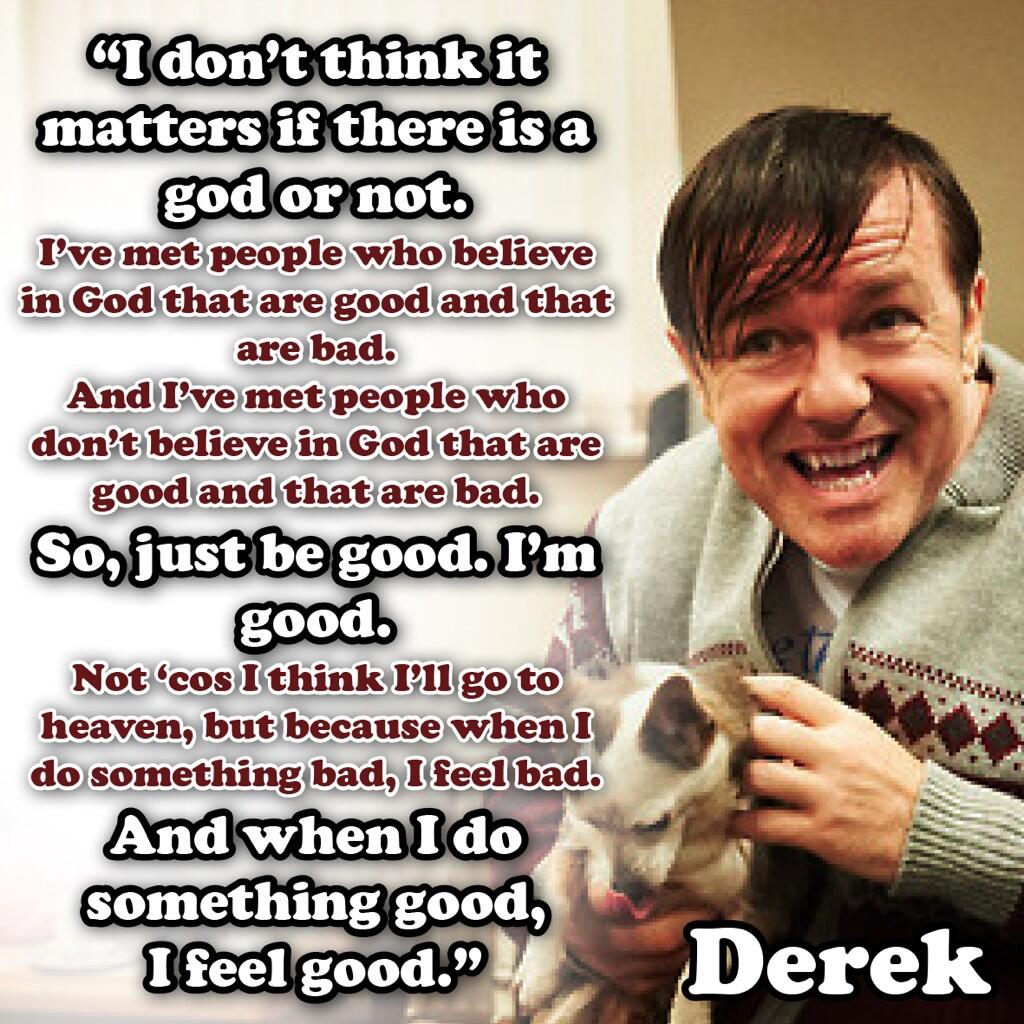
Derek was a British television series starring Ricky Gervais.
Derek says to be good, and I agree. How does one do that? By what standard does he measure his goodness?

Some New Atheists will rely on convoluted arguments to try to prove that man can have absolute morality (right and wrong) without an absolute source (God). One might suspect that the argument behind this meme is not quite so complicated. Ricky Gervais, whose character Derek gives us the sage advice to “just be good,” seems to be like so many average people who are de facto atheists; they say they don’t believe in an absolute system of right and wrong, but live as though they do. This standard of “good” which Derek calls his fellow man to live up to is supposed to be understood by all people. Indeed, I believe it is understood by all people; I simply disagree with the New Atheists regarding the reason why that is the case.

This is one of the problems with New Atheism that people don’t seem to want to acknowledge: We are supposed to accept the conflicting ideas that 1) there is no absolute truth or morality, decreed by God and built into mankind, and 2) everyone automatically knows what “good” is. For all the talk of the irresolvable paradoxes of Christianity, this problem of morality is significant for the New Atheists. If there is no absolute standard by which to judge morality, then all morality must be relative to the culture out of which it arises. Even if there are similarities between cultures, one cannot claim that there is an absolute standard. How, then, can one say that a given thought, word, or deed is good inter-culturally? How can one society apply its standard of “good” to another society, absent a universal standard? At least the Christian points to God, and says that He ultimately understands the religious paradoxes, if we cannot.

Or, looked at another way, how can we judge any given thought, word, or deed as “bad” if there is no absolute standard of morality? New Atheists like to point this out to Christians who condemn sin and call people to repentance and faith in Jesus Christ for the forgiveness of those sins; the point applies equally to them. And, contrary to how it may seem based on the circulation of internet memes, the New Atheists condemn quite a lot as bad. Christianity, for starters. Richard Dawkins believes it is child abuse to teach children the Christian faith;[1] so did the late Christopher Hitchens. In fact, they despise all religion as evil. This includes Islam.

Their hatred of religion made for some strange bedfellows during the war on terror. After the September 11th terrorist attacks on the World Trade Center some leftist atheists, like Christopher Hitchens, supported aggressive war against Muslims in Afghanistan and Iraq alongside the likes of, well, me. This was because terrorism is bad. The oppression, abuse, and subjugation of women is bad. Murdering political and religious minorities is bad. Oppressing and murdering homosexuals is bad. All these things are bad according to the New Atheists, and I agree. I must again, however, ask the question: by what standard? Clearly, the Islamic terrorists don’t think those things are bad. Why is their standard different? Where did it come from? Do they not have the innate sense of right and wrong, good and evil, which all men are supposed to have? Absent a universal standard of right and wrong, what makes them evil?

The Christian has an answer: the God who created the universe has set an immutable standard of right and wrong for mankind and expects us to keep it. We cannot. In fact, we ignore and suppress it. We turn away from God and His moral standard. We fail to keep it. And, when we do not keep it, that is called sin. And, because we cannot keep this moral standard perfectly, He took on human flesh in the person of Jesus of Nazareth, so that He could destroy sin, its inevitable result – death, and the one who brought it into the world – the devil, once and for all. He accomplished this by the death, resurrection, and ascension of Jesus Christ. He did it by living up to the standard, and dying as the sacrifice for sin on man’s behalf. Then, after dying on the cross, He rose up from the dead. We benefit from this sacrifice when we are brought to penitent faith in Christ for the forgiveness of our sins, by the power of the Holy Spirit, through the means of God’s Word and Sacraments. That is our explanation. What is theirs?

Their explanation for morality seems to be that morality has developed in man’s psyche as a product of evolution. The late Christopher Hitchens said:

I think our knowledge of right and wrong is innate in us. Religion gets its morality from humans. We know that we can’t get along if we permit perjury, theft, murder, rape. All societies at all times, well before the advent of monarchies have forbidden it. Socrates called it his daemon; it was his inner voice that stopped him when he was trying to take advantage of someone… Why don’t we just assume that we do have some internal compass?[2]

This view is almost comically simplistic. We just all should know what good is, because good comes from inside man. I see much evidence in man’s history that, far from being innately good, man is innately evil. Mr. Hitchens sets up this straw man: religion teaches that men only do good things, return lost property, give blood transfusion, etc., because they fear divine punishment and, if they didn’t have that threat hanging over them, they would act like the worst psychopathic criminal.[3] Perhaps other religions teach this idea; Christianity does not. In fact, Christianity teaches that, outwardly, and because of the conscience, men can and do live outwardly good and decent lives. Men can choose not to steal, rape, or murder their fellows, but this civil righteousness does nothing to justify a man before God. The Book of Concord has this to say on the issue:

Our churches teach that a person’s will has some freedom to choose civil righteousness and do things subject to reason. It has no power, without the Holy Spirit, to work the righteousness of God, that is spiritual righteousness… This is what Augustine says in his Hypogonosticon, Book III: We grant that all people have a free will. It is free as far as it has the judgment of reason…It is free only in works of this life, whether good or evil. Good I call those works that spring from the good in nature, such as [sic] willing to labor in the field, to eat and drink, to have a friend, to clothe oneself… For all of these things depend on the providence of God. They are from Hm and exist through Him. Works that are willing to worship an idol, to commit murder, and so forth, I call evil… Although nature is able in a certain way to do the outward work (for it is able to keep the hands from theft and murder), yet it cannot produce the inward motions, such as the fear of God, trust in God, chastity, patience, and so on.[4]

Christianity also teaches that this innate morality is objective and immutable, created by God. It is perfect, and requires perfection. And, no matter how many good deeds one may do, no matter how “good” a person may be in the eyes of the society, it is impossible to keep this moral standard perfectly, as God requires. Our relationship with God, therefore, must be repaired in some other way than by being good, or doing good deeds. On the contrary, our relationship with God is repaired by the death and resurrection of Jesus, who died as the propitiation for the sins of the world; and we receive those gifts of forgiveness and life eternal through the gift of faith, which God creates in us through the means of His word.

I see man, when left to determine what is right and wrong for himself, holding his neighbor to a separate, higher standard than the one to which he holds himself. This phenomenon manifests itself from the individual level to the societal level. The Godless [sic] principle that the strongest is always right has been openly declared as recently as the twentieth century in Mussolini’s Italy and operated in practice in Hitler’s Germany, Stalin’s Soviet Union, and many other states.[5] The evidence shows us that, unless man’s moral code is instituted by an authority higher than himself, he will, when it is advantageous to himself or his societal group, alter it. The unregenerate individual says to himself: it might be wrong when other people perjure themselves, steal, murder, or commit rape, but when I did those things, I had a good reason, and am therefore justified. Man can always reason out why their bad deed was not bad, but his neighbor’s was. Christopher’s brother Peter Hitchens, makes this point:

Left to themselves, human beings can in a matter of minutes justify the incineration of populated cities, the mass deportation – accompanied by slaughter, disease, and starvation – of inconvenient people, and the mass murder of the unborn. I have heard people who believe themselves to be good defend all these things and convince themselves as well as others. Quite often the same people will condemn similar actions committed by different countries, often with great vigor.[6]

You see, morality cannot be absolute and relative at the same time. We cannot say that the sense of good and evil it is innate in all of humanity, and at the same time, say there is no absolute source of that morality other than ourselves. If all morality is relative to the individual and to the individual’s culture, and there is no absolute standard for it set by God, the only way to determine right and wrong, good and bad, is ultimately by the sword. Might makes right, as they say. And why shouldn’t it? Why shouldn’t the unarmed give way to the lightly armed, and the lightly armed give way to the heavily armed?[7] Should not all societies, from the primitive to the advanced, decide for themselves what is right and what is wrong? Should not every individual decide for themselves their own religious beliefs (which is just another way of saying the same thing as morality)? This all sounds high minded and enlightened until you put it into practice. If what was just described was actually the type of world in which we lived, on what basis can one group of people condemn another group of people for, well, anything?

We look back at the Nazis and their systematic, state run genocide of the Jews and call it horrible. It was horrible. But on what basis can we condemn Nazi genocide of the Jews if there is no absolute truth that, “Thou shalt not kill”?[8] There is none. You may appeal to the innate sense inside of man that it is wrong to murder all you like; the Nazis would not call what they were doing murder. The only alternative that remains is that their actions were no better or worse than any other actions; we were simply stronger than they, and wanted to end their social, economic, and cultural system because it conflicted with our own, and so we did.

But it is wrong to murder people, especially on account of their race! Why? Says who?

Our culture takes a dim view of killing a person, generally speaking, unless one has a reasonable belief that one is in imminent danger of receiving great bodily harm, or death from them. In Nazi Germany, Jews were considered to be sub-humans, and therefore exempt from “normal” moral considerations. To turn a Jew in to the state, and thus mark him for persecution and death, was, in that society, to do a good work. But who are we to judge the society that has a different view of this matter? The National Socialists (Nazis) were quite deliberate in creating their society and culture, all based on the philosophical beliefs of Adolf Hitler. Are those beliefs, and the resulting consequences, not just as valid as our society’s contention that all men are created equal and endowed by their creator with inalienable rights? If you say they are not equally valid, you must answer why, and relative morality does not help your case. If you say they are equally valid, you are ignoring that impulse inside of mankind that does tell us that murdering another human being is wrong, and that we should do unto others as we would have others do unto us. It isn’t so much that religion gets it’s morality from man, as Christopher Hitchens contends; rather, the New Atheism, living as it does in the afterglow of the western Christian society, benefits from the fact that Judeo-Christian morality has served as the foundation for western society and culture and remains, for the time being, dominant and familiar to the vast majority of people.

In the afterglow of western Christian society, Peter Hitchens writes, where God’s moral standard served as the basis, it is convenient for the New Atheists to speak of an innate morality, which has its origins in man through evolutionary processes.[9] Morality is indeed imprinted on the heart of man. It is there because God put it there. It is His law, or at least a shadow of it; it convicts us of our sin when we transgress it, but it has no power to help us live up to its rigorous, unalterable standards. If we, as the New Atheists do, usurp God’s place as lawgiver, we become the one who sets the standard, if only in our own deluded mind. And, if we set the standard, we can change the standard. We can set the bar just high enough that it looks rigorous to other men. We can set the standard to define our behavior as good, and change it when we deem it expedient. We can do nothing, however, to hide our deficiency in living up to God’s moral standard from He, who is the true and only judge between right and wrong. We can only repent of our sins, because God has appointed a day on which He will judge the world in righteousness by the Man whom He has ordained. He has given assurance of this to all by raising Him from the dead.[10]


[1] Hitchens, Peter. 2010. The Rage against God: How Atheism Led Me to Faith. Grand Rapids, MI: Zondervan.
[2] “Christopher Hitchens: The Morals of an Atheist.” 2007. Broadcast. Uncommon Knowledge. PBS. https://youtu.be/b6DW0e70DF0.
[3] “Christopher Hitchens: The Morals of an Atheist.” 2007. Broadcast. Uncommon Knowledge. PBS. https://youtu.be/b6DW0e70DF0.
[4] McCain, Paul Timothy., et. al., eds. 2005. Concordia: the Lutheran Confessions: a Readers Edition of the Book of Concord. St. Louis, MO: Concordia Pub. House. AC XCIII 1-9
[5] Hitchens, Peter. 2010. The Rage against God: How Atheism Led Me to Faith. Grand Rapids, MI: Zondervan. p. 145.
[6] Hitchens, Peter. 2010. The Rage against God: How Atheism Led Me to Faith. Grand Rapids, MI: Zondervan. p. 141-142.
[7] Hitchens, Peter. 2010. The Rage against God: How Atheism Led Me to Faith. Grand Rapids, MI: Zondervan.
[8] In the Fifth Commandment, thou shalt not kill, God forbids us to take the life of another person, or our own life. This includes murder, abortion, euthanasia, and suicide.
[9] Hitchens, Peter. 2010. The Rage against God: How Atheism Led Me to Faith. Grand Rapids, MI: Zondervan.
[10] Acts 17:31-32

Thursday, September 6, 2018

All You Need Is Love

One of the biggest problems in American Christianity today is free will. Many American Christians believe that human beings have it, and that is a huge problem, especially where evangelism is concerned. Perhaps you even believe that humans have free will. Well, we don’t, at least where spiritual matters are concerned. I’m not saying that we aren’t free to choose our career, which house to live in, what car to drive, or which pair of socks we want to wear on that particular day. In those matters, we are free to choose away. Nowhere does Holy Scripture tell us that we need to seek God’s hidden will in such matters. Conversely, if we do not seek His will in such everyday matters, we do not run the risk of stepping outside of God’s will by picking out the wrong color necktie. Neither does God speak to us individually regarding these things (nor, I would argue, any others). But, where faith and conversion are concerned, we have no choice.

Lutherans, as well as other flavors of Christians, have recognized this spiritual truth in scripture since the beginning. We come into this world a sinful creature. We are conceived in sin, and born in iniquity. We are spiritually blind, and dead in our trespasses from the get-go. Scripture tells us so; it is up to God to make the dead alive. It is up to Him to give sight to the blind. It is up to Him to pay for sin, destroy death, and defeat the devil. He does this by the death and resurrection of Christ for the sins of the world; and He delivers those gifts to us personally through the proclamation of Law and Gospel. The Holy Spirit, working in the word and the sacraments, converts and makes alive. Only after a person has been raised to new life through the working of the Holy Spirit through the word is man able to cooperate with God, and then, only feebly.

This comes up now because, while listening to a conservative podcast, I heard the host give some advice to which I just had to respond.[1] The person who wrote the letter said his sister came out as a trans person; he and the family don’t agree with the lifestyle morally, and think it is detrimental to his sister’s physical and spiritual health. He asked if he should continue to love and support his sister, even though this left a bad taste in his mouth, or should he tell her in a loving way that what she was doing was wrong. I agreed with the host when he said the man should express love and compassion for his sister. When he said not to preach to her, my ears perked up. To summarize the advice: We should express love for those with whom we disagree morally, and not preach repentance to them. If we express love toward them, they are far more likely to be convinced that they are wrong and come to Christ. If we preach repentance at them and call them vile sinners, we run the risk of turning them off. It’s basically the, “You catch more flies with honey than you do with vinegar” approach. And it is perfectly logical, if we are marketing a 7-Eleven, or if humans have free will in spiritual matters. The problem is, the church isn’t a 7-Eleven, and we don’t have such a will.

If it were our job as Christians to convince others to become Christians, this is the way to do it. Sell your product by advertising it well. But, if the inclinations of our heart (i.e. our will) are only evil from our youth, that means we are incapable of making such a decision. The one piece of equipment that is supposed to make the decision is broken. Our wills aren’t neutral, they’re evil. The broken piece of equipment needs to be replaced with a new one. This is what the Holy Spirit does to us through the means of word and sacrament. So, conversion isn’t so much presenting Christianity as a proposition, or a product, and trying to convince people to choose it; it is rather more like replacing the broken alternator in our car with a new one. Since the will is the thing that makes the decisions, conversion is replacing our old evil will with a new good will. And that’s not an operation we could do on ourselves. We wouldn’t even want to, since our wills are inclined toward evil and away from good.

The podcast host cited as support the fact that Jesus ate with tax collectors and sinners. But what was Jesus doing when He “hung out” with those outcasts of Jewish society, both secular and religious? Was He seeking these people out so that He could set a good example for them, and to move them to be good people by showing them the example of what it means to love one’s neighbor? Not at all, but a good chunk of American Christianity says so. In His own words, Jesus was calling those sinners to repentance.[2] He says that those who are well have no need of a doctor, but those who are sick do. He’s specifically calling those people with whom He surrounded Himself “sick”. He is the physician healing their physical, but more importantly their spiritual sickness of sin, calling them to repentance. This involves preaching the Law and showing them that they are indeed sinners, not simply “loving” them, whatever that may mean.

When Jesus meets the adulteress who is about to be stoned for her transgression, He does indeed show her love and compassion. After pointing out to the mob that, they too, were sinners condemned by the law and deserving of punishment, He proclaims to her the Gospel: “Woman, where are those accusers of yours? Has no one condemned you?” She said, “No one, Lord.” And Jesus said to her, “Neither do I condemn you; go and sin no more.”[3] He doesn’t ignore her sin; Jesus meets her repentance with forgiveness, and He tells her to sin no more. He forgives her, and tells her now to stop gratifying her sinful nature, and live in accordance with with the new creation Christ has made out of her.[4] He does not simply ignore her sin and allow His “love” and compassion to convince her to become a follower of Christ. He grants her repentance and faith, and the forgiveness or sins. He does the same for us now. Preaching the Gospel isn’t merely motivational speaking, emotional manipulation, rhetorical exercises, or self-help lectures. It is the proclamation of the Law and the Gospel, the very means through which the Holy Spirit converts people.  

The church isn’t ours. It belongs to Jesus. He is it’s foundation.[5] In Christ the whole building is joined together and rises to become a holy temple in the Lord and, in Him, we are being built together to become a dwelling in which God lives by His Spirit.[6] We can find Christ’s Church wherever the Gospel is preached in its purity and the holy sacraments are administered according to the Gospel.[7] It is easy to mistake the denominational designation on the church sign for a brand that needs to be marketed. We have to remember that the church, no matter what it looks like to us, is in Jesus’ hands, and doesn’t need the Madison Avenue treatment.

Built on the Rock the Church doth stand,
Even when steeples are falling;
Crumbled have spires in every land,
Bells still are chiming and calling,
Calling the young and old to rest,
But above all the soul distrest [sic],
Longing for rest everlasting.[8]

We are God's house of living stones,
Builded for His habitation;
He through baptismal grace us owns
Heirs of His wondrous salvation.
Were we but two His name to tell,
Yet He would deign with us to dwell,
With all His grace and His favor.[9]


[1] Andrew Klavan. "The Andrew Klavan Show, Ep. 568, No News, All Agenda." August 29, 18. Accessed August 29, 18. The “Mail Bag” segment.
[2] Mark 2:17
[3] John 8:10-11
[4] Galatians 5:16; 2 Corinthians 5:17
[5] 1 Corinthians 3:11
[6] Ephesians 2:19-22
[7] AC VII 1
[8] The Lutheran Hymnal. St. Louis, MO: Concordia Publishing House, 1941. Hymn #467, stanza 1.
[9] The Lutheran Hymnal. St. Louis, MO: Concordia Publishing House, 1941. Hymn #467, stanza 3.

Saturday, June 20, 2015

Three Examples of How Lutherans Deny Justification by Faith Alone: A Response – Part Two of Two

Rev. Dr. Robert Preus

3) Loss of Salvation: Lutherans do not believe in eternal security. They correctly read the warning passage of Scripture as being addressed to believers, but they incorrectly believe that those warnings concern the possibility of losing our eternal salvation. If Lutherans held consistently to faith alone in Christ alone, they would know that losing our salvation is impossible. The fact that they teach eternal salvation can be lost, shows that Lutherans do not really believe in salvation by faith alone apart from works.

Response


The fact that confessional Lutherans teach that believers can fall away from the faith, while at the same time teaching that God earnestly desires all men to be saved, shows that confessional Lutherans confess what the Bible teaches, even when we cannot reconcile those teachings through the use of our human reason. Holy Scripture most assuredly teaches that God wants all men to be saved:

I take no pleasure in the death of the wicked, but rather that they turn from their ways and live… [God] wants all men to be saved and to come to a knowledge of the truth…The Lord is not slow to fulfill his promise as some count slowness, but is patient toward you, not wishing that any should perish, but that all should reach repentance (Ezekiel 33:11; 1 Timothy 2:4; 2 Peter 3:9).

Holy Scripture also makes it abundantly clear that not all men will be saved. To add another wrinkle, the Bible also teaches that those who are saved are saved by the grace of God alone, through faith (not, as the author repeatedly writes, by “faith alone”). We return once again to St. Paul’s letter to the Ephesians:

For by grace you have been saved through faith. And this is not your own doing; it is the gift of God, not a result of works, so that no one may boast (Ephesians 2:8-9).

Those who are lost, however, are lost through their own doing. I suppose one could think of it as Salvation by grace, through faith; Damnation by will, through works:

O Jerusalem, Jerusalem, you who kill the prophets and stone those sent to you, how often I have longed to gather your children together, as a hen gathers her chicks under her wings, but you were not willing…You stiff-necked people, with uncircumcised hearts and ears! You are just like your fathers: You always resist the Holy Spirit (Matthew 23:37; Acts 7:51)!

Luther certainly understood this concept. 

He [Erasmus] argues that there is something in men that responds to the gospel. But this will not do, because even if God shows the gift of his own Son to ungodly men, they don’t respond unless he works within them. Indeed, without the Father’s inward working, men are more likely to persecute his Son rather than follow him (Luther and Pond 1984).

So, there you have it. The Holy Spirit wants to convert all people and bring them to salvation and everlasting life, but many reject the Word and resist the Holy Spirit. They, therefore, remain in unbelief and under Gods’ judgment by their own fault (Concordia Publishing House 1991). God gets the credit for the saving; man gets the blame for the damning.

This very issue comes into play when St. Paul discusses with Timothy the case of Hymenaeus and Alexander.

This charge [Timothy’s duty to order certain teachers not stray from pure doctrinal teaching] I entrust to you, Timothy, my child, in accordance with the prophecies previously made about you, that by them you may wage the good warfare, holding faith and a good conscience. By rejecting this, some have made shipwreck of their faith, among whom are Hymenaeus and Alexander, whom I have handed over to Satan that they may learn not to blaspheme (1 Timothy 1:18-20).

St. Paul is not saying here that Hymenaeus and Alexander will be judged in the temporal realm, by dying or some such thing, and suffer a loss of reward at the judgment seat of Christ on the Last Day, but still march into the New Heavens and New Earth, “as through fire[1].” He is saying that the very thing through which they would be saved, their faith, has been “shipwrecked.” It has been destroyed. The faith, which they once had as members of the Ephesian congregation, is no more. They have passed from life to death, so to speak. 

Hymenaeus and Alexander rejected this precious gift of faith graciously given to them by God the Father, through the Word, by the power of God the Holy Spirit. St. Paul recognized this and disciplined them by, “handing them over to Satan,” or as we would say today – they were excommunicated. They were expelled from the fellowship of the Christian congregation so that they would, “learn not to blaspheme.” In other words, the goal of their excommunication was not punitive punishment, but rather proper exercise of the Law, the function of which is to show men their sin. St. Paul wanted them to be led to repentance and be restored to the faith they previously confessed (Engelbrecht 2009). The beauty of the Gospel is that Christ died even for the sin of Hymenaeus and Alexander. We are not told what happened to them in Scripture. If they repented of their sin God, who is faithful and just, forgave them and cleansed them of all unrighteousness. St. Paul similarly warns the Corinthians not to fall away from their faith into idolatry.

Therefore let anyone who thinks that he stands take heed lest he fall (1 Corinthians 10:12).

The, “therefore…” at the beginning of the verse indicates that St. Paul just finished explaining some really important concept to the Corinthians. In verses 1-11 his entire point can be summed up in one statement – You shall have no other gods. St. Paul makes the comparison between the people of Israel leaving Egypt and wandering for 40 years in the desert, and the congregation at Corinth. Just as the Israelites were “baptized into Moses” by passing through the water of the Red Sea and coming out a new, free people on the other side, so have the Corinthian believers been baptized into Christ and his death, and are a new creation. St. Paul, however, goes on to explain that, “…with most of them God was not pleased, for they were overthrown in the wilderness[2].” The reason St. Paul gives for God’s displeasure is idolatry. They did not fear, love, and trust in God, who had delivered them, above all things. Rather than repenting of this breach of the First Commandment, they continued in unbelief, and were lost:

Now these things took place as examples for us, that we might not desire evil as they did. Do not be idolaters as some of them were; as it is written, “The people sat down to eat and drink and rose up to play.” We must not indulge in sexual immorality as some of them did, and twenty-three thousand fell in a single day. We must not put Christ to the test, as some of them did and were destroyed by serpents, nor grumble as some of them did and were destroyed by the Destroyer. Now these things happened to them as an example, but they were written down for our instruction, on whom the end of the ages has come (1 Corinthians 10:6-11).

It is revealing that St. Paul uses the words “fell” and “destroyed” when describing what happened to those who continued in their unbelief. Again, he is not describing merely a temporal consequence of sin. Scripture tells us that these people, who were graciously delivered from bondage, persisted in unbelief. They resisted the working of God the Holy Spirit and eventually fell from the faith they had been given and were destroyed. Why does St. Paul recount this to the Corinthians? It is to be an example to them so that they do not similarly fall into sin, away from God, and be destroyed. Knowing our hearts as only we can, it may seem impossible for any one of us to remain in the faith. As Christ told his disciples, however, “With man this is impossible, but with God all things are possible” (Matthew 19:26).

It isn’t that Hymenaeus and Alexander, or the Israelites who died in the wilderness, committed the “wrong” sin, or too many sins, and were ultimately rejected by God as the author claims Lutherans teach. Rather, it is that they rejected the faith they had been given, and persisted in unbelief and unrepentance. Luther makes this observation regarding repentance, and in so doing demonstrates just how Law and Gospel work:

When holy people – still having and feeling original sin and daily repenting and striving against it – happen to fall into manifest sins (as David did into adultery, murder, and blasphemy [2 Samuel 11]), then faith and the Holy Spirit have left them. The Holy Spirit does not permit sin to have dominion, to gain the upper hand so that it can be carried out, but represses and restrains it from doing what it wants[3]. If sin does what it wants, the Holy Spirit and faith are not present. For St. John says, “No one born of God makes a practice of sinning…and he cannot keep on sinning[4].” And yet it is also true when St. John says, “If we say we have no sin, we deceive ourselves, and the truth is not in us[5]…We will now return to the Gospel, which does not give us counsel and aid against sin in only one way. God is superabundantly generous in His grace: First, through spoken Word, by which the forgiveness of sins is preached in the whole world[6]. This is the particular office of the Gospel. Second, through Baptism. Third through the holy Sacrament of the Altar. Fourth, through the Power of the Keys. Also through the mutual conversation and consolation of brethren, “Where two or three are gathered[7]” and other such verses, especially Romans 1:12 (McCain, et al. 2005)[8].

Confessing my sin, I say along with the father of the demon-possessed child, “I believe; Help my unbelief[9]!” I know that, even as I now believe in Christ my Savior, I also know that I have been chosen to eternal life out of pure grace in Christ without any merit of my own and that no one can pluck me out of His hand (Concordia Publishing House 1991). When the Devil calls my sin to mind and shows me how unworthy I am to enter into eternal life, I can point to God’s promise which he delivered to me in my baptism and say, “I am baptized.” I can receive the pardon and peace which Christ delivers to me in His Supper when I eat His body and drink His blood which was given and shed for me on the cross, since His body is true food, and His blood is true drink[10]. From these places, the means of God’s grace – Word and Sacrament – come my assurance as a believer and not from any decision I make, or any other work I do. Thanks be to God, Father, Son, and Holy Spirit, that I am saved by His grace, through faith in Christ Jesus.


Works Cited

Concordia Publishing House. Luther's Small Catechism. Translated by Concordia Publishing House. Saint Louis, Missouri: Concordia Publishing House, 1991.

Engelbrecht, Rev. Edward A., ed. The Lutheran Study Bible. Saint Louis: Concordia Publishing House, 2009.

Luther, Martin, and Clifford Pond. Born Slaves. Edited by J. P. Arthur M.A. and H. J. Appleby. London: Grace Publications Trust, 1984.

McCain, Paul Timothy, Robert Cleveland Baker, Gene Edward Veith, and Edward Andrew Engelbrecht, . Concordia: The Lutheran Confessions. Translated by William Hermann Theodore Dau and Gerhard Friedrich Bente. St. Louis, MO: Concordia Publishing House, 2005.


End Notes

[1] 1 Corinthians 3:15 
[2] 1 Corinthians 10:5 
[3] Psalm 51:11; Romans 6:14 
[4] 1 John 3:9 
[5] 1 John 1:8 
[6] Luke 24:45-47 
[7] Matthew 18:20 
[8] SA III III 43 - IV 
[9] Mark 9:24 
[10] John 6:55

Saturday, June 13, 2015

Three Examples of How Lutherans Deny Justification by Faith Alone: A Response – Part One of Two

Rev. Dr. Robert Preus
This blog article, “How Lutherans Implicitly Deny Faith Alone in Christ Alone,” showed up in my Facebook news feed a couple days ago. I usually allow things like this to drift past without a second glance. This one, however, I thought merited a response because the author – whether intentionally or not – seems to be presenting a bastardized version of confessional Lutheran theology. I have no idea what “Free Grace Theology” is. I am merely a layman with no formal theological training. I have simply extracted the author’s three points and attempted to answer them from the confessional Lutheran point of view. The first two points regarding baptism are dealt with below. The third, how Lutherans deny justification by faith alone by teaching that a believer can lose their salvation will be dealt with in a separate article.

The photo of Robert Preus has been included, as the author of the offending article used it, and that irritated me. - THL

Unfortunately, unlike Free Grace theology, the Lutheran tradition has not kept to faith alone in Christ alone, despite their stated intention. Indeed, I believe the Lutheran tradition has adopted a number of doctrines in direct opposition to justification/eternal life by faith in Christ apart from works. Let me give three examples:

1) Infant baptism: The fact that Lutherans baptize infants denies justification by faith alone. Infants cannot believe and yet Lutherans claim they are justified in the act of water baptism. By baptizing people who do not have faith, the Lutheran churches effectively teach that justification is apart from faith, not by it. Some Lutherans will respond by saying that infants can believe and be justified by faith apart from works, and so are the proper subjects of baptism. If so, that leads to an obvious problem. If infants can believe, they can also disbelieve. How can you tell the difference between believing infants and non-believing infants? How can you tell a difference between infants who believe in justification by faith alone and those who believe in salvation by works? You can’t. Indeed, the whole idea is quite silly, and yet that very argument is often made by Lutherans. I have heard a Lutheran dismiss the problem as being “rationalistic,” whatever that means. In reply, it seems like special pleading of the worst kind to insist that infants can believe, but deny that we would be able to tell whether they do or not.

If Lutherans held consistently to justification by faith in Christ alone, they would not baptize infants. They would only baptize believers (however old they may be).


Response

Let’s forget for a second that infants are included in the phrase “all nations[1].” Let’s set aside for the moment that St. Peter explains that a) baptism now saves you[2] and b) is for you and for your children and all those who are far off[3]. Let’s even ignore for the moment that St. Paul equates baptism with circumcision by calling it a circumcision of the heart[4] not made by hands[5], and circumcision was mandated for infants eight days old (all those things will be dealt with in greater detail later)[6]. Leaving all that aside, let’s focus our attention on the idea that infants can’t believe. Such an idea is totally, completely, and utterly true. Infants cannot believe…and neither can adults. We are all, by nature, objects of God’s wrath. In fact, let’s take a look at St. Paul’s letter to the Ephesians. No one can explain it better than him.

And you were dead in the trespasses and sins in which you once walked, following the course of this world, following the prince of the power of the air, the spirit that is now at work in the sons of disobedience— among whom we all once lived in the passions of our flesh, carrying out the desires of the body and the mind, and were by nature children of wrath, like the rest of mankind. But God, being rich in mercy, because of the great love with which he loved us, even when we were dead in our trespasses, made us alive together with Christ—by grace you have been saved— and raised us up with him and seated us with him in the heavenly places in Christ Jesus, so that in the coming ages he might show the immeasurable riches of his grace in kindness toward us in Christ Jesus. For by grace you have been saved through faith. And this is not your own doing; it is the gift of God, not a result of works, so that no one may boast. For we are his workmanship, created in Christ Jesus for good works, which God prepared beforehand, that we should walk in them (Ephesians 2:1-10).

The message of the cross is foolishness to those who are perishing[7], the sinful mind is hostile to God[8], and we all – every single human being since The Fall – have been born dead in trespass and sin. We were all born with a mind hostile to God, and with a heart inclined to evil[9]. Left on our own to make a decision using our reason, whether or not to put our trust in Jesus, we would all choose “not Jesus” every time.

The analogy of a dead body is often used, but for good reason: Just as a corpse has no power to raise itself to life, so the spiritually dead person has no power to raise themselves to spiritual life, as St. Paul explicitly says in Ephesians 2. It is the Holy Spirit who calls people by the Gospel when and where he wills. And we know, from Christ’s institution of the Lord’s Supper and from what is normally known as “The Great Commission” – not to mention the rest of Holy Scripture – that God works through means. Christ has specifically commanded his Apostles to make disciples of all nations, baptizing them…and teaching them to observe all that he has commanded. So, it doesn’t matter if an unregenerate person is nine seconds old, nine days old, nine years old, or nine decades old because, as St. Paul writes, no one can say Jesus is Lord except by the Holy Spirit[10]. That faith by which they are saved comes from God as a gift through the Word. So, to be accurate, man is saved sola gratia, sola fide – by grace, through faith. That Word – God’s promised redemption – comes to an adult through preaching, or reading; that same word comes to an infant through the sacrament of Holy Baptism, which leads to the next point of contention.

2) Baptismal regeneration: Paul chastised the Galatians for thinking that circumcision was necessary for our salvation. And yet Lutherans insist that we must be baptized in order to be saved. Water baptism was as much a work of the Law as circumcision (Lev 16:23-24). How can Lutherans teach that making circumcision a condition of salvation is legalism but making baptism a condition of salvation is not? Some Lutherans will respond that baptism is not a work like circumcision, but the Gospel promise put into visible form. It is a work that God does to us, not something that we do for God. But this same reasoning could also apply to circumcision. Infant boys certainly don’t circumcise themselves. It is something done to them. And yet Paul denounced this practice as seeking to be justified by works of the law. What if the Galatians had said to Paul: “Paul, this isn’t legalism. It isn’t the boy’s work. This is God’s gift to the boy—a circumcised heart!” Apparently, Paul did not take that view. Adding any requirement to faith was a form of salvation by works, and another gospel.

If Lutherans held consistently to faith alone in Christ alone, they would not make baptism a condition of eternal salvation.


Response

The author of this article seems to be confused about the Lutheran position regarding baptism. He certainly doesn’t understand what St. Paul writes regarding baptism’s relationship to Old Testament circumcision. It isn’t a condition of eternal salvation in the way the author suggests. Baptism is the vehicle through which God’s promises are delivered. I guess baptism is a condition of eternal salvation in the same way that going through the front door is a condition of entering a house. You can try to crawl in through the mail slot, but the blessing is available by the means through which the homeowner has provided access. Baptism works the forgiveness of sins[11], rescues from death and the devil[12], and gives eternal salvation[13]. It is a washing of rebirth and renewal by the Holy Spirit.

Today in the United States circumcision is performed routinely in hospitals when a male child is born. The practice has little to do with religious faith, and is heavily debated between those who support the practice for medical and hygienic reasons, and those who decry the practice as mutilation and an infringement on individual liberty. The purpose of circumcision as instituted by God in the book of Genesis, however, was to be a mark of his covenant with Abraham. God had promised to send a savior to redeem mankind after The Fall, and he promised that savior would be the seed of Abraham. By the removal of the foreskin, males received a visible sign of this promise that God would send a Savior, born of a woman. No Hebrew male could live a day without being reminded of the promise God had made long before, and every conjugal act between a husband and wife would illustrate the hope that God was working to restore creation and redeem all people (Engelbrecht 2009). As a pledge, or sign, of the covenant, circumcision pointed to something greater than merely the act itself. The Word – the promise of God – not the mere removal of flesh from the body, was the chief thing in circumcision (Engelbrecht 2009).

St. Paul correlates baptism with Old Testament circumcision. As a covenant sign, circumcision physically established the covenant and pointed to what God was doing in order to redeem us to himself. In Christ, however, the purpose of the covenant with Abraham (i.e. to be a blessing to all the families of the earth) was fulfilled. The new covenant is established with a different kind of circumcision – baptism (Engelbrecht 2009).

As the Bible sees it, baptism is not primarily a sign of repentance and faith on the part of the baptized. It is not a sign of anything that we do at all. It is a covenant sign (like circumcision, but without blood-shedding), and therefore a sign of the work of God on our behalf which precedes and makes possible our own responsive movement (Harrison, Bromiley and Henry 1990).

Certainly, based on what the Bible tells us about the nature of circumcision, and St. Paul’s correlation of circumcision with baptism, one is certainly justified in concluding that there is a Biblical basis for baptizing infants. This rite was performed on infants eight days old. It would be odd to refer to Baptism as the “circumcision of Christ” if Baptism of infants was to be forbidden while circumcision was given almost exclusively to infants. However, this is by no means the only reasoning for infant baptism. Babies, even before they are born as evidenced in the case of John the Baptist, are capable of faith by the working of the Holy Spirit. The work of God’s Holy Spirit is not limited by age, or anything else. The Holy Spirit works when and where he wills.

For he [John the Baptist] will be great in the sight of the Lord; and he will drink no wine or liquor, and he will be filled with the Holy Spirit while yet in his mother's womb…When Elizabeth heard Mary's greeting, the baby leaped in her womb; and Elizabeth was filled with the Holy Spirit. And she cried out with a loud voice and said, 'Blessed are you among women, and blessed is the fruit of your womb! And how has it happened to me, that the mother of my Lord would come to me? For behold, when the sound of your greeting reached my ears, the baby leaped in my womb for joy'" (Luke 1: 15, 41-44).

Children clearly have a part in God’s kingdom, and are not merely some sort of amoral being until they reach a nebulous “age of accountability”. Being born in the flesh, children have a sinful human nature. Along with that corrupt nature comes the inclination and desire to flee from God, and they therefore need the forgiveness that Christ offers in baptism, just as an unregenerate adult does. Scripture tells us that all people are sinful from the time of their birth[14]. St. Paul tells us in Romans 3: 23-24 that all have sinned and fall short of the glory of God, and are justified freely by his grace through the redemption that came by Christ Jesus. Christ distributes this grace to us in the sacrament of baptism, by the working of the Holy Spirit, and makes it possible for us to respond to him, though feebly[15]. In this way baptism is not unlike the defibrillator used by paramedics on a person whose heart has stopped beating; such a person is technically dead, and is powerless to make themselves alive again. Someone – a paramedic – must do something to them without their help to get their heart beating again. St. Paul tells us that we are dead in our transgressions. Through baptism, God takes us who were dead in our transgressions, and makes us alive in Christ.

Additionally, there are several reports in scripture where people bring their children to Christ to have him touch and bless them. Jesus warns against the danger of offending against little ones that believe in him, and in the same context says that to be Christians we have not to become adults but to become as children (Harrison, Bromiley and Henry 1990).

One such passage is in the Gospel of St. Mark:

People were bringing little children to Jesus to have him touch them, but the disciples rebuked them. When Jesus saw this, he was indignant. He said to them, “Let the little children come to me, and do not hinder them, for the kingdom of God belongs to such as these. I tell you the truth, anyone who will not receive the kingdom of God like a little child will never enter it.” And he took the children in his arms, put his hands on them and blessed them (Mark 10: 13-16).

St. Luke also writes:

People were also bringing babies to Jesus to have him touch them (Luke 18:15).

On the contrary, there is a long tradition in the church of baptizing children, derived from Scripture, dating back to apostolic times. Infant Baptism was common practice in the early church. Scripture lends support to this when it reports that the Apostles baptized entire families – some of which, at least, would normally include children. When entire families, and all indeed who belonged to them were baptized, it is probable that if there were a number of children in these families, the Apostles did not exclude them. More importantly, the Apostles could refer Jesus’ command to “let the little children come to me,” and to the rite of circumcision from the Old Testament. The fathers of the early church certainly debated the subject of infant baptism. However, the volume of writings in favor of infant baptism far outweighs those in opposition to the practice, from the second century to the time of the Apostolic Constitutions:

He came to save all persons by means of Himself – all, I say, who through Him are born again to God – infants, children, boys, youth, and old men[16]…Even to the greatest sinners and to those who have sinned much against God, when they subsequently believe, remission of sins is granted. Nobody is hindered from baptism and from grace. How much more should we shrink from hindering an infant. For he, being lately born, has not sinned – other than, in being born after the flesh according to Adam, he has contracted the contagion of the ancient death at its earliest birth. For this reason, he more easily approaches the reception of the forgiveness of sins. For to him are remitted – not his own sins – but the sins of another. Therefore, dearest brother, this was our opinion in council that no one should be hindered by us from baptism and from the grace of God[17]…Baptize your infants also and bring them up in the nurture and admonition of God. For He says, “Allow the little children to come unto me and do not forbid them[18],” (Bercot 2002).


Baptism is not just plain water, but it is the water included in God’s command and combined with God’s word (Concordia Publishing House 1991). Through baptism, God receives people into fellowship with himself. Babies are to be baptized because they are included in the Savior’s command to baptize all nations. And, like all of mankind, a baby is, by nature, an object of wrath, prior to regeneration through faith in Christ. Thanks be to God that he has provided for mankind this means of grace by which he works forgiveness of sins, rescues from death and the devil, and gives eternal salvation to all who believe this, as the words and promises of God declare.

Stay tuned for part two.


Works Cited

Bercot, David W., ed. A Dictionary of Early Christian Beliefs. Peabody, Massachusetts: Hendrickson Publishers, Inc., 2002.

Concordia Publishing House. Luther's Small Catechism. Translated by Concordia Publishing House. Saint Louis, Missouri: Concordia Publishing House, 1991.

Engelbrecht, Rev. Edward A., ed. The Lutheran Study Bible. Saint Louis: Concordia Publishing House, 2009.

Harrison, Everett F, Geoffrey W Bromiley, and Carl F Henry, . Wycliffe Dictionary of Theology. Peabody, Massachusetts: Hendrickson Publishers, Inc., 1990.


End Notes

[1] Matthew 28:18-20
[2] 1 Peter 3:21
[3] Acts 2:38-39
[4] Romans 2:29
[5] Colossians 2:11-14
[6] Genesis 17:12
[7] 1 Corinthians 1:18
[8] Romans 8:7
[9] Genesis 6:5; Psalm 51:5
[10] 1 Corinthians 12:3
[11] Acts 2:38; 22:16
[12] Romans 6:3-5
[13] 1 Peter 3:21
[14] Psalm 51:5
[15] Galatians 3:27; Colossians 1:13-14; 1 Corinthians 6:11
[16] Irenaeus (c. 180 E/W), 1.391
[17] Cyprian (c. 250, W), 5.354
[18] Apostolic Constitutions (compiled c. 390, E) 7.457