Showing posts with label divinity of Christ. Show all posts

Friday, February 4, 2022

Thoughts on the Divinity of Christ

The Good Shepherd - Coptic Icon


“I am the good shepherd. The good shepherd gives His life for the sheep. But a hireling, he who is not the shepherd, one who does not own the sheep, sees the wolf coming and leaves the sheep and flees; and the wolf catches the sheep and scatters them. The hireling flees because he is a hireling and does not care about the sheep. I am the good shepherd; and I know My sheep, and am known by My own. As the Father knows Me, even so I know the Father; and I lay down My life for the sheep. And other sheep I have which are not of this fold; them also I must bring, and they will hear My voice; and there will be one flock and one shepherd” (John 10:11-16).

The confession of Christ's divinity is the rock upon which the Church is founded, the confession which gives eternal life (Pieper, 1951).

Rationalists deny the true deity of Christ. Jesus is God, they might argue, only in the sense that the Father's will was active in Him. Worship of Jesus as God, therefore, comes from "pious sentiment" rather than the scriptures, since Jesus didn't really claim to be God or command worship (Pieper, 1951). Rationalists, generally, object to the literal deity of Christ. This is because they generally discount anything supernatural or miraculous. And, if the deity of Christ is figurative, we don't have to accept the miracle of the God-man (Pieper, 1951).

But, Jesus does call Himself God.

We might not be able to recognize it immediately. Those people with whom Jesus directly interacted sure did. That's why the Jews wanted to stone Jesus to death when He told them, “I and the Father are one.” This is Jesus Himself claiming literal union with God the Father. Jesus says that He and the Father are made of the same material (Pieper, 1951). To claim to have a divine nature is to claim to be God. Scripture also calls Jesus God in other ways. It says that He is before all things. It says that Jesus is the creator of all things. It describes people worshiping Jesus as God, and He does not stop them. The opening verse of John's Gospel call Jesus God: In the beginning was the word, and the word was with God, and the word was God (John 1:1). Jesus is the word of God incarnate. John says here that Jesus, the Word, was God. Whether or not you believe what John writes is another matter entirely. You cannot dispute the plain meaning of what he wrote.

In John 10, Jesus says, "I am the gate for the sheep," and "I am the Good Shepherd." Speaking in this way, Jesus intentionally applies God's name to Himself. This is a name so sacred to the Jews that they would not even say it out loud in order to avoid unintentionally misusing the name of Lord. It shocked them to hear Jesus describe Himself in messianic terms while using God's name.

He was essentially saying that the Messiah was God Himself, and that He, Jesus, was the Messiah (Baumler, 1997).

Jesus is simultaneously the Good Shepherd and the Passover Lamb of God that takes away the sin of the world (Baumler, 1997). If Jesus is just a man, His death can be described as a tragic but notable example of self-sacrifice for people to copy. If Jesus is God, then His death is the propitiatory sacrifice for the sins of the world. It is the Good Shepherd dying for His sheep.

Moreover, the title Good Shepherd says to us that Jesus is God. Through the prophet Ezekiel, God said that He Himself would rescue His sheep. When Jesus says that He is the Good Shepherd who will die for His sheep, He is making two very important statements. First, He is saying that He is the fulfillment of Ezekiel's prophecy. Second, He is claiming to be God and asserting His authority over all the earth (Englebrecht, et. al., 2009).

Jesus is also calling the Pharisees, the religious leaders of His day, the bad shepherds whom Ezekiel describes. They were being removed and replaced by God Himself (Englebrecht, et. al., 2009).

Ezekiel wrote that God would get rid of the bad shepherds who do not care for God's flock. God would not, however, replace them with earthly rulers, as the people of Jesus' day perhaps expected. Those bad shepherds would be replaced with David. God Himself would enter humanity to rescue His flock. He would lay down His life to redeem them. He would unite all His sheep into one fold. He would rule them by His servant David. All this was accomplished in Jesus, God in human flesh, great David's greater Son (Englebrecht, et. al., 2009).

Without the literal deity of Christ, Jesus becomes a mythological object lesson teaching people to be nice. Being nice is great, but if there are eternal consequences for our sin, then some more is necessary. Nice won't take away the guilt of our sin. And, Jesus' words can be twisted so that “nice” means whatever you want it to mean. It also means that nothing is required of us. Or, at least, we are able to do whatever God requires of us. Men like that idea. It makes them responsible for their own destiny. It makes us all our own god.

If, however, mankind's salvation can only be completed by God becoming human to be the propitiation for the sins of the world, then our own efforts to earn God's favor, or to appease His wrath are worthless.

Thanks be to God that Jesus is the Good Shepherd who lays down His life for His sheep. ###


Works Cited

Pieper, Francis. 1951. Christian Dogmatics, vol. 2 of 3. St. Louis: Concordia Publishing House.

Baumler, Gary P., 1997. The People's Bible Commentary: John. St. Louis: Concordia Publishing House.

Englebrecht, Edward, et. al., eds. 2009 The Lutheran Study Bible. Notes on the Book of Ezekiel. St. Louis: Concordia Publishing House.

Friday, November 19, 2021

Jesus Drives Out an Evil Spirit

The people were all so amazed that they asked each other, “What is this? A new teaching - and with authority! He even gives orders to evil spirits and they obey him.” (Mark 1:27)

Mark records what happened when Jesus taught in the synagogue in Capernaum. There is a lot packed into this brief account. Jesus stuns the people by teaching with divine authority. He heals a demon-possessed man. We might not immediately understand how these events relate to us today, but they serve the same function for us as they did for the people gathered with Jesus in person.

The events of Mark 1:21-28 happened right after Jesus was rejected at Nazareth, His hometown. That’s when He told the people gathered in that synagogue He was the fulfillment of the prophets, specifically a prophecy of Isaiah, and the people tried to kill Him for claiming to be divine. Mark didn’t record what Jesus taught in this instance, just what happened. It is, however, a pretty good bet it was the same message He proclaimed in Nazareth: The kingdom of God is at hand! Repent, and believe the Gospel.

Jesus was different. He taught with authority. That’s what drove everybody so crazy.

Jesus didn’t teach like the other rabbis of His time. He didn’t cite other teachers to support the things He said. He did not say “thus saith the LORD” like a prophet speaking on God’s behalf. He spoke like He was God Himself speaking directly to the people.

Because He is God in human flesh.

Jesus taught as the authority Himself. It is the difference between a physics teacher teaching a class about Einstein’s Theory of Relativity, and Einstein teaching it himself. Those two classes would sound different.

Jesus says that all the prophecies about the Messiah refer to Him. He is the God who created the universe and set up the plan of salvation for mankind. Jesus is saying He is the one who told Adam and Eve the first Gospel. He directed and inspired the prophets. Now He was there in the world. In the flesh.

But Jesus doesn’t just say He has divine authority, He demonstrates it. He casts out a demon from a possessed man.

The exorcism Jesus performs shows both Jesus’ compassion and His authority to say the things that He said. He does this a lot, like when He heals the paralytic, feeds the multitudes, and clams the storm.

The temporal salvation Jesus granted this man who was demon-possessed is a shadow of Jesus’ larger work for all mankind. Jesus came to free all mankind from sin, death, and the devil by sacrificing Himself to pay for all sins on the cross. And, like all of Jesus’ miracles, this exorcism testifies to the truth of Jesus’ message and the authenticity of His claims to be God.

Jesus ordered the demon which possessed the man in the synagogue to be quiet because Satan is not a proper witness. Satan is the father of lies. He is a murderer from the beginning. Jesus’ reputation would be suspect if He allowed Satan to vouch for who Jesus was through His demon minions. Moreover, if Jesus would have allowed the testimony of the demon to stand and to claim the title of Messiah openly at that time, the people would have tried to make Him king.

The time for that revelation was not right. The people, including the disciples, were looking for a political savior to lead a rebellion and establish an independent earthly kingdom.

We don’t need new signs and wonders to believe in Jesus. We don’t need personal revelations. We have the word of God which shows us our sin and calls us to repentance. We have Jesus’ words and the record of the miracles He performed. Scripture is a trustworthy record. We hear Jesus’ proclamation that the kingdom of God has come in Him, and that He has come to pay for all our sins and give us eternal life recorded for us by the evangelists. We can rejoice that in Jesus, God’s promises are fulfilled, our sins are forgiven, and creation is restored.

We hear Him along with those people who heard Him in Nazareth and Capernaum.

Let’s repent of our sinful desire to reject Him, and believe the good news Jesus brings us. ###

Wednesday, December 4, 2019

Reconciled in Christ

December 4, 2019 - Wednesday after Ad Te Levavi

For it pleased the Father that in Him all the fullness should dwell, and by Him to reconcile all things to Himself, by Him, whether things on earth or things in heaven, having made peace through the blood of His cross. And you, who once were alienated and enemies in your mind by wicked works, yet now He has reconciled in the body of His flesh through death, to present you holy, and blameless, and above reproach in His sight—if indeed you continue in the faith, grounded and steadfast, and are not moved away from the hope of the gospel which you heard, which was preached to every creature under heaven, of which I, Paul, became a minister (Colossians 1:19-23).

One of Paul’s purposes in writing here is to emphasize that Christ is first and foremost in everything because He is God in human flesh. He wants the Colossians to be rooted in Christ, the head of the body, the church, rather than in hollow and deceptive philosophy. Based on the focus of his letter, Paul may have been aware that the Colossians were struggling with false teachers, who were denying the deity of Christ, and teaching the Colossians to trust in their own works and minds as a means of making a right relationship with God. Paul, however, continues to proclaim the Gospel he always proclaimed: that mankind is reconciled to the Father by Christ’s sacrifice, through His blood shed on the cross, and that Christ gives this gift of reconciliation to us individually by creating faith in us through the Word - the hope of the gospel which we heard preached.

He writes, “For it pleased the Father that in Him all the fullness should dwell.” That is, God the Father wanted Jesus to be both 100% a human being, and 100% divine, God in human flesh, no mere created being or demi-god. Nothing short of the substitutionary death of God could atone for the sin of mankind.

And it isn’t only mankind who needed saving from sin, death, and the devil. The entire creation was placed under the curse because of the disobedience of Adam and Eve. The blood of Christ atones for our sin, and by it, all of creation is restored to friendship and harmony with God. This peace which Christ has made with us through the blood of His cross will only be fully realized on the Last Day. He has reconciled the world, that is, all creation, by His death and resurrection; make no mistake, that also includes the Christians in Colossae, you, and me, as individuals - all who were baptized into Christ’s death and resurrection, washed clean of sin by Water and the Word.

The thing that actually does the reconciling is the actual death of an actual Jesus, who is actually God in human flesh, as the actual propitiatory sacrifice for sin. Paul does not mean this in some figurative sense. Christ presents us holy by cleansing us, as Paul wrote to the Ephesians, “with the washing of water by the word.” It is this way that baptism, as Peter says, saves us: by the resurrection of Jesus Christ. This water, in Holy Baptism, is bound and connected to the promise of forgiveness and life by Jesus Himself. It is a way He has ensured that all people, old or young, simple or educated, can receive His Word and promise. He binds the promise to a physical element, water. This should not surprise us, since God has a history of connecting His promises to physical things, such as when by God’s promise the ordinary water of the Jordan River had the power to cure Naaman of leprosy.[1]

Moreover, Paul warns that this gracious gift of forgiveness, life, and salvation can be lost, if one does not remain firmly fixed in place on the basis for our faith, which is the Gospel: Christ died for our sins according to the scriptures, He was buried, and rose again on the third day for our justification, according to the scriptures; that He ascended into Heaven, and will come again in glory, to judge the living and the dead, something which could happen at any time. There is no prophecy left to fulfill which is holding Jesus back. God the Father has appointed the day, and He alone knows it. Everything has been done that was to be done, including the preaching of the Gospel to all nations before the end, which Paul confirms when he writes, “...which [the Gospel] has come to you, as it has also in all the world…” and also here in this verse, “...which was preached to every creature under heaven…”

He comes to judge the nations,
A terror to His foes,
A Light of consolations
And blessed Hope to those
Who love the Lord’s appearing. 
O glorious Sun, now come,
Send forth Thy beams most cheering, 
And guide us safely home.[2]


[1] 2 Kings 5:1-27

[2] Hymn 58, “O Lord, How Shall I Meet Thee”, The Lutheran Hymnal, stanza 9. Author: Paul Gerhardt. Translation: Composite.

Thursday, May 16, 2019

Could This Be the Christ?


Now some of them from Jerusalem said, “Is this not He whom they seek to kill? But look! He speaks boldly, and they say nothing to Him. Do the rulers know indeed that this is truly the Christ? However, we know where this Man is from; but when the Christ comes, no one knows where He is from.” Then Jesus cried out, as He taught in the temple, saying, “You both know Me, and you know where I am from; and I have not come of Myself, but He who sent Me is true, whom you do not know. But I know Him, for I am from Him, and He sent Me.” Therefore they sought to take Him; but no one laid a hand on Him, because His hour had not yet come. And many of the people believed in Him, and said, “When the Christ comes, will He do more signs than these which this Man has done?” (John 7:25-31).

C. S. Lewis wrote the following about Jesus in his wonderful book, Mere Christianity:

I am trying here to prevent anyone saying the really foolish thing that people often say about Him: I’m ready to accept Jesus as a great moral teacher, but I don’t accept his claim to be God. That is the one thing we must not say. A man who was merely a man and said the sort of things Jesus said would not be a great moral teacher. He would either be a lunatic - on the level with the man who says he is a poached egg - or else he would be the Devil of Hell. You must make your choice. Either this man was, and is, the Son of God, or else a madman or something worse. You can shut him up for a fool, you can spit at him and kill him as a demon or you can fall at his feet and call him Lord and God, but let us not come with any patronizing nonsense about his being a great human teacher. He has not left that open to us. He did not intend to.[1]

This was really the question the people of Jerusalem, the pilgrims, and the Jewish religious leaders were debating as they watched Jesus teaching in the temple: Who is Jesus? They see Him teaching in the temple courts, not like a proper rabbi should, but claiming some kind of divine authority, almost as if He were the author of the Scriptures; they see Him going around and performing miracles; He heals the sick, the blind, the deaf and mute, the demon-possessed, acting almost as though He had some kind of divine authority to command nature. Even the wind and waves obey Him![2] He ignores the traditions of the elders, the oral teachings, guarded and protected by the Pharisees, the hedge of protection which could keep men from transgressing the Law. He calls them the vain teachings of men; He condemns the Jewish religious establishment by saying that the hearts of the Pharisees were far from God.[3] He will soon say much worse. He acts as though He had the authority to define faith and tell people how to worship. Probably the most shocking thing was that Jesus goes around telling people that He is the Christ,[4] using messianic titles like “son of man”,[5] saying that He is the fulfillment of Scripture,[6] that He would die as the sacrifice for the sins of mankind,[7] and that He would rise again.[8] It is almost like Jesus is not just claiming to have divine authority, but that He is God Himself, in the flesh.

Well, C. S. Lewis would be satisfied that the Jews at least made a choice about who Jesus was. They did not try to come down somewhere in the diplomatic middle. They looked at Him and saw the Devil of Hell. They would soon spit at Him, and kill Him as a demon. The people see a good man, a political revolutionary perhaps, a prophet even, but God in human flesh? That just can’t be. That’s blasphemy. Besides, Jesus comes from Nazareth. His parents are Mary and Joseph. The people know His origin, or so they choose to believe despite Jesus’ miraculous testimony to the contrary. He couldn’t be the Messiah because,

the supposition had gained ground that no one would know whence He [Messiah] would come. This idea was due to a misunderstanding of some Old Testament passages referring to the eternity of the Messiah and to sections of apocryphal literature which was circulating among the Jews in those days.[9]

Yet, Jesus is in the temple courts teaching, and the Jews aren’t stopping Him. The people, mockingly, wonder aloud if the Pharisees have changed their minds about who Jesus is. This is how Jesus forces everyone, including us, to deal with His question: Who do you say that I am?[10]

Jesus says, “You both know Me, and you know where I am from; and I have not come of Myself, but He who sent Me is true, whom you do not know. But I know Him, for I am from Him, and He sent Me.”[11] Jesus asserts here, as He would later in an even more overt way, that He is divine. He tells the Pharisees that, not only is He sent by YHWH to do YHWH’s work, they are not even believers in YHWH and, in fact, they do not even know YHWH.[12] Later, Jesus will tell the Jews that they are not children of Abraham, and the promises of YHWH, but rather children of the devil, and Jesus will then call Himself YHWH.[13]

Considering all this, if we judge Jesus according to the standards of man, Jesus can only be either a lunatic or the Devil of Hell. But, if we judge Him according to God’s standard, according to what God has said about Himself and His Christ in Holy Scripture, we must fall at His feet and call Him Lord and God. These words of Scripture have been given to us by God for that very purpose: for us to use as the only standard to judge all teachings about God. It is through God’s Word that the Holy Spirit creates faith in us.[14] All Scripture is given by inspiration of God, and is profitable for doctrine, for reproof, for correction, for instruction in righteousness, that the man of God may be complete, thoroughly equipped for every good work.[15] So, we gather together around Word and Sacrament as the Body of Christ. We hear the words Christ has given us, and we eat the body and drink the blood of Him, the Word made flesh, as He bids us, all for the strengthening of our faith and the forgiveness of ours sins.[16]

Just as Jesus explains to the Jews, “The doctrine is not Mine, but His who sent me.”[17] We, accordingly, follow Jesus’ example and confess[18] (that is, we say with Jesus) His doctrine. We confess that we are, by nature, sinful and unclean.[19] We confess that Christ died for our sins, to pay the penalty we deserved for them, that He was buried, and that He rose again from the dead for our justification.[20] He sits at the right hand of God, in the glory of God the Father. We believe that He shall come to be our judge. The doctrine is not our own, but comes from Jesus, the Christ, the one by whom we are sent. We believe, teach, and confess that which we are given, because the One who gave it is true.[21]


[1] Lewis, C. S. Mere Christianity. Read by Geoffrey Howard. Blackstone Audio Incorporated: Audible, 2006.
[2] Matthew 8:24-27
[3] Matthew 15:1-9
[4] John 4:25-26
[5] Daniel 7:9-14; John 8:28
[6] Luke 4:16-22
[7] Mark 10:45
[8] Matthew 20:18-19; Mark 9:31; 10:33-34; Luke 18:32-34; 24:6-8;
[9] Kretzmann, Paul E. Popular Commentary of the Bible: New Testament, Vol. I. St. Louis, MO: Concordia Publishing House, 1921
[10] Matthew 16:14-16
[11] John 7:28-29
[12] YHWH: Yahweh, whose name was revealed to Moses as four Hebrew consonants (YHWH) called the tetragrammaton. Whenever the word Lord is found printed in such a way in the Old Testament, in a mainstream translation of a modern English language Bible, it is translating the tetragrammaton and can be read as, “Yahweh.”

Britannica, The Editors of Encyclopaedia. “Yahweh.” Encyclopaedia Britannica, Encyclopaedia Britannica, Inc., September 24, 2018, www.britannica.com/topic/Yahweh.
[13] John 8:37-59
[14] Romans 10:17
[15] 2 Timothy 3:16-17
[16] Luke 22:19-20; Matthew 26:26-28; Mark 14:22-24; 1 Corinthians 11:23-25
[17] John 7:16
[18] Confess: From the assimilated form of com “together” and fateri “to admit,” akin to fari “speak”; “To speak, or admit, together.”

"Confess." Online Etymology Dictionary. Accessed May 16, 2019. https://www.etymonline.com/word/confess?ref=etymonline_crossreference.
[19] Psalm 51:5; Ephesians 2:1-10
[20] 1 Corinthians 15:1-8; Romans 4:25
[21] John 7:28; Romans 3:4

Wednesday, May 15, 2019

The Heavenly Scholar

Icon - Christ Teaching the Doctors

Now about the middle of the feast Jesus went up into the temple and taught. And the Jews marveled, saying, “How does this Man know letters, having never studied?” Jesus answered them and said, “My doctrine is not Mine, but His who sent Me. If anyone wills to do His will, he shall know concerning the doctrine, whether it is from God or whether I speak on My own authority. He who speaks from himself seeks his own glory; but He who seeks the glory of the One who sent Him is true, and no unrighteousness is in Him. Did not Moses give you the law, yet none of you keeps the law? Why do you seek to kill Me?” The people answered and said, “You have a demon. Who is seeking to kill You?” Jesus answered and said to them, “I did one work, and you all marvel. Moses therefore gave you circumcision (not that it is from Moses, but from the fathers), and you circumcise a man on the Sabbath. If a man receives circumcision on the Sabbath, so that the law of Moses should not be broken, are you angry with Me because I made a man completely well on the Sabbath? Do not judge according to appearance, but judge with righteous judgment” (John 7:14-24).

Jesus had no credentials. He did not have the 1st Century Jewish equivalent to our Master of Divinity degree. This was a serious affront to the scribes, the Pharisees, and the teachers of the Law. The Jews who gather around Jesus as He teaches in the temple courts are surprised and offended that a man with no proper education would presume to teach in public, and palm himself off as one who is versed in Scriptural learning.[1] There may not have been a system of accredited seminaries in first century Judea like we have today in the United States, but there certainly was a system. There were rabbinical schools for the training of rabbis, run by well-known and well-pedigreed rabbis. Paul witnesses to this when he gives his defense to the crowd after he is arrested in Jerusalem; He tells them, “I am indeed a Jew, born in Tarsus of Cilicia, but brought up in this city at the feet of Gamaliel, taught according to the strictness of our fathers’ law, and was zealous toward God as you all are today.”[2] Gamaliel was one such rabbi, of whom Paul was a disciple. Jesus, however, had not been a part of that system and for Him to teach as he did was scandalous.

It wasn't, however, only that Jesus was teaching without being properly certified. When the Jews taught, they carefully cited previous teachers and scholars of the Law. They all tried to cite their teachings in order to show that they were smart, that they were correct, and that they had credibility (not unlike certain blog authors...). Jesus taught as one who had authority. In other words, Jesus taught the people, not by showing what those rabbis who came before Him said about the Law; He taught as the one who wrote and implemented the Law. This attitude was not lost on the people. The Bible tells us that the people marveled and openly wondered what kind of statement Jesus was trying to make.[3]

The Jews, however, really understood that Jesus was claiming to be God. That’s why they plot to kill him. Jesus could, of course, teach in this way because He is the Messiah, the divine Son of God and second person of the Trinity, coequal together, and coeternal with the Father and the Spirit, one God in three persons, three persons in one God. He is the author of life,[4] the one through whom creation came into being, the one who was the very image of God the Father.

He is the image of the invisible God, the firstborn over all creation. For by Him all things were created that are in heaven and that are on earth, visible and invisible, whether thrones or dominions or principalities or powers. All things were created through Him and for Him. And He is before all things, and in Him all things consist. And He is the head of the body, the church, who is the beginning, the firstborn from the dead, that in all things He may have the preeminence.[5]
Jesus demonstrated His divine authority by what He did, in addition to what He said, and the manner in which He taught.[6] He restored sight to the blind, opened the ears of the deaf, loosed the tongues of the dumb, raised the dead, and ultimately, rose from the dead Himself. The Jews saw all these things but refused to see them for the signs they were. These things were the credentials that Holy Scripture said would accompany the Messiah. The Jews, however, demanded that Jesus "tell them plainly" if He was the Christ and demanded a sign to prove it. Jesus bluntly explains, “I told you, and you do not believe. The works that I do in My Father’s name, they bear witness of Me.”[7] Having ears, they did not hear; having eyes they did not see.

So, what does this mean? We know that it is our sin which put Jesus on the cross. We are in the same situation as the Jews to whom Peter preached in Solomon’s Portico.[8] We do not escape responsibility for the death of Jesus simply because we did not drive the nails into His hands with our own. Because of our sin, we are just as guilty as those who wanted to put Jesus to death at that time. We, as Peter says, “...denied the Holy One and the Just, and asked for a murderer to be granted to you, and killed the Prince of life, whom God raised from the dead, of which we are witnesses.”[9]

The devil, the world, and our own sinful nature mislead us into false belief, despair, and other sin. When we repent of our sin, God who is faithful and just, forgives our sin and cleanses us from all unrighteousness. We can rest in the assurance of Jesus' authority as God to forgive our sin by the blood of His cross; because of the divine authority of Jesus, ultimately demonstrated by His resurrection, we can have faith that, even though we may suffer many things on this earth, including physical death, Jesus will one day call us out of our graves, and we will come out.[10] We who hear and recognize the voice of Jesus, as a sheep recognizes it’s shepherd, make up His body, The Church. In this Christian Church, Jesus, by the means of Word and Sacrament, daily and richly forgives all our sins, and the sins of all believers.[11] Until such time as we fall asleep in Him, Jesus continues to give His Church His Word in preaching, in Holy Baptism, and in the Lord’s Supper; He does this to create, sustain, strengthen and preserve us in this, the one true faith, unto life everlasting. On the Last Day, He will raise all the dead, and give eternal life to all believers in Christ.[12] Making use of these gracious gifts of Word and Sacrament which He has given to us, and receiving in them forgiveness and life, we can go in peace, come what may.


[1] Lenski, R. C. H. The Interpretation of St. John’s Gospel. Columbus, OH: The Wartburg Press, 1942.
[2] Acts 22:3
[3] Matthew 21:23-27; Mark 1:22, 27
[4] Acts 3:15
[5] Colossians 1:15-18
[6] Matthew 9:5-7
[7] John 10:22-30
[8] Acts 3:11-26
[9] Acts 3:14-15
[10] John 5:28-29;
[11] Luther, Martin. Luther’s Small Catechism with Explanation. St. Louis, MO: Concordia Publishing House, 1986.
[12] ibid.

Tuesday, May 15, 2018

The Shepherd Knows His Sheep

The Jews gathered around him, saying, “How long will you keep us in suspense? If you are the Christ, tell us plainly.” Jesus answered, “I did tell you, but you do not believe. The miracles I do in my Father’s name speak for me, but you do not believe because you are not my sheep. My sheep listen to my voice; I know them, and they follow me. I give them eternal life, and they shall never perish; no one can snatch them out of my hand. My Father, who has given them to me, is greater than all; no one can snatch them out of my Father’s hand. I and the Father are one.” Again the Jews picked up stones to stone him, but Jesus said to them, “I have shown you many great miracles from the Father. For which of these do you stone me?” “We are not stoning you for any of these,” replied the Jew, “but for blasphemy because you, a mere man, make yourself God” (John 10:24-33 NIV).

Tell us plainly! Are you the Christ? What has Jesus been doing up to this point? Precisely what the Pharisees demand. He has shown them many great miracles from the Father. He has healed many people. He has taught in the temple and the synagogues as one who has authority. He has declared that the scriptures were fulfilled in Him. He casts out demons who testify to who Jesus is. He has called the Pharisees lying children of the devil, and Himself the Son of God. He has called Himself I AM, applying YAHWEH’s divine name to Himself. He calls Himself the Good Shepherd, the one come to search out the lost and scattered sheep, and rescue them from all the places where they have been scattered.[1] In calling Himself the Good Shepherd, Jesus is calling Himself YAHWEH. The prophet Ezekiel wrote that, because those who were supposed to shepherd Israel would neglect the responsibility given to them, God Himself would come among His sheep and be their shepherd Himself.[2] Jesus announces to the Jews here in John 10 that the long wait for their shepherd is over. He has arrived.

The Jews still reject Him. They are not His sheep, and therefore, do not hear His voice. They are the false shepherds who eat the fat, clothe themselves with the wool, slaughter the fat ones, but do not feed the sheep. They rule the sheep with force and harshness.[3] They try to charge Jesus with breaking the Law when He heals on the Sabbath.[4] After hearing Jesus read the scriptures and teach, they try to throw Him off a cliff.[5] They ignore the casting out of demons, and the restoration of people possessed by them, and say He colludes with the devil to cast out devils.[6] They have eyes, but do not see. They have ears, but do not hear. They have hearts, but do not understand.[7] Here, as He did just a short time before, Jesus tells them exactly who He is. He is one with the Father. Not merely one in will and work, but one in being and essence.[8] Jesus is telling us that He and the Father are one in essence, or nature, but they are not identical persons. As the Scripture says, the Jews understood exactly what Jesus was saying. They took these words to be blasphemy and tried to impose the penalty for blasphemy prescribed in the law, though without due process.[9]

Jesus calls Himself the Good Shepherd and, in so doing, gives us an indication of the intimate relationship He has with His followers, and the love that moved Jesus to die for them all. Sheep who do not listen to the voice of the shepherd are bound to wander away from the safety of the flock and be devoured by wolves. Like the shepherd who lays down His life for His sheep, the God-man’s love for His own moved Him to endure the humiliating death on the cross to be the sacrifice for their sins.[10] Jesus’ declaration that He and the Father are one, and that no one can snatch His sheep from His hand should give all believers hope, no matter what they face. Believers can rest secure that they belong to Jesus Christ and will never perish; all of Jesus’ works affirm this truth.[11] Consequently, to reject Jesus as the Pharisees did, even in the face of the miracles Jesus did and the testimony of the Law and the Prophets, is to reject God Himself and His gift of forgiveness and everlasting life.


[1] Ezekiel 34:11-12
[2] Ezekiel 34:1-4; 11-12
[3] Lenski, R. C. (1942). The Interpretation of St. John's Gospel. Columbus: The Wartburg Press.
[4] Matthew 12:9-14
[5] Luke 4:16-30
[6] Matthew 12:22-30
[7] Matthew 13:10-17
[8] Engelbrecht, E. A. (2009). The Lutheran Study Bible, English Standard Version. Saint Louis: Concordia Publishing House. John 10:38
[9] Leviticus 24:16
[10] Engelbrecht, E. A. (2009). The Lutheran Study Bible, English Standard Version. Saint Louis: Concordia Publishing House. Philippians 2:8
[11] Engelbrecht, E. A. (2009). The Lutheran Study Bible, English Standard Version. Saint Louis: Concordia Publishing House.
Friday, April 20, 2018

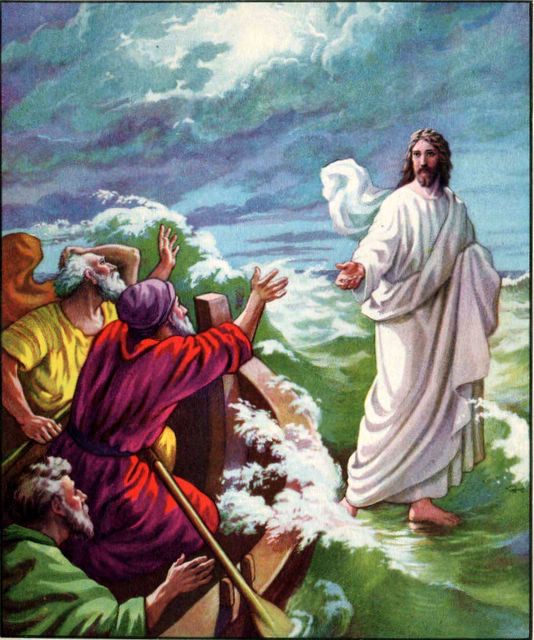
Jesus Walks on the Sea

Therefore when Jesus perceived that they were about to come and take Him by force to make Him king, He departed again to the mountain by Himself alone. Now when evening came, His disciples went down to the sea, got into the boat, and went over the sea toward Capernaum. And it was already dark, and Jesus had not come to them. Then the sea arose because a great wind was blowing. So when they had rowed about three or four miles, they saw Jesus walking on the sea and drawing near the boat; and they were afraid. But He said to them, “It is I; do not be afraid.” Then they willingly received Him into the boat, and immediately the boat was at the land where they were going (John 6:15-21).

The disciples cross the sea in a boat without Jesus. Jesus crosses the sea by miraculous means. He walks across the water. He comes near the disciples and they are frightened. One of the Evangelists records that they thought Jesus was a ghost.[1] But this is not ghost. It is a flesh and bone Jesus doing something that should not be possible. He speaks to the disciples to calm and reassure them. The NKJV[2] gives us, “It is I; do not be afraid.” The Greek is more telling. Literally translated, what Jesus said was, “I am. Do not be afraid.”[3] Jesus refers to Himself this way several times, and in significant situations. Theologians sometimes call these the “I AM statements”. At various times, Jesus says: I am the bread of life; I am the light of the world; I am the door; I am the Good Shepherd; I am the resurrection and the life. This passage doesn’t record one of those statements previously mentioned; Jesus uses this scandalous way of referring to Himself at other times too, like in this instance of walking on the sea.

Another famous time He used I AM to refer to Himself was also recorded by John. Jesus speaks to the Pharisees. They argue with Him about whether or not they are sons of Abraham (No, Jesus says they are sons of Satan) and whether or not they are slaves (Yes, Jesus says they are slaves to sin). At the climax of their interaction, Jesus says, “Most assuredly I say to you, before Abraham was, I AM.”[4] At this they were incited to murder Jesus but He, miraculously, passed by though the midst of them. Why such an uproar over Jesus’ grammar? Were the Pharisees such sticklers for proper Greek that an improper conjugation could earn you a rock to the face? No. In making the I AM statements, Jesus was claiming to be the Great I AM: YAHWEH, the God of Abraham, Isaac, and Jacob, in person, and in the flesh. That was a super big deal to the Jews.

When Moses fled to Midian after murdering the Egyptian, he tended sheep for his father-in-law. One day, while tending the sheep on Mt. Horeb, the Angel of the Lord appeared to Moses in a flame of fire from the midst of a bush. From this burning bush, the Second Person of the Trinity in His pre-incarnate form spoke to Moses: Come now, therefore, and I will send you to Pharaoh, that you may bring my people, the children of Israel, out of Egypt.[5] Moses tries to get out of doing this. His first tactic is to say that the Israelites won’t listen to him because he doesn’t know God’s name, and won’t be able to tell them when they ask. God’s reply: “I AM WHO I AM.” And He said, “Thus shall you say to the children of Israel, ‘I AM has sent me to you.’”[6] By applying God’s name to Himself, Jesus expressed the eternity of His being and His oneness with God the Father.

After arriving at the other shore, Jesus would declare to the people, “I am the bread of life. He who comes to Me shall never hunger, and he who believes in Me shall never thirst.”[7] Jesus left the previous day because the people wanted to make him king by force. Now He speaks to the crowds who seek Him, not because they believe, but because they ate of the loaves and were filled.[8] They see in Jesus a miracle worker who will give them all their earthly wants. They fear, love, and trust their bellies, just as we do. Jesus wants to give them the true bread from heaven - Himself, literally, His flesh. For the bread of God is He who comes down from heaven and gives life to the world.[9] Jesus is I AM in the flesh. He is, literally, Immanuel, which is translated, “God with us.”[10] He has come to save His people from their sins by giving His flesh.


[1] Matthew 14:26
[2] New King James Version
[3] Brown, Robert K., and Philip Wesley Comfort, trans. The New Greek-English Interlinear New Testament: A New Interlinear Translation of the Greek New Testament, United Bible Societies Fourth, Corrected Edition with the New Revised Standard Version, New Testament. Edited by J. D. Douglas. Wheaton, IL: Tyndale House Publishers, 1993.
[4] John 8:58
[5] Exodus 3:10
[6] Exodus 3:13-14
[7] John 6:35
[8] John 6:26
[9] John 6:32-33
[10] Matthew 1:23