Showing posts with label Corinth. Show all posts

Thursday, June 14, 2018

Paul Ministering in Corinth

Now the Lord spoke to Paul in the night by a vision, “Do not be afraid, but speak, and do not keep silent; for I am with you, and no one will attack you to hurt you; for I have many people in this city” (Acts 18:9-10).

Paul preaches Christ in Thessalonica. His opponents gather a mob and set the city in an uproar. They attack the house of a man named Jason, where Paul was staying. At the end of the affair it is Jason, Paul, and the other brethren who are arrested and must post bond. Paul preaches Christ in Berea. The reception is a little better there; but when the Jews from Thessalonica learned that the word of God was preached by Paul in Berea, they came there also and stirred up the crowds. Paul preaches Christ in Athens. He wasn’t physically attacked by an angry mob but, when they heard of the resurrection of the dead, some mocked, some were converted, and some said they wanted to hear more. Paul departed from among them.

In Corinth, the scene appears set to play out as it did in the other places. Paul preaches Christ in Corinth. He was compelled by the Spirit to do so, Scripture says, and he testified to the Jews that Jesus is the Christ. But when they opposed him and blasphemed, he shook his garments and said to them, “Your blood be upon your own heads; I am clean. From now on I will go to the Gentiles.” This time, however, the risen Jesus tells Paul not to be afraid. He should keep speaking, “...for I am with you, and no one will attack or hurt you; for I have many people in this city.” And Paul does, for a year and a half. And the Jews bring Paul to the judgment seat of proconsul Gallio. They hope Gallio will assume Paul is advocating illegal religion and acting treasonously by telling people to pledge their allegiance to a king other than Caesar. They charge Paul with persuading men to worship God contrary to the law. Gallio wants no part of this religious dispute. He tells them to handle it amongst themselves and clears the court. Paul is saved; the one who takes the beating is Sosthenes, the ruler of the synagogue. The church steadily grows and becomes more firmly established through the bold proclamation of Christ crucified for our sins and risen from the dead; God the Holy Spirit, working as He wills, makes Christians in the face of ferocious opposition through His means of the external word of God.

Paul wasn’t surprised or disheartened when he was mocked, beaten, stoned, and imprisoned for preaching the Gospel. Scripture tells us he was compelled to preach by the Holy Spirit. He knew what the reaction would be. We also should know what the reaction of the pagan world will be to us as well. Jesus, the Word made flesh, came to His own and His own did not receive Him. Jesus taught His disciples that He was sending them out as sheep among wolves; that they would be delivered up to councils; that they would be scourged; that they would be brought before kings and governors for His sake, as a testimony to them and to the Gentiles. Jesus’ disciples, we included, will be hated by all for His name’s sake; but he who endures to the end will be saved.[1] The world hates us because it hated Jesus before us, and no student is above his master. They hate us because of the message we proclaim: that Christ died for our sins according to the Scriptures, and that He was buried, and that He rose again the third day; that by His atoning sacrifice, Jesus purchased and won me from all sin, from death, and from the power of the devil, not with gold or silver, but with His holy, precious blood, and by His innocent suffering and death. This message is foolishness to those who are perishing. The carnal mind cannot understand spiritual things.

Being dead in our transgression, we must be made alive by the working of God, through water and the Word. Being dead we must be born from above by water and the spirit. And even though the world may mock us, reject us, and even react violently toward us, we continue to bring them the Gospel, the message of the cross. It isn’t through the elegant turning of a phrase that God makes Christians out of non-Christians, as we see from Paul’s example; Christians are made through the preaching of the Gospel. We must not be afraid to boldly proclaim that Gospel to those around us, according to our vocation. It is the power of God to salvation for everyone who believes.[2]


[1] Matthew 10:16-26
[2] Romans 1:16

Tuesday, September 25, 2012

To Eat, or Not To Eat, That is the Question

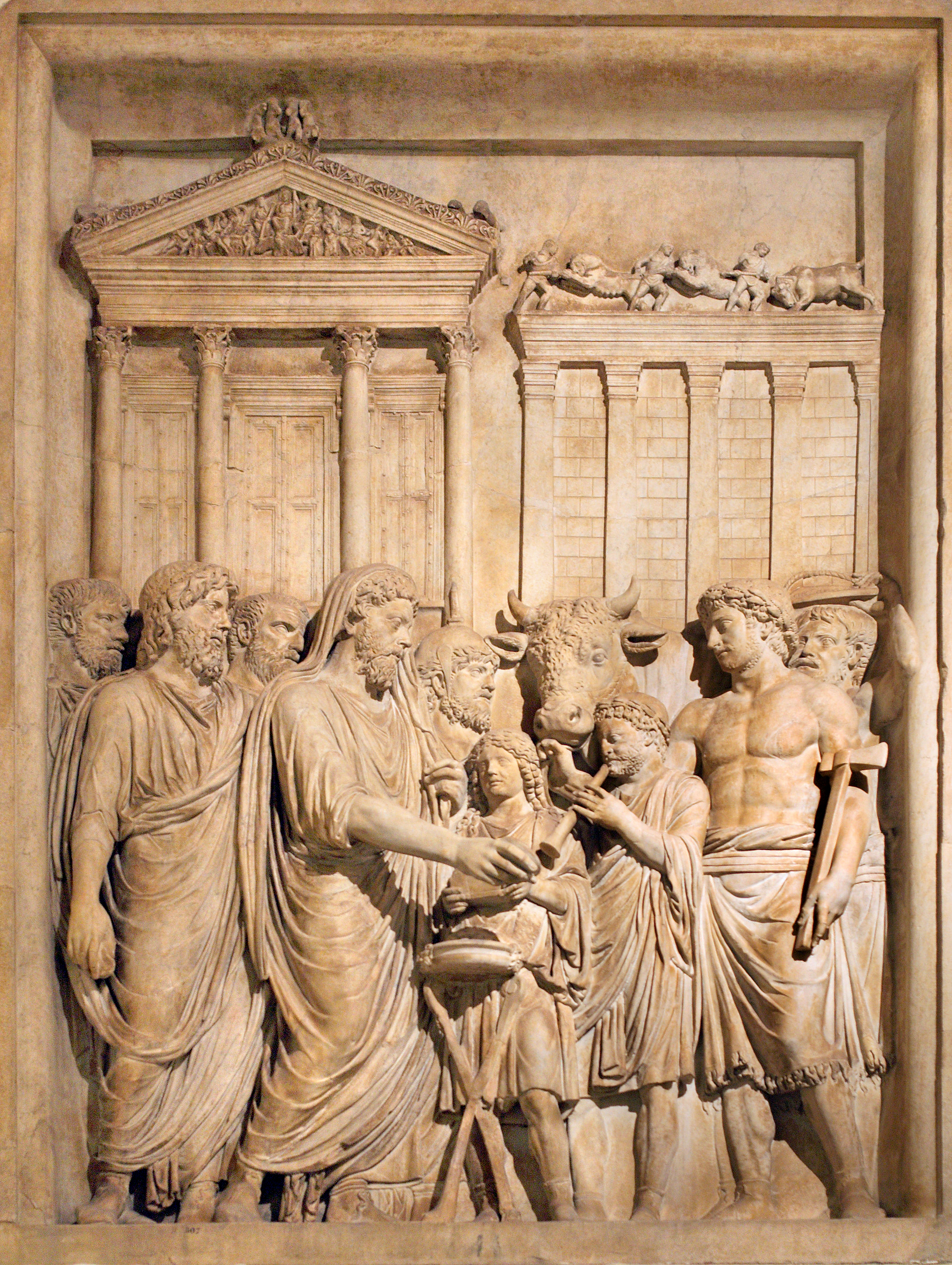
Emperor Marcus Aurelius sacraficing at the
Temple of Jupiter in Rome
As for the one who is weak in faith, welcome him, but not to quarrel over opinions. One person believes he may eat anything, while the weak person eats only vegetables. Let not the one who eats despise the one who abstains, and let not the one who abstains pass judgment on the one who eats, for God has welcomed him. Who are you to pass judgment on the servant of another? It is before his own master that he stands or falls. And he will be upheld, for the Lord is able to make him stand (Romans 14:1-4).

The words of Paul to the Romans, and elsewhere to the Corinthians, addressing their concerns over “meat sacrificed to idols” may seem, to modern ears, archaic. In our modern western society we do not have to deal with issues such as the public funding and worship of gods as did the early Christian subjects of the Roman Empire. The Corinthians, though, were facing a difficult spiritual situation. As Christians, they were in the minority in a culture which revolved around the pagan temple. Lenski, in his commentary, briefly explains the dilemma:

The pagan temple rituals, many state occasions, festivals of various kinds of societies, the lives of families and of individuals, all involved sacrifices to the gods and the participation of larger or smaller circles in the feasts connected with these rituals. The desire to participate in such feasts as well as the obligations of family connections or of friendship raised the question as to how far a Christian might go in this regard (Lenski, 1957).

In the worship of the pagan gods a part of the animal would be burned on the pagan altar. The rest of the animal would be prepared for the feast that followed (Lenski, 1957). Any of the sacrifice that was not either burned on the altar or eaten at the subsequent feast would have been taken home and eaten there. Lenski explains that some of the leftover meat sacrificed to the pagan gods would necessarily end up in the market butcher shops, and would be sold along with the ordinary meat.

The Corinthians had, evidently, debated how they should handle the situation in which they found themselves. Was it permissible to eat meat that had been sacrificed to a pagan god? Could a person eat in an idol’s temple or in the home of a pagan friend? Questions such as these were almost certainly asked of Paul by the Corinthians, and he devotes a significant portion of his epistle to their response.

Therefore, as to the eating of food offered to idols, we know that “an idol has no real existence,” and that “there is no God but one.” For although there may be so-called gods in heaven or on earth—as indeed there are many “gods” and many “lords”— yet for us there is one God, the Father, from whom are all things and for whom we exist, and one Lord, Jesus Christ, through whom are all things and through whom we exist (1 Corinthians 8:4-6).

So, the short answer from Paul is yes, you can eat meat sacrificed to idols. Paul briefly explains why. He reminds us that an idol is nothing – it is merely a carving made by man. He points out that all foods have been declared to be clean by our Lord. He gives thanks to God for what he receives. He declares, nevertheless, that he would rather never eat meat again, if his eating of meat causes one of his fellow brothers to stumble and harms their faith[1]. It doesn't matter what is permissible for Paul. It matters what builds up the body of Christ - the Church - because, as Paul explains, his entire existence is concerned with winning souls for Christ by proclaiming the Gospel.

Food will not commend us to God. We are no worse off if we do not eat, and no better off if we do. But take care that this right of yours does not somehow become a stumbling block to the weak. For if anyone sees you who have knowledge eating in an idol's temple, will he not be encouraged, if his conscience is weak, to eat food offered to idols? And so by your knowledge this weak person is destroyed, the brother for whom Christ died.  Thus, sinning against your brothers and wounding their conscience when it is weak, you sin against Christ. Therefore, if food makes my brother stumble, I will never eat meat, lest I make my brother stumble (1 Corinthians 8:8-13).

The things you do, like eating meat sacrificed to idols, may not be bad. Indeed, Paul says this elsewhere. All foods have been declared clean[2]. If you don't have an issue of conscience eating such things, you are free to eat them. If, however, one of your Christian brothers sees you in the corner idol-meat butcher shop and he, not having as mature an understanding of these ideas as you, is offended by your actions, or encouraged to participate in contradiction to his conscience, Paul tells the Corinthians that they should abstain. The reason: Christ died for that brother of yours who is offended, however unjustified that offense may be.

For Paul at once explains in regard to what point the knowledge of some is insufficient: “due to the custom hitherto”, when they [the “weak” Christians] were still Gentiles and attended idol feasts. They cannot, now that they are Christians, rid themselves of the old feeling regarding the idol that is honored by such a feast…The old custom or habit of thinking regarding the idol still has its effect, not, indeed, as though they still think that the idol is a real being, but that they eat “as an idol offering”…They still feel that eating such meat in some way connects a person with the idol, unreal though that idol is to whom that meat has been sacrificed. That is their weak point (Lenski, 1957).

If your actions have the potential to harm his faith and cause him to fall away (put a "stumbling block" in front of him, as Paul says), you should not do the thing that causes offense, even if you may have the Christian liberty to do so. Lenski comments:

Not our knowledge but our love for the weak must govern our action a [stumbling block] is something that lies in a path, against which an unwary foot may strike and cause a person to stumble or to fall; metaphorically, anything that may cause a person to sin and to suffer injury to his soul, (Lenski, 1957).

If these relatively insignificant issues of personal conduct get in the way of Paul's Christian witness and example because Paul is stubborn about exercising his Christian liberty, he explains, his Gospel witness is ineffective to outsiders, and the faith of those less spiritually mature brothers could be jeopardized. Paul writes in his epistle to the Romans:

Do not, for the sake of food, destroy the work of God. Everything is indeed clean, but it is wrong for anyone to make another stumble by what he eats. It is good not to eat meat or drink wine or do anything that causes your brother to stumble,” (Romans 14:20-21).

How do these questions, and Paul’s response to them, apply to those of us who comprise the church today? The last time I looked, there were no enormous marble statues of Jupiter in the town square. There don’t seem to be many pagan temples conducting animal sacrifices in my neighborhood, and I couldn’t tell you the last time I was invited to eat meat at a pagan feast. So, can we just let this one go, and chalk this section of the Scripture up as the vestigial remnant of an ancient culture, with no application for us today? Hardly. What applies to Paul, the Corinthians, and the Romans also applies to us. We might not be dealing with the whole" meat sacrificed to idols" issue, but that doesn't mean there aren't issues that come up by which we offend each other. 

One that leaps to mind immediately is consumption of alcohol. Different Christian denominations have differing views regarding alcohol. I went to college in the south and, even though I spent many summers of my youth visiting relatives in Mississippi, moving to western Kentucky and actually living under the so-called “Bible Belt” was a different experience. For one thing, no one knew what a Lutheran was. Those who were familiar with the Lutheran church had a vague sense that we were sort of like Roman Catholics. That meant crucifixes, strange “costumes” (vestments), and confusing and elaborate religious rituals to them. The predominant religious culture where I lived was that of the Southern Baptists. I don't want to get into a comparative religions lecture here. Suffice it to say that there are theological differences between Lutherans and Baptists, chief among them being how we view the sacraments. There are also sociological differences, and the one that I experienced most prominently had to do with alcohol.

The county in which the university I attended was located was "dry". That is to say, it was illegal to purchase, possess, or consume alcoholic beverages. Being a Lutheran of German heritage, this was quite perplexing to me. Beer was a part of our history and heritage. Real wine was (and is) used in the sacrament of the altar in our churches. Now I was being confronted by fellow brothers and sisters in Christ with the idea that drinking alcohol was sinful and evil. Alcohol was so bad that it was outlawed because it was perceived to be damaging to the very fabric of society. The fact that it was outlawed in the county did not, however, stop some people from purchasing, possessing, and consuming it.

The Bible, of course, does not say that alcohol is sinful or evil. To the contrary, one could even say that the Bible, in at least one place, advocates the drinking of alcohol. Every booze hound in the world is familiar with the Biblical passage where Paul tells Timothy to drink a little wine to cure his stomach ailments. This passage is often misused by alcoholics to try and nullify the calls of their concerned family and friends to stop drinking. Scripture does warn, strongly and repeatedly, against the abuse, misuse, or excessive use of alcohol.

For you were called to freedom, brothers. Only do not use your freedom as an opportunity for the flesh, but through love serve one another. For the whole law is fulfilled in one word: “You shall love your neighbor as yourself,” (Galatians 5:13-14).

So, just like eating meat sacrificed to an idol, it is permissible to drink alcohol. If, however, my drinking offends my brother who does not yet have this understanding and causes a division, or encourages him to imbibe against the warnings of his conscience, I should follow Paul’s example and abstain from drinking. These issues should be explained to those who do not understand them, to be sure. In the meantime, however, we should not do anything that might hinder or damage their faith. This goes for idol meat, alcohol, or whatever has the potential to cause a division in the church. Conversely, those who abstain should not, as Paul writes, judge those who do not. Paul tells us not to quarrel over opinions. We shouldn’t engage in behaviors that would cause other believers to stumble in their faith (Engelbrecht, et al., 2009). When those outside the church see those of us who are members of Christ’s body “biting and devouring” each other through ugly and sinful quarreling, we cease to be an effective witness to them[3]. The Christian liberty we have in Christ is not just freedom from the Law without a purpose. To the contrary, God has given us this liberty to serve others in love.


Works Cited

Engelbrecht, E. A., Deterding, P. E., Ehlke, R. C., Joersz, J. C., Love, M. W., Mueller, S. P., et al. (Eds.). (2009). The Lutheran Study Bible. Saint Louis, Missouri, USA: Concordia Publishing House.

Lenski, R. C. (1957). The Interpretation of I and II Corinthians. Columbus, Ohio: Wartburg Press.


End Notes

[1] 1 Corinthians 8:13
[2] Romans 14:14
[3] Galatians 5:15

Tuesday, June 12, 2012

I Believed, And So I Spoke


The Resurrection of Christ - Cranach

Since we have the same spirit of faith according to what has been written, “I believed, and so I spoke,” we also believe, and so we also speak, knowing that he who raised the Lord Jesus will raise us also with Jesus and bring us with you into his presence. For it is all for your sake, so that as grace extends to more and more people it may increase thanksgiving, to the glory of God. So we do not lose heart. Though our outer self is wasting away, our inner self is being renewed day by day. For this light momentary affliction is preparing for us an eternal weight of glory beyond all comparison, as we look not to the things that are seen but to the things that are unseen. For the things that are seen are transient, but the things that are unseen are eternal. For we know that if the tent that is our earthly home is destroyed, we have a building from God, a house not made with hands, eternal in the heavens (2 Corinthians 4:13 – 5:1).

You have seen Christian men and Christian churches so dispirited and discouraged that you knew at once that they could not hope for success at that rate. What a pity to work so hard for years in the kingdom of God and then to give up, just because we do not seem to be making much headway – possibly none at all. Humanly speaking, what would have become of that little band of Saxon immigrants in 1839 when their leader went wrong if Dr. C.F.W. Walther and his colleagues had given up in despair (Burgess, 1988)?

Dr. Walther, along with approximately 800 other German Lutherans left Saxony when they came to realize that they were not free to practice their Christian faith according to the Lutheran Confessions. This group of Christians found themselves increasingly at odds with the Saxon government at the time, which vigorously promoted rationalism and unionism among the Lutheran (Evangelical) and Reformed (Calvinist) churches in Saxony (Lutheran Church - Missouri Synod, 2012). Unwilling to compromise the Lutheran Confessions, this group set out to the United States in 1838. One of their ships was lost at sea; after an arduous voyage, the settlers landed in New Orleans, Louisiana. They made their way up the Mississippi River and settled in Perry County, Missouri. Soon after the immigrants were settled in the new homeland, their leader, Martin Stephan, was accused of financial and sexual misconduct and was expelled from the settlement (Concordia Historical Institute). This shook the community. The people were deeply disturbed. They were unsure whether or not they were a new church after having left the governing church authorities and church hierarchy in Germany, or if they were simply a branch of the old church in Germany. Dr. Walther eventually emerged as the leader of the community, and was able to persuade the people that they were indeed a new church body, separate from the church they left behind in the Old World (Concordia Historical Institute).

This letter was written to the church at Corinth; they seem to have been a congregation with plenty of their own troubles as well. Paul visited Corinth during his second missionary journey; he later wrote a letter to them, mentioned in 1 Corinthians 5:9, which has been lost to the ages. Paul then sent them what we today call 1 Corinthians, to which some scholars believe Paul may have referred to as the “painful letter” in 2 Corinthians 2:4 (Engelbrecht, et al., 2009). 2 Corinthians was written in approximately AD 55. The purpose of the entire letter was to show the Corinthian Christians that Paul’s work among them was truly Christ’s work (Engelbrecht, et al., 2009). He writes about the very real human problems congregations, both ancient and modern, face such as divisions, false apostles/teachers, human frailty, poverty of sin, generosity, suffering, and self-examination. He wrote directly to the Corinthians; he is, by virtue of the universality of his message, speaking to all Christians of all times. Paul quotes Psalm 116:10:

I believed, even when I spoke: “I am greatly afflicted” (Psalm 116:10).

He does so to explain his motivation for proclaiming the Gospel in the midst of suffering (Engelbrecht, et al., 2009). The psalmist writes that, even though he was greatly afflicted with terrible trials, he nevertheless believed and trusted in the Lord. St. Paul also seeks to encourage the reader to remain faithful to the Lord in the midst of trials, looking forward to the Lord’s redemption. This would be significant to the Corinthians, as they were a congregation in turmoil, and Paul has been shepherding them through their tumultuous times. They are also, as Paul writes earlier in chapter four, “jars of clay,” in which God has placed his treasure[1]. Paul wants the Corinthians, though frail, afflicted, persecuted, perplexed, and struck down, to continue speaking to the Gospel to everyone. As they continue to do so, God’s saving grace would naturally extend to more people. Such is the nature of evangelism[2]. As God’s kingdom grows, thanksgiving among his subjects would grow as well, and God would be glorified all the more among mankind.

…knowing that he who raised the Lord Jesus will raise us also with Jesus and bring us with you into his presence (2 Corinthians 4:14).

St. Paul gives the Corinthians the thing upon which they must always remain focused in verse 14 – the resurrection of Jesus. The “he” in that verse is clearly God the Father, as we are told elsewhere in the New Testament that God the Father raised Jesus from the dead[3]. This is not to be taken as some sort of evidence that Jesus is inferior to God the Father, or that he is not divine in his nature. Scripture also tells us that Jesus raised himself from the dead[4], and that Jesus was raised by the Spirit[5]. Jesus, Scripture teaches, has two natures – one human, and one divine. With respect to his human nature, Jesus was certainly subordinate to God the Father and, while he was on the earth, he had to rely on God the Father for everything. This is called Jesus being in the “state of humiliation” (Luther, 1991). The reason for this is not because Jesus was essentially less than divine. It is because he voluntarily emptied himself of his divine power and set it aside to take on human nature, in fulfillment of God the Father’s will[6]. When St. Paul speaks of the resurrection, he means the literal, bodily raising of Jesus, or another, from the dead. Paul uses lots of imagery in 2 Corinthians 4, but not where the resurrection is concerned. To Paul the literal bodily resurrection of Jesus is the most important aspect of the Christian faith[7].

Though our outer self is wasting away, our inner self is being renewed day by day. For this light momentary affliction is preparing for us an eternal weight of glory beyond all comparison, as we look not to the things that are seen but to the things that are unseen. For the things that are seen are transient, but the things that are unseen are eternal (2 Corinthians 4:16-18).

The Outer self is the physical person; the inner self is the spiritual person. The outer self experiences all of the wasting away that St. Paul describes in Chapter four because of the Fall and sin. When sin entered creation, God’s creation became totally corrupted. Sin entered God’s creation through one man, and death through sin[8]. Because the corruption of sin reaches the very nature of mankind, all people are subject to physical death. Our inner, or spiritual, self is revived by the power of God’s Holy Spirit working through his means – Word and Sacrament – as God has promised us (Luther, 1991). The Holy Spirit works a renewal of a believer’s whole life – in spirit, will, attitude, and desires[9]. This spiritual renewal manifests itself in a believer’s life as what Paul calls the fruits of the Spirit – love, joy, peace, patience, kindness, goodness, faithfulness, gentleness, and self-control[10].

What does St. Paul mean by the “light momentary affliction”, and how does that affliction prepare St. Paul’s readers for, “…an eternal weight of glory…”? He is writing about life. After sin entered the world and corrupted God’s creation, life got difficult. Man had to eat his bread by the sweat of his brow, woman had to endure pain in childbirth, our corrupt nature turned away from God and turned in toward ourselves. We became subject to sorrow, pain, and death. Paul tells us, however that this light, momentary affliction is not all that there is. Because we have been spiritually united with Christ in his resurrection through baptism, we will also be physically resurrected to eternal life, just as he was[11]. And, just as an athlete endures the pain of training so that he may bear the weight of the sport in which he competes, so we endure the affliction of a corrupt and sinful world, in anticipation of the weight of eternal glory with Christ.

Paul continues with his comparison of temporal and eternal things in verse 18. “The things that are seen” is the physical world; “the things that are unseen” is the spiritual world. The physical world is in a state of decay; the spiritual world is eternal. Paul is not a Christian Scientist; he is not saying that that humanity and the universe are spiritual rather than material (Christian Science, 2012). He does not deny that the physical world is real, as the Gnostics of his day did, and claim that it is evil, and only a projection, or shadow, of the true spiritual reality. The physical world is merely in a state of “passing away”. Even if St. Paul believed that the physical world was not real, and only the spiritual world was reality, he was reminded of the truth constantly. He could not simply project, or believe his way out of beatings, stoning, imprisonment, and ultimately, death.

For the things that are seen are transient, but the things that are unseen are eternal. For we know that if the tent that is our earthly home is destroyed, we have a building from God, a house not made with hands, eternal in the heavens (2 Corinthians 4:18 – 5:1).

Paul moves from talking about the general physical world to our individual physical bodies. Our corrupted physical body will eventually be destroyed by death. Paul refers to it as a tent, which is a temporary structure. When this happens, though, we know that, through faith in Christ, we have a building from God – a permanent structure – which will last forever. This building from God is the resurrected body promised to us by Christ, redeemed for eternity, restored and transformed by God himself (Engelbrecht, et al., 2009).

This is what we, as Christians, must focus on when times become tough for us. We may not be facing the same sort of obstacles that St. Paul and the Corinthian church faced in their everyday lives, such as violence and persecution. We do, however, face life as believing Christians in an increasingly secular world that is more hostile to the message of Christ crucified and risen every day. We may not be dealing with the trials of establishing and holding together a religious colony in a new country, trying to overcome all the obstacles that go along with such an undertaking. We are, however, a church made up of human beings, complete with sinful human natures; our human failings prove this to us, and those around us, daily. St. Paul instructs Christians to look beyond the momentary affliction to the eternal glory of salvation in Jesus (Engelbrecht, et al., 2009). We must fix our eyes on Jesus, the author and perfector of our faith. And, because we believe, we must also speak. We must speak to those around us who do not know the good news of what Jesus accomplished on the cross at Calvary. The goal of St. Paul’s ministry among the Corinthians was to reach more people with the Gospel. Our goal is the same. Our human failings, our afflictions, all those things that Satan uses to trouble and harass us, become temporary nuisances that will surely give way to the glory of life eternal with our Savior (Engelbrecht, et al., 2009).


Works Cited

Burgess, D. F. (1988). Encyclopedia of Sermon Illustrations. St. Louis, MO, USA: Concordia Publishing House.

Christian Science. (2012, June 12). Retrieved June 12, 2012, from Wikipedia: http://en.wikipedia.org/wiki/Christian_Science

Concordia Historical Institute. (n.d.). Concordia Historical Institute. Retrieved June 12, 2012, from C. F. W. Walther: http://www.lutheranhistory.org/collections/fa/m-0004.htm

Engelbrecht, E. A., Deterding, P. E., Ehlke, R. C., Joersz, J. C., Love, M. W., Mueller, S. P., et al. (Eds.). (2009). The Lutheran Study Bible. Saint Louis, Missouri, USA: Concordia Publishing House.

Luther, M. (1991). Kleine Katechismus, English. (C. P. House, Trans.) Saint Louis, Missouri, USA: Concordia Publishing House.

Lutheran Church - Missouri Synod. (2012, June 12). Retrieved June 12, 2012, from Wikipedia: http://en.wikipedia.org/wiki/Lutheran_Church%E2%80%93Missouri_Synod


End Notes

[1] 2 Corinthians 4:7
[2] Isaiah 55:11
[3] Romans 10:9
[4] John 2:19-21; 10:17-18
[5] Romans 8:11
[6] Philippians 2:5-11
[7] See 1 Corinthians 15. The resurrection of Christ is the subject for the entire 15th chapter of this book. St. Paul writes, “And if Christ has not been raised, then our preaching is in vain and your faith is in vain…And if Christ has not been raised, your faith is futile and you are still in you sins…If in Christ we have hope in this life only, we are of all people most to be pitied,” (1 Cor. 15:14, 17, 19).
[8] Romans 5:12-21
[9] Romans 8:9; 2 Corinthians 5:17
[10] Galatians 5:22-23
[11] Romans 6:3-4