Showing posts with label external word. Show all posts

Sunday, June 14, 2020

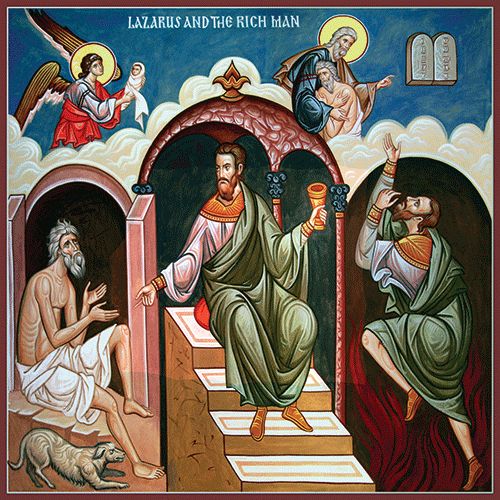
The Rich Man and Lazarus


First Sunday after Trinity

“But Abraham replied, ‘Son, remember that in your lifetime you received your good things, while Lazarus received bad things, but now he is comforted here and you are in agony.’” (Luke 16:25)

“He said to him, ‘If they do not listen to Moses and the Prophets, they will not be convinced even if someone rises from the dead.’” (Luke 16:31)

Scripture tells us that Jesus did not say anything to the people without using parables.[1] But what is a parable, and what is it’s purpose? After Jesus’ resurrection, the Apostles’ preaching would be clear and direct. Now Jesus must teach by using stories to match the level of understanding of His hearers, so as not to disrupt the plan of salvation which was reaching its end.[2] If He were to say bluntly that He was the Son of God in human flesh, the promised son of David, the people would start a revolt and try to make Him king, as they would try to do at other times during His ministry.[3] In this parable, Jesus teaches about wealth and faith in a way that compels those who hear to carefully consider what He says.

A parable is a short, fictitious story intended to teach a spiritual truth.[4] When teaching through parables, Jesus uses pictures with which his hearers are familiar to explain these truths. He doesn’t do this to hold back truth from them, but rather to press them to search for truth in the scriptures, which He says testify about Him.[5] No one, not even the Apostles, can understand divine revelation unless it is given them to understand by God. This is because we are all conceived and born in sin,[6] and by the nature we inherited from Adam, children of God’s wrath.[7] In spiritual things particularly, our sinful minds are hostile to God; they cannot and will not submit to God’s law.[8] We are spiritually blind and dead. Jesus sends the Holy Spirit to us through His word to open our ears and our eyes; He makes we, who were dead in our sins, alive in Him. Jesus connects us to His death, and to His resurrection in our baptism.[9] In our baptism He also clothes us in His righteousness.[10] He gives to us the gifts of the forgiveness of sins, eternal life, and salvation that He won by His death on the cross.[11]

The first truth of this parable is that God intends for us to use our earthly wealth wisely, and not to make money our god. All through His ministry, Jesus seems to paint a hopeless picture for rich people. He isn’t saying that it is impossible for the rich to get into heaven. In fact, Jesus tells the disciples that, without the working of God, it is impossible for anyone, rich or poor, to enter the kingdom of heaven![12] He wants us all to know, rich and poor alike, that the wealth which gives us earthly comfort and security cannot buy us eternal comfort and security. Jesus wants us to use our wealth to help our neighbors, thus storing up for ourselves treasures in heaven, where moth and rust do not destroy.[13] The rich man in the parable has made an idol of his wealth. He trusted in it to save him, and he was sorely disappointed.

The second truth Jesus teaches through this parable is that God’s word creates faith and saves. The rich man wants Abraham to send Lazarus back from the dead to warn his brothers to change their ways, so they don’t end up like him. Abraham says no. He says that they have God’s word: If they do not listen to Moses and the Prophets, they will not be convinced even if someone rises from the dead. Jesus is teaching that miracles are not enough to convince people to believe in Him. It is God’s Holy Spirit, working through God’s word, that creates repentance and faith in men. St. Paul spells this out when he writes: “I am not ashamed of the gospel, because it is the power of God for the salvation of everyone who believes,[14]” and “Faith comes from hearing the message, and the message is heard through the word of Christ.[15]” Jesus would later raise a dead man named Lazarus to life in front of His enemies, but it wouldn’t make them believe in Him. In the face of that miracle they would still refuse to believe that Jesus was the promised Savior, and plot to kill Him.[16]

Jesus wants His hearers to carefully consider what He is saying to them, and not to harden our hearts and resist the working of the Holy Spirit. In this parable He teaches that we are to use our earthly wealth wisely, as a tool to help our neighbor. Our money cannot save us from hell and separation from God. Money will be of no use to us when we die. But, we have something far more precious than money or things. Because Jesus’ work is now complete, we can stop using parables and speak clearly, just as the Apostles did after they received the Spirit from Jesus.[17] In Christ we have forgiveness of sins, eternal life, and salvation. He purchased and won those things for us on the cross. He bought them, not with gold or silver, but with His holy, precious blood, and by His innocent suffering and death. He gives those gifts to us through faith in Him, which comes through His word. ###


Bibliography


Concordia Publishing House. 2009. The Lutheran Study Bible. Edited by Edward A Engelbrecht, Paul E Deterding, Roland Cap Ehlke, Jerald C Joersz, Mark W Love, Steven P Mueller, Scott R Murray, et al. Saint Louis, MO: Concordia Publishing House.

Prange, Victor H. 1988. The People's Bible Commentary: Luke. Milwaukee: Northwestern Publishing House.

Wicke, Harold E. 1992. People's Bible Commentary: Mark. St. Louis: Concordia Publishing House.


[1] Mark 4:34
[2] Wicke, Mark, 68.
[3] John 6:15
[4] Wicke, Mark, 61; Webster, Webster’s Collegiate Dictionary, 697.
[5] Luke 4:21; John 5:29
[6] Psalm 51:5
[7] Ephesians 2:3
[8] Romans 8:7
[9] Romans 6:3-5
[10] Galatians 3:27
[11] Acts 2:38-41; 1 Peter 3:18-21
[12] Matthew 19:16-30
[13] Matthew 6:19-21
[14] Romans 1:16
[15] Romans 10:17
[16] Englebrecht, et. al., Lutheran Study Bible, 1751
[17] Wicke, Mark, 68

Monday, May 4, 2020

Many Disciples Turn Away


Monday after Jubilate

“It is the Spirit who gives life; the flesh profits nothing. The words that I speak to you are spirit, and they are life” (John 6:63).

Sacramentarians[1] have the same problem here that the disciples who left Jesus had: Jesus’ teaching that His flesh is food indeed, and His blood is drink indeed is for them a hard saying and they cannot understand it. Some teachers of that sect try to use the words of this verse to spiritualize and symbolize all that Jesus had previously said about Him being the Bread of Life come down from heaven, and whoever eats His flesh and drinks His blood has eternal life. The following quotation, taken from Bibleref.com, is typical of the Sacramantarian teaching on this passage:

The idea of His flesh being the bread of life was meant to extend the analogy of bread, in order to include His upcoming sacrificial death on the cross. Here, Jesus makes a direct statement that His prior words were not meant to be taken literally. In other words, Christ is not actually saying that people need to consume His material flesh or drink His liquid blood. Rather, the point Jesus is making is spiritual…faith in Christ is not the same as intellectual knowledge. Saving faith means receiving Christ in the deepest parts of ourselves.[2]

Faith is indeed different from intellectual knowledge. It is the gift of God;[3] it is the substance, the foundation, of things hoped for and the evidence of things not seen.[4] Why, then, do we treat it as intellectual knowledge by rationalizing Jesus’ words, and changing their context? Jesus is not speaking in figuratively in the Bread of Life passage. In fact, when John is writing something figurative or symbolic he, like the other New Testament authors, makes it clear in the text. Jesus often teaches in parables, which are figures of speech. When He does so, it is obvious; He says things like, “What is the kingdom of God like? And to what shall I compare it?” Or, “A certain man had a fig tree…” And the Gospel writers clearly indicate that Jesus is speaking figuratively by writing something like, “He spoke this parable to them, saying…” When Jesus cleanses the temple and the Pharisees demand a sign from Him to show the authority by which He did what He did, Jesus answers, “Destroy this temple, and in three days I will raise it up.” They misunderstand, and think Jesus is talking about the actual building, but John makes sure it is clear to the reader, “But He was speaking of the temple of His body. Therefore, when He had risen from the dead, His disciples remembered that He had said this to them; and they believed the Scripture and the word which Jesus had said.”[5] It was symbolic language, a figure of speech. There are no such indications in the Bread of Life passage that Jesus is using the eating and drinking of His flesh and blood figuratively.

On the contrary, Jesus gets more and more specific and clear as He teaches precisely what it means that He is the Bread of Life. He uses the Greek word for true, living flesh, [6] and the blood that goes through that flesh,[7] when He teaches. His reference to the Holy Spirit being life in verse 63 hardly negates as figurative His statement, “He who eats my flesh and drinks my blood abides in Me and I in him.”

Jesus’ words here mean precisely what they say. It is the Spirit who gives life: It is the Holy Sprit who creates life and faith in men, turning their hearts of stone into hearts of flesh, as we know, through the word. And it should be no surprise that Jesus delivers the word of His promises to us by different means. There are many examples of Him using something intermediate as an instrument to deliver His faith-creating word. He attaches His words to water in Holy Baptism where He promises to give us a new birth, save us from sin, death, and the devil, clothe us with His righteousness, and connect us to Him, His death, and His resurrection. He attaches His words to mud made out of spit to restore sight to a man born blind.[8] He attaches His words, through the prophet Elisha, to the waters of the Jordan river to heal Naaman’s leprosy.[9] Even the preacher preaching the word, and the book containing the scriptures itself, are means – instruments for delivering His word. If we say that Jesus does not use means to deliver His word to men to create faith in them, we must say that He creates faith directly in a man’s heart without means. This is directly contradicted by scripture, for we know that faith comes by hearing and hearing through the word of Christ.[10]

The flesh profits nothing: Jesus did not say His flesh profits nothing, but rather the flesh profits nothing. His use of the word flesh recorded in verse 63 is different from His use of it earlier. Here Jesus uses it as Paul does when the apostle writes about the sinful human nature, when he writes, for example, “For I know that in me (that is, in my flesh) nothing good dwells.”[11] Jesus is here talking about man’s sinful human nature. He is literally saying that the flesh profits nothing; the sinful flesh which lusts for bread rather than the things of God cannot help in spiritual matters.[12] But Jesus, the word made flesh, can and does. The words of promise that He delivers to us, through the waters of our baptism, through the word preached to us by faithful pastors, through the word read in our Bibles and meditated upon, and through the word combined with bread and wine by which Jesus gives us His real body and blood to eat and drink, bring to us also the Holy Spirit, who creates faith and gives eternal life.

It is the word that makes the sacrament of the altar, i.e. the Lord’s Supper, and sets it apart.[13] Jesus, on the night He was betrayed, took bread, and when He had given thanks, He broke it and gave it to the disciples and said, “Take, eat; this is My body, which is given for you. This do in remembrance of me.” In the same way also He took the cup after supper, and when He had given thanks, He gave it to them saying, “Drink of it all of you; this is My blood of the new testament, which is shed for you for the forgiveness of sins. This do, as often as you drink it, in remembrance of Me.”[14] It is about this that Jesus was teaching in John chapter six. And in this sacrament He gives us his real body and blood.

If a hundred thousand devils, together with all fanatics, should rush forward, crying “How can bread and wine be Christ’s body and blood?” and such, I know that all spirits and scholars together are not as wise as is the Divine Majesty in His little finger. Now here stands Christ’s Word, “Take, eat; this is My body…Drink of it, all of you; this is My blood of the new testament,” and so on. Here we stop to watch those who will call themselves His masters and make the matter different from what He has spoken. It is true, indeed, that if you take away the Word or regard the Sacrament without the words, you have nothing but mere bread and wine. But if the words remain with them, as they shall and must, then, by virtue of the words, it is truly Christ’s body and blood. What Christ’s lips say and speak, so it is. He can never lie or deceive.[15]


Bibliography

Baumler, Gary P. John. Saint Louis: Concordia Pub. House, 2005.

Engelbrecht, Edward. The Lutheran Study Bible: English Standard Version. St. Louis: Concordia Publishing House, 2016.

“Haima Meaning in Bible - New Testament Greek Lexicon - King James Version.” Bible Study Tools. Accessed May 4, 2020. https://www.biblestudytools.com/lexicons/greek/kjv/haima.html.

Lutheran Worship. St. Louis: Concordia Pub. House, 1982.

McCain, Paul Timothy., W. H. T. Dau, and F. Bente. Concordia: the Lutheran Confessions: a Readers Edition of the Book of Concord. St. Louis, MO: Concordia Pub. House, 2009.

“Sarx Meaning in Bible - New Testament Greek Lexicon - New American Standard.” Bible Study Tools. Accessed May 4, 2020. https://www.biblestudytools.com/lexicons/greek/nas/sarx.html.

Websters Collegiate Dictionary. Third Edition of the Merriam Series. The Largest Abridgment of Websters New International Dictionary of the English Language. 1700 Illustrations. Springfield: Published by G. and C. Merriam Co., 1919.

“What Does John 6:63 Mean?” BibleRef.com. Accessed May 4, 2020. https://www.bibleref.com/John/6/John-6-63.html.


[1] Sacramentarian: One who holds the sacraments to be simply symbols; a name given to Zwinglians and Calvinists. Websters Collegiate Dictionary. Third Edition of the Merriam Series. The Largest Abridgment of Websters New International Dictionary of the English Language. 1700 Illustrations (Springfield: Published by G. and C. Merriam Co., 1919))  
[2] “What Does John 6:63 Mean?,” BibleRef.com, accessed May 4, 2020, https://www.bibleref.com/John/6/John-6-63.html)
[3] Ephesians 2:8
[4] Hebrews 11:1
[5] John 2:13-22
[6] Sarx: 1. Flesh (the soft substance of the living body, which covers the bones and is permeated with blood) of both man and beasts; 2. the body; 3. a living creature (because possessed of a body of flesh) whether man or beast; 4. the flesh, denotes mere human nature, the earthly nature of man apart from divine influence, and therefore prone to sin and opposed to God. “Sarx Meaning in Bible - New Testament Greek Lexicon - New American Standard,” Bible Study Tools, accessed May 4, 2020, https://www.biblestudytools.com/lexicons/greek/nas/sarx.html)
[7] Haima: 1. Blood (of man or animals; refers to the seat of life; of those things that resemble blood, grape juice); 2. blood shed, to be shed by violence, slay, murder. “Haima Meaning in Bible - New Testament Greek Lexicon - King James Version,” Bible Study Tools, accessed May 4, 2020, https://www.biblestudytools.com/lexicons/greek/kjv/haima.html)
[8] John 9:6-7
[9] 2 Kings 5:9-10
[10] Romans 10:17
[11] Romans 7:18
[12] Edward Engelbrecht, The Lutheran Study Bible: English Standard Version (St. Louis: Concordia Publishing House, 2016))
[13] LC V, 10
[14] Lutheran Worship (St. Louis: Concordia Pub. House, 1982)): The Words of Institution.
[15] LC V, 12-14

Friday, June 7, 2019

Lazarus Raised from the Dead

The Raising of Lazarus
Friday after Exaudi

Then Jesus, again groaning in Himself, came to the tomb. It was a cave, and a stone lay against it. Jesus said, “Take away the stone.” Martha, the sister of him who was dead, said to Him, “Lord, by this time there is a stench, for he has been dead four days.” Jesus said to her, “Did I not say to you that if you would believe you would see the glory of God?” Then they took away the stone from the place where the dead man was lying. And Jesus lifted up His eyes and said, “Father, I thank You that You have heard Me. And I know that You always hear Me, but because of the people who are standing by I said this, that they may believe that You sent Me.” Now when He had said these things, He cried with a loud voice, “Lazarus, come forth!” And he who had died came out bound hand and foot with graveclothes, and his face was wrapped with a cloth. Jesus said to them, “Loose him, and let him go” (John 11:38-44).

Jesus told Martha that He was the resurrection and the life; now, everyone gathered at Lazarus’ tomb can see the proof. Jesus, the Word made flesh, gives life through the word. His word does the things He says. When God says over the formless void of the earth, “Let there be light!” there is light.[1] When Jesus, through whom and for whom all things were created,[2] tells the dead Lazarus to come out of his grave, he comes out, and by absolutely no effort of his own. God’s Word does what it says. It is creative. It is successful in producing the desired result, that is, it is efficacious.

God’s Word is no less efficacious now. When God’s Word comes to us connected to water in Holy Baptism, promising to wash away our sins and to save us,[3] it does. When we confess our sins, God tells us that He, who is faithful and just, will forgive our sins and cleanse us from all unrighteousness.[4] He does so, through the man called to preach and administer the sacraments, our faithful pastor, as well as informally through our brothers and sisters to whom we confess our sins.[5] When we hear the preaching of the Gospel, that while we were God’s enemies, Christ died for the ungodly as the Lamb of God, the ransom for the sins of the world, we know that it is efficacious;[6] it is the power of God to the salvation of all who believe, the means by which the Holy Spirit works faith in all men.[7] When we receive the very body and blood of the Word made flesh for the forgiveness of our sins, that is truly what He gives us - both His body and His blood to eat and to drink, and the forgiveness of sins, life, and salvation He has won for us by His death and resurrection.[8]

Lazarus’ resurrection is a foreshadowing of our own resurrection. One day, Jesus will return and call us out of our graves:

For the Lord Himself will descend from heaven with a shout, with the voice of an archangel, and with the trumpet of God. And the dead in Christ will rise first.[9]
Because we have been baptized into Christ’s death and resurrection, His death and resurrection belong to us.[10] In our baptism we have put on Christ. It is God’s guarantee that we will not all sleep, but we will all be raised and changed to have a glorious body, just as Christ does.

For since by man came death, by Man also came the resurrection of the dead. For as in Adam all die, even so in Christ all shall be made alive. But each one in his own order: Christ the firstfruits, afterward those who are Christ’s at His coming.[11]
We are made His through our baptism, being born again from above by the power of the Holy Spirit, through water and the Word.

Here, in this fallen world of sin and death, we must endure much that is difficult to bear. Take heart! Christ died for our sins, according to the Scriptures; He was buried, and He rose again the third day.[12] That means that all who belong to Him have the forgiveness of sins, life, and salvation. So, even if those troubles we experience in the world lead to our physical death, which they all ultimately will if Jesus should delay His coming, we can be certain that God the Father has saved us by what Jesus Christ the Son has done for us on the cross. He who is faithful and true has promised us. So, in Christ, God has turned death from a curse into something that guarantees us life. That is not to say that death is our friend, or we should welcome it, or we should not mourn those who pass from this veil of tears before us. We should, however, recognize that when a Christian dies, he is brought safely to the Lord in heaven, where Satan no longer has access to him, to safely await the resurrection on the Last Day. God has worked all things, including death, for our good, according to His purpose.[13]

Behold, I tell you a mystery: We shall not all sleep, but we shall all be changed - in a moment, in the twinkling of an eye, at the last trumpet. For the trumpet will sound, and the dead will be raised incorruptible, and we shall all be changed.[14]


[1] Genesis 1:1-3
[2] John 1:3,10
[3] Acts 2:38; 22:16; 1 Peter 3:18-22
[4] 1 John 1:6-9
[5] James 5:16
[6] Romans 5:10; John 1:29; Mark 10:45
[7] Romans 1:16; 10:17
[8] Matthew 26:26-27; 1 Corinthians 11:23-30
[9] 1 Thessalonians 4:16
[10] Romans 6:3-5; Galatians 2:26-27
[11] 1 Corinthians 15:21-23
[12] 1 Corinthians 15:3-8
[13] Romans 8:28
[14] 1 Corinthians 15:51-52

Thursday, June 14, 2018

Paul Ministering in Corinth

Now the Lord spoke to Paul in the night by a vision, “Do not be afraid, but speak, and do not keep silent; for I am with you, and no one will attack you to hurt you; for I have many people in this city” (Acts 18:9-10).

Paul preaches Christ in Thessalonica. His opponents gather a mob and set the city in an uproar. They attack the house of a man named Jason, where Paul was staying. At the end of the affair it is Jason, Paul, and the other brethren who are arrested and must post bond. Paul preaches Christ in Berea. The reception is a little better there; but when the Jews from Thessalonica learned that the word of God was preached by Paul in Berea, they came there also and stirred up the crowds. Paul preaches Christ in Athens. He wasn’t physically attacked by an angry mob but, when they heard of the resurrection of the dead, some mocked, some were converted, and some said they wanted to hear more. Paul departed from among them.

In Corinth, the scene appears set to play out as it did in the other places. Paul preaches Christ in Corinth. He was compelled by the Spirit to do so, Scripture says, and he testified to the Jews that Jesus is the Christ. But when they opposed him and blasphemed, he shook his garments and said to them, “Your blood be upon your own heads; I am clean. From now on I will go to the Gentiles.” This time, however, the risen Jesus tells Paul not to be afraid. He should keep speaking, “...for I am with you, and no one will attack or hurt you; for I have many people in this city.” And Paul does, for a year and a half. And the Jews bring Paul to the judgment seat of proconsul Gallio. They hope Gallio will assume Paul is advocating illegal religion and acting treasonously by telling people to pledge their allegiance to a king other than Caesar. They charge Paul with persuading men to worship God contrary to the law. Gallio wants no part of this religious dispute. He tells them to handle it amongst themselves and clears the court. Paul is saved; the one who takes the beating is Sosthenes, the ruler of the synagogue. The church steadily grows and becomes more firmly established through the bold proclamation of Christ crucified for our sins and risen from the dead; God the Holy Spirit, working as He wills, makes Christians in the face of ferocious opposition through His means of the external word of God.

Paul wasn’t surprised or disheartened when he was mocked, beaten, stoned, and imprisoned for preaching the Gospel. Scripture tells us he was compelled to preach by the Holy Spirit. He knew what the reaction would be. We also should know what the reaction of the pagan world will be to us as well. Jesus, the Word made flesh, came to His own and His own did not receive Him. Jesus taught His disciples that He was sending them out as sheep among wolves; that they would be delivered up to councils; that they would be scourged; that they would be brought before kings and governors for His sake, as a testimony to them and to the Gentiles. Jesus’ disciples, we included, will be hated by all for His name’s sake; but he who endures to the end will be saved.[1] The world hates us because it hated Jesus before us, and no student is above his master. They hate us because of the message we proclaim: that Christ died for our sins according to the Scriptures, and that He was buried, and that He rose again the third day; that by His atoning sacrifice, Jesus purchased and won me from all sin, from death, and from the power of the devil, not with gold or silver, but with His holy, precious blood, and by His innocent suffering and death. This message is foolishness to those who are perishing. The carnal mind cannot understand spiritual things.

Being dead in our transgression, we must be made alive by the working of God, through water and the Word. Being dead we must be born from above by water and the spirit. And even though the world may mock us, reject us, and even react violently toward us, we continue to bring them the Gospel, the message of the cross. It isn’t through the elegant turning of a phrase that God makes Christians out of non-Christians, as we see from Paul’s example; Christians are made through the preaching of the Gospel. We must not be afraid to boldly proclaim that Gospel to those around us, according to our vocation. It is the power of God to salvation for everyone who believes.[2]


[1] Matthew 10:16-26
[2] Romans 1:16

Saturday, April 14, 2018

The Savior of the World

Verbum Domini Manet in Aeternum - The Word of the Lord endures forever.
And many of the Samaritans of that city believed in Him because of the word of the woman who testified, “He told me all that I ever did.” So when the Samaritans had come to Him, they urged Him to stay with them; and He stayed there two days. And many more believed because of His own word (John 4:39-41).

The Word is the thing. It is the tool God uses to create faith. Faith comes by hearing, and hearing by the word of God.[1] It was her encounter with the Incarnate Word which kindled faith in the heart of the Samaritan woman. It was the word of the Samaritan woman to her neighbors that brought them to Jesus; it was Jesus’ words, His teaching, which strengthened their faith and caused it to grow, so that they could declare that Jesus was the Savior of the world. This is the miracle: God created faith in the hearts of sinners, who were incapable of understanding the spiritual things of God, through His Word, by the working of His Holy Spirit.[2]

He works the same way with all people, including man today. Some believe a man must be convinced by logic and rational argument to believe in Christ; he must be reasoned into the faith and make a decision to follow Jesus by the power of his will. Others think, as the Pharisees did, that they can make themselves acceptable to God by following the Law, and doing good works of their own devising. Still others attempt to reach God through mystical experiences; they follow rituals and practices designed to manipulate emotions, and they look for signs and personal revelations from God. But the Word is the thing. God does not want to deal with us in any other way than through the spoken word and the Sacraments, which are God’s word and promise associated by Him with a physical element.[3]

In the past God spoke to our ancestors through the prophets at many times and in various ways, but in these last days He has spoken to us by His Son.[4] God’s communication with man has been concentrated down to Christ’s atoning death and resurrection. This message of Christ has been collected for us into the volume of Holy Scripture we call the Bible. When you read the words of the Bible, you hear God’s voice for it is God who speaks to you in the pages of Holy Scripture. When you hear faithful preaching, it is God’s voice you hear through the mouth of your faithful pastor. There is no need to search for personal revelation; God has already given you His revelation. God, however, does not use His Word only as a means of creating faith in unbelieving hearts. God has also given us the external Word so we can be certain of His promise of forgiveness and eternal life, even when we don’t feel saved. Bosoms will cease to burn. Inner illuminations will dim. Enthusiasm will wane. Our works will fail to measure up. The Word of the Lord, however, endures forever. When we remember what kind of rotten sinners we really are, we can look to God’s external Word. We find that Word in the Scriptures, in the preaching of a faithful pastor, in the Lord’s Supper or remembrance of our Baptism. By the external Word we have assurance that though we are sinners, God has forgiven us for Christ’s sake, and is faithful.[5]


[1] Romans 10:17
[2] 1 Corinthians 2:14
[3] McCain, Paul T., Robert C. Baker, Gene E. Veith, and Edward A. Engelbrecht, eds. Concordia: The Lutheran Confessions. A Reader’s Edition of the Book of Concord. St. Louis, MO: Concordia Publishing House, 2005.
SA VIII, 10
[4] Hebrews 1:1-2
[5] Klotz, Joseph D. "The External Word." The Hodgkins Lutheran. December 4, 2014. Accessed April 14, 2018. http://hodgkinslutheran.blogspot.com/2014/12/the-external-word.html.