Showing posts with label Lazarus. Show all posts

Sunday, June 14, 2020

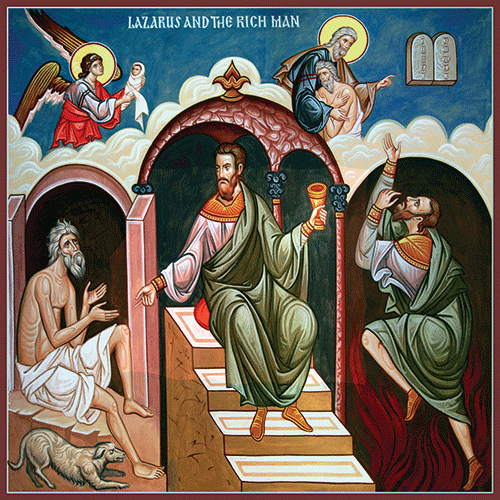
The Rich Man and Lazarus


First Sunday after Trinity

“But Abraham replied, ‘Son, remember that in your lifetime you received your good things, while Lazarus received bad things, but now he is comforted here and you are in agony.’” (Luke 16:25)

“He said to him, ‘If they do not listen to Moses and the Prophets, they will not be convinced even if someone rises from the dead.’” (Luke 16:31)

Scripture tells us that Jesus did not say anything to the people without using parables.[1] But what is a parable, and what is it’s purpose? After Jesus’ resurrection, the Apostles’ preaching would be clear and direct. Now Jesus must teach by using stories to match the level of understanding of His hearers, so as not to disrupt the plan of salvation which was reaching its end.[2] If He were to say bluntly that He was the Son of God in human flesh, the promised son of David, the people would start a revolt and try to make Him king, as they would try to do at other times during His ministry.[3] In this parable, Jesus teaches about wealth and faith in a way that compels those who hear to carefully consider what He says.

A parable is a short, fictitious story intended to teach a spiritual truth.[4] When teaching through parables, Jesus uses pictures with which his hearers are familiar to explain these truths. He doesn’t do this to hold back truth from them, but rather to press them to search for truth in the scriptures, which He says testify about Him.[5] No one, not even the Apostles, can understand divine revelation unless it is given them to understand by God. This is because we are all conceived and born in sin,[6] and by the nature we inherited from Adam, children of God’s wrath.[7] In spiritual things particularly, our sinful minds are hostile to God; they cannot and will not submit to God’s law.[8] We are spiritually blind and dead. Jesus sends the Holy Spirit to us through His word to open our ears and our eyes; He makes we, who were dead in our sins, alive in Him. Jesus connects us to His death, and to His resurrection in our baptism.[9] In our baptism He also clothes us in His righteousness.[10] He gives to us the gifts of the forgiveness of sins, eternal life, and salvation that He won by His death on the cross.[11]

The first truth of this parable is that God intends for us to use our earthly wealth wisely, and not to make money our god. All through His ministry, Jesus seems to paint a hopeless picture for rich people. He isn’t saying that it is impossible for the rich to get into heaven. In fact, Jesus tells the disciples that, without the working of God, it is impossible for anyone, rich or poor, to enter the kingdom of heaven![12] He wants us all to know, rich and poor alike, that the wealth which gives us earthly comfort and security cannot buy us eternal comfort and security. Jesus wants us to use our wealth to help our neighbors, thus storing up for ourselves treasures in heaven, where moth and rust do not destroy.[13] The rich man in the parable has made an idol of his wealth. He trusted in it to save him, and he was sorely disappointed.

The second truth Jesus teaches through this parable is that God’s word creates faith and saves. The rich man wants Abraham to send Lazarus back from the dead to warn his brothers to change their ways, so they don’t end up like him. Abraham says no. He says that they have God’s word: If they do not listen to Moses and the Prophets, they will not be convinced even if someone rises from the dead. Jesus is teaching that miracles are not enough to convince people to believe in Him. It is God’s Holy Spirit, working through God’s word, that creates repentance and faith in men. St. Paul spells this out when he writes: “I am not ashamed of the gospel, because it is the power of God for the salvation of everyone who believes,[14]” and “Faith comes from hearing the message, and the message is heard through the word of Christ.[15]” Jesus would later raise a dead man named Lazarus to life in front of His enemies, but it wouldn’t make them believe in Him. In the face of that miracle they would still refuse to believe that Jesus was the promised Savior, and plot to kill Him.[16]

Jesus wants His hearers to carefully consider what He is saying to them, and not to harden our hearts and resist the working of the Holy Spirit. In this parable He teaches that we are to use our earthly wealth wisely, as a tool to help our neighbor. Our money cannot save us from hell and separation from God. Money will be of no use to us when we die. But, we have something far more precious than money or things. Because Jesus’ work is now complete, we can stop using parables and speak clearly, just as the Apostles did after they received the Spirit from Jesus.[17] In Christ we have forgiveness of sins, eternal life, and salvation. He purchased and won those things for us on the cross. He bought them, not with gold or silver, but with His holy, precious blood, and by His innocent suffering and death. He gives those gifts to us through faith in Him, which comes through His word. ###


Bibliography


Concordia Publishing House. 2009. The Lutheran Study Bible. Edited by Edward A Engelbrecht, Paul E Deterding, Roland Cap Ehlke, Jerald C Joersz, Mark W Love, Steven P Mueller, Scott R Murray, et al. Saint Louis, MO: Concordia Publishing House.

Prange, Victor H. 1988. The People's Bible Commentary: Luke. Milwaukee: Northwestern Publishing House.

Wicke, Harold E. 1992. People's Bible Commentary: Mark. St. Louis: Concordia Publishing House.


[1] Mark 4:34
[2] Wicke, Mark, 68.
[3] John 6:15
[4] Wicke, Mark, 61; Webster, Webster’s Collegiate Dictionary, 697.
[5] Luke 4:21; John 5:29
[6] Psalm 51:5
[7] Ephesians 2:3
[8] Romans 8:7
[9] Romans 6:3-5
[10] Galatians 3:27
[11] Acts 2:38-41; 1 Peter 3:18-21
[12] Matthew 19:16-30
[13] Matthew 6:19-21
[14] Romans 1:16
[15] Romans 10:17
[16] Englebrecht, et. al., Lutheran Study Bible, 1751
[17] Wicke, Mark, 68

Thursday, December 8, 2011

Lazarus, Come Out!


Lazarus, come out!

When he had said this, Jesus called in a loud voice, “Lazarus, come out!” The dead man came out, his hands and feet wrapped with strips of linen, and a cloth around his face. Jesus said to them, “Take off the grave clothes and let him go” (John 11:43-44).

The story of Lazarus’ death, and how Jesus raised him from the dead, is one of the most striking stories recorded in the New Testament. I'm not, however, going to dwell on whether or not it's possible or probable. I'm not going to try to prove that Jesus brought Lazarus back to life. This is one of those things that you either believe, or you don't. No one, except for the Holy Spirit, can convince someone that this - or anything else - is true. It all depends on what you think about Holy Scripture; either it is the divinely inspired, inerrant word of God, or it isn't. It is either truth, or a lie. The Lutheran Confessions to which we subscribe profess that God's word is truth - divinely inspired, and without error - and not simply a collection of myths, parables, and morality tales. With that in mind, let us examine what I believe is the absolute essential message of the story of the resurrection of Lazarus.

Every day we read about doctors and paramedics bringing people back from the brink of death. Sometimes they use sophisticated medical equipment, such as a defibrillator; sometimes they use only their hands and mouth to perform CPR. These dedicated medical professionals are not always successful. With each minute that passes after a grave medical emergency, the odds against a successful revival become greater and greater.

What is so amazing about this person Jesus is that, without any medical equipment of any kind – with only his words – Jesus brought a man back from death to life. Lazarus had been dead and in his grave for four days, and Jesus simply commanded him to come out – and he did! In one amazing instance, Jesus uses the tragedy of Lazarus’ death to bring glory to the Father in heaven, confirm and strengthen the faith of his followers, show his own power and intimate relationship with the Father, and prove that he was who he said he was – the divine Son of God, the Messiah. And, we are told, many Jews put their faith in Jesus because of what they saw.

All of those things are important parts of John 11, and we could spend an hour discussing each of them. There is, however, another aspect to this story which, while it may not be as theologically lofty as a discussion of Jesus' dependence on God the Father while in the state of humiliation, hits much closer to home for the average person:

We are Lazarus.

Or, rather, we all can put ourselves in Lazarus’ place. Because of sin, we were all as dead to God as Lazarus was when he was lying in his tomb. St. Paul tells the Ephesians this very thing:

"And you were dead in the trespasses and sins in which you once walked, following the course of this world, following the prince of the power of the air, the spirit that is now at work in the sons of disobedience — among whom we all once lived in the passions of our flesh, carrying out the desires of the body and the mind, and were by nature children of wrath, like the rest of mankind" (Ephesians 2: 1-3).

And, just as there was nothing that Lazarus could do to raise himself from the dead and leave his grave, there is nothing we can do to “reanimate” ourselves to God. St. Paul dashes all human hopes of self-righteousness by quoting the Psalms in his letter to the Romans:

“As it is Written: There is no one righteous, not even one; there is no one who understands, no one who seeks God. All have turned away, they have together become worthless; There is no one who does good not even one…For it is by grace you have been saved, through faith – and this not from yourselves, it is the gift of God – not by works, so that no one can boast,” (Romans 3:10-12; Ephesians 2:8-9).

While we can do nothing, Jesus can - and has - done everything for us. By his death and resurrection, Jesus became the perfect sacrifice for our sins. He now calls us with a loud voice, as he called Lazarus, to come out of our graves, through his word. He gives us the full forgiveness and salvation that he won for mankind through his word and the sacraments of holy baptism and the Lord’s Supper. By the power of the Holy Spirit living in us, God daily strips away the stinking grave clothes of sin that stick to us, and he keeps us steadfast in the faith. “But if Christ is in you," Paul tells the Romans, "although the body is dead because of sin, the Spirit is life because of righteousness" (Romans 8:10).

God has made us alive in Christ, and has given us forgiveness freely as a gift - the same way Jesus raised Lazarus from the dead. Lazarus didn't decide he wanted to be alive again, he didn't ask Jesus to save him, and he certainly did not assist in his resurrection. Jesus loved Lazarus, as he loves us; Jesus called Lazarus, as he calls us, from death to life.

The question is now what shall we do with our new gift of life? We have two options: 1) Live as we always have, according to our sinful nature, satisfying our every carnal desire or 2) By the power of the Holy Spirit, live according to our new spiritual nature that God has created within us. Paul gives us our answer:

“What shall we say then? Are we to continue in sin that grace may abound? By no means! How can we who died to sin still live in it? Do you not know that all of us who have been baptized into Christ Jesus were baptized into his death? We were buried therefore with him by baptism into death, in order that, just as Christ was raised from the dead by the glory of the Father, we too might walk in newness of life. For if we have been united with him in a death like his, we shall certainly be united with him in a resurrection like his. We know that our old self was crucified with him in order that the body of sin might be brought to nothing, so that we would no longer be enslaved to sin. For one who has died has been set free from sin. Now if we have died with Christ, we believe that we will also live with him. We know that Christ, being raised from the dead, will never die again; death no longer has dominion over him. For the death he died he died to sin, once for all, but the life he lives he lives to God. So you also must consider yourselves dead to sin and alive to God in Christ Jesus. Let not sin therefore reign in your mortal body, to make you obey its passions. Do not present your members to sin as instruments for unrighteousness, but present yourselves to God as those who have been brought from death to life, and your members to God as instruments for righteousness. For sin will have no dominion over you, since you are not under law but under grace" (Romans 6: 1-14).

When we live according to the Holy Spirit and by His power, using God's Law as our guide to that which is God-pleasing, we glorify God. When people see the new creation we have become, they cannot help but be evangelized by God himself, seeing Christ in us. God’s evangelism is much more effective than anything we could ever “do” for ourselves.