Showing posts with label Means of Grace. Show all posts

Monday, May 4, 2020

Many Disciples Turn Away


Monday after Jubilate

“It is the Spirit who gives life; the flesh profits nothing. The words that I speak to you are spirit, and they are life” (John 6:63).

Sacramentarians[1] have the same problem here that the disciples who left Jesus had: Jesus’ teaching that His flesh is food indeed, and His blood is drink indeed is for them a hard saying and they cannot understand it. Some teachers of that sect try to use the words of this verse to spiritualize and symbolize all that Jesus had previously said about Him being the Bread of Life come down from heaven, and whoever eats His flesh and drinks His blood has eternal life. The following quotation, taken from Bibleref.com, is typical of the Sacramantarian teaching on this passage:

The idea of His flesh being the bread of life was meant to extend the analogy of bread, in order to include His upcoming sacrificial death on the cross. Here, Jesus makes a direct statement that His prior words were not meant to be taken literally. In other words, Christ is not actually saying that people need to consume His material flesh or drink His liquid blood. Rather, the point Jesus is making is spiritual…faith in Christ is not the same as intellectual knowledge. Saving faith means receiving Christ in the deepest parts of ourselves.[2]

Faith is indeed different from intellectual knowledge. It is the gift of God;[3] it is the substance, the foundation, of things hoped for and the evidence of things not seen.[4] Why, then, do we treat it as intellectual knowledge by rationalizing Jesus’ words, and changing their context? Jesus is not speaking in figuratively in the Bread of Life passage. In fact, when John is writing something figurative or symbolic he, like the other New Testament authors, makes it clear in the text. Jesus often teaches in parables, which are figures of speech. When He does so, it is obvious; He says things like, “What is the kingdom of God like? And to what shall I compare it?” Or, “A certain man had a fig tree…” And the Gospel writers clearly indicate that Jesus is speaking figuratively by writing something like, “He spoke this parable to them, saying…” When Jesus cleanses the temple and the Pharisees demand a sign from Him to show the authority by which He did what He did, Jesus answers, “Destroy this temple, and in three days I will raise it up.” They misunderstand, and think Jesus is talking about the actual building, but John makes sure it is clear to the reader, “But He was speaking of the temple of His body. Therefore, when He had risen from the dead, His disciples remembered that He had said this to them; and they believed the Scripture and the word which Jesus had said.”[5] It was symbolic language, a figure of speech. There are no such indications in the Bread of Life passage that Jesus is using the eating and drinking of His flesh and blood figuratively.

On the contrary, Jesus gets more and more specific and clear as He teaches precisely what it means that He is the Bread of Life. He uses the Greek word for true, living flesh, [6] and the blood that goes through that flesh,[7] when He teaches. His reference to the Holy Spirit being life in verse 63 hardly negates as figurative His statement, “He who eats my flesh and drinks my blood abides in Me and I in him.”

Jesus’ words here mean precisely what they say. It is the Spirit who gives life: It is the Holy Sprit who creates life and faith in men, turning their hearts of stone into hearts of flesh, as we know, through the word. And it should be no surprise that Jesus delivers the word of His promises to us by different means. There are many examples of Him using something intermediate as an instrument to deliver His faith-creating word. He attaches His words to water in Holy Baptism where He promises to give us a new birth, save us from sin, death, and the devil, clothe us with His righteousness, and connect us to Him, His death, and His resurrection. He attaches His words to mud made out of spit to restore sight to a man born blind.[8] He attaches His words, through the prophet Elisha, to the waters of the Jordan river to heal Naaman’s leprosy.[9] Even the preacher preaching the word, and the book containing the scriptures itself, are means – instruments for delivering His word. If we say that Jesus does not use means to deliver His word to men to create faith in them, we must say that He creates faith directly in a man’s heart without means. This is directly contradicted by scripture, for we know that faith comes by hearing and hearing through the word of Christ.[10]

The flesh profits nothing: Jesus did not say His flesh profits nothing, but rather the flesh profits nothing. His use of the word flesh recorded in verse 63 is different from His use of it earlier. Here Jesus uses it as Paul does when the apostle writes about the sinful human nature, when he writes, for example, “For I know that in me (that is, in my flesh) nothing good dwells.”[11] Jesus is here talking about man’s sinful human nature. He is literally saying that the flesh profits nothing; the sinful flesh which lusts for bread rather than the things of God cannot help in spiritual matters.[12] But Jesus, the word made flesh, can and does. The words of promise that He delivers to us, through the waters of our baptism, through the word preached to us by faithful pastors, through the word read in our Bibles and meditated upon, and through the word combined with bread and wine by which Jesus gives us His real body and blood to eat and drink, bring to us also the Holy Spirit, who creates faith and gives eternal life.

It is the word that makes the sacrament of the altar, i.e. the Lord’s Supper, and sets it apart.[13] Jesus, on the night He was betrayed, took bread, and when He had given thanks, He broke it and gave it to the disciples and said, “Take, eat; this is My body, which is given for you. This do in remembrance of me.” In the same way also He took the cup after supper, and when He had given thanks, He gave it to them saying, “Drink of it all of you; this is My blood of the new testament, which is shed for you for the forgiveness of sins. This do, as often as you drink it, in remembrance of Me.”[14] It is about this that Jesus was teaching in John chapter six. And in this sacrament He gives us his real body and blood.

If a hundred thousand devils, together with all fanatics, should rush forward, crying “How can bread and wine be Christ’s body and blood?” and such, I know that all spirits and scholars together are not as wise as is the Divine Majesty in His little finger. Now here stands Christ’s Word, “Take, eat; this is My body…Drink of it, all of you; this is My blood of the new testament,” and so on. Here we stop to watch those who will call themselves His masters and make the matter different from what He has spoken. It is true, indeed, that if you take away the Word or regard the Sacrament without the words, you have nothing but mere bread and wine. But if the words remain with them, as they shall and must, then, by virtue of the words, it is truly Christ’s body and blood. What Christ’s lips say and speak, so it is. He can never lie or deceive.[15]


Bibliography

Baumler, Gary P. John. Saint Louis: Concordia Pub. House, 2005.

Engelbrecht, Edward. The Lutheran Study Bible: English Standard Version. St. Louis: Concordia Publishing House, 2016.

“Haima Meaning in Bible - New Testament Greek Lexicon - King James Version.” Bible Study Tools. Accessed May 4, 2020. https://www.biblestudytools.com/lexicons/greek/kjv/haima.html.

Lutheran Worship. St. Louis: Concordia Pub. House, 1982.

McCain, Paul Timothy., W. H. T. Dau, and F. Bente. Concordia: the Lutheran Confessions: a Readers Edition of the Book of Concord. St. Louis, MO: Concordia Pub. House, 2009.

“Sarx Meaning in Bible - New Testament Greek Lexicon - New American Standard.” Bible Study Tools. Accessed May 4, 2020. https://www.biblestudytools.com/lexicons/greek/nas/sarx.html.

Websters Collegiate Dictionary. Third Edition of the Merriam Series. The Largest Abridgment of Websters New International Dictionary of the English Language. 1700 Illustrations. Springfield: Published by G. and C. Merriam Co., 1919.

“What Does John 6:63 Mean?” BibleRef.com. Accessed May 4, 2020. https://www.bibleref.com/John/6/John-6-63.html.


[1] Sacramentarian: One who holds the sacraments to be simply symbols; a name given to Zwinglians and Calvinists. Websters Collegiate Dictionary. Third Edition of the Merriam Series. The Largest Abridgment of Websters New International Dictionary of the English Language. 1700 Illustrations (Springfield: Published by G. and C. Merriam Co., 1919))  
[2] “What Does John 6:63 Mean?,” BibleRef.com, accessed May 4, 2020, https://www.bibleref.com/John/6/John-6-63.html)
[3] Ephesians 2:8
[4] Hebrews 11:1
[5] John 2:13-22
[6] Sarx: 1. Flesh (the soft substance of the living body, which covers the bones and is permeated with blood) of both man and beasts; 2. the body; 3. a living creature (because possessed of a body of flesh) whether man or beast; 4. the flesh, denotes mere human nature, the earthly nature of man apart from divine influence, and therefore prone to sin and opposed to God. “Sarx Meaning in Bible - New Testament Greek Lexicon - New American Standard,” Bible Study Tools, accessed May 4, 2020, https://www.biblestudytools.com/lexicons/greek/nas/sarx.html)
[7] Haima: 1. Blood (of man or animals; refers to the seat of life; of those things that resemble blood, grape juice); 2. blood shed, to be shed by violence, slay, murder. “Haima Meaning in Bible - New Testament Greek Lexicon - King James Version,” Bible Study Tools, accessed May 4, 2020, https://www.biblestudytools.com/lexicons/greek/kjv/haima.html)
[8] John 9:6-7
[9] 2 Kings 5:9-10
[10] Romans 10:17
[11] Romans 7:18
[12] Edward Engelbrecht, The Lutheran Study Bible: English Standard Version (St. Louis: Concordia Publishing House, 2016))
[13] LC V, 10
[14] Lutheran Worship (St. Louis: Concordia Pub. House, 1982)): The Words of Institution.
[15] LC V, 12-14

Tuesday, June 25, 2019

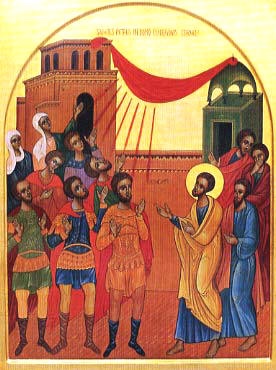
Peter Meets Cornelius

Peter meets Cornelius
Tuesday after the First Sunday after Trinity
And the following day they entered Caesarea. Now Cornelius was waiting for them, and had called together his relatives and close friends. As Peter was coming in, Cornelius met him and fell down at his feet and worshiped him. But Peter lifted him up, saying, “Stand up; I myself am also a man.” And as he talked with him, he went in and found many who had come together. Then he said to them, “You know how unlawful it is for a Jewish man to keep company with or go to one of another nation. But God has shown me that I should not call any man common or unclean. Therefore I came without objection as soon as I was sent for. I ask, then, for what reason have you sent for me?” So Cornelius said, “Four days ago I was fasting until this hour; and at the ninth hour I prayed in my house, and behold, a man stood before me in bright clothing, and said, ‘Cornelius, your prayer has been heard, and your alms are remembered in the sight of God. Send therefore to Joppa and call Simon here, whose surname is Peter. He is lodging in the house of Simon, a tanner, by the sea. When he comes, he will speak to you.’ So I sent to you immediately, and you have done well to come. Now therefore, we are all present before God, to hear all the things commanded you by God” (Acts 10:24-33).
Peter preached to the masses at Pentecost and 5,000 Christians were made. These were foreigners from many different countries, but they were all there for the feast of Pentecost; they were all Jews. Gentiles were a different story. How should they be treated? Could they jump right into the the Way, without first becoming a Jew? It shouldn’t be surprising that this issue came up. The Israelites were instructed to separate themselves from the Gentiles, or the nations, and given special laws to govern them civilly, ceremonially, and morally, to mark them as different. Paul, at one point, calls out Peter for his hypocrisy regarding interacting with Gentiles,
For before certain men came from James, he would eat with the Gentiles; but when they came, he withdrew and separated himself, fearing those who were of the circumcision.[1]
God granted a vision to both the Apostle Peter, and to Cornelius the centurion. They were, however, different visions. Peter’s was a direct prophetic revelation from God. God showed Peter a bunch of unclean animals and told him, “Kill and eat.” Upon meeting Cornelius, Peter explains that, in this vision,
“…God has shown me that I should not call any man common or unclean.”[2]
Peter is shown by God in this vision that God is the God of the gentiles as well as the Jews; In Christ there is not Jew or Gentile, slave or free, male or female for in Christ Jesus we are all one.[3]
The vision God gave to Cornelius was different. He was basically told to talk to Peter, and Peter would tell him what he needed to know. God used supernatural means to direct Cornelius to the Apostle. Why? Why not just give Cornelius the Gospel through a direct revelation? The answer is simple, if not entirely obvious: God does not wish to deal with man except through His outward Word. Jesus promised to give special revelation, and special spiritual gifts like tongue-speaking and healing, to the Apostles. He said those signs would accompany them, and act as a confirmation that the Word they proclaimed was true. He did not make such a promise to everyone. The episode of Peter and Cornelius demonstrates to us that God’s preferred method of converting men is through the means of the Word, baptizing and teaching, in no particular order.
Our Lord could have easily done to Cornelius what He did to Paul. Jesus could have appeared to Him, converted Him in a glorious and terrible flash of light, and personally taught him all the things he needed to know. He didn’t do that. That kind of communication was reserved for the Apostles, like Peter and Paul. Our Lord pointed Cornelius to Peter, a preacher of the Gospel, one of the sent-ones whose job it was to proclaim God’s Word to all people throughout the whole world.
We are not ashamed of the Gospel, for it is the power of God to salvation for all who believe, for the Jew first, then for the Gentile.[4] And we know that faith comes from the preaching, and preaching through the Word of Christ.[5]
Cornelius, living among the Jews, had heard long before about the coming Messiah, through whom he was righteous before God. In such faith, his prayers and alms were acceptable to God (since Luke calls him God-fearing). Without the Word coming first and without hearing it, he could not have believed or been righteous.[6]
After Peter preaches the Word to Cornelius and his household, a miracle happens: another Pentecost. God the Holy Spirit manifests outwardly in the speaking of tongues by those on whom He fell. Then, baptism for the whole household: “Can anyone forbid water, that these should not be baptized who have received the Holy Spirit just as we have?”[7] Baptism accompanies this preaching and teaching because, the baptizing and teaching must never be separated. They go together. They are both forms of the outward Word.
Whether it be through the proclamation of the Word in preaching, or the outward Word and promise of God of the forgiveness of sins and everlasting life in Christ’s death and resurrection joined to water, or bread and wine,
we must firmly hold that God grants His Spirit or grace to no one except through or with the preceding outward Word (Galatians 3:2, 5).[8]
The Word proclaimed by our faithful pastors from the pulpit is this same efficacious, outward Word that Peter proclaimed to Cornelius and his household. The baptism we have received, the promise that by the death and resurrection of Christ our sins have been washed away, and we have put on Christ, received the Holy Spirit, and eternal life, is the same as theirs also. Just as it did then, the outward Word creates faith in the hearts of men by the working of the Holy Spirit.
Do not despise preaching and God’s Word, but hold it sacred, and gladly hear and learn it. It is the means through which God works repentance and faith; it is the means through which He works to break our hearts and bring us to repentance for our sins, and draws us to Him through Christ, who died as the ransom for the sin of the world, and rose again. Hear the Word, repent, and believe the Gospel. Christ has redeemed you, a lost and condemned person, not with gold or silver, but with His holy, precious blood, and by His innocent suffering and death. He applies this redemption to us through the outward Word: His means of Word and Sacrament.

Bibliography

McCain, Paul T, Robert C Baker, Gene E Veith, and Edward A Engelbrecht. Concordia, The Lutheran Confessions: A Reader's Edition of the Book of Concord. 1st. Saint Louis: Concordia Publishing House, 2005.


[1] Galatians 2:11
[2] Acts 10:28
[3] Galatians 3:28
[4] Romans 1:16
[5] McCain, Paul T, Robert C Baker, Gene E Veith, and Edward A Engelbrecht, Concordia, The Lutheran Confessions: A Reader's Edition of the Book of Concord. 1st. Saint Louis: Concordia Publishing House, 2005. Romans 10:17, quoted from FC SD II, 51
[6] McCain, et. al. Concordia, The Lutheran Confessions, SA III, VIII, 8
[7] Acts 10:47
[8] McCain, et. al., Concordia, The Lutheran Confessions, SA III VIII 3

Thursday, June 13, 2019

The Way, the Truth, and the Life


Thursday after Pentecost
“Let not your heart be troubled; you believe in God, believe also in Me. In My Father’s house are many mansions; if it were not so, I would have told you. I go to prepare a place for you. And if I go and prepare a place for you, I will come again and receive you to Myself; that where I am, there you may be also. And where I go you know, and the way you know.” Thomas said to Him, “Lord, we do not know where You are going, and how can we know the way?” Jesus said to him, “I am the way, the truth, and the life. No one comes to the Father except through Me. If you had known Me, you would have known My Father also; and from now on you know Him and have seen Him” (John 14:1-7).
Earlier, Thomas declared that he would die with Jesus.[1] Now, even after all the time Jesus and the disciples have spent together, he cannot see who Jesus is, and what His work on earth was. His problem seemed to be the same as the rest of the disciples; they could not rationally understand how Jesus could be the savior they thought He was, and also die a humiliating death: How could Jesus be the Messiah if He was murdered before He could set up His kingdom?
The dark spot in the mind of Thomas was his inability to follow the mission and work of Jesus beyond the boundary of death. For him the mission of Jesus was an earthly kingdom (Acts 1:6) – how, then, could Jesus retire to heaven; and how could there be a way to this kingdom that would lead via heaven? So Thomas grows downhearted like one who is lost in the dark.[2]
The disciples, like the rest of the Jews of Jesus’ day, were expecting a political Messiah.[3],[4] They expected the Messiah instantly to sweep away the old order of things; He would remove the boot of Roman rule from the neck of the Israelites; He would restore the house of David to a physical throne, and the kingdom of Israel would be a mighty nation once more. The disciples did not yet realize that Jesus’ kingdom was not of this world.[5]
Phillip asks Jesus to show them the Father. Jesus must have been quite frustrated by His disciples’ lack of understanding. He spent all this time with them, showing them works from the Father.[6] He explained to them that He was the incarnate Word,[7] the exact representation of the Father,[8] and they still didn’t get it. They still didn’t know Jesus. It wouldn’t be until after His resurrection that they would see Jesus through the eyes of faith.
We have the same problem. Jesus said to Thomas, “I am the way, the truth, and the life. No one comes to the Father except through Me.” How can we know Jesus? How could His words here apply to us today? The disciples could meet, see, touch, and talk to Jesus. They heard His teaching and saw His mighty works. How is this possible, though, for us living today? Are we not merely relegated to knowing only about Jesus? If Jesus of Nazareth was merely a man, His death on the cross would be the end of the story. Not only would it be pointless to try to “know” Jesus, it would be impossible. To us He would be nothing more than an historical figure, about which we could only memorize factual information. While Jesus did die on the cross on Good Friday, He did not stay in the grave; Jesus, God in human flesh, rose from the dead on the third day and, because He lives, we who believe in Him will also live.
Because of Adam and Eve’s disobedience in the Garden of Eden, sin entered God’s perfect creation; creation was cursed and our human nature was changed. Jesus voluntarily humbled Himself by becoming a man, to save mankind. He was born of the Virgin Mary and was without the stain of sin. He identified Himself with sinful man as He was baptized by John in the Jordan River; He assumed responsibility for our sin; He endured temptation, just as all men must, but He lived a perfect life; He kept all of God’s law, and died as the ransom for our sin.[9] God made Jesus, who knew no sin, to be sin for us, that we might become the righteousness of God in Him.[10] The author of Hebrews writes this:
Since the children have flesh and blood, He too shared in their humanity so that by His death He might destroy him who holds the power of death – that is the devil – and free those who all their lives were held in slavery by their fear of death…For this reason He had to be made like His brothers in every way, in order that He might become a merciful and faithful high priest in service to God, and that He might make atonement for the sins of the people.[11]
Christ, our living Savior restored the relationship between God and man. Jesus gives His gifts of life and salvation to us today through His Word proclaimed, read, and coupled with water, bread and wine, all by the working of the Holy Spirit. He calls out to us through the Holy Scriptures that we might know Him, and have eternal life: Come to me all who labor and are heavy laden and I will give you rest.[12] He gives us His Spirit,[13] connects us to Himself, His death, and resurrection,[14] and washes away our sins through Baptism,[15] by washing us with water through His Word.[16] He comes to us, to strengthen and preserve us in this faith, through the Lord’s Supper. In this sacrament, He gives us His very body and blood to eat and drink for the forgiveness of our sins, and as a sign of unity as members of His Body, the Church. We can know Jesus because He is alive, and through Jesus, we know God the Father.


Bibliography

Englebrecht, Edward A, ed. The Lutheran Study Bible - English Standard Version. Saint Louis: Concordia Publishing House, 2005.

Lenski, R. C. H. The Interpretation of St. John's Gospel. Columbus: The Wartburg Press, 1959.


[1] John 11:16
[2] Lenski, R. C. H. The Interpretation of St. John's Gospel. Columbus: The Wartburg Press, 1959.
[3] Mark 10: 35-45; Acts 1:6
[4] Engelbrecht, Edward A, ed. The Lutheran Study Bible. Saint Louis: Concordia Publishing House, 2005.
[5] John 18:33-38
[6] John 14:10-11
[7] John 8:48-59; 10: 22-39
[8] Hebrews 1:3
[9] Mark 10:45
[10] 2 Corinthians 5:21
[11] Hebrews 2:14-15; 17
[12] Matthew 11:28
[13] John 3:5; Titus 3:5;
[14] Romans 6:3-5; Galatians 3:27
[15] Acts 22:16; 1 Peter 3:18-22
[16] Ephesians 5:25-27

Thursday, May 30, 2019

Christ Ascends to God's Right Hand

Ascension icon.
Ascension

Later He appeared to the eleven as they sat at the table; and He rebuked their unbelief and hardness of heart, because they did not believe those who had seen Him after He had risen. And He said to them, “Go into all the world and preach the gospel to every creature. He who believes and is baptized will be saved; but he who does not believe will be condemned. And these signs will follow those who believe: In My name they will cast out demons; they will speak with new tongues; they will take up serpents; and if they drink anything deadly, it will by no means hurt them; they will lay hands on the sick, and they will recover.” So then, after the Lord had spoken to them, He was received up into heaven, and sat down at the right hand of God. And they went out and preached everywhere, the Lord working with them and confirming the word through the accompanying signs. Amen (Mark 16:14-20).

Jesus appears to the eleven and rebukes them. This makes sense; they certainly deserve a scolding. Jesus had chosen specific people to be the first witnesses of His resurrection: Mary Magdalene and the other Mary. He appeared to them and told them to bring the news of His defeat of death and the grave to His disciples. But, when Mary Magdalene went and told them, as they mourned and wept, the disciples did not believe. Jesus also appeared to two of them on the road to Emmaus;[1] they went and told the rest of the disciples, but they did not believe them either. Isn’t it a little ironic that the disciples, who would soon be the Apostles (the sent ones), did not believe the ones sent to them?

How could the disciples expect others to believe them, when they in turn would be sent out to proclaim the risen Lord, if the disciples themselves persisted in unbelief? Besides, Jesus had even prophesied his resurrection while he was still with them.[2]
Then Jesus speaks what we have come to call The Great Commission to His disciples, though Mark records it differently from Matthew:

Go into all the world and preach the gospel to every creature. He who believes and is baptized will be saved; but he who does not believe will be condemned.[3]
What Mark writes here is often interpreted, particularly by certain factions of American Protestantism, as commanding that Christians only baptize those who profess faith beforehand: First, a person declares that they believe; then, and only then, they are to be baptized. This is not so. Through the sacrament of Holy Baptism God creates faith, saves, and washes away sin. This promise, Peter will later proclaim to the crowd:

“Repent, and let every one of you be baptized in the name of Jesus Christ for the remission of sins; and you shall receive the gift of the Holy Spirit. For the promise is to you, and to your children, and to all who are afar off, as many as the Lord Our God will call.”[4]
Baptism is connected to repentance, to the remission of sins, and to the giving of the Holy Spirit; it connects us to Christ’s death and resurrection;[5] in baptism we are clothed with Christ.[6] The order of the actions is not as important as the one who is doing the actions; and the person doing all the actions in conversion is God.

What I mean is this: It is the means of the Word that creates faith, by the working of the Holy Spirit.[7] Baptism, which God calls a washing of regeneration and renewing of the Holy Spirit,[8] is a way God has instituted of delivering the Word that creates faith, using a physical thing. In baptism, God bound His word to a physical thing, water; He promised when water and His Word were bound in the way He gave it, it would be for creating faith, forgiving sins, and giving the Holy Spirit - just as with His preached word. The power working in baptism is the power of the Gospel of Christ, or as Peter says, the resurrection of Jesus Christ;[9] that is the same Gospel that is the power of God to salvation for everyone who believes.[10] The preaching, teaching, and baptizing cannot be separated from one another.

Continuing His commission of His disciples-turned-Apostles, Jesus describes a list of signs that would go with them as they preached: exorcism, speaking in tongues, taking up serpents, drinking poison, and healing the sick. If these are the signs that will follow those who believe, then I am in trouble, as are most people who have called themselves Christians for the last 2,000 years. I have cast out no demons; I speak a foreign language, but only due to hard studying; it was no miracle. I have not ever taken up serpents or imbibed poison. The only healing I have ever done by my own hand was to provide medicine to members of my family when they were sick. Not only have I not performed any of these signs and wonders, but I also know no one personally who even makes such a claim. If we are to understand what Jesus says here as applying to all people at all times, as many in the Pentecostal movement do, there are far fewer Christians out there than previous assumed.

Mark, conveniently enough, explains the purpose of these signs:

And they [the Apostles] went out and preached everywhere, the Lord working with them and confirming the word through the accompanying signs. Amen.[11]
Amen indeed! These signs were promised to the Apostles, not to every individual Christian as a sign of faith. These signs were the credentials of the Apostles to verify that what they were saying was true. All of these signs

were already promised (Mark 3:15) when he [Jesus] called the Twelve and were put into practice when they went out on their first preaching journey (Mark 6:13). Examples of all of them are recorded in the book of Acts...Nowhere did Jesus say that they would continue to the end of time. What is to continue is the preaching of the gospel.[12]
And the thing that each Christian is given, that they may cling to, that will reassure them that they are connected to Christ and His righteousness, and are a child of God, is their baptism - the preaching of the Gospel through physical means - not signs and wonders, or personal, inward encounters with God.

Do not misunderstand: It isn’t that God can’t cause signs and wonders to happen. God is able to do whatever He wants to do. If He chooses to give someone the gift of healing, of speaking a language that they previously did not know, of speaking to someone directly, He can and will. The issue is that God does not want to do these things. He has made that clear to us in His Word. Those things are the incredibly rare exception, not the rule. The author of Hebrews writes,

"God, who at various times and in various ways spoke in time past to the fathers by the prophets, has in these last days spoken to us by His Son, whom He has appointed heir of all things, through whom also He made the worlds;"[13]
And what does Jesus, through whom God the Father has spoken to us in these last days, say? Rather than looking to perform signs and wonders, He tells His Christians that the people who will perform signs and wonders are the false prophets:

“And unless those days were shortened, no flesh would be saved; but for the elect’s sake those days will be shortened. Then if anyone says to you, ‘Look, here is the Christ!’ of ‘There!’ do not believe it. For false christs and false prophets will rise and show great signs and wonders to deceive, if possible even the elect. See, I have told you beforehand.”[14]
Since Christ ascended to the right hand of God the Father, we have no more need of signs, wonders, and direct revelation. He does not wish to deal with us in any other way than through His external Word.[15] It is in that Word, proclaimed by the Apostles, attested by God through their signs and wonders, that He creates faith, forgives sins, teaches good doctrine, and brings us to everlasting life in Christ Jesus. We should praise God that He has given us such a wondrously simple, and gracious, way to reach all people, infant or adult, hearing or deaf, mentally sound or mentally handicapped, with His saving Word through baptism, which now saves us through the resurrection of the ascended Jesus Christ.
  

Bibliography


McCain, Paul T, Robert C Baker, Gene E Veith, and Edward A Engelbrecht,. Concordia, The Lutheran Confessions: A Reader's Edition of the Book of Concord. 1st. Saint Louis: Concordia Publishing House, 2005.

Wicke, Harold E. People's Bible Commentary: Mark. Saint Louis: Concordia Publishing House, 2004.


[1] Luke 24:13-35
[2] Wicke, People’s Bible Commentary: Mark, p.238
[3] Mark 16:15-16
[4] Acts 2:38-39
[5] Romans 6:3-5
[6] Galatians 3:27
[7] Romans 10:17
[8] Titus 3:5
[9] 1 Peter 3:18-22
[10] Romans 1:16
[11] Mark 16:20
[12] Wicke, People’s Bible Commentary: Mark, p.239
[13] Hebrews 1:1-2
[14] Matthew 24:22-25
[15] SA III VIII 10-13, McCain, et. al., Concordia, the Lutheran Confessions,p.307