Showing posts with label Holy Spirit. Show all posts

Sunday, May 31, 2020

The Outpouring of the Holy Spirit


The Day of Pentecost 

Then Peter stood up with the Eleven, raised his voice and addressed the crowd: “Fellow Jews and all of you who live in Jerusalem, let me explain this to you; listen carefully to what I say. These men are not drunk, as you suppose. It’s only nine in the morning! No, this is what was spoken by the prophet Joel: In the last days, God says, I will pour out my Spirit on all people. Your sons and daughters will prophesy, your young men will see visions, your old men will dream dreams” (Acts 2:14-17).

Pentecost is the day that Christians celebrate the outpouring of the Holy Spirit on the Apostles in Jerusalem, manifested by the descent of tongues of fire from heaven, and the speaking of the Apostles in the many languages of the peoples assembled there. By this event, and Peter’s subsequent preaching, we are taught how to understand God’s word. Pentecost also reveals to us the nature and work of God, the Holy Spirit. Most importantly, however, Pentecost shows that God’s saving grace is not confined to one ethnic group of people, but that the Gospel of Christ crucified as the sacrifice for sin and risen from the dead for man’s redemption belongs to the whole world. Moreover, the outpouring of the Holy Spirit is something that continues to happen from that day to this, and until Our Lord Jesus returns to judge the living and the dead, through His word preached, and given through water, bread and wine.

First, the opening of Peter’s Pentecost sermon teaches us how to read the Bible. Peter connects the Old Testament scriptures, specifically the words of the prophet Joel that he quotes, to the events unfolding around them. Peter then goes on to use the power and authority given him by the Holy Spirit by preaching to the people repentance and forgiveness of sins in the crucified and risen Jesus. The New Testament is basically a commentary on, or more precisely, an exposition of the Old Testament. When we read the Bible, or listen to preaching, we are to recognize that the Old Testament always points to Christ and is to be explained in the light of the New Testament, and not the other way around.[1]

Consequently, the New Testament scriptures expose in greater detail what the Old Testament scriptures reveal about the divine nature and work of God, and His Holy Spirit, by the events of Pentecost. The Holy Spirit is the third person of the triune, or “three-person” God, and not just an impersonal force, power, or energy. Jesus tells us that the Holy Spirit has His own work, that of convicting the world of sin, and leading the disciples into all truth;[2] He tells us that the Spirit proceeds from both Him and God the Father; Also, as recorded by Luke in the book of Acts, the Holy Spirit is called God, and speaks to and directs the Apostles Himself.[3] The Holy Spirit operates in perfect harmony with God the Father, and God the Son, to work the forgiveness of sins, life, and salvation in man through the word of God. An inanimate object, or an impersonal being, cannot speak and do things as Jesus tells us the Holy Spirit speaks and does; The outpouring of the Spirit on the Apostles at Pentecost, and their preaching to the people shows us that the Holy Spirit is God, and demonstrates His unity with the other divine members of the God-head.

Finally, this outpouring of the divine Holy Spirit is not confined to just the Apostles at Pentecost, but it is continual. The supernatural speaking in tongues by the Apostles is the sign that accompanies the power they received by the Holy Spirit, not the main gift, and not something Christians should expect will always accompany the Spirit’s working. The purpose of this miracle was to show that foreigners, i.e. non-Jews, could hear God’s word, and the Holy Spirit could use that word as His tool to create faith in them.[4] The coming of the Spirit is not a one-time occurrence but something that happens continually when God’s word is preached and His Sacraments, namely Holy Baptism, through which God gives the gift of the Holy Spirit,[5] as Peter preaches, are properly administered. The miracle of Pentecost shows all people that God does not want anyone to perish, but instead wants everyone to come to repentance.[6]

Pentecost is not just some crazy miracle story invented to spice up the narrative of Christianity, or to give legitimacy to the Apostles by endowing them with supernatural tongue-speaking powers. Even though videos of people rolling around on the floor “in the spirit” babbling nonsensical gibberish may provide endless entertainment for viewers of YouTube, Pentecost is about something far more important than the miracle of speaking in tongues God performed that day. The events of Pentecost give us an important instruction as to how we must understand God’s word. It shows us the nature and work of the Holy Spirit. Most of all, Pentecost show us that God’s forgiveness and eternal life in Jesus, won by his atoning sacrifice on the cross, is for all people, and is given as a gift by the working of the Holy Spirit. ###


[1] John 5:39
[2] John 16:7-11
[3] Acts 5:1-4; 13:1-3;
[4] Romans 10:17; 1 Corinthians 2:14; 6:11; 12:3;
[5] Acts 2:38-29
[6] 2 Peter 3:9

Tuesday, June 25, 2019

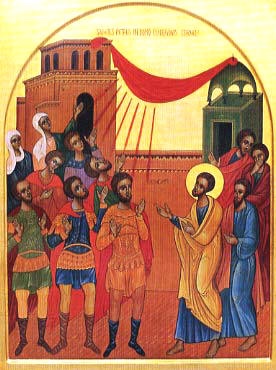
Peter Meets Cornelius

Peter meets Cornelius
Tuesday after the First Sunday after Trinity
And the following day they entered Caesarea. Now Cornelius was waiting for them, and had called together his relatives and close friends. As Peter was coming in, Cornelius met him and fell down at his feet and worshiped him. But Peter lifted him up, saying, “Stand up; I myself am also a man.” And as he talked with him, he went in and found many who had come together. Then he said to them, “You know how unlawful it is for a Jewish man to keep company with or go to one of another nation. But God has shown me that I should not call any man common or unclean. Therefore I came without objection as soon as I was sent for. I ask, then, for what reason have you sent for me?” So Cornelius said, “Four days ago I was fasting until this hour; and at the ninth hour I prayed in my house, and behold, a man stood before me in bright clothing, and said, ‘Cornelius, your prayer has been heard, and your alms are remembered in the sight of God. Send therefore to Joppa and call Simon here, whose surname is Peter. He is lodging in the house of Simon, a tanner, by the sea. When he comes, he will speak to you.’ So I sent to you immediately, and you have done well to come. Now therefore, we are all present before God, to hear all the things commanded you by God” (Acts 10:24-33).
Peter preached to the masses at Pentecost and 5,000 Christians were made. These were foreigners from many different countries, but they were all there for the feast of Pentecost; they were all Jews. Gentiles were a different story. How should they be treated? Could they jump right into the the Way, without first becoming a Jew? It shouldn’t be surprising that this issue came up. The Israelites were instructed to separate themselves from the Gentiles, or the nations, and given special laws to govern them civilly, ceremonially, and morally, to mark them as different. Paul, at one point, calls out Peter for his hypocrisy regarding interacting with Gentiles,
For before certain men came from James, he would eat with the Gentiles; but when they came, he withdrew and separated himself, fearing those who were of the circumcision.[1]
God granted a vision to both the Apostle Peter, and to Cornelius the centurion. They were, however, different visions. Peter’s was a direct prophetic revelation from God. God showed Peter a bunch of unclean animals and told him, “Kill and eat.” Upon meeting Cornelius, Peter explains that, in this vision,
“…God has shown me that I should not call any man common or unclean.”[2]
Peter is shown by God in this vision that God is the God of the gentiles as well as the Jews; In Christ there is not Jew or Gentile, slave or free, male or female for in Christ Jesus we are all one.[3]
The vision God gave to Cornelius was different. He was basically told to talk to Peter, and Peter would tell him what he needed to know. God used supernatural means to direct Cornelius to the Apostle. Why? Why not just give Cornelius the Gospel through a direct revelation? The answer is simple, if not entirely obvious: God does not wish to deal with man except through His outward Word. Jesus promised to give special revelation, and special spiritual gifts like tongue-speaking and healing, to the Apostles. He said those signs would accompany them, and act as a confirmation that the Word they proclaimed was true. He did not make such a promise to everyone. The episode of Peter and Cornelius demonstrates to us that God’s preferred method of converting men is through the means of the Word, baptizing and teaching, in no particular order.
Our Lord could have easily done to Cornelius what He did to Paul. Jesus could have appeared to Him, converted Him in a glorious and terrible flash of light, and personally taught him all the things he needed to know. He didn’t do that. That kind of communication was reserved for the Apostles, like Peter and Paul. Our Lord pointed Cornelius to Peter, a preacher of the Gospel, one of the sent-ones whose job it was to proclaim God’s Word to all people throughout the whole world.
We are not ashamed of the Gospel, for it is the power of God to salvation for all who believe, for the Jew first, then for the Gentile.[4] And we know that faith comes from the preaching, and preaching through the Word of Christ.[5]
Cornelius, living among the Jews, had heard long before about the coming Messiah, through whom he was righteous before God. In such faith, his prayers and alms were acceptable to God (since Luke calls him God-fearing). Without the Word coming first and without hearing it, he could not have believed or been righteous.[6]
After Peter preaches the Word to Cornelius and his household, a miracle happens: another Pentecost. God the Holy Spirit manifests outwardly in the speaking of tongues by those on whom He fell. Then, baptism for the whole household: “Can anyone forbid water, that these should not be baptized who have received the Holy Spirit just as we have?”[7] Baptism accompanies this preaching and teaching because, the baptizing and teaching must never be separated. They go together. They are both forms of the outward Word.
Whether it be through the proclamation of the Word in preaching, or the outward Word and promise of God of the forgiveness of sins and everlasting life in Christ’s death and resurrection joined to water, or bread and wine,
we must firmly hold that God grants His Spirit or grace to no one except through or with the preceding outward Word (Galatians 3:2, 5).[8]
The Word proclaimed by our faithful pastors from the pulpit is this same efficacious, outward Word that Peter proclaimed to Cornelius and his household. The baptism we have received, the promise that by the death and resurrection of Christ our sins have been washed away, and we have put on Christ, received the Holy Spirit, and eternal life, is the same as theirs also. Just as it did then, the outward Word creates faith in the hearts of men by the working of the Holy Spirit.
Do not despise preaching and God’s Word, but hold it sacred, and gladly hear and learn it. It is the means through which God works repentance and faith; it is the means through which He works to break our hearts and bring us to repentance for our sins, and draws us to Him through Christ, who died as the ransom for the sin of the world, and rose again. Hear the Word, repent, and believe the Gospel. Christ has redeemed you, a lost and condemned person, not with gold or silver, but with His holy, precious blood, and by His innocent suffering and death. He applies this redemption to us through the outward Word: His means of Word and Sacrament.

Bibliography

McCain, Paul T, Robert C Baker, Gene E Veith, and Edward A Engelbrecht. Concordia, The Lutheran Confessions: A Reader's Edition of the Book of Concord. 1st. Saint Louis: Concordia Publishing House, 2005.


[1] Galatians 2:11
[2] Acts 10:28
[3] Galatians 3:28
[4] Romans 1:16
[5] McCain, Paul T, Robert C Baker, Gene E Veith, and Edward A Engelbrecht, Concordia, The Lutheran Confessions: A Reader's Edition of the Book of Concord. 1st. Saint Louis: Concordia Publishing House, 2005. Romans 10:17, quoted from FC SD II, 51
[6] McCain, et. al. Concordia, The Lutheran Confessions, SA III, VIII, 8
[7] Acts 10:47
[8] McCain, et. al., Concordia, The Lutheran Confessions, SA III VIII 3

Thursday, May 2, 2019

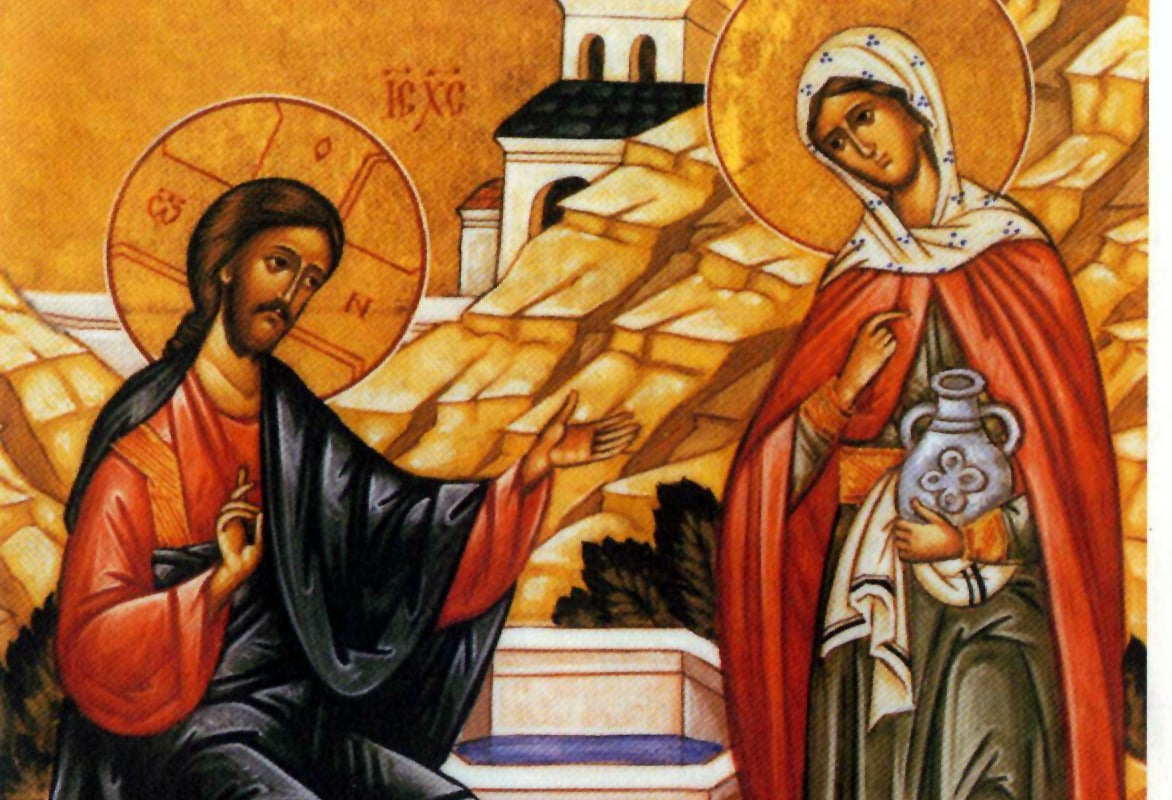
A Samaritan Woman Meets Her Messiah


The woman said to Him, “Sir, I perceive that You are a prophet. Our fathers worshiped on this mountain, and you Jews say that in Jerusalem is the place where one ought to worship.” Jesus said to her, “Woman, believe Me, the hour is coming when you will neither on this mountain, nor in Jerusalem, worship the Father. You worship what you do not know; we know what we worship, for salvation is of the Jews. But the hour is coming, and now is, when the true worshipers will worship the Father in spirit and truth; for the Father is seeking such to worship Him. God is Spirit, and those who worship Him must worship in spirit and truth.” The woman said to Him, “I know that Messiah is coming” (who is called Christ). “When He comes, He will tell us all things.” Jesus said to her, “I who speak to you am He” (John 4:19-26).

It is commonly held that the Samaritans were descendants of the Jews who remained in Palestine after the Assyrians defeated Israel. The Samaritans inhabited the area between Judea and Galilee. They came from mixed marriages between Jews and Assyrian settlers who entered the Promised Land.[1], [2] For this reason the Jews of the day despised the Samaritans. They also regarded the Samaritan’s observance of Judaism as corrupted. It goes without saying that contact with the Samaritans was to be avoided. Due to the long history of animosity between the Jews and the Samaritans, it would be surprising that a Jew would even speak to a Samaritan; what is even more surprising is that the Samaritan with whom Jesus speaks, and asks for a drink, is a woman. Jesus, however, used the opportunity of the water, and the well, to preach the gospel.

Living water, quite simply, is the Holy Spirit. Jesus explains this to the Jews: On the last day, that great day of the feast, Jesus stood and cried out, saying, “If anyone thirsts, let him come to Me and drink. He who believes in Me, as the Scripture has said, out of his heart will flow rivers of living water.” But this He spoke concerning the Spirit, whom those believing in Him would receive; for the Holy Spirit was not yet given, because Jesus was not yet glorified.[3] While no specific scripture verse is cited by either Jesus or St. Luke, Jesus' words call to mind the words of the prophet Isaiah: The Lord will guide you continually, and satisfy your soul in drought, and strengthen your bones; You shall be like a watered garden, and like a spring of water, whose waters do not fail.[4] These waters give life and strength. That Jesus is speaking of the power of the Holy Spirit becomes evident on the day of Pentecost.[5] Jesus connects the application of water, better known as baptism, with the giving of the Holy Spirit. It is through baptism that the Spirit is given because baptism is God’s word connected to water. It is the washing of rebirth and renewal by the Holy Spirit,[6] water that is included in God’s command and combined with God’s word of promise; it washes away our sins, clothes us with Christ, connects us to His death and resurrection, and saves us.[7] It is only natural that Jesus should have this conversation about living water with this woman by the well, since He and His disciples were so recently baptizing people in Judea.[8]

Jesus, who proclaims to the Samaritan woman that He is the promised Messiah, says that it is now the hour when true worshipers will worship the Father in spirit and truth. Jesus is saying that true worship is that which is done in His name and through Him; it no longer depends on a specific location, like the temple in Jerusalem. Temples don't matter, mountains don't matter; faith in Messiah is what matters. The Lord is near to all who call on Him in truth,[9] that is, trusting in God's promise of redemption through Christ. Jesus is that promise in the flesh. How do we get that faith? Is faith in Christ something we decide to have? Do we produce it in ourselves? Jesus says that the Father is seeking true worshippers to worship Him. In other words, He comes to us, we do not come to Him. He binds that work of the Spirit, of creating faith in the hearts of men, to His Word,[10] whether preached, read, meditated upon, eaten and drunk in the Lord’s Supper, or applied to the body in the waters of Holy Baptism. He comes to us and works faith in us by the power of the Holy Spirit, through God’s means of Word and Sacrament, just as He came to the woman of Samaria.


[1] J. I Packer, and M.C. Tenney, Illustrated Manners and Customs of the Bible  (Nashville, TN: Thomas Nelson Publishers, 1980) p. 509
[2] 2 Kings 17:24-28, 33-34
[3] John 7:37-39
[4] Isaiah 58:11
[5] John 16:7; Acts 1:4-8
[6] Titus 3:5
[7] Matthew 28:19-20; Mark 16:16; Acts 2:38-39; 22:16; Romans 6:3-5; 1 Corinthians 6:11; Galatians 3:27; Colossians 1:13-14; 1 Peter 3:18-22;
[8] John 3:22
[9] Psalm 145:18
[10] John 15:26; 16:13; Romans 10:17