|
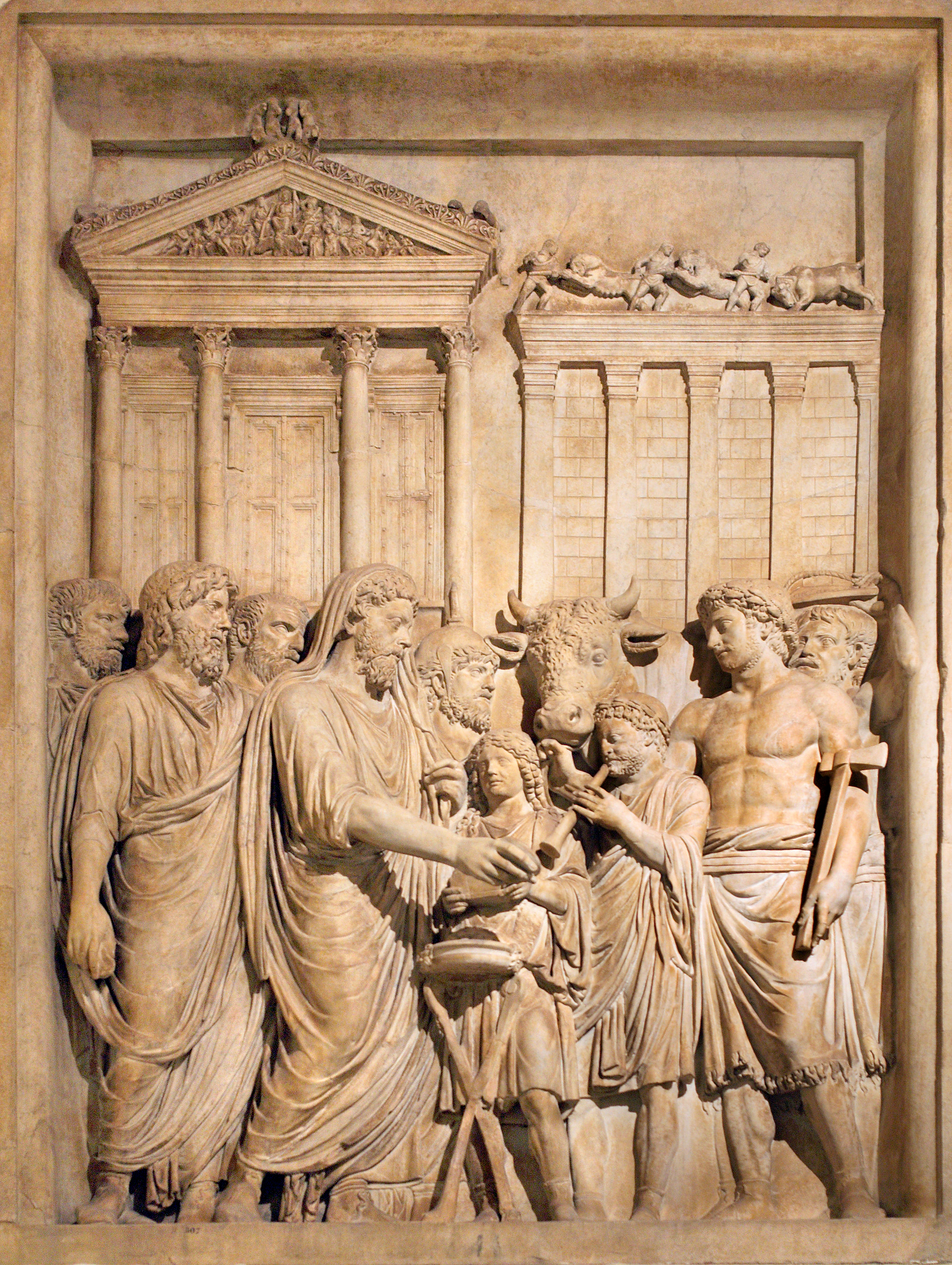
Emperor Marcus Aurelius sacraficing at the
Temple of Jupiter in Rome |
As for
the one who is weak in faith, welcome him, but not to quarrel over opinions.
One person believes he may eat anything, while the weak person eats only
vegetables. Let not the one who eats despise the one who abstains, and let not
the one who abstains pass judgment on the one who eats, for God has welcomed
him. Who are you to pass judgment on the servant of another? It is before his
own master that he stands or falls. And he will be upheld, for the
Lord is able to make him stand (Romans 14:1-4).
The words of Paul to the Romans,
and elsewhere to the Corinthians, addressing their concerns over “meat
sacrificed to idols” may seem, to modern ears, archaic. In our modern western
society we do not have to deal with issues such as the public funding and
worship of gods as did the early Christian subjects of the Roman Empire. The
Corinthians, though, were facing a difficult spiritual situation. As Christians,
they were in the minority in a culture which revolved around the pagan temple.
Lenski, in his commentary, briefly explains the dilemma:
The pagan temple rituals, many state
occasions, festivals of various kinds of societies, the lives of families and
of individuals, all involved sacrifices to the gods and the participation of
larger or smaller circles in the feasts connected with these rituals. The
desire to participate in such feasts as well as the obligations of family
connections or of friendship raised the question as to how far a Christian
might go in this regard (Lenski, 1957).
In the worship of the pagan
gods a part of the animal would be burned on the pagan altar. The rest of the
animal would be prepared for the feast that followed (Lenski, 1957). Any of the
sacrifice that was not either burned on the altar or eaten at the subsequent
feast would have been taken home and eaten there. Lenski explains that some of
the leftover meat sacrificed to the pagan gods would necessarily end up in the
market butcher shops, and would be sold along with the ordinary meat.
The Corinthians had, evidently,
debated how they should handle the situation in which they found themselves.
Was it permissible to eat meat that had been sacrificed to a pagan god? Could a
person eat in an idol’s temple or in the home of a pagan friend? Questions such
as these were almost certainly asked of Paul by the Corinthians, and he devotes
a significant portion of his epistle to their response.
Therefore, as to the eating of food offered
to idols, we know that “an idol has no real existence,” and that “there is no
God but one.” For although there may be so-called gods in heaven or on earth—as
indeed there are many “gods” and many “lords”— yet for us there is one God, the
Father, from whom are all things and for whom we exist, and one Lord, Jesus
Christ, through whom are all things and through whom we exist (1 Corinthians
8:4-6).
So, the short answer from Paul
is yes, you can eat meat sacrificed to idols. Paul briefly explains why. He
reminds us that an idol is nothing – it is merely a carving made by man. He
points out that all foods have been declared to be clean by our Lord. He gives
thanks to God for what he receives. He declares, nevertheless, that he would
rather never eat meat again, if his eating of meat causes one of his fellow
brothers to stumble and harms their faith.
It doesn't matter what is permissible for Paul. It matters what builds up the
body of Christ - the Church - because, as Paul explains, his entire existence
is concerned with winning souls for Christ by proclaiming the Gospel.
Food will not commend us to God. We are no
worse off if we do not eat, and no better off if we do. But take care that this
right of yours does not somehow become a stumbling block to the weak. For if
anyone sees you who have knowledge eating in an idol's temple, will he not be
encouraged, if his conscience is weak, to eat food offered to idols? And so by
your knowledge this weak person is destroyed, the brother for whom Christ died.
Thus, sinning against your
brothers and wounding their conscience when it is weak, you sin against Christ.
Therefore, if food makes my brother stumble, I will never eat meat, lest I make
my brother stumble (1 Corinthians 8:8-13).
The things you do, like eating
meat sacrificed to idols, may not be bad. Indeed, Paul says this elsewhere. All
foods have been declared clean.
If you don't have an issue of conscience eating such things, you are free to
eat them. If, however, one of your Christian brothers sees you in the corner
idol-meat butcher shop and he, not having as mature an understanding of these
ideas as you, is offended by your actions, or encouraged to participate in
contradiction to his conscience, Paul tells the Corinthians that they should
abstain. The reason: Christ died for that brother of yours who is offended,
however unjustified that offense may be.
For Paul at once explains in regard to what
point the knowledge of some is insufficient: “due to the custom hitherto”, when
they [the “weak” Christians] were still Gentiles and attended idol feasts. They
cannot, now that they are Christians, rid themselves of the old feeling
regarding the idol that is honored by such a feast…The old custom or habit of
thinking regarding the idol still has its effect, not, indeed, as though they
still think that the idol is a real being, but that they eat “as an idol
offering”…They still feel that eating such meat in some way connects a person
with the idol, unreal though that idol is to whom that meat has been
sacrificed. That is their weak point (Lenski, 1957).
If your actions have the
potential to harm his faith and cause him to fall away (put a "stumbling
block" in front of him, as Paul says), you should not do the thing that
causes offense, even if you may have the Christian liberty to do so. Lenski
comments:
Not our knowledge but our love for the weak
must govern our action a [stumbling block] is something that lies in a path,
against which an unwary foot may strike and cause a person to stumble or to
fall; metaphorically, anything that may cause a person to sin and to suffer
injury to his soul, (Lenski, 1957).
If these relatively
insignificant issues of personal conduct get in the way of Paul's Christian
witness and example because Paul is stubborn about exercising his Christian
liberty, he explains, his Gospel witness is ineffective to outsiders, and the
faith of those less spiritually mature brothers could be jeopardized. Paul
writes in his epistle to the Romans:
Do not, for the sake of food, destroy the
work of God. Everything is indeed clean, but it is wrong for anyone to make
another stumble by what he eats.
It is good not to eat meat or drink wine or do anything that
causes your brother to stumble,” (Romans 14:20-21).
How do these questions, and
Paul’s response to them, apply to those of us who comprise the church today?
The last time I looked, there were no enormous marble statues of Jupiter in the
town square. There don’t seem to be many pagan temples conducting animal
sacrifices in my neighborhood, and I couldn’t tell you the last time I was
invited to eat meat at a pagan feast. So, can we just let this one go, and
chalk this section of the Scripture up as the vestigial remnant of an ancient
culture, with no application for us today? Hardly. What applies to Paul, the
Corinthians, and the Romans also applies to us. We might not be dealing with
the whole" meat sacrificed to idols" issue, but that doesn't mean
there aren't issues that come up by which we offend each other.
One that leaps to mind
immediately is consumption of alcohol. Different Christian denominations have
differing views regarding alcohol. I went to college in the south and, even
though I spent many summers of my youth visiting relatives in Mississippi,
moving to western Kentucky and actually living under the so-called “Bible Belt”
was a different experience. For one thing, no one knew what a Lutheran was.
Those who were familiar with the Lutheran church had a vague sense that we were
sort of like Roman Catholics. That meant crucifixes, strange “costumes” (vestments),
and confusing and elaborate religious rituals to them. The predominant
religious culture where I lived was that of the Southern Baptists. I don't want
to get into a comparative religions lecture here. Suffice it to say that there
are theological differences between Lutherans and Baptists, chief among them
being how we view the sacraments. There are also sociological differences, and
the one that I experienced most prominently had to do with alcohol.
The county in which the university
I attended was located was "dry". That is to say, it was illegal to
purchase, possess, or consume alcoholic beverages. Being a Lutheran of German
heritage, this was quite perplexing to me. Beer was a part of our history and
heritage. Real wine was (and is) used in the sacrament of the altar in our
churches. Now I was being confronted by fellow brothers and sisters in Christ
with the idea that drinking alcohol was sinful and evil. Alcohol was so bad
that it was outlawed because it was perceived to be damaging to the very fabric
of society. The fact that it was outlawed in the county did not, however, stop
some people from purchasing, possessing, and consuming it.
The Bible, of course, does not
say that alcohol is sinful or evil. To the contrary, one could even say that
the Bible, in at least one place, advocates the drinking of alcohol. Every
booze hound in the world is familiar with the Biblical passage where Paul tells
Timothy to drink a little wine to cure his stomach ailments. This passage is
often misused by alcoholics to try and nullify the calls of their concerned
family and friends to stop drinking. Scripture does warn, strongly and repeatedly,
against the abuse, misuse, or excessive use of alcohol.
For
you were called to freedom, brothers. Only do not use your freedom as an
opportunity for the flesh, but through love serve one another. For the whole
law is fulfilled in one word: “You shall love your neighbor as yourself,”
(Galatians 5:13-14).
So, just like eating meat
sacrificed to an idol, it is permissible to drink alcohol. If, however, my
drinking offends my brother who does not yet have this understanding and causes
a division, or encourages him to imbibe against the warnings of his conscience,
I should follow Paul’s example and abstain from drinking. These issues should
be explained to those who do not understand them, to be sure. In the meantime,
however, we should not do anything that might hinder or damage their faith. This
goes for idol meat, alcohol, or whatever has the potential to cause a division
in the church. Conversely, those who abstain should not, as Paul writes, judge
those who do not. Paul tells us not to quarrel over opinions. We shouldn’t
engage in behaviors that would cause other believers to stumble in their faith (Engelbrecht,
et al., 2009).
When those outside the church see those of us who are members of Christ’s body
“biting and devouring” each other through ugly and sinful quarreling, we cease
to be an effective witness to them.
The Christian liberty we have in Christ is not just freedom from the Law
without a purpose. To the contrary, God has given us this liberty to serve
others in love.
Works
Cited
Engelbrecht, E. A., Deterding, P. E., Ehlke, R. C.,
Joersz, J. C., Love, M. W., Mueller, S. P., et al. (Eds.). (2009). The
Lutheran Study Bible. Saint Louis, Missouri, USA: Concordia Publishing
House.
Lenski,
R. C. (1957). The Interpretation of I and II Corinthians. Columbus,
Ohio: Wartburg Press.
.jpg/280px-V%26A_-_Raphael%2C_St_Paul_Preaching_in_Athens_(1515).jpg)