Showing posts with label Roman. Show all posts

Friday, November 23, 2018

Make Your Calling and Election Sure

The Death of Capt. John H. Miller - Saving Private Ryan
Therefore, brethren, be even more diligent to make your call and election sure, for if you do these things you will never stumble; for so an entrance will be supplied to you abundantly into the everlasting kingdom of our Lord and Savior Jesus Christ (2 Peter 1:10-11).

It sure sounds like Peter is saying here that, in order to keep your salvation, you must do good works. In the verses immediately preceding 2 Peter 1:10, he gives us a list of things to do so we can make our calling and election sure: Add to your faith virtue… knowledge… self-control… perseverance… godliness… brotherly kindness… love.[1] Do these things and your election will be sure; stop doing them, and it won’t be. Doing this list of good works will earn you the pardon Christ has won for you. It’s like the end of the movie “Saving Private Ryan”, when Tom Hanks’ character, dying, having secured the salvation of the aforementioned Private Ryan, looks into his eyes and, with his dying breath says, “Earn this.”[2] This is the way the theologians of the Roman church in Luther’s day certainly thought about good works.

When Rome responded to the Augsburg Confession in a document called the Roman Confutation, they rejected the Lutheran insistence that the forgiveness of sins is not merited by doing good works.[3] One of the scripture texts they used to try to support their argument was 2 Peter 1:10. But, as Philip Melanchthon replied in the Apology to the Augsburg Confession: If the promise were to depend upon our works it would not be sure. If forgiveness of sins were to be given because of our works, when would we know that we had received it?[4] That’s sort of the whole idea upon which the system of indulgences that developed in the medieval church was built; You can’t be sure you’ve given enough money, or done enough good, to insure your salvation, so you’d better give and do just a little bit more. This idea of making your calling and election sure, that Peter writes about here, is often misunderstood this way by Roman Catholic and Protestant alike. Peter, however, is actually instructing us to cultivate the good works, which flow naturally out of us because of our faith in Christ, rather than doing those good works to turn us into, or insure that we remain, Christians.

James also gives this same type of exhortation. In chapter two of his letter, James says that faith without works is dead: But someone will say, “You have faith, and I have works.” Show me your faith without your works, and I will show you my faith by my works. You believe that there is one God? You do well. Even the demons believe – and tremble.[5] James is not teaching contrary to Christ, or Peter, or most notably Paul, who constantly writes that it is by grace you are saved, and not by works. To the contrary, James’ words here enhance those of Paul; James is explaining the same idea as Paul and Peter, but coming from the opposite direction. What that means is this: Paul begins by telling us that we are saved by God’s grace alone through faith in Christ, and not by works. After explaining that, Paul then exhorts the Christians who have been saved by grace through faith, to then do good works. He tells us to act like the Christians God has made us into. We are to cultivate the good works, which naturally come forth from our new nature, and we are to resist and deny the impulses and desires of the flesh: And those who are Christ’s have crucified the flesh with it’s passions and desires. If we live in the Spirit, let us also walk in the Spirit. Let us not become conceited, provoking one another, envying one another.[6] And later: For he who sows to the flesh will of the flesh reap corruption, but he who sows to the Spirit will of the Spirit reap everlasting life. And let us not grow weary while doing good, for in due season we shall reap if we do not lose heart. Therefore, as we have opportunity, let us do good to all, especially to those who are of the household of faith.[7] These exhortations come only after Paul expounds on how man is justified by faith, how the law brings a curse and it’s purpose is to show us our sin, and that we are all heirs to God’s promise in Christ.

Paul explains that, since we are baptized into Christ’s death and resurrection, we should not let sin reign in our mortal bodies. We should not obey sin’s lusts. We should not present our members as instruments of unrighteousness to sin.[8] This is also what the apostle John teaches when he writes: By this we know love, because He laid down His life for us. And we also ought to lay down our lives for the brethren. But whoever has this world’s goods, and sees his brother in need, and shuts up his heart from him, how does the love of God abide in him? My little children, let us not love in word or in tongue, but in deed and in truth.[9] This teaching, however, is no innovation of Peter, Paul, James, or John; it comes from Christ. This is what Christ is saying when He instructs the now forgiven woman caught in adultery to go forth and sin no more.[10] This is the meaning of the exhortation of both Christ and John the Baptist to bear fruit in keeping with repentance. We are forgiven, set free from sin, and bondservants to Christ; we should not waste our freedom, time, and energy pursuing opportunities to sin. We have been called to follow Christ.[11]

Melanchthon, responding to the Roman theologians, explains the folly of trying to make one’s calling sure by good works in the way they wrongly understood Peter’s words: Now you see, reader that our adversaries have not wasted any effort in learning logic, but have the art of concluding whatever pleases them from the Scriptures. For they conclude, “Make your calling sure by good works.” Therefore, they think that works merit the forgiveness of sins. This is a very nice way of thinking, if one would argue this way about a person who’s death sentence had been pardoned. “The judge commands that from now on you stop stealing for others. Therefore, you have earned the pardon from the punishment, because you no longer steal from others.” To argue in this way makes a cause out of no cause. Peter speaks of works following the forgiveness of sins and teaches why they should be done…Do good works in order that you may persevere in your calling, in order that you do not lose the gifts of your calling. They were given to you before, and not because of works that follow, which now are kept through faith.[12]

You can’t earn a gift. You can only be grateful for it. Christ has died as the atonement for the sins of the world; He rose from the grave as the conqueror or death. He gives us this gift through His Word because He loves us; we take hold of it by faith, created in us by the working of the Holy Spirit. He joins us to Him, to His death and resurrection, and gives us the Holy Spirit, in our baptism. He nourishes us, as sap flowing through a tree feeds all it’s branches, when we eat His body and drink His blood in the Lord’s Supper as He commanded. Because He has made us a new creature, He calls us to live according to the nature of that new creature, and not according to the impulses of the sinful flesh with which we must still contend, all the days of our lives. Our works are evidence of our faith.


[1] 2 Peter 1:5-7
[2] Saving Private Ryan. Directed by Steven Spielberg. Performed by Tom Hanks, Edward Burns, Tom Sizemore, Jeremy Davies, and Vin Diesel. USA: DreamWorks, 1998. https://youtu.be/Lv-67DFlOsM
[3] "The Confutatio Pontificia." The Roman Confutation 1530. Accessed November 25, 2018. http://bookofconcord.org/confutatio.php. In the twentieth article, which does not contain so much the confession of the princes and cities as the defense of the preachers, there is only one thing that pertains to the princes and cities - viz. concerning good works, that they do not merit the remission of sins, which, as it has been rejected and disapproved before, is also rejected and disapproved now.
[4] Ap. XX 87
[5] James 2:17-18
[6] Galatians 5:24-26
[7] Galatians 6:8-10
[8] Romans 6:12-13
[9] 1 John 3:16-18
[10] John 8:11
[11] Engelbrecht, Edward, et. al., eds. The Lutheran Study Bible: English Standard Version. Saint Louis: Concordia Pub. House, 2009.
[12] Ap. XX 89-90

Tuesday, September 25, 2012

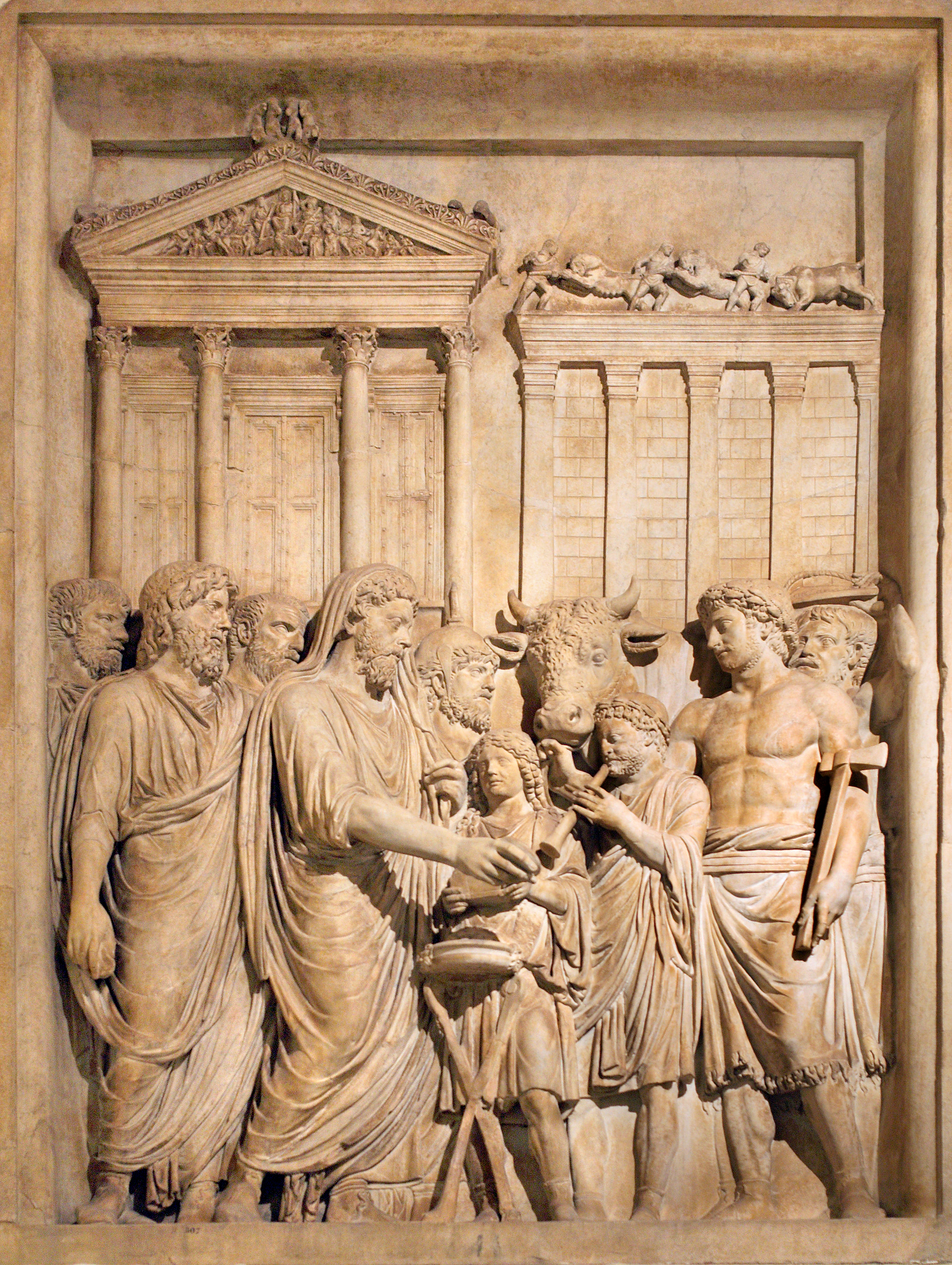
To Eat, or Not To Eat, That is the Question

Emperor Marcus Aurelius sacraficing at the
Temple of Jupiter in Rome
As for the one who is weak in faith, welcome him, but not to quarrel over opinions. One person believes he may eat anything, while the weak person eats only vegetables. Let not the one who eats despise the one who abstains, and let not the one who abstains pass judgment on the one who eats, for God has welcomed him. Who are you to pass judgment on the servant of another? It is before his own master that he stands or falls. And he will be upheld, for the Lord is able to make him stand (Romans 14:1-4).

The words of Paul to the Romans, and elsewhere to the Corinthians, addressing their concerns over “meat sacrificed to idols” may seem, to modern ears, archaic. In our modern western society we do not have to deal with issues such as the public funding and worship of gods as did the early Christian subjects of the Roman Empire. The Corinthians, though, were facing a difficult spiritual situation. As Christians, they were in the minority in a culture which revolved around the pagan temple. Lenski, in his commentary, briefly explains the dilemma:

The pagan temple rituals, many state occasions, festivals of various kinds of societies, the lives of families and of individuals, all involved sacrifices to the gods and the participation of larger or smaller circles in the feasts connected with these rituals. The desire to participate in such feasts as well as the obligations of family connections or of friendship raised the question as to how far a Christian might go in this regard (Lenski, 1957).

In the worship of the pagan gods a part of the animal would be burned on the pagan altar. The rest of the animal would be prepared for the feast that followed (Lenski, 1957). Any of the sacrifice that was not either burned on the altar or eaten at the subsequent feast would have been taken home and eaten there. Lenski explains that some of the leftover meat sacrificed to the pagan gods would necessarily end up in the market butcher shops, and would be sold along with the ordinary meat.

The Corinthians had, evidently, debated how they should handle the situation in which they found themselves. Was it permissible to eat meat that had been sacrificed to a pagan god? Could a person eat in an idol’s temple or in the home of a pagan friend? Questions such as these were almost certainly asked of Paul by the Corinthians, and he devotes a significant portion of his epistle to their response.

Therefore, as to the eating of food offered to idols, we know that “an idol has no real existence,” and that “there is no God but one.” For although there may be so-called gods in heaven or on earth—as indeed there are many “gods” and many “lords”— yet for us there is one God, the Father, from whom are all things and for whom we exist, and one Lord, Jesus Christ, through whom are all things and through whom we exist (1 Corinthians 8:4-6).

So, the short answer from Paul is yes, you can eat meat sacrificed to idols. Paul briefly explains why. He reminds us that an idol is nothing – it is merely a carving made by man. He points out that all foods have been declared to be clean by our Lord. He gives thanks to God for what he receives. He declares, nevertheless, that he would rather never eat meat again, if his eating of meat causes one of his fellow brothers to stumble and harms their faith[1]. It doesn't matter what is permissible for Paul. It matters what builds up the body of Christ - the Church - because, as Paul explains, his entire existence is concerned with winning souls for Christ by proclaiming the Gospel.

Food will not commend us to God. We are no worse off if we do not eat, and no better off if we do. But take care that this right of yours does not somehow become a stumbling block to the weak. For if anyone sees you who have knowledge eating in an idol's temple, will he not be encouraged, if his conscience is weak, to eat food offered to idols? And so by your knowledge this weak person is destroyed, the brother for whom Christ died.  Thus, sinning against your brothers and wounding their conscience when it is weak, you sin against Christ. Therefore, if food makes my brother stumble, I will never eat meat, lest I make my brother stumble (1 Corinthians 8:8-13).

The things you do, like eating meat sacrificed to idols, may not be bad. Indeed, Paul says this elsewhere. All foods have been declared clean[2]. If you don't have an issue of conscience eating such things, you are free to eat them. If, however, one of your Christian brothers sees you in the corner idol-meat butcher shop and he, not having as mature an understanding of these ideas as you, is offended by your actions, or encouraged to participate in contradiction to his conscience, Paul tells the Corinthians that they should abstain. The reason: Christ died for that brother of yours who is offended, however unjustified that offense may be.

For Paul at once explains in regard to what point the knowledge of some is insufficient: “due to the custom hitherto”, when they [the “weak” Christians] were still Gentiles and attended idol feasts. They cannot, now that they are Christians, rid themselves of the old feeling regarding the idol that is honored by such a feast…The old custom or habit of thinking regarding the idol still has its effect, not, indeed, as though they still think that the idol is a real being, but that they eat “as an idol offering”…They still feel that eating such meat in some way connects a person with the idol, unreal though that idol is to whom that meat has been sacrificed. That is their weak point (Lenski, 1957).

If your actions have the potential to harm his faith and cause him to fall away (put a "stumbling block" in front of him, as Paul says), you should not do the thing that causes offense, even if you may have the Christian liberty to do so. Lenski comments:

Not our knowledge but our love for the weak must govern our action a [stumbling block] is something that lies in a path, against which an unwary foot may strike and cause a person to stumble or to fall; metaphorically, anything that may cause a person to sin and to suffer injury to his soul, (Lenski, 1957).

If these relatively insignificant issues of personal conduct get in the way of Paul's Christian witness and example because Paul is stubborn about exercising his Christian liberty, he explains, his Gospel witness is ineffective to outsiders, and the faith of those less spiritually mature brothers could be jeopardized. Paul writes in his epistle to the Romans:

Do not, for the sake of food, destroy the work of God. Everything is indeed clean, but it is wrong for anyone to make another stumble by what he eats. It is good not to eat meat or drink wine or do anything that causes your brother to stumble,” (Romans 14:20-21).

How do these questions, and Paul’s response to them, apply to those of us who comprise the church today? The last time I looked, there were no enormous marble statues of Jupiter in the town square. There don’t seem to be many pagan temples conducting animal sacrifices in my neighborhood, and I couldn’t tell you the last time I was invited to eat meat at a pagan feast. So, can we just let this one go, and chalk this section of the Scripture up as the vestigial remnant of an ancient culture, with no application for us today? Hardly. What applies to Paul, the Corinthians, and the Romans also applies to us. We might not be dealing with the whole" meat sacrificed to idols" issue, but that doesn't mean there aren't issues that come up by which we offend each other. 

One that leaps to mind immediately is consumption of alcohol. Different Christian denominations have differing views regarding alcohol. I went to college in the south and, even though I spent many summers of my youth visiting relatives in Mississippi, moving to western Kentucky and actually living under the so-called “Bible Belt” was a different experience. For one thing, no one knew what a Lutheran was. Those who were familiar with the Lutheran church had a vague sense that we were sort of like Roman Catholics. That meant crucifixes, strange “costumes” (vestments), and confusing and elaborate religious rituals to them. The predominant religious culture where I lived was that of the Southern Baptists. I don't want to get into a comparative religions lecture here. Suffice it to say that there are theological differences between Lutherans and Baptists, chief among them being how we view the sacraments. There are also sociological differences, and the one that I experienced most prominently had to do with alcohol.

The county in which the university I attended was located was "dry". That is to say, it was illegal to purchase, possess, or consume alcoholic beverages. Being a Lutheran of German heritage, this was quite perplexing to me. Beer was a part of our history and heritage. Real wine was (and is) used in the sacrament of the altar in our churches. Now I was being confronted by fellow brothers and sisters in Christ with the idea that drinking alcohol was sinful and evil. Alcohol was so bad that it was outlawed because it was perceived to be damaging to the very fabric of society. The fact that it was outlawed in the county did not, however, stop some people from purchasing, possessing, and consuming it.

The Bible, of course, does not say that alcohol is sinful or evil. To the contrary, one could even say that the Bible, in at least one place, advocates the drinking of alcohol. Every booze hound in the world is familiar with the Biblical passage where Paul tells Timothy to drink a little wine to cure his stomach ailments. This passage is often misused by alcoholics to try and nullify the calls of their concerned family and friends to stop drinking. Scripture does warn, strongly and repeatedly, against the abuse, misuse, or excessive use of alcohol.

For you were called to freedom, brothers. Only do not use your freedom as an opportunity for the flesh, but through love serve one another. For the whole law is fulfilled in one word: “You shall love your neighbor as yourself,” (Galatians 5:13-14).

So, just like eating meat sacrificed to an idol, it is permissible to drink alcohol. If, however, my drinking offends my brother who does not yet have this understanding and causes a division, or encourages him to imbibe against the warnings of his conscience, I should follow Paul’s example and abstain from drinking. These issues should be explained to those who do not understand them, to be sure. In the meantime, however, we should not do anything that might hinder or damage their faith. This goes for idol meat, alcohol, or whatever has the potential to cause a division in the church. Conversely, those who abstain should not, as Paul writes, judge those who do not. Paul tells us not to quarrel over opinions. We shouldn’t engage in behaviors that would cause other believers to stumble in their faith (Engelbrecht, et al., 2009). When those outside the church see those of us who are members of Christ’s body “biting and devouring” each other through ugly and sinful quarreling, we cease to be an effective witness to them[3]. The Christian liberty we have in Christ is not just freedom from the Law without a purpose. To the contrary, God has given us this liberty to serve others in love.


Works Cited

Engelbrecht, E. A., Deterding, P. E., Ehlke, R. C., Joersz, J. C., Love, M. W., Mueller, S. P., et al. (Eds.). (2009). The Lutheran Study Bible. Saint Louis, Missouri, USA: Concordia Publishing House.

Lenski, R. C. (1957). The Interpretation of I and II Corinthians. Columbus, Ohio: Wartburg Press.


End Notes

[1] 1 Corinthians 8:13
[2] Romans 14:14
[3] Galatians 5:15

Thursday, June 7, 2012

Citizens of Heaven

But our citizenship is in heaven. And we eagerly await a savior from there, the Lord Jesus Christ, who, by the power that enables him to bring everything under his control, will transform our lowly bodies so that they will be like his glorious body (Philippians 3: 20-21).

What does it mean to be a citizen? This topic has been in the news and part of the American political debate for many years now. The question itself, however, is not a new one. Societies throughout history have struggled with defining what citizenship means, what rights and privileges are associated with it, to whom it is conferred, and how.

Citizenship in ancient Rome was a privileged political and legal status afforded to free-born individuals with respect to laws, property, and governance (Roman Citizenship, 2012). A male Roman citizen enjoyed a wide range of privileges and protections defined in detail by the Roman state. A citizen could, only under certain exceptional and extreme circumstances, be deprived of his citizenship.

Slaves, in contrast to citizens, were considered property and had only very limited rights. During the Roman Republic, a master could dispose of his slaves as he did any other property, and while excessive cruelty toward slaves was considered a sign of bad character, killing one's own slave was not a crime (Roman Citizenship, 2012). Most slaves were subjected to lives of extreme hardship. The life of a slave working in the fields, or as laborers in mines, could be brutish and short. A significant number of slaves, however, were highly skilled, and educated; these slaves were often treated as part of the extended family. These educated slaves were often given a degree of independence to work for themselves and could keep some of their own earnings, sometimes accumulating enough to buy their freedom. Until they did so, however, they were not Roman citizens, and enjoyed none of the rights of a citizen.

Some slaves were freed by their masters for services rendered, like indentured servants, or through a provision in their master’s will when he died. Once free, former slaves faced few barriers, beyond normal social snobbery, to participating in Roman society. The principle that a person could become a citizen by law rather than birth was important in Rome’s development as a society. These Freedmen, slaves who had gained their freedom, were granted a limited form of Roman citizenship (Roman Citizenship, 2012). Freedmen could later attain full Roman citizenship; their former status as a slave was not taken into account.

Roman citizenship was coveted by those barbarians living outside the empire, as well as those provincials who lived in territory controlled by Rome. Citizens had commercial (trade) rights, and were subject to the protections of the Roman legal system (Bible History Online). Roman citizenship was seen by these groups as the key to prosperity in a difficult world. In the most generic sense, Roman officials could legally punish noncitizens without proper legal proceedings as Roman law did not apply to noncitizens (Engelbrecht, et al., 2009). But, besides making one safe from the death penalty, a Roman citizen enjoyed, among other things, the right to vote, the right to make contracts, and the right to contract a legal marriage (Jahnige, 2002).

The Apostle Paul himself was a Roman citizen, as we read in the book of Acts. In one instance, after preaching to the crowd after his arrest at the temple, St. Paul is subdued by his Roman guards and stretched out in preparation to be “interrogated” by flogging[1]. As the soldiers are preparing to whip St. Paul he says to the centurion, “Is it lawful for you to flog a man who is a Roman citizen and uncondemned?” The centurion, knowing full well that it was not lawful to do such a thing under Roman law, becomes frightened:

So the tribune came and said to him, “Tell me, are you a Roman citizen?” And he said, “Yes.” The tribune answered, “I bought this citizenship for a large sum.” Paul said, “But I am a citizen by birth.” So those who were about to examine him withdrew from him immediately, and the tribune was also afraid, for he realized that Paul was a Roman citizen and that he had bound him (Acts 22:27-29).

Citizenship was a powerful and precious thing for a person in First Century Rome to have. In some cases citizenship could mean the difference between freedom or slavery, life or death, as it did for St. Paul in this instance.

On at least two occasions, which are recorded in Scripture, St. Paul invokes his Roman citizenship. St. Paul, in his letter to the Philippians however, emphasizes that our citizenship, as Christians, is in heaven. We are aliens in this world[2]. Christ, by the power of the Holy Spirit, has made us into a new creation – something completely different than we were before[3]. Although we live in this world and are fully involved in it, we are not “of” it. In his prayer before he is arrested and lead away to face death for our transgression, Jesus says this about his disciples:

“…but I [Jesus] say these things while I am still in the world, so that they may have the full measure of my joy within them. I have given them your word and the world has hated them, for they are not of the world any more than I am of the world” (John 17: 14-15).

The disciples, and all believers, are not “of” the world. Since we are a new creation we do not think according to the pattern of this world. This world is hostile to God.

For although they [mankind] knew God, they neither glorified him as God nor gave thanks to him, but their thinking became futile and their foolish hearts were darkened. Although they claimed to be wise, they became fools and exchanged the glory of the immortal God for images made to look like mortal man and birds and animals and reptiles (Romans 1: 21-23).

Believers, however, have been born of the Spirit, and are now children of God. Our citizenship, like St. Paul’s Roman citizenship, came with a price, and it, to, rescues those who hold it from death. Our citizenship in heaven was purchased for us, not with gold or silver as Roman citizenship would have been purchased by a Roman slave, but with the holy, precious blood of Jesus, and with his innocent suffering and death (Luther, 1991).

Yet to all who received him, to those who believed in his name, he gave the right to become children of God – children born not of natural descent, nor of human decision or a husband’s will, but born of God (John 1: 12-13).


Because Jesus came to earth, took on human nature, kept the law perfectly and died on the cross as a substitute for us, we can have the gift of eternal life and a restored relationship with Him. This gift is ours by faith in Jesus Christ, as St. Luke writes, “…believe in the Lord Jesus and you will be saved – you and your household” (Acts 16:31).

Multiple citizenship, sometimes referred to as “dual citizenship”, is when a person is regarded as a citizen under the laws of more than one country. This situation can exist because different countries have different citizenship laws. People generally refer to someone in this situation as a person who “holds” dual citizenship, but this can be misleading. Technically each nation of which the person is a citizen is making a claim that this person is its own citizen. For example, a person may have American citizenship and German citizenship. Each country sees the person as their own citizen fully, without any regard to that person’s status in any other country. There are some countries, however, that forbid holding multiple citizenships (Dual Citizenship). When you become a citizen of Country B, your citizenship in Country A is dissolved.

God’s country is like this. We are either citizens of heaven, or citizens of this world, and God is not willing to share us with the world[4]. It is through Baptism that the Holy Spirit works faith and creates in us new spiritual life with the power to overcome sin. This is the naturalization process by which we become citizens of heaven. When this happens, our citizenship in this world is dissolved and we are made citizens of heaven with Christ. The world is no longer our home, though we must live in it for a time. We must also stop living according to the customs of our “old” country, and begin acting like citizens of our new, heavenly country[5].

Christ loved the church and gave Himself up for her to make her holy, cleansing her by the washing with water through the word…He saved us through the washing of rebirth and renewal of the Holy Spirit, whom he poured out on us generously through Jesus Christ our Savior, so that, having been justified by His grace, we might become heirs having the hope of eternal life. This is a trustworthy saying (Ephesians 5:26; Titus 3: 5-8).

We are no longer, as believers in Christ, under the dominion of evil, though sin surely affects us constantly. It is easy to lose sight of this comforting truth and become bogged down with the cares and trials of our life in this world. However, no matter what our circumstance, we are under the benevolent rule of God’s Son.

For he [God] has rescued us from the dominion of darkness and brought us into the kingdom of the Son he loves, in whom we have redemption, the forgiveness of sins (Colossians 1: 13-14).

Travelers to a foreign country, when they need assistance, information, or are in danger, can seek out their own country’s embassy. Popular culture claims these embassies to be sovereign soil of the country they represent. While this isn’t true, an embassy can be looked at as part of the home country abroad. Even though a traveler may be on the other side of the world, their country’s embassy is a place where their interests, as well as the interests of their home country, are represented in a foreign land. Christians are aliens here on earth.  Our citizenship is in heaven, and we look forward to the day when Jesus will return visibly to judge the world and we will be with him forever.

For the Lord himself will come down from heaven, with a loud command, with the voice of the archangel and with the trumpet call of God, and the dead in Christ will rise first. After that, we who are still alive and are left will be caught up together with them in the clouds to meet the Lord in the air. As so we will be with the Lord forever. Therefore encourage each other with these words (1 Thessalonians 4: 16-18).

Until that day comes, however, we can take comfort in the fact that we can visit the embassy of our home country – the church. While we are here in our earthly exile, we can still be connected with our spiritual home country. By gathering together with our fellow Christians, we can offer each other strength and encouragement in our exile. By participating in the liturgy, the roots of which can be traced back to the early church, we leave behind our secular worldly culture, and participate for a brief time in the “heavenly culture” of worship. And, when we hear the Word preached and receive the Sacraments, we participate in the body of Christ, and we are nourished by him who is our head.

In the Lord’s Prayer, we pray the petition “Thy Kingdom come.” In this petition, Jesus teaches us to pray for His Holy Spirit so that we believe his Word and lead godly lives in this world – and for the hastened coming of his kingdom of glory (Luther, 1991). By the power of God’s Holy Spirit, we say with St. John, “Amen. Come, Lord Jesus.” In the mean time, we must remember to act like the citizens of heaven that we are.


Works Cited

Bible History Online. (n.d.). Retrieved June 7, 2012, from Roman Citizenship: http://www.bible-history.com/rome/RomeRoman_Citizenship.htm

Dual Citizenship. (n.d.). Retrieved June 7, 2012, from immihelp.com: http://www.immihelp.com/citizenship/dual-citizenship-recognize-countries.html

Engelbrecht, E. A., Deterding, P. E., Ehlke, R. C., Joersz, J. C., Love, M. W., Mueller, S. P., et al. (Eds.). (2009). The Lutheran Study Bible. Saint Louis, Missouri, USA: Concordia Publishing House.

Jahnige, J. (2002, May). Roman Law And Government: Roman Citizenship. Retrieved June 7, 2012, from Kentucky Educational Television Distance Learning (Latin I): http://www.dl.ket.org/latin1/mores/law/citizenship.htm

Luther, M. (1991). Kleine Katechismus, English. (C. P. House, Trans.) Saint Louis, Missouri, USA: Concordia Publishing House.

Roman Citizenship. (2012, June 6). Retrieved June 7, 2012, from Wikipedia: http://en.wikipedia.org/wiki/Roman_citizenship


End Notes

[1] Acts 22

[2] Hebrews 13:14

[3] 2 Corinthians 5:17

[4] Romans 12:2, Galatians 5:16-25

[5] Ephesians 4:17-24