Showing posts with label Matthew 5:1-12. Show all posts

Thursday, November 1, 2018

Rejoice and be Exceedingly Glad

Blessed are you when they revile and persecute you, and say all kinds of evil against you falsely for My sake. Rejoice and be exceedingly glad, for great is your reward in heaven, for so they persecuted the prophets who were before you (Matthew 5:11-12).

At the end of what has come to be called the Beatitudes, in what we have come to call the Sermon on the Mount, Jesus tells us that we are blessed when we are reviled and persecuted for His name’s sake. We should be glad and rejoice when we are so treated, because we are in the company of the prophets and Apostles, who were persecuted and martyred for the name of Christ before us.

Coptic Christians beheaded by ISIS in 2015 for their faith.
Jesus spends a lot of time talking about how the world will hate Him, His Word, and those who confess it. Jesus says: If you were of the world, the world would love its own. Yet because you are not of the world, but I chose you out of the world, therefore the world hates you.[1] He tells His disciples that there will come a time that whoever kills them will think that he offers God a service.[2] All of the Apostles, except for John, saw that time and were martyred for the name of Jesus. The continued persecution of Christians, and their gruesome beheading at the hands of men shouting “god is great”, testifies that we are still in that time. It shall remain so until Christ returns to judge the living and the dead.

So, how can we rejoice in the face of such a dismal prognosis? Peter tells us: Rejoice to the extent that you partake of Christ’s sufferings, that when His glory is revealed, you may also be glad with exceeding joy.[3] Our reproach is to Christ’s glory. We must understand, as those who have gone before us certainly did, that here we have no continuing city, but we seek the one that is to come.[4] Remembering this we can, as the author of the letter to the Hebrews directs, continually offer the sacrifice of praise to God, that is, the fruit of our lips, giving thanks to His name, not forgetting to do good.[5]

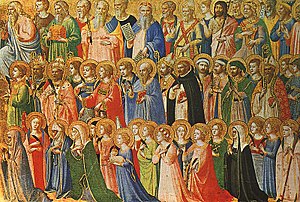
The Beatitudes are not a quid pro quo that we must do in order to get the blessings Jesus describes. We understand, rather, that the blessings Jesus describes belong to His disciples already through faith in him, according to our new nature. We were washed, we were sanctified, we were justified in the name of the Lord Jesus Christ and by the Spirit of our God.[6] This is how we can rejoice in the face of suffering, persecution, and death because of the name of Jesus that we bear through our Baptism. We have as our present possession, through faith in Christ, the forgiveness of sins and everlasting life. And we have for our examples in that faith all those brothers and sisters in Christ who have endured persecution and suffering to the end, and have fallen asleep in Jesus. And, if Our Lord should tarry, we will also go to our rest in Christ to await the resurrection of the body, and life everlasting in the new heavens and the new earth.

Despised and scorned, they sojourned here;
But now, how glorious they appear!
Those martyrs stand a priestly band,
God’s throne forever near.

So oft, in troubled days gone by,
In anguish they would weep and sigh.
At home above the God of Love
For aye their tears shall dry.

They now enjoy their Sabbath rest,
The paschal banquet of the blest;
The Lamb, their Lord, at festal board
Himself is Host and Guest.[7]


[1] John 15:19
[2] John 16:2
[3] 1 Peter 4:13
[4] Hebrews 13:14
[5] Hebrews 13:15-16
[6] 1 Corinthians 6:11
[7] The Lutheran Hymnal. St. Louis, MO: Concordia Publishing House, 1941. Hymn #656, “Behold a Host, Arrayed in White”, stanza 2.

Tuesday, January 16, 2018

The Beatitudes

Sermon on the Mount - Carl Bloch
And seeing the multitudes, He went up on a mountain, and when He was seated His disciples came to Him. Then He opened His mouth and taught them, saying: “Blessed are the poor in spirit, For theirs is the kingdom of heaven. Blessed are those who mourn, For they shall be comforted. Blessed are the meek, For they shall inherit the earth. Blessed are those who hunger and thirst for righteousness, For they shall be filled. Blessed are the merciful, For they shall obtain mercy. Blessed are the pure in heart, For they shall see God. Blessed are the peacemakers, For they shall be called sons of God. Blessed are those who are persecuted for righteousness’ sake, For theirs is the kingdom of heaven. Blessed are you when they revile and persecute you, and say all kinds of evil against you falsely for My sake. Rejoice and be exceedingly glad, for great is your reward in heaven, for so they persecuted the prophets who were before you” (Matthew 5:2-12).

The beginning of Jesus’s Galilean ministry begins with preaching, teaching, and healing. Great multitudes followed him. Jesus, seeking to withdraw from the multitudes as he often would, went up on a mountain. His disciples went to him, and he taught them. The Sermon on the Mount, as Jesus’s words recorded in Matthew, chapters five through seven have come to be called, is the most famous sermon in all of history. It is also, arguably, the most misunderstood. We must understand to whom Jesus is speaking, and what he intends to teach, if we are to understand what he is saying. Though there are multitudes of people clamoring to get near Jesus, and some certainly heard his words, Jesus directed his teaching to his disciples. This message is for Christians. What Jesus is actually teaching becomes more apparent when this fact remains in mind.

This most famous sermon begins with the equally famous Beatitudes. Throughout the secular world, not to mention American Evangelicalism, the Beatitudes are often understood as a quid pro quo. If you are poor in spirit, the kingdom of heaven is yours, so work really hard to be as poor in spirit as you can. If you do this, then you get that; or this thing will happen to you. Jesus, however, is not declaring here an ethical demand of his followers by laying out a law of behavior or attitude. The Beatitudes are not so much a mountain of law which one is to climb to be a better Christian, or to qualify for blessing and eternal life, but rather it can be seen – particularly by your “old” man – as a mountain of law under which one is to be totally crushed.

Make no mistake, Jesus is certainly also assuring his disciples of God’s goodness, and the future blessings in store for them. In fact, the blessings Jesus describes in the Beatitudes are ours already, in Him. And, as we are sanctified by the working of the Holy Spirit through Word and Sacrament, we will grow in these blessings more and more. The crushing weight of the law, however, must first bring us to see our sin and to repent of it. This repentance and forgiveness comes as the gracious gift of God through the Gospel. The Christian is simul justus et peccator – simultaneously justified and sinner. The new man hears in the Beatitudes assurance of God’s goodness and future blessing; the old man hears law and judgment. When we recognize our own spiritual poverty, when the Lord leads us to hunger and thirst for God’s righteousness, when He makes us pure in heart so that we seek to worship only the true God, then we are blessed, now and forever.[1]


[1] Engelbrecht, Rev. Edward A., ed. The Lutheran Study Bible. Saint Louis: Concordia Publishing House, 2009.