Showing posts with label Messiah. Show all posts

Friday, November 25, 2022

Thoughts on Psalm 69

You know how I am scorned, disgraced and shamed; all my enemies are before you. Scorn has broken my heart and has left me helpless; I looked for sympathy, but there was none, for comforters, but I found none. They put gall in my food and gave me vinegar for my thirst. (Psalm 69:19-21)

Psalm 69 is a messianic psalm. It prophesies of Israel's King who was to come and rescue them. It is both a prophecy and prayer of Jesus, the true savior-king of which David was a foreshadowing. This Psalm of David is rivaled only by Psalm 22 in terms of its messianic character.

In the Psalm, the Messiah cries out to God that He is stuck in the miry depths. He laments that the deep waters are engulfing Him. The imagery of mire, mud, and deep waters is used elsewhere in scripture to describe the bond of sin. (Brug, Psalms 1, 1992) It is like quicksand. It is a peril from which the man in it cannot extract himself. The more one struggles to release himself, the deeper he sinks into it until he is finally destroyed. He needs someone to pull him out.

This is just what the Messiah was supposed to do. He was supposed to come and rescue God's people. Only He didn't do it the way everybody thought He should. He did it by taking our place in the mud. But why was that necessary? When one man rescues another from drowning in quicksand he doesn't have to crawl into it and die in his place. Quite right. But when you remember that sin is like debt, a better picture of our circumstance emerges. It isn't something we can be plucked out of. It requires something of the one who would save us. When you spend too much on your credit cards so that you can't pay it back, the friend or family member who bails you out must pay the debt for you. And doesn't owing all that money that you know you can't pay back cause you to have a constant anxious feeling? A feeling like you are drowning? That is the feeling the psalmist is trying to evoke in these verses. That is the feeling of Jesus under the weight of our sin.

If you continue on through verse 5 this becomes even more true:

“You know my folly, O, God; my guilt is not hidden from you.”
This talk of the psalmist being caught up in sin, and God knowing His folly and His guilt does not seem to fit into the messianic character of this Psalm. Isn't Christ sinless? How can He be foolish? Even more, how can He say that He is drowning, being deluged by sin?

Though some theologians see these verses as evidence that this Psalm primarily refers to David, they can rightly be applied to Jesus, who is their fulfillment, as well. (Brug, Psalms 1, 1992) St. Paul wrote that the message of the cross is foolishness (folly) to those who are perishing (1 Corinthians 1:18). Jesus' folly is indeed known to God the Father. It was His will that Jesus engage in it; it is Jesus will to obey the Father. It is the folly He who Himself is sinless, being made to become sin for us on the cross so that we might become the righteousness of God (2 Corinthians 5:21). He was cursed, for as it is written, “cursed is every man who is hung on a tree” (Deuteronomy 21:23; Galatians 3:13-14). It is, therefore, quite appropriate that these words be applied to Jesus. You see, where we could not overcome sin and death, He could because He is God.

Theologians also point to verse 21 as further evidence that Psalm 69 is foremost a messianic prophecy. There is no direct parallel in David's life for, “They put gall in my food and gave me vinegar for my thirst.” These specific things do, however, happen to Jesus and are recorded in the accounts of His crucifixion – when He was hung on the tree.

Some people also have a problem with the imprecatory prayer found in verses 22-28. An imprecatory prayer is a prayer to God against one's enemies. It is asking God to punish them, to literally call evil on them. There are entire psalms which we call imprecatory psalms. Most of the time we just ignore them because they make us feel uncomfortable. I suspect it is why they were left out of our Lutheran hymnals. The reason for the difficulty is understandable. It is hard to think that Jesus would pray for His enemies to be blotted out of the book of life (v. 28).

Jesus is indeed the one who lamented over the faithlessness of Jerusalem. He wants to gather us all like a hen gathers her chicks. He wants all men to be saved and come to a knowledge of the truth. Most, like the religious leaders of Jesus' day, would not (Matthew 23:37). Those who will reject Jesus will be damned. They will be cast into hell, which was prepared for the devil and his angels, since it is their wish to push away God and flee from His presence. This is on them, not Jesus.

The last section of the Psalm (vv. 29ff.) is a prayer of deliverance and thanksgiving. Here Christ talks about how God will save Zion, His people. He prays also that God's salvation would protect Him in His pain and distress. God the Father does this by delivering Him from the grave and raising Him from the dead on the third day. By this work, Jesus saved His people, personified in the Psalm as Zion.

Zion will be saved. Her cities will be rebuilt. The land will be inhabited by the faithful, those who love the name of Jesus. The ultimate fulfillment of this prophecy will come on the Day of Judgment when Christ returns. On that day, every knee shall bow, and every tongue shall confess that Jesus is Lord, to the glory of God the Father (Daniel 7:13-14; Matthew 26:62-66; Philippians 2:10-11). ###

Works Cited

Brug, John C. People’s Bible Commentary: Psalms 1. St. Louis, MO: Concordia Publishing House, 1992.

Thursday, June 13, 2019

The Way, the Truth, and the Life


Thursday after Pentecost
“Let not your heart be troubled; you believe in God, believe also in Me. In My Father’s house are many mansions; if it were not so, I would have told you. I go to prepare a place for you. And if I go and prepare a place for you, I will come again and receive you to Myself; that where I am, there you may be also. And where I go you know, and the way you know.” Thomas said to Him, “Lord, we do not know where You are going, and how can we know the way?” Jesus said to him, “I am the way, the truth, and the life. No one comes to the Father except through Me. If you had known Me, you would have known My Father also; and from now on you know Him and have seen Him” (John 14:1-7).
Earlier, Thomas declared that he would die with Jesus.[1] Now, even after all the time Jesus and the disciples have spent together, he cannot see who Jesus is, and what His work on earth was. His problem seemed to be the same as the rest of the disciples; they could not rationally understand how Jesus could be the savior they thought He was, and also die a humiliating death: How could Jesus be the Messiah if He was murdered before He could set up His kingdom?
The dark spot in the mind of Thomas was his inability to follow the mission and work of Jesus beyond the boundary of death. For him the mission of Jesus was an earthly kingdom (Acts 1:6) – how, then, could Jesus retire to heaven; and how could there be a way to this kingdom that would lead via heaven? So Thomas grows downhearted like one who is lost in the dark.[2]
The disciples, like the rest of the Jews of Jesus’ day, were expecting a political Messiah.[3],[4] They expected the Messiah instantly to sweep away the old order of things; He would remove the boot of Roman rule from the neck of the Israelites; He would restore the house of David to a physical throne, and the kingdom of Israel would be a mighty nation once more. The disciples did not yet realize that Jesus’ kingdom was not of this world.[5]
Phillip asks Jesus to show them the Father. Jesus must have been quite frustrated by His disciples’ lack of understanding. He spent all this time with them, showing them works from the Father.[6] He explained to them that He was the incarnate Word,[7] the exact representation of the Father,[8] and they still didn’t get it. They still didn’t know Jesus. It wouldn’t be until after His resurrection that they would see Jesus through the eyes of faith.
We have the same problem. Jesus said to Thomas, “I am the way, the truth, and the life. No one comes to the Father except through Me.” How can we know Jesus? How could His words here apply to us today? The disciples could meet, see, touch, and talk to Jesus. They heard His teaching and saw His mighty works. How is this possible, though, for us living today? Are we not merely relegated to knowing only about Jesus? If Jesus of Nazareth was merely a man, His death on the cross would be the end of the story. Not only would it be pointless to try to “know” Jesus, it would be impossible. To us He would be nothing more than an historical figure, about which we could only memorize factual information. While Jesus did die on the cross on Good Friday, He did not stay in the grave; Jesus, God in human flesh, rose from the dead on the third day and, because He lives, we who believe in Him will also live.
Because of Adam and Eve’s disobedience in the Garden of Eden, sin entered God’s perfect creation; creation was cursed and our human nature was changed. Jesus voluntarily humbled Himself by becoming a man, to save mankind. He was born of the Virgin Mary and was without the stain of sin. He identified Himself with sinful man as He was baptized by John in the Jordan River; He assumed responsibility for our sin; He endured temptation, just as all men must, but He lived a perfect life; He kept all of God’s law, and died as the ransom for our sin.[9] God made Jesus, who knew no sin, to be sin for us, that we might become the righteousness of God in Him.[10] The author of Hebrews writes this:
Since the children have flesh and blood, He too shared in their humanity so that by His death He might destroy him who holds the power of death – that is the devil – and free those who all their lives were held in slavery by their fear of death…For this reason He had to be made like His brothers in every way, in order that He might become a merciful and faithful high priest in service to God, and that He might make atonement for the sins of the people.[11]
Christ, our living Savior restored the relationship between God and man. Jesus gives His gifts of life and salvation to us today through His Word proclaimed, read, and coupled with water, bread and wine, all by the working of the Holy Spirit. He calls out to us through the Holy Scriptures that we might know Him, and have eternal life: Come to me all who labor and are heavy laden and I will give you rest.[12] He gives us His Spirit,[13] connects us to Himself, His death, and resurrection,[14] and washes away our sins through Baptism,[15] by washing us with water through His Word.[16] He comes to us, to strengthen and preserve us in this faith, through the Lord’s Supper. In this sacrament, He gives us His very body and blood to eat and drink for the forgiveness of our sins, and as a sign of unity as members of His Body, the Church. We can know Jesus because He is alive, and through Jesus, we know God the Father.


Bibliography

Englebrecht, Edward A, ed. The Lutheran Study Bible - English Standard Version. Saint Louis: Concordia Publishing House, 2005.

Lenski, R. C. H. The Interpretation of St. John's Gospel. Columbus: The Wartburg Press, 1959.


[1] John 11:16
[2] Lenski, R. C. H. The Interpretation of St. John's Gospel. Columbus: The Wartburg Press, 1959.
[3] Mark 10: 35-45; Acts 1:6
[4] Engelbrecht, Edward A, ed. The Lutheran Study Bible. Saint Louis: Concordia Publishing House, 2005.
[5] John 18:33-38
[6] John 14:10-11
[7] John 8:48-59; 10: 22-39
[8] Hebrews 1:3
[9] Mark 10:45
[10] 2 Corinthians 5:21
[11] Hebrews 2:14-15; 17
[12] Matthew 11:28
[13] John 3:5; Titus 3:5;
[14] Romans 6:3-5; Galatians 3:27
[15] Acts 22:16; 1 Peter 3:18-22
[16] Ephesians 5:25-27

Thursday, May 2, 2019

A Samaritan Woman Meets Her Messiah


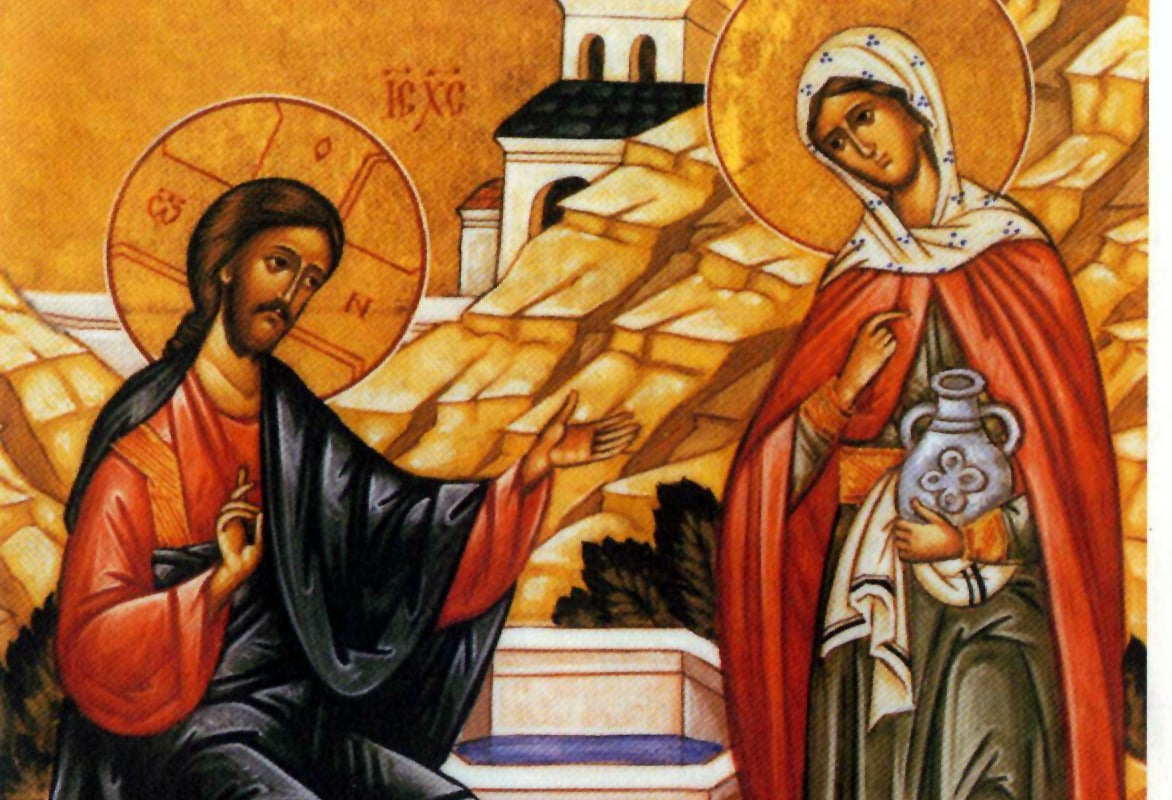
The woman said to Him, “Sir, I perceive that You are a prophet. Our fathers worshiped on this mountain, and you Jews say that in Jerusalem is the place where one ought to worship.” Jesus said to her, “Woman, believe Me, the hour is coming when you will neither on this mountain, nor in Jerusalem, worship the Father. You worship what you do not know; we know what we worship, for salvation is of the Jews. But the hour is coming, and now is, when the true worshipers will worship the Father in spirit and truth; for the Father is seeking such to worship Him. God is Spirit, and those who worship Him must worship in spirit and truth.” The woman said to Him, “I know that Messiah is coming” (who is called Christ). “When He comes, He will tell us all things.” Jesus said to her, “I who speak to you am He” (John 4:19-26).

It is commonly held that the Samaritans were descendants of the Jews who remained in Palestine after the Assyrians defeated Israel. The Samaritans inhabited the area between Judea and Galilee. They came from mixed marriages between Jews and Assyrian settlers who entered the Promised Land.[1], [2] For this reason the Jews of the day despised the Samaritans. They also regarded the Samaritan’s observance of Judaism as corrupted. It goes without saying that contact with the Samaritans was to be avoided. Due to the long history of animosity between the Jews and the Samaritans, it would be surprising that a Jew would even speak to a Samaritan; what is even more surprising is that the Samaritan with whom Jesus speaks, and asks for a drink, is a woman. Jesus, however, used the opportunity of the water, and the well, to preach the gospel.

Living water, quite simply, is the Holy Spirit. Jesus explains this to the Jews: On the last day, that great day of the feast, Jesus stood and cried out, saying, “If anyone thirsts, let him come to Me and drink. He who believes in Me, as the Scripture has said, out of his heart will flow rivers of living water.” But this He spoke concerning the Spirit, whom those believing in Him would receive; for the Holy Spirit was not yet given, because Jesus was not yet glorified.[3] While no specific scripture verse is cited by either Jesus or St. Luke, Jesus' words call to mind the words of the prophet Isaiah: The Lord will guide you continually, and satisfy your soul in drought, and strengthen your bones; You shall be like a watered garden, and like a spring of water, whose waters do not fail.[4] These waters give life and strength. That Jesus is speaking of the power of the Holy Spirit becomes evident on the day of Pentecost.[5] Jesus connects the application of water, better known as baptism, with the giving of the Holy Spirit. It is through baptism that the Spirit is given because baptism is God’s word connected to water. It is the washing of rebirth and renewal by the Holy Spirit,[6] water that is included in God’s command and combined with God’s word of promise; it washes away our sins, clothes us with Christ, connects us to His death and resurrection, and saves us.[7] It is only natural that Jesus should have this conversation about living water with this woman by the well, since He and His disciples were so recently baptizing people in Judea.[8]

Jesus, who proclaims to the Samaritan woman that He is the promised Messiah, says that it is now the hour when true worshipers will worship the Father in spirit and truth. Jesus is saying that true worship is that which is done in His name and through Him; it no longer depends on a specific location, like the temple in Jerusalem. Temples don't matter, mountains don't matter; faith in Messiah is what matters. The Lord is near to all who call on Him in truth,[9] that is, trusting in God's promise of redemption through Christ. Jesus is that promise in the flesh. How do we get that faith? Is faith in Christ something we decide to have? Do we produce it in ourselves? Jesus says that the Father is seeking true worshippers to worship Him. In other words, He comes to us, we do not come to Him. He binds that work of the Spirit, of creating faith in the hearts of men, to His Word,[10] whether preached, read, meditated upon, eaten and drunk in the Lord’s Supper, or applied to the body in the waters of Holy Baptism. He comes to us and works faith in us by the power of the Holy Spirit, through God’s means of Word and Sacrament, just as He came to the woman of Samaria.


[1] J. I Packer, and M.C. Tenney, Illustrated Manners and Customs of the Bible  (Nashville, TN: Thomas Nelson Publishers, 1980) p. 509
[2] 2 Kings 17:24-28, 33-34
[3] John 7:37-39
[4] Isaiah 58:11
[5] John 16:7; Acts 1:4-8
[6] Titus 3:5
[7] Matthew 28:19-20; Mark 16:16; Acts 2:38-39; 22:16; Romans 6:3-5; 1 Corinthians 6:11; Galatians 3:27; Colossians 1:13-14; 1 Peter 3:18-22;
[8] John 3:22
[9] Psalm 145:18
[10] John 15:26; 16:13; Romans 10:17

Saturday, February 22, 2014

Jesus at the Feast of Booths - I

After this Jesus went about in Galilee. He would not go about in Judea, because the Jews were seeking to kill him (John 7:1).


The "this" to which John refers here is the confrontation between Jesus and the Jews in chapter six. After having fed the 5,000 the crowds followed Jesus with the intention of crowing him a bread-king. Jesus teaches the crowds, pointing out their unbelief and culminating with the shocking statement that, "Whoever feeds on my flesh and drinks my blood has eternal life, and I will raise him up on the last day" (John 6:54). As a result of this "hard saying" many of those disciples who had followed him because of the miracles he had done left him. Jesus offended the masses by claiming that he was the bread of life sent by the Father, which was prefigured by the manna of the Old Testament. This, along with his claims to be God's Son - and therefore equal to God - is why the Jews were seeking to kill him and why he withdrew to the more remote region of Galilee.


Now the Jew's Feast of Booths was at hand. So his brothers said to him, "Leave here and go to Judea, that your disciples also may see the works you are doing. For no one works in secret if he seeks to be known openly. If you do these things show yourself to the world." For not even his brothers believed in him (John 7:2-5).


The Feast of Booths was the major harvest festival, one of the three times per year when it was required for Jewish men to present themselves before the LORD at the temple. It was a celebration that lasted seven days, during which the people constructed huts, or "booths", from tree branches and dwelt therein. The feast commemorated Israel's travels in the desert on the way to the Promised Land and the fact that God protected, blessed, and cared for his people.


Jesus' brothers, who are not among his disciples, taunt him, and mockingly encourage him to go up to the feast. "Ok, Messiah," they are telling him, "put your money where your mouth is. You're not going to be the King of the Jews out here in the sticks. If you're really the Messiah go to Jerusalem and prove it." Jesus' brothers speak to Jesus as if he is running for the office of Messiah. They taunt Jesus by telling him that, "...no one works in secret if he seeks to be known openly," as if Jesus was attempting to garner support for an uprising like other revolutionary zealots of the day. This attitude betrays the fundamental misunderstanding Jesus' brothers had - along with the Scribes, Pharisees, and Teachers of the Law - of what the Messiah would be and do. They expected a political savior who would throw off the yoke of Roman oppression and establish Israel as a powerful independent kingdom, with the religious establishment wielding political power.


They, simply put, didn't believe Jesus was who he said he was. The implication of their taunting was that their weirdo brother Jesus, who said these strange and enigmatic things about feeding people with his body and blood, would be exposed as the crazy person he was. Either he would go to the feast and be exposed, or he would stay in isolation in Galilee, effectively admitting to everyone that all this Son of God nonsense was just that - nonsense.


Jesus said to them, "My time has not yet come, but your time is always here. The world cannot hate you, but it hates me because I testify about it that its works are evil. You go up to the feast. I am not going up to this feast, for my time has not yet fully come." After saying this he remained in Galilee (John 7:6-9).


Jesus responds to the taunts of his brothers by pointing out that they are of the world, and he is not of the world, a theme he will revisit and expand upon when talking to the Pharisees in chapter eight. Jesus says that he will not go to the feast. This makes sense for two reasons. First, he has already caused great controversy among the religious leaders and the people who had been following him. It could hardly be safe for him to publicly go up to Jerusalem where the Jewish leaders were seeking to kill him. Secondly, as Jesus explained, his time had not yet come. Jesus, the lamb of God who takes away the sin of the world, was the ultimate Passover lamb. His would be a once for all sacrifice to make atonement for the sin of mankind. Consequently, Jesus' time would come, but not at the Feast of Booths (Lenski, 1964). Jesus would enter Jerusalem amid great spectacle on Palm Sunday. Jesus would be killed on the cross as the final sacrifice for sin, the one to which all those previous Passover sacrifices pointed, at Passover.


But after his brothers had gone up to the feast, then he also went up, not publicly but in private. The Jews were looking for him at the feast, and saying, “Where is he?” And there was much muttering about him among the people. While some said, “He is a good man,” others said, “No, he is leading the people astray.” Yet for fear of the Jews no one spoke openly of him (John 7:10-13).


Does John here record Jesus lying? I mean, first he told them that he was not going to the feast. Then, in the next paragraph John writes, "...then he also went up..." in seeming contradiction to what Jesus said he was going to do. Kretzmann believes that Jesus was not opposed to going to Jerusalem per se; Jesus did not wish to make a public spectacle of his arrival in Jerusalem and his attendance at the feast because doing so would quite possibly disrupt the sequence of events as they were to play out. Jesus did certainly miss a good portion of the feast. There is also no real evidence from the text that Jesus participated in any of the festivities associated with the Feast of Booths, though the text does go on to say that he goes to the temple to teach (Lutheran Study Bible, 2009).

Jesus let His brothers, with their peculiar ideas concerning Messianic revelations, go up to the capital alone. But after they were gone, He started out on His journey to the feast, with none of the publicity which they had recommended. It was for that reason that He had refused to go with them openly, because the attention which it would draw on the way and on His arrival in Jerusalem would not be beneficial to the cause. He went secretly, in order not to cause excitement and to irritate the Jews into such a mental condition that they would carry out their murderous design at once. The object of His journey was only to teach in Jerusalem once more, to preach the Gospel of redemption through His Word and work (Kretzmann, 1921).


The people attending the feast, as well as the Jewish religious leaders, were indeed waiting to see if Jesus would show himself. John writes that Jesus was the topic of much debate among the people, though it had to be carried on in secret. No one wanted to take any chances where Jesus was concerned. To be perceived as defending him or being his disciple could get a person expelled from the community, and that was a seriously big deal. Such was the threat to the man born blind and his parents after he was healed by Jesus. The attitude of the people and the tenor of their debate shows how the world, left on it's own, looks at Jesus. The religious establishment seeks to murder Jesus to save their place in the nation; the people are divided as to whether Jesus is a good man, or a deceptive man. Though they have the witness of the Scriptures, those people who are "of the world" cannot see Jesus for what he really is - true God, begotten of the Father from all eternity, true man born of a woman - the God-man who would make purification for sins, and sit down at the right hand of the Father.


The world continues to see Jesus this way. In the eyes of the unbelieving world Jesus is either a champion of morality and virtue who prescribes a right way of living, or he is charlatan and a liar who attempted to gain a following through deception, or he is a self-deceived lunatic (Kretzmann, 1921). Jesus, in turn, calls the world and it's works evil. People, who are by nature sinful and unclean, inclined to sin and turn away from God, cannot help but see Jesus in one of these ways. The Father, however, draws us out of the world to Jesus, by the power of the Holy Spirit working through the means of his word. We hear God's Law, see our sin, and are terrified, because we know what we deserve for all of our worldly evil. That, however, is not the end of the story. Because of Jesus' atoning sacrifice on the cross, we have been reconciled to God. If we confess our sin God, who is faithful and just, will forgive our sin and cleanse us from all unrighteousness.

Lord Jesus Christ, Your time has come, for You have traveled to Jerusalem fro the Passover from death to life. help us to live knowing that the time of our redemption is at hand as You continue to dwell among us at the feast of Your very body and blood, a foretaste of the feast to come; for You live and reign with the Father and the Holy Spirit, one God now and forever. Amen (Treasury of Daily Prayer, 2008).


Works Cited


Engelbrecht, Edward, and Paul E. Deterding. The Lutheran Study Bible: English Standard Version. Saint Louis: Concordia Pub. House, 2009. Print.


Kinnaman, Scot A., and Henry V. Gerike. Treasury of Daily Prayer. St. Louis, MO: Concordia Pub. House, 2008. Print.


Lenski, R. C. H. The Interpretation of St. John's Gospel. Minneapolis, MN: Augsburg, 1961. Print.


"Popular Commentary, by Paul E. Kretzmann." Popular Commentary, by Paul E. Kretzmann. N.p., n.d. Web. 22 Feb. 2014.

Sunday, March 31, 2013

The Resurrection of Jesus

But on the first day of the week, at early dawn, they went to the tomb, taking the spices they had prepared (Luke 24:1). 

Matthew tells us that all Jesus’ disciples who had accompanied him to the Garden of Gethsemane deserted him and fled upon his arrest. We don’t know what they were up to during the time between Jesus’ arrest in the garden and the time when they first received word of Jesus’ resurrection on Sunday morning. We only know that by Sunday morning they had all gathered together again. We are told only that Peter followed Jesus and the arrest party at a distance, monitoring the proceedings in the High Priest’s house as surreptitiously as possible from the courtyard. After Peter is reminded by the crowing of a rooster that Our Lord had said Peter would deny him, we are given no more account of Peter until Sunday morning. Mark gives us a detail unique to his Gospel account; that a young man, dressed in nothing but a linen cloth, followed Jesus to the Garden as well. Mark writes, “And a young man followed him with nothing but a linen cloth about his body. And they seized him, but he left the linen cloth and ran away naked” (Mark 14:51-52). Some commentators believe that this “young man” was Mark himself, though there is nothing in the text to support or refute this view. His departure from the scene of Jesus’ arrest, however, indicates the urgency of the situation and the haste with which Jesus’ friends abandoned him. The young man was so frightened and desperate to save himself that he ran away naked, leaving Jesus to his fate (Engelbrecht, et al., 2009). 

Evidently, however, a group of Jesus’ friends and disciples did gather some distance away to watch Jesus die. This group included John, Jesus’ mother Mary, Mary Magdalene, and Mary the mother of James and Joseph and the mother of the sons of Zebedee[1]. Joseph of Arimathea may have also been among the band of on-lookers as well. It was he who went to Pontius Pilate and requested Jesus’ body. Scripture tells us that Pilate was shocked to hear from Joseph of Arimathea that Jesus was already dead[2]. Joseph took the body of Jesus and laid him in the tomb while the two Marys – Mary Magdalene and “the other Mary” – watched. They would have to come back the next day to carry out the burial customs of anointing the Jesus’ body as the Sabbath would begin shortly. It is here that Luke continues the story, on Sunday morning, with the same two Marys bringing the required supply of spices to the tomb to anoint the body of Jesus. 

And they found the stone rolled away from the tomb (Luke 24:2), 

Tombs were often cut into the rock of the hillside. Their entrances would have been blocked by a large, disk-shaped stone, rolled into a channel cut in the ground in front of the tomb. This stone disk would have been several feet in diameter, and would have required several men to move (Engelbrecht, et al., 2009). This was certainly in the thoughts of the women as they made their way to the tomb with their supplies[3]. When they arrive, however, they are greeted with an earthquake, at least one angel, and some very frightened guards. Matthew writes that there was an earthquake as an angel rolled the stone away from the grave’s entrance[4]. The guards posted at the tomb were frightened so badly that they fainted – they “became like dead men”[5]

but when they went in they did not find the body of the Lord Jesus. While they were perplexed about this, behold, two men stood by them in dazzling apparel. And as they were frightened and bowed their faces to the ground, the men said to them, “Why do you seek the living among the dead? He is not here, but has risen. Remember how he told you, while he was still in Galilee, that the Son of Man must be delivered into the hands of sinful men and be crucified and on the third day rise” (Luke 24:3-7). 

This is the heart of Easter, the climax of the story of mankind’s redemption. Jesus’ tomb was empty. He rose from the dead and left the grave. Immanuel, God with us, who had looked to his enemies so defeated on the cross the previous Friday afternoon had, in reality, defeated sin, death, and the devil. The grave could not hold him. St. Paul tells us that this fact is of supreme importance. He writes in his first letter to the Corinthians, “For I delivered to you as of first importance what I also received: that Christ died for our sins in accordance with the Scriptures, that he was buried, that he was raised on the third day in accordance with the Scriptures, and that he appeared to Cephas, then to the twelve[6].” 

Without Christ’s resurrection on Easter Sunday, we have nothing more than the tragic story of the murder of a Jewish teacher and philosopher who crossed the leaders of the religious establishment, and paid the ultimate price for his challenge to their authority. We have no forgiveness of sins, if we have no risen Jesus. St. Paul understood this as well. He continues in his first letter to the Corinthians, “But if there is no resurrection of the dead, then not even Christ has been raised. And if Christ has not been raised, then our preaching is in vain and your faith is in vain. We are even found to be misrepresenting God because we testified about God that he raised Christ, whom he did not raise if it is true that the dead are not raised. For if the dead are not raised, not even Christ has been raised. And if Christ has not been raised, your faith is futile and you are still in your sins. Then those also who have fallen asleep in Christ have perished. If in Christ we have hope in this life only, we are of all people most to be pitied[7].” 

To the dismay of Satan, however, Jesus’ tomb is empty. C.F.W. Walther put it this way, in his famous Easter hymn: “O, where is your sting, death? We fear you no more; Christ rose, and now open is fair Eden’s door. For all our transgressions His blood does atone; Redeemed and forgiven, we now are His own[8]” (The Commission on Worship of The Lutheran Church-Missouri Synod, 2006). 

A common objection to the resurrection story made by many non-Christians is that Jesus’ body was simply stolen by Jesus’ followers so that it would look like he rose from the dead. This is, in fact, said by Matthew to be the case[9]. He writes that the Roman guards reported to the Chief Priests what had happened. The Chief Priests, in turn, told the guards to circulate the story that Jesus’ disciples stole his body while they slept on duty. Matthew says that the guards were paid a tidy sum and assured that the Chief Priests would smooth everything over with Pilate, should he ever get wind of their story. 

The story that someone removed Jesus’ body from the tomb, though, just doesn’t make sense to me. If the disciples took his body, they would all have known that the Gospel they were proclaiming was no Gospel at all. Being disappointed that Jesus was just another false messiah, the story goes, they were reluctant to undergo the public humiliation, ridicule, and persecution that was surely coming their way, so they stole Jesus’ body and claimed he rose from the dead, thus saving face. One might put some stock in that, if it were not for what happened to the disciples of Jesus next. 

All of the Apostles, with the exception of John, were martyred for their faith. That is, they went to their death rather than deny their risen Lord and Savior Jesus. If all they faced was ridicule and derision, I might give this thesis of the resurrection-deniers some more thought. The Apostles and other first generation disciples of Christ, however, faced not only ridicule, but death, and that in some of the most gruesome ways imaginable by man. I have not met the person who was willing to die for that which he knew to be a lie. Men have been willing to die for ideas in which they believed but only later found out were false; I have never heard of anyone who willingly submit to a horribly painful and humiliating death rather than renounce a belief or idea that they knew for a fact to be false. The apostles and early followers of Jesus were beheaded, crucified, stoned, burned alive, and fed to wild animals for the entertainment of bloodthirsty crowds, all because they refused to renounce their faith in Jesus. They stood steadfast in their faith because they knew it to be true first hand. 

And they remembered his words, and returning from the tomb they told all these things to the eleven and to all the rest. Now it was Mary Magdalene and Joanna and Mary the mother of James and the other women with them who told these things to the apostles, but these words seemed to them an idle tale, and they did not believe them (Luke 24:8-11). 

The women who went to the tomb, discovered it empty, and heard the first proclamation of the resurrection from the angels there went joyfully to inform the Apostles. The Apostles, however, were still mourning Jesus' death. The angels had reminded the women about how Jesus told them all beforehand how he would die for the sin of mankind at the hands of sinful men and rise again. At this Gospel proclamation their faith blossomed forth. when they told the men that Jesus had risen, their minds could not yet grasp it. They considered the women's account an "idle tale". After all, they were only lowly women. Their testimony was not even valid in a court of law. This is another reason that seems to lend more credibility to the Gospel story. If the Gospel writers wanted to make up a story, surely they would not have scripted it so as to have women discover the empty tomb. Their testimony would be considered unreliable in First century Israel (Packer & Tenney, 1980). Furthermore, the Gospel writers do not paint the Apostles in a particularly flattering light, especially in the resurrection accounts. They are disbelieving and even mock the women, being mired firmly in their mistaken belief that Jesus was a political messiah struggling to establish an earthly kingdom. 

Why would God choose to use these women, who were so despised by the culture in which they lived, to deliver the news of the resurrection to the Apostles? Surely he would choose some person more worthy and esteemed in the eyes of the world to carry such news, in order to make it more credible to the world. To the contrary, God was mocking the unbelieving world and its governing authorities, which subscribed to such nonsense as the inferiority of women. In using these women as the vehicles for bringing the news of Jesus’ resurrection to the Apostles, “God chose what is foolish in the world to shame the wise; God chose what is weak in the world to shame the strong; God chose what is low and despised in the world, even things that are not to bring to nothing things that are, so that no human being might boast in the presence of God.”[10]

But Peter rose and ran to the tomb; stooping and looking in, he saw the linen cloths by themselves; and he went home marveling at what had happened (Luke 24:12). 

Peter reacts in his typical brash and impulsive fashion. Earlier in the garden of Gethsemane, when the temple guard came to arrest Jesus, Peter impulsively, and a little clumsily, attempted to stand and fight, cutting off the high priest's servant's ear with his sword[11]. He was going to meet force with force it seems, but Jesus stopped and rebuked him. He, like the others, did not understand that Jesus' kingdom was not of this world[12]. Peter, along with all the rest of the Apostles, felt defeated and were afraid of their religious/political adversaries who had murdered their leader. But when Peter heard the women's story, he reacted by running to the tomb to see what was going on for himself. John records that he also went with Peter. John says that he ran ahead of Peter, but only looked into the tomb upon his arrival, apparently too awestruck at what he found to enter[13]. Peter was the one who actually entered the empty tomb first. He saw the linen cloths that had been wrapped around Jesus' corpse, and the cloth that had been on Jesus head, folded neatly. This was no case of grave robbery. Why would grave robbers strip the corpse and take the time to fold the linen cloths they left behind? We know that the Apostles didn’t have Jesus’ body. Surely, if the Pharisees had taken Jesus’ corpse away, they would have produced it and put it on display when the Apostles began preaching that Jesus rose from the dead. 

After Peter went inside the tomb, John then also entered. John writes that he saw and believed[14]. They may not yet have understood but, by the power of God's Holy Spirit, faith was kindled in them they believed. During the following 40 days Jesus would show himself alive to his disciples, and equip them for their mission of spreading the Good News of Jesus' atonement for man's sin to the world. 

Jesus’ resurrection proves that he is the Christ, the Son of God, and that the things he taught were true. The sacrifice Jesus made on the cross was accepted by God the Father for the reconciliation of the world (Luther, 1991). The resurrection of Jesus is proof of this. Because of our sins we deserve nothing but God’s wrath, displeasure, death, and eternal damnation. Christ, by his holy precious blood and with his innocent suffering and death, redeemed mankind on the cross. His victory was confirmed by his resurrection from the dead, and we receive the forgiveness Christ won on the cross by faith in Him. Christ’s resurrection is the basis for the new life that Christians begin to experience now, and will receive fully on the Last Day (Engelbrecht, et al., 2009). Because Jesus lives, we who believe in him will live also[15]

Christ is risen, he is risen indeed! Alleluia! 


Works Cited 

Engelbrecht, E. A., Deterding, P. E., Ehlke, R. C., Joersz, J. C., Love, M. W., Mueller, S. P., et al. (Eds.). (2009). The Lutheran Study Bible. Saint Louis, Missouri, USA: Concordia Publishing House. 

Luther, M. (1991). Kleine Katechismus, English. (C. P. House, Trans.) Saint Louis, Missouri, USA: Concordia Publishing House. 

Packer, J. I., & Tenney, M. C. (Eds.). (1980). Illustrated Manners and Customs of the Bible. Nashville, TN, USA: Thomas Nelson Publishers. 

The Commission on Worship of The Lutheran Church-Missouri Synod. (2006). Lutheran Service Book. St. Louis : Concordia Publishing House. 


End Notes

[1] Matthew 27:55-56 
[2] Mark 15:44 
[3] Mark 16:3 
[4] Matthew 28:2 
[5] Matthew 28:3 
[6] 1 Corinthians 15:3-5 
[7] 1 Corinthians 15:13-19 
[8] "He’s Risen, He’s Risen", LSB 480, Text: C.F.W. Walther, 1811-87, abr.; tr Anna M. Meyer, 1867-1941, alt. 
[9] Matthew 28:11-15 
[10] 1 Corinthians 1:27-29 
[11] Matthew 26:51; John 18:10 
[12] John 18:36 
[13] John 20:3-4 
[14] John 20:8 
[15] John 11:25-26; 14:19

Thursday, June 28, 2012

Jesus Calms a Storm

Jesus Calms the Storm - Rembrant 1633
On that day, when evening had come, he said to them, “Let us go across to the other side.” And leaving the crowd, they took him with them in the boat, just as he was. And other boats were with him. And a great windstorm arose, and the waves were breaking into the boat, so that the boat was already filling. But he was in the stern, asleep on the cushion. And they woke him and said to him, “Teacher, do you not care that we are perishing?” And he awoke and rebuked the wind and said to the sea, “Peace! Be still!” And the wind ceased, and there was a great calm. He said to them, “Why are you so afraid? Have you still no faith?” And they were filled with great fear and said to one another, “Who then is this, that even the wind and the sea obey him?” (Mark 4:35-41).

Jesus had been “teaching by the sea” all day[1]. Immediately prior to his teaching session by the sea, Jesus had argued with, and been rejected by, the Pharisees, whom he decried as the evil and adulterous generation[2]. Jesus had healed a demon-possessed man, and the common people began to wonder if Jesus might be the Messiah[3]. The Pharisees accused him of being possessed himself rather than acknowledging the messianic claims of his followers, and demanded from Jesus a sign proving that he was the Messiah. As a side note, this is ironic, as Jesus’ healing of the demon-possessed man was recognized by the common people and the Jewish religious establishment of the day as sign pointing to the Messiah (Fruchtenbaum). The rabbis of Jesus’ time taught that, when Messiah came, he would cast out mute demons from those people possessed by them.

There was one kind of demon against which [Judaism’s methodology] was powerless, and that was the kind of demon who caused the controlled person to be dumb or mute. And, because he could not speak, there was no way of establishing communication with this kind of demon; no way of finding out this demon’s name. So…it was impossible to cast out a dumb demon. The rabbis had taught, however that when the Messiah came, he would be able to cast out this type of demon. This was the second of the three messianic miracles: the casting out of a dumb or mute demon (Fruchtenbaum).
Jesus, however, told the Pharisees that there would be no further signs given to them, the evil and adulterous generation, except for the “sign of Jonah”, thereby alluding to his crucifixion, death, and resurrection.

Jesus and his disciples were in Galilee, on the western shore of the Sea of Galilee. They would be traveling to the region of the Gerasenes (Engelbrecht, et al., 2009). This region was part of the Decapolis[4] and was more Gentile in culture. Consequently, the Jewish people living there had probably adopted some Gentile customs in violation of the Law of Moses[5] (Mark 5:11). This is the region where Jesus will meet and exorcize “Legion” from a man and send him into a herd of pigs.

The "Jesus Boat" on display at the Yigal Allon Museum in Israel.
If they were in a typical Galilean fishing boat of the day, it would have been approximately 25½ feet long, 7½ feet wide, and just over 4 feet high. An excellent example of this type of fishing boat is on display at the Yigal Allon Museum in Israel. The “Jesus” or “Sea of Galilee” boat, as it is known, was discovered in 1986 on the northwest shore of the Sea of Galilee (Sea of Galilee Boat, 2012). The remains of the boat first appeared during a drought when the waters of the sea receded. The boat is made of 12 different types of wood and measures 25.5 ft. (8.2 m) long, 7.5 ft. wide, and 4.1 ft high. It would have had a crew of five (four rowers and a helmsman) and could carry about 15 additional persons (Jesus Boat Museum, 2012).

Unless a person has ever been in the position of similar life threatening danger, I don’t think they can really know just exactly what the disciples were feeling as they battled the storm. They would have been literally terrified to death. They had experienced that chilling moment when the idea of losing their lives had ceased to be an abstract idea, as it is to most people for much of the time, and become a looming possibility that had to be considered. As they struggled fruitlessly to keep their boat from sinking, it became apparent to them that something more than their efforts would be required if they were to make it through the situation. They would have to be rescued; their situation was hopeless. In exasperation they wake Jesus and ask him if he does not care about their fate. At this point they do not realize just who Jesus really was.

The disciples believed, or at least confessed, that Jesus was the Son of David, just as some of the people who saw him cast out the mute demon did. Probably, like most of the average people, though, they understood the Son of David – the Messiah – to be a political savior rather than a spiritual one. In fact, this view would not be totally eradicated from the minds of the disciples until after Jesus’ death and resurrection. Even the disciples to whom Jesus appeared on the road to Emmaus talked to him about how they had hoped that the murdered Jesus might have been the one to “save Israel”, the implication being that he must not have been the one, since he was killed by the Romans at the urging of the Jews.

Jesus was indeed the savior of Israel, but certainly not in the way that the Jewish religious establishment, or the Disciples (at this point in their story) expected. Jesus also certainly cared for the disciples’ well-being, but he, unlike we sinful human beings, totally trusted that care into God the Father’s hands[6]. He also understood that man’s physical needs were secondary to man’s spiritual needs. That is why he can sleep on a cushion, on a boat, in the middle of a raging storm – this situation, like all others, is in the Father’s hands. In a sense, you could say that, no Jesus didn’t care that the Disciples were “perishing”, at least in the manner about which they were concerned. He didn’t have to care about that physical situation because it was already in the care of God the Father. No one in the history of human kind, however, cared more than Jesus about how the disciples were truly perishing – spiritually and for eternity. The spiritual situation of mankind is that of the disciples rowing and bailing their boat against the storm. Those efforts will prove fruitless, the proverbial boat of our soul will sink into the sea of sin and death, and our efforts to keep it from doing so are woefully insufficient. We need to be rescued from slipping into the abyss. Jesus cared so much about this that he came to earth a human being in order to atone for the disciples’ sin – and the sin of all mankind – to save them from eternal destruction. Jesus tells the disciples, in fact, that these are the things – those things which pertain to our eternal destiny – to which we should devote our time and attention[7].

Verses 38-39 illustrate for us the dual nature of Jesus. He is truly a human being as evidenced by his physical needs; he was exhausted after a long day of “teaching by the sea” and contending with the Pharisees, and he needed to sleep. He is also divine because, as the disciples point out, “…the wind and the sea obey him.” Jesus is, in addition to being a man, the King of Creation, the one through whom all things were made[8]. When he came to earth, Jesus did not cease to be God; Jesus became Immanuel, “God with us”. He emptied himself of his divine power and took on the form of a servant. He did this so that he could live the sinless life we were incapable of living, and then he paid the debt of guilt that we, mankind, owed to God because of sin[9] by dying on the cross, for, as St. Paul writes, the wages of sin is death[10]. Jesus is the Son, the God-man, second person of the Holy Trinity. Kretzmann observes:

The evangelist here pictures Jesus, the Lord of the universe, who commands the sea, and it gives Him unquestioning obedience. The man Jesus is the almighty God (Kretzmann, 1921).

If the disciples believed what Jesus was teaching about who he was, why he was on the earth, and what was really important (spiritual things rather than physical things), they wouldn’t have been afraid of the storm. They would trust in God in all situations, even the ones which potentially lead to death. Jesus knows, however that they do not yet understand the things he is teaching them properly. They will eventually, though, properly hail him as Messiah. They will also, much later, exhibit the same type of trust in God that Jesus exemplifies in the boat as he slept when they all are, with the exception of St. John, martyred for their faith.

Jesus’ miracle of calming the sea shows that Jesus possesses divine power and authority over creation. It confronts the disciples with the actual Word of God manifested in the flesh, through whom creation itself was brought into existence. Jesus is the Creator of Genesis, and the Designer who spoke to Job[11]. This miracle should also give us, who are also his disciples, comfort. We can look at Jesus the man, sleeping on a cushion in the boat amongst the raging tempest, and know that Jesus the Divine Son of God is aware, and in control of all things. Kretzmann explains:

From that little nutshell of a boat, even while He was asleep, He governed heaven and earth, land and sea. Only His divine majesty was covered by the form of a servant. And as He did then, so He does now: He uses His divine power, His omnipotence, in the interest, in the service of men, especially of His disciples, of His believers. That is the comfort of this story (Kretzmann, 1921).

Therefore, in the mist of tribulations, we know that all things work to the good of them who love Him, who are called according to his purpose[12]. We know that Jesus will calm the storm which threatens the passage of our spiritual ship, and he will pilot it safely into the peaceful rest of eternal life with him, where we will be once and for all free of the stain of sin, death, and the power of the devil.


Works Cited

Decapolis. (2012, June 28). Retrieved June 28, 2012, from Wikipedia: http://en.wikipedia.org/wiki/Decapolis

Engelbrecht, E. A., Deterding, P. E., Ehlke, R. C., Joersz, J. C., Love, M. W., Mueller, S. P., et al. (Eds.). (2009). The Lutheran Study Bible. Saint Louis, Missouri, USA: Concordia Publishing House.

Fruchtenbaum, A. (n.d.). The Three Messianic Miracles. Retrieved June 28, 2012, from Ariel Ministries: www.arielministries.us/archive-files/mbs-masters/mbs/mbs035m.pdf

Jesus Boat Museum. (2012, December 28). Retrieved June 27, 2012, from Sacred Destinations: http://www.sacred-destinations.com/israel/jesus-boat

Kretzmann, P. E. (1921). Popular Commentary of the Bible (Vol. 1). St. Louis, MO, USA: Concordia Publishing House.

Sea of Galilee Boat. (2012, June 27). Retrieved June 27, 2012, from Wikipedia: http://en.wikipedia.org/wiki/Sea_of_Galilee_Boat


End Notes

[1] Matthew 13; Mark 4:1
[2] Matthew 12:38-42
[3] Matthew 12:22-23
[4] The Decapolis was a group of ten cities on the eastern frontier of the Roman Empire in Judea and Syria. The ten cities were not an official league or political unit, but they were grouped together because of their language, culture, location, and political status. The Decapolis cities were centers of Greek and Roman culture in a region that was otherwise Semitic. With the exception of Damascus, the "Region of the Decapolis" was located in modern-day Jordan, one of them located west of the Jordan River in Israel. Each city had a certain degree of autonomy and self-rule (Decapolis, 2012).
[5] Leviticus 11:7-8; Mark 5:11
[6] Matthew 6:25-34
[7] Matthew 6:25-34; 13-44
[8] John 1:3
[9] Philippians 2:5-11
[10] Romans 6:23
[11] Job 38:1-11
[12] Romans 8:28