Showing posts with label water. Show all posts

Thursday, May 2, 2019

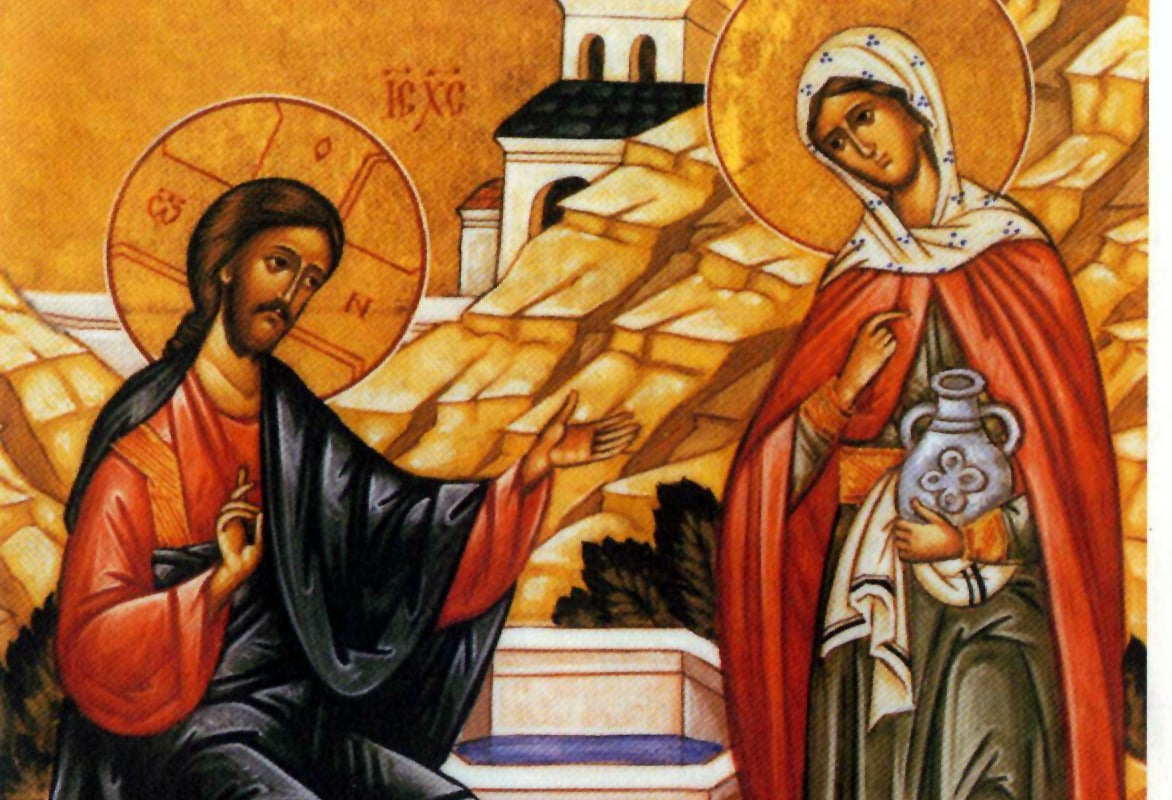
A Samaritan Woman Meets Her Messiah


The woman said to Him, “Sir, I perceive that You are a prophet. Our fathers worshiped on this mountain, and you Jews say that in Jerusalem is the place where one ought to worship.” Jesus said to her, “Woman, believe Me, the hour is coming when you will neither on this mountain, nor in Jerusalem, worship the Father. You worship what you do not know; we know what we worship, for salvation is of the Jews. But the hour is coming, and now is, when the true worshipers will worship the Father in spirit and truth; for the Father is seeking such to worship Him. God is Spirit, and those who worship Him must worship in spirit and truth.” The woman said to Him, “I know that Messiah is coming” (who is called Christ). “When He comes, He will tell us all things.” Jesus said to her, “I who speak to you am He” (John 4:19-26).

It is commonly held that the Samaritans were descendants of the Jews who remained in Palestine after the Assyrians defeated Israel. The Samaritans inhabited the area between Judea and Galilee. They came from mixed marriages between Jews and Assyrian settlers who entered the Promised Land.[1], [2] For this reason the Jews of the day despised the Samaritans. They also regarded the Samaritan’s observance of Judaism as corrupted. It goes without saying that contact with the Samaritans was to be avoided. Due to the long history of animosity between the Jews and the Samaritans, it would be surprising that a Jew would even speak to a Samaritan; what is even more surprising is that the Samaritan with whom Jesus speaks, and asks for a drink, is a woman. Jesus, however, used the opportunity of the water, and the well, to preach the gospel.

Living water, quite simply, is the Holy Spirit. Jesus explains this to the Jews: On the last day, that great day of the feast, Jesus stood and cried out, saying, “If anyone thirsts, let him come to Me and drink. He who believes in Me, as the Scripture has said, out of his heart will flow rivers of living water.” But this He spoke concerning the Spirit, whom those believing in Him would receive; for the Holy Spirit was not yet given, because Jesus was not yet glorified.[3] While no specific scripture verse is cited by either Jesus or St. Luke, Jesus' words call to mind the words of the prophet Isaiah: The Lord will guide you continually, and satisfy your soul in drought, and strengthen your bones; You shall be like a watered garden, and like a spring of water, whose waters do not fail.[4] These waters give life and strength. That Jesus is speaking of the power of the Holy Spirit becomes evident on the day of Pentecost.[5] Jesus connects the application of water, better known as baptism, with the giving of the Holy Spirit. It is through baptism that the Spirit is given because baptism is God’s word connected to water. It is the washing of rebirth and renewal by the Holy Spirit,[6] water that is included in God’s command and combined with God’s word of promise; it washes away our sins, clothes us with Christ, connects us to His death and resurrection, and saves us.[7] It is only natural that Jesus should have this conversation about living water with this woman by the well, since He and His disciples were so recently baptizing people in Judea.[8]

Jesus, who proclaims to the Samaritan woman that He is the promised Messiah, says that it is now the hour when true worshipers will worship the Father in spirit and truth. Jesus is saying that true worship is that which is done in His name and through Him; it no longer depends on a specific location, like the temple in Jerusalem. Temples don't matter, mountains don't matter; faith in Messiah is what matters. The Lord is near to all who call on Him in truth,[9] that is, trusting in God's promise of redemption through Christ. Jesus is that promise in the flesh. How do we get that faith? Is faith in Christ something we decide to have? Do we produce it in ourselves? Jesus says that the Father is seeking true worshippers to worship Him. In other words, He comes to us, we do not come to Him. He binds that work of the Spirit, of creating faith in the hearts of men, to His Word,[10] whether preached, read, meditated upon, eaten and drunk in the Lord’s Supper, or applied to the body in the waters of Holy Baptism. He comes to us and works faith in us by the power of the Holy Spirit, through God’s means of Word and Sacrament, just as He came to the woman of Samaria.


[1] J. I Packer, and M.C. Tenney, Illustrated Manners and Customs of the Bible  (Nashville, TN: Thomas Nelson Publishers, 1980) p. 509
[2] 2 Kings 17:24-28, 33-34
[3] John 7:37-39
[4] Isaiah 58:11
[5] John 16:7; Acts 1:4-8
[6] Titus 3:5
[7] Matthew 28:19-20; Mark 16:16; Acts 2:38-39; 22:16; Romans 6:3-5; 1 Corinthians 6:11; Galatians 3:27; Colossians 1:13-14; 1 Peter 3:18-22;
[8] John 3:22
[9] Psalm 145:18
[10] John 15:26; 16:13; Romans 10:17

Saturday, June 25, 2016

Baptismal Regeneration: A False Gospel?

Caitlyn's Baptism - 2004
St. John's Ev. Luth. Church - Chicago, IL
I am consistently amazed at the visceral reaction of those who deny the efficacy of Baptism to any talk about how Baptism is efficacious. One person wrote a long response to my article, “Three Examples of How Lutherans DenyJustification by Faith Alone: A Response – Part One of Two,” decrying baptismal regeneration as a false gospel, and calling “water baptism” merely a symbol, commanded to be carried out on/by those who are believers. His comments are too long to reproduce here in their entirety (if you want to read them, simply go to the original article and scroll down to the bottom). I will, however, respond to two points the person made, as I think they get to the heart of the matter. Firstly, he writes:

“Water baptism is simply a remembrance. It is not the means of grace through which God provides salvation; that is simply ‘warmed over’ Roman Catholicism. The Bible asserts unambiguously that an unregenerate sinner is justified by faith alone in Christ alone. Trying to assert that water baptism plays any part in regeneration is simply a false gospel. Any ecclesiastical (church) procedure plays no part in justification.”
First, we have to deal with this term “water baptism.” To talk about “water” baptism is akin to talking about “food” eating. There is no baptism without water, as the Greek word “baptizo,” from which we get our word baptism, means to apply water either by immersing, dipping, pouring, or sprinkling[1]. Certainly we hear about things such as the baptism of the Holy Spirit. John the Baptist said that the one to come after him would baptize with the Holy Spirit and with fire[2]. Understanding how language works, though, we know that when one applies a word like baptism (which means “to apply water”) to something which is not water, one understands from context that the speaker is using analogy. Continuing with our food/eating parallel, one might say, after reading an interesting book, “I devoured every word!” One would not mean that he engaged in any type of actual eating. Rather, he is saying that the book was interesting and he read it with enthusiasm. So, we must agree with Paul that there is only one baptism, and can dispense with the rather annoying and theologically loaded term “water baptism.”

There is one body and one Spirit, just as you were called in one hope of your calling; one Lord, one faith, one baptism; one God and Father of all, who is above all, and through all, and in you all (Ephesians 4:4-6).
Second, I understand what this person thinks they are trying to say, but he misses the mark. Perhaps this is just me knit-picking, but the Bible does not assert that “an unregenerate sinner is justified by faith alone in Christ alone.” I know this, because what this person is attempting to use in his argument, though he may not realize it, are the “solas” which came from Luther's theology and the Lutheran Reformation (you’re welcome, by the way). As I stated in the original article, Paul says we are saved by grace, through faith in Christ, and even this faith does not come from us. Back to Ephesians two, yet again:

For by grace you have been saved, through faith, and that not of yourselves; it is the gift of God (Ephesians 2:8).
So, how does that faith, which is God’s gift, get to us, since it isn’t by work, so that men are deprived of boasting? It comes through his means – His Word. And, when God couples his word of promise with a physical element…voila! You get a sacrament. When God couples water and his word of promise, you get Holy Baptism, which is the washing of regeneration.

For we ourselves were also once foolish, disobedient, deceived, serving various lusts and pleasures, living in malice and envy, hateful and hating one another. But when the kindness and the love of God our Savior toward man appeared, not by works of righteousness which we have done, but according to his mercy he saved us, through the washing of regeneration and renewing of the Holy Spirit whom he poured out on us abundantly through Jesus Christ our Savior, that having been justified by his grace we should become heirs according to the hope of eternal life (Titus 3:3-7).
So, you may say all day long that baptism is simply a remembrance and that it is not a means of grace. I challenge you to show me in Scripture where it says such a thing. You cannot. I, on the other hand, can, as countless orthodox Christian theologians have for 2,000 years, point to the words of St. Peter:

There is also an antitype which now saves us – baptism (not the removal of the filth of the flesh, but the answer of a good conscience toward God), through the resurrection of Jesus Christ (1 Peter 3:21).
Emma's Baptism - 2006
Immanuel Ev. Luth. Church - Hodgkins, IL
Did you catch that? Peter says that baptism now saves us! And he clarifies, just so we don’t mistakenly think that he means the physical act of washing dirt away by itself. Baptism saves us through the resurrection of Jesus Christ. What wonderful news! If the commenter wants to maintain that, “…to assert that water baptism plays any part in regeneration is simply a false gospel,” he may take that up with the Apostle Peter if he likes. I will cling to the plain reading of the words of Scripture in their context.

That context is the comparison Peter makes between baptism and the flood and Noah’s Ark. Eight people were saved in the ark, “through water,” Peter writes, and in the next sentence likens this salvation (the shadow) to the salvation given by God in baptism, through the resurrection of Jesus. Luther, in his Small Catechism, explains it this way:

How can water do such great things? Answer: It is not the water indeed that does them, but the word of God which is in and with the water, and faith, which trusts such word of God in the water. For without the word of God the water is simple water and no baptism. But with the word of God it is a baptism, that is, a gracious water of life and a washing of regeneration in the Holy Ghost as St. Paul says, Titus, Chapter three…this is a trustworthy saying (Luther 2008).
In the end, it is a question of what you see baptism to be. Is it God’s act, or man’s? Is it something God does to you, or a work of obedience you offer to God? Scripture is clear that baptism is God’s work, done using the hands of a pastor, and the power of the Holy Spirit, to deliver His gifts to us. It all comes from outside of us.

This brings me to the second point of contention. If baptism is so important in regenerating people, why did Paul say he was not sent to baptize? The commenter writes:

“It is interesting that Christ did not send the apostle Paul, his chief evangelist, to baptize, isn’t it? Instead, he was sent to preach the gospel. That is where the power is…in the gospel, not water.”
My friend, you and I agree. The gospel of Christ is the power of God to salvation for everyone who believes[3]. As we have discussed previously, that is why baptism is able to work forgiveness of sins, deliver from death and the devil, and give eternal salvation to all who believe this: It is not simple water only, but it is the water comprehended in God’s command and connected with God’s word! That Gospel, of which we are not ashamed, is the power working in baptism.

Yes, Paul did write that he was not sent to baptize. He was, as he says sent to preach the Gospel. Here is the entire passage in context:

Now I plead with you, brethren, by the name of our Lord Jesus Christ, that you all speak the same thing, and that there be no divisions among you, but that you be perfectly joined together in the same mind and in the same judgment. For it has been declared to me concerning you, my brethren, by those of Chloe’s household, that there are contentions among you. Now I say this, that each of you says, “I am of Paul,” or “I am of Apollos,” or “I am of Cephas,” or “I am of Christ.” Is Christ divided? Was Paul crucified for you? Or were you baptized in the name of Paul? I thank God that I baptized none of you except Crispus and Gaius, lest anyone should say that I had baptized in my own name. Yes, I also baptized the household of Stephanas. Besides, I do not know whether I baptized any other. For Christ did not send me to baptize, but to preach the gospel, not with wisdom of words, lest the cross of Christ should be made of no effect (1 Corinthians 1:10-17).
Paul did not baptize. He was sent to preach. Well, except for Crispus and Gaius…and also Stephanas’ household…and maybe some others he doesn’t recall…but he didn’t baptize! Paul is addressing the issue of sectarianism among the Corinthians and he is making the point that it’s good he didn’t personally baptize a bunch of people, otherwise these wretched Corinthians might say he was doing it to gain a following. Certainly Paul is not saying that his mission was only to preach separate and apart from baptism. Paul’s mission is the same as that of the other Apostles:

Then the eleven disciples went away into Galilee, to the mountain which Jesus had appointed for them. When they saw Him, they worshiped Him; but some doubted. And Jesus came and spoke to them, saying, “All authority has been given to Me in heaven and on earth. Go therefore and make disciples of all the nations, baptizing them in the name of the Father and of the Son and of the Holy Spirit, teaching them to observe all things that I have commanded you; and lo, I am with you always, even to the end of the age.” Amen (Matthew 28:16-20).
So, the disciples are sent here by Jesus to baptize and teach, but not to preach? Right, that was going to be Paul’s job…how absurd. Jesus gave the same mission to all the Apostles. The baptizing, preaching, and teaching can’t be separated out and any one thing omitted, because it is all part of them delivering the means of grace – God’s Word – to unregenerate sinners so that God could, by the power of His Spirit, do his work of making these sinners into regenerate Christians, when and where he willed to do so.

God comes to we who are spiritually dead from outside of ourselves, by means. Jesus is delivered to us through the external word, whether by reading, preaching, or through the Sacraments. The Holy Spirit uses those means, as he wills, to create believers out of unbelievers or, as the confessions say, willing persons out of unwilling ones. This faith is more than intellectual assent and knowledge and comes to us without our work, through the work of the Holy Spirit. Repentance? Another gift worked in us by God the Holy Spirit, and not something done of our own will.

That’s really as far as I know how to take this, so I’ll end with the words of the Small Catechism (which are really the words of St. Paul, because in this passage, Luther ends by quoting Romans):

What does such baptizing with water signify? Answer: It signifies that the old Adam in us should, by daily contrition and repentance, be drowned and die with all sins and evil lusts, and, again, a new man daily come forth and arise; who shall live before God in righteousness and purity forever. Where is this written? Answer: St. Paul says, Romans, chapter six: We are buried with Christ by Baptism into death, that, like as he was raised up from the dead, by the glory of the Father, even so we also should walk in newness of life (Luther 2008).


Works Cited

Catholic Answers. "Baptism: Immersion Only?" Catholic Answers. August 14, 2004. http://www.catholic.com/tracts/baptism-immersion-only (accessed June 22, 2016).

Joersz, Dr. Jerald C. "Baptism: Dunking, Sprinkling, or Pouring?" The Lutheran Church Missouri Synod: News and Information. October 5, 2010. https://blogs.lcms.org/2010/baptism-dunking-sprinkling-or-pouring-10-2010 (accessed June 22, 2016).

Luther, Dr. Martin. "The Small Catechism." The Book of Concord: The Confessions of the Lutheran Church. September 2008. http://www.bookofconcord.org/smallcatechism.php#baptism (accessed June 22, 2016).


[1] According to Strong’s Concordance, baptizo means “submerge” or, literally, “dip under.” It is used in the New Testament, however, to also describe the washing of things which would have been impossible to immerse (such as dining couches), or were not normally washed by being fully submerged under water, (such as the hands of the Pharisees prior to eating). See Mark 7:4; Luke 11:38 (Catholic Answers 2004). One Greek dictionary widely used by translators today gives examples of acceptable ways to translate the term and then says: “such expressions do not necessarily imply the quantity of water, nor the particular means by which the water is applied.” In some churches in Luther’s day the pastor poured water from the baptismal font over the infant’s head. Others immersed an infant three times in the baptismal font. Luther expressed a personal preference for this latter practice because of its symbolic significance (Joersz 2010).  

[2] Matthew 3:11

[3] Romans 1:16

Sunday, January 15, 2012

Water Into Wine

On the third day a wedding took place at Cana in Galilee. Jesus’ mother was there, and Jesus and his disciples had also been invited to the wedding. When the wine was gone, Jesus’ mother said to him, “They have no more wine” (John 2: 1-3).

“My time has not yet come” (John 2:4).

Jesus was very aware of his time line. Jesus had a specific mission to complete on earth, he knew it, and he said so. Jesus was sent to be the sacrificial lamb to atone for the sin of mankind. He is the fulfillment of God’s promise of a redeemer to Adam and Eve, the Messiah foretold by the prophets. Jesus himself claims this:

“He went to Nazareth, where he had been brought up, and on the Sabbath day he went into the synagogue, as was his custom. And he stood up to read. The scroll of the prophet Isaiah was handed to him. Unrolling it, he found the place where it is written: ‘The Spirit of the Lord is on me because he has anointed me to preach good news to the poor. He has sent me to proclaim freedom for the prisoners and recovery of sight for the blind, to release the oppressed, to proclaim the year of the Lord’s favor.’ Then he rolled up the scroll, gave it back to the attendant and sat down. The eyes of everyone in the synagogue were fastened on him, and he began by saying to them, ‘Today this scripture is fulfilled in your hearing.’” (Luke 4: 16-21).

Luke goes on to say that the people marveled. I’m sure that they did. Basically what Jesus did here was take this verse of Isaiah which tells of the coming Messiah’s ministry of preaching and healing, and applied it to himself.

“He then began to teach them [the disciples] that the Son of Man must suffer many things and be rejected by the elders, chief priests and teachers of the law, and that he must be killed after three days and after three days rise again” (Mark 8:31).

This moment, however, at this wedding celebration in Cana, his time had not yet come. Jesus’ time of fulfillment would come soon enough on the cross.

“His mother said to the servants, ‘Do whatever he tells you’” (John 2:5).

You sort of get this image of Mary in this passage that she is some sort of state mom, pushing her reluctant child to perform so that he becomes famous and she can reap the benefits of that fame. Knowing, however, the Bible’s description of Mary’s character, such cannot be the case. Rather, the Old Testament figure of Joseph is called to mind by what Mary says. Joseph was a foreshadowing of the Messiah and we are reminded of this in Genesis:

“When all Egypt began to feel the famine the people cried out to Pharaoh for food. Then Pharaoh told all the Egyptians, ‘Go to Joseph and do what he tells you,’” (Genesis 41:55).

The details are different, but this story and the story of the famine in Egypt in the book of Genesis are parallels, in a broad sense. The wedding guests are, like the Egyptians, experiencing a kind of famine - a “wine famine”. When Jesus miraculously provides for the wedding guests, as God provided for the Egyptians through Joseph, we get a hint of who Jesus really is - Messiah, God in human flesh.

“…six stone water jars…” (John 2: 6-7).

We are not talking about an insignificant amount of water here. Western culture has a hard time taking off it’s shoes when it comes over to visit for coffee. Ceremonial foot-washing is simply a concept we Westerners do not generally grasp. Sandals being the footwear of the day, travelers making their way through the desert on foot tended to get dirty quickly. An end-of-journey foot wash was not only a sign of hospitality and respect, but almost certainly an necessity at the end of any trip made in the ancient Middle East. One can only imagine the amount of water needed for the wedding’s host to fulfill his cultural foot washing obligations. John says, “six stone water jars.” Bible commentator Paul E. Kretzmann elaborates:

“The water-pots held two or three firkins apiece, for upon this occasion there was a great deal of water needed; each measure being the equivalent of nine gallons, the combined capacity of the water pots may well have been 120 gallons,” (Kretzmann vol. 1, 417).
When the servants did what Jesus told them, this meant that they filled six large stone vessels to the brim with approximately 120 gallons of water which they had to draw from a well by hand. There was no question to the servants that the liquid contained therein was water. I often wonder what the attitude of the servant was who was sent to draw the water from the jars for the steward to taste. Was he reluctant? Did he hesitate for fear that the dipper once retrieved from the jar would bear only the water they had they had so recently filled the jar with? John doesn’t say. We can assume, however, that the miracle had significant impact on them, since John tells us, “He [the master] did not realize where it [the wine] had come from, thought the servants who had drawn the water knew,” (John 2:9).

The significance of the miracle was not lost on the disciples either, as John indicates that this was the moment when the disciples, “put their faith in him [Jesus].” Indeed, throughout Holy Scripture, this seems to be the purpose of miracles - to inspire faith and reveal the Glory of God. The miracle at the wedding feast at Cana not only did this for the disciples but it does the same also for us. It is a comforting fact indeed that Jesus concerns himself with, “not only the great and pressing needs of men…but also the small embarrassments of life. Our trust in his kindness and love should be unlimited,” (Kretzmann vol. 1, 417).


Works Cited

Kretzmann, Paul E. Popular Commentary of the Bible, The New Testament Vol. 1. St. Louis, MO: Concordia Publishing House. 1921

Thursday, October 27, 2011

Born Again


Jesus talks with Nicodemus

Now there was a man of the Pharisees named Nicodemus, a ruler of the Jews. This man came to Jesus by night and said to him, "Rabbi, we know that you are a teacher come from God, for no one can do these signs that you do unless God is with him." Jesus answered him, "Truly, truly, I say to you, unless one is born again he cannot see the kingdom of God." Nicodemus said to him, "How can a man be born when he is old? Can he enter a second time into his mother’s womb and be born?" Jesus answered, "Truly, truly, I say to you, unless one is born of water and the Spirit, he cannot enter the kingdom of God. That which is born of the flesh is flesh, and that which is born of the Spirit is spirit. Do not marvel that I said to you, 'You must be born again.' The wind blows where it wishes, and you hear its sound, but you do not know where it comes from or where it goes. So it is with everyone who is born of the Spirit." Nicodemus said to him, "How can these things be?" Jesus answered him, "Are you the teacher of Israel and yet you do not understand these things? Truly, truly, I say to you, we speak of what we know, and bear witness to what we have seen, but you do not receive our testimony. If I have told you earthly things and you do not believe, how can you believe if I tell you heavenly things? No one has ascended into heaven except he who descended from heaven, the Son of Man. And as Moses lifted up the serpent in the wilderness, so must the Son of Man be lifted up, that whoever believes in him may have eternal life (John 3:1-15).

Lets take a look at this well-known passage from John 3 after having read a portion of the book of Ezekiel:

"I will sprinkle clean water on you and you shall be clean from all your uncleanness, and from all your idols I will cleanse you. And I will give you a new heart, and a new spirit I will put within you. And I will remove the heart of stone from your flesh and give you a heart of flesh. And I will put my Spirit within you, and cause you to walk in my statutes and be careful to obey my rules," (Ezekiel 36:25-27).

Why did Nicodemus come to Jesus at night? Who is the "we" of whom he speaks? What are the signs he references? Is Nicodemus, a believer?

Nicodemus came to Jesus at night, probably because he was afraid. Jesus is fresh off of changing water into wine at the wedding feast at Cana, and completing his one-man riot at the Temple (John 2). The second incident in particular - the cleansing of the temple - would be good cause for someone like Nicodemus, a Pharisee, a member of the Council, to be afraid of meeting Jesus in public. The members of the Council, called the Sanhedrin, already believed that Jesus was exerting authority that he did not have. As Jesus ministry progresses, we will see that John the Baptist, Jesus, and his disciples become marginalized and outcast from the religious establishment. For John the Baptist this marginalization culminates with his beheading. For Jesus, it leads to his passion and death on the cross. The “we” Nicodemus references is most likely the Sanhedrin. As evidenced by Jesus further conversation with Nicodemus, he's probably not a believer. Coming to visit Jesus, and investigation into Jesus based on his signs, could possibly be an indication that the Holy Spirit was here, making him into a new creation. That is known only to the Lord for certain.

Jesus does not seem to acknowledge Nicodemus's statement in his response to Nicodemus. Why does Jesus answer Nicodemus in the way that he does?

The Pharisees believed in order to live as Israel had in the days of Moses and David, the Jews need to separate themselves from the Gentiles. The Pharisees taught that the Jews had to return to a strict observance of Mosaic Law[1]. To that end, over hundreds of years, the Jews had developed a long list of traditions and rituals, and superimposed these things on top of the Mosaic Law. To begin with, these traditions and rituals were meant to assist the Jews in keeping the law. In actuality, however, they became, of greater importance than the Mosaic Law[2], and also a heavy burden. Another example of this is found in Matthew 12, were Jesus and his disciples are chided by the Pharisees for "breaking the Law" by plucking heads of grain as they walked through the field on the Sabbath.[3] The Law of Moses forbade all forms of work on the Sabbath, including harvesting of grain,[4] which is what the Pharisees were accusing Jesus and his disciples are doing. Jesus' answer to the Pharisees is that they should not prioritize the details of the Sabbath law, and especially their own man-made rules, over Mercy. The keeping of these traditions and minute details became a source of pride among the Pharisees; Jesus called them on this when he says that they are like whitewashed tombs.[5] Therefore, it is not surprising that Jesus stresses the importance of a spiritual rebirth, rather than a righteousness that comes by observing the law and the traditions of the Pharisees, in his answer to Nicodemus.

What does "born again" mean?

"Born again" is a metaphor of salvation. It alludes to the transformation of a human being from an unregenerate sinner into a new spiritual being – an adopted, forgiven, son (or daughter) of God[6]. Just as natural human life comes from natural human birth, spiritual life must come from spiritual birth. As children of our original parents, Adam and Eve, we have inherited their corrupt, sinful human nature[7]. From the time we are born we are spiritually dead, and require a "new birth.”[8] This is what Jesus is telling Nicodemus about. When Nicodemus doesn’t understand (or pretends not to understand) Jesus elaborates slightly. He says, “…unless one is born of water and the Spirit, he cannot enter the kingdom of God. That which is born of the flesh is flesh, and that which is born of the Spirit is spirit.”[9] Without spiritual rebirth, we remain dead in our transgressions[10].

Is Jesus referring to Baptism in verses 3-7?

In light of the fact that we spent much of chapter one with John the Baptist, who was preparing the way for Jesus by baptizing, and that St. John also reports Jesus, following his conversation with Nicodemus, went with his disciples into the countryside where they were also baptizing[11], I think a good case can be made that Jesus is referring to Baptism in John 3:3-8. The new spiritual birth is something we cannot bring about ourselves[12]. Just as a corpse is not able to bring itself back to physical life, so those who are spiritually dead also cannot revive themselves from spiritual death. This spiritual resurrection is effected by God, through his means, by the power of the Holy Spirit.

God the Holy Spirit creates faith in the hearts of mankind by the means of grace – Word and Sacrament[13]. In a way, these two things are really the opposite sides of the same coin. They all convey the message of the Gospel[14]. When a person hears the Word preached, the Holy Spirit uses that word to create faith in that person’s heart, by his own means. When a person is baptized the physical element of water, and the spiritual element of God’s message/promise of salvation through Christ, are delivered to that person, and the Holy Spirit, again, in his mysterious way, uses that word to create faith in that person’s heart. A sacrament, therefore, is God’s word, or pledge, joined to a physical element by his command, or promise. In addition to this means by which the Holy Spirit creates faith, the act of Baptism (and the Lord’s Supper) is also a public profession of a Christian’s faith, as well as the faith of all believers.

That is not to say that a person who is unbaptized cannot be saved. The thief crucified next to Jesus was assured by Our Lord himself of his salvation upon his cry of “Lord, remember me when you come into your kingdom[15].” It is only unbelief that condemns[16]. I think, though, that the Lord provided us with baptism and communion specifically as a present pledge of the gifts he has won for us on the cross. While those gifts belong to us here in time because of Christ, we will not fully enjoy or possess them until we are with Christ – until we die and go to heaven, or Christ returns[17].

If no one has ascended into heaven except he who descended from heaven, where are the dead now? What about Enoch[18]?

I have not a clue. I know that the prophet Daniel speaks of the multitudes that sleep in the dust of the earth, presumably referring to the dead[19]. This sure sounds like we spend the rest of time after our death in the grave, in a sort of sleep, slumbering until Jesus returns and raises us up. However, Jesus told the thief on the cross that he would be with him in paradise “today”[20]. The thief had spoken an indefinite “when”; Jesus responded with a definite “today”. These two things do seem to reconcile with each other. I tend to think of this issue in an unconventional sort of way. Settle in for a quick dose of “Josephology”.

When I got my wisdom teeth removed, they gave me some gas and knocked me out. From my perspective, the operation was over instantaneously. I went to sleep, and the next thing I knew, I was awake with a numb and swollen face. I had no idea that the operation had taken an hour and a half, and I had been blissfully unaware of anything happening to me during that time. I think that, when a person dies, they cease to maintain the same relationship with linear time that we are bound to while alive. What I mean is, when we are alive, as a condition of our nature, we are bound to exist only in linear time, and then in a one way (forward) line. At death, this relationship with time changes, and we stand outside of time. From the earthly “linear time” perspective, our souls may very well be slumbering in the dust, awaiting the Last Day. From the soul’s perspective, however, maybe it only seems like an instant, and the soul of the deceased person is in heaven “today” – just like someone undergoing anesthesia. As for Enoch…again, I’m stumped. I assumed that, when God “took” him, he took him to heaven.

Don’t mistake me for Walter Cronkite; I’m not saying that’s the way it is. I’m just thinking out loud (or, if you are reading this, on paper). In these difficult matters, we must simply pray for wisdom and understanding from God, give him glory and praise, and pass them over for the time being.

End Notes

[1] The Lutheran Study Bible, p. 1557; Josephus, Ant, 13:172, 288-98, 372-76; 18:12-15.

[2] Matthew 15:1-9.

[3] Matthew 12:1-8.

[4] Exodus 31:13-21; Deuteronomy 5:14.

[5] Matthew 23:27.

[6] 2 Corinthians 5:17; Romans 8:15

[7] Genesis 3; Romans 5:12

[8] Genesis 8:21; Psalm 51:5; Ephesians 2:1-3; 1 Corinthians 2:14; Romans 8:7.

[9] John 3:5-6.

[10] Ephesians 2:1-7.

[11] John 3:22

[12] Ephesians 2:8-9

[13] 1 Peter 1:23; Titus 3:5 (Baptism); John 20:22-23 (Absolution); Matthew 26:27-28 (The Lord’s Supper).

[14] Romans 10:17.

[15] Luke 23:39-43.

[16] Mark 16:16.

[17] Romans 6:3-4.

[18] Genesis 5:24.

[19] Daniel 12:2.

[20] Luke 23:45.