Showing posts with label Gospel. Show all posts

Friday, December 24, 2021

I Am the Alpha and the Omega

"I am the Alpha and the Omega," says the Lord God, "who is, and who was, and who is to come, the Almighty" (Revelation 1:8).

This is Jesus telling John that He is Yahweh. Yahweh, often rendered in our Bibles as the Lord, is who we encounter in Genesis 1:1: In the beginning, God made the heavens and the earth...

John already knew this, of course. John's Gospel, like the other three Gospels, is littered with accounts of Jesus confronting His people with this fact. Jesus is telling John so that John can continue to tell us.

Jesus told the Jews to whom He came that He was God in many different ways. One way Jesus does this in John's Gospel is by saying "I am". I am the true vine. I am the bread of life. I am the door. Before Abraham was, I Am. This is significant because God revealed His name to Moses as "I Am Who I Am". In other words, He is God, the self-existent one. He is the one who is, who was, and who always has been.

The Jews understood that Jesus was calling Himself God by calling Himself "I Am" and they tried to stone Him for it. That was the penalty for such blasphemy, recorded in Holy Scripture.

Except that it isn't blasphemy if Jesus claims it, because He is Immanuel, God with us. 

This is the same message Jesus and the disciples preached: God came into human flesh as a man and died on the cross for us, as the ransom for our sin, so we could have forgiveness and eternal life.

This message is what Christianity is.

That Jesus is God incarnate is the only reason what He says is binding. If He were not God, His words would have no more weight or authority than those of other teachers. If Jesus is just a man, then His commands are just opinions. You know what they say about opinions.

So, do we listen to Jesus? If He is God, we had better. Jesus' resurrection proves that He is. 

But what He tells us is not a list of rules to follow to please Him. He doesn't give us tasks to accomplish to make ourselves better, or to atone for our own sin. He tells us that He is God, and He has taken away the guilt of our sin by the shedding of His own blood. He offers that gift to us when we hear people proclaim His message, when people are baptized into Him, His death, and His resurrection, and when they eat His body and drink His blood in the Lord's Supper. He empowers us, through His Word, by the working of His Spirit, to believe it, and to turn away from our sin. He makes us who were dead in our trespasses - really and truly spiritually, damned-for-all-eternity dead - alive.

Only God can do that. ###

Wednesday, June 26, 2019

Herod's Violence to the Church

Wednesday after the First Sunday after Trinity
Now about that time Herod the king stretched out his hand to harass some from the church. Then he killed James the brother of John with the sword. And because he saw that it pleased the Jews, he proceeded further to seize Peter also. Now it was during the Days of Unleavened Bread. So when he had arrested him, he put him in prison, and delivered him to four squads of soldiers to keep him, intending to bring him before the people after Passover. Peter was therefore kept in prison, but constant prayer was offered to God for him by the church (Acts 12:1-5).
There are many reports of increased violence against Christians all over the world. Persecution of Christians is not something limited to the pages of Holy Scripture, or the history books. So far in 2019, according to Open Doors USA, a non-profit group focused on serving persecuted Christians in more than 60 countries, 4,136 Christians were killed for their faith (an average of 11 per day); 2,625 Christians were detained without trial, arrested, sentenced, and imprisoned; 1,266 churches or other Christian buildings were attacked.[1] Open Doors USA says that persecution of Christians is intensifying in Africa, Asia, and the Middle East. Not surprisingly perhaps, it is Christian women who have the most difficult time, often facing persecution because of both their religion and their sex.
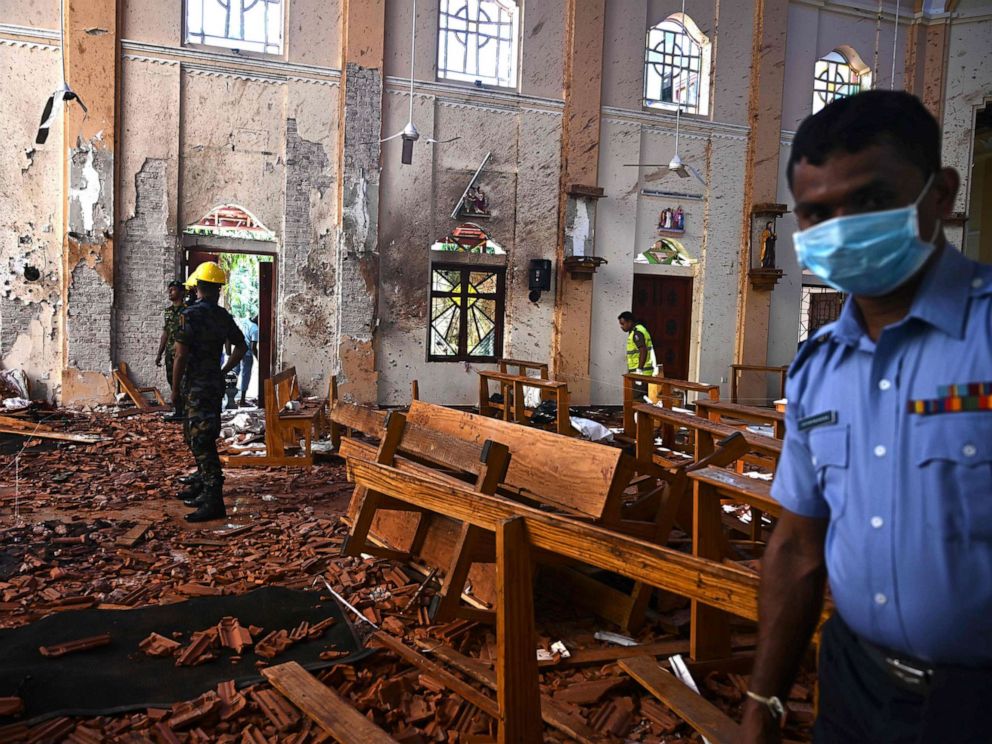
Security personnel inspect the interior of St Sebastian's Church in Negombo.
On Easter Sunday, as Christians in Sri Lanka gathered to celebrate the resurrection of Our Lord, Muslim terrorists blew up three churches, killing more than 200 Christians.[2] In March, 120 Christians were killed by Muslim militants in Nigeria.[3] In both of these cases, major news agencies, such as the BBC, and fact-checking websites like Snopes.com said that these incidents were not necessarily due to the religious persecution of Christians. Rather, the church bombings in Sri Lanka were more about terrorism to achieve political goals, and the deaths in Nigeria were because of ongoing regional conflicts. Nevertheless, the Christians in those places are dead at the hands of people who wanted them dead because of their faith in Christ. Moreover, Christians around the world are increasingly marginalized, prohibited by law in many Islamic countries from practicing their faith, and under the threat of imprisonment or death if they are discovered.[4] Hate speech laws in Great Britain and Canada threaten the free exercise of religion, jailing preachers who call homosexuality a sin.[5] Praise be to God that, for the time being, the First Amendment prohibits Congress from making any law respecting an establishment of religion, or prohibiting the free exercise thereof, or abridging the freedom of speech, hurt feelings or offended sensibilities notwithstanding. But the United States is the exception, not the rule. Christians today are in the same situation as Christians during the 1st Century.
Persecution of Christians, and the rest of the world’s disinterest/participation in it, should not surprise us. Jesus said that these things would happen at the end of the age:
“Then they will deliver you up to tribulation and kill you, and you will be hated by all nations for my name’s sake. And then many will be offended, will betray one another, and will hate one another. Then many false prophets will rise up and deceive many. And because lawlessness will abound, the love of many will grow cold. But he who endures to the end shall be saved.”[6]
But, even though the love of many grows cold in these last days, we Christians are called to love even more. We are called to love our neighbors as ourselves; we are called to love one another; we are called to love God:
Beloved, let us love one another, for love is of God; and everyone who loves is born of God and knows God. He who does not love does not know God, for God is love. In this the love of God was manifested toward us, that God has sent His only begotten Son into the world, that we might live through Him. In this is love, not that we loved God, but that He loved us and sent His Son to be the propitiation for our sins. Beloved, if God so loved us, we also ought to love one another.[7]
Not only ought we to love one another, we want to; we now have the ability to do so. Because we have put on Christ in our baptism, we have died with Him, and will be raised with Him. We are a new creation, with the Holy Spirit living in us. Our New Man desires the things that God desires, including a desire to love our neighbor as ourself.
How do we do this? We care for our neighbor and help him meet his bodily needs; we bless those who curse us; we do good to those who hate us; we pray for those who spitefully use and persecute us.[8] We proclaim to our neighbor the Gospel, the good news of how, while we were still sinners and God’s enemies, Christ died for the ungodly:[9] That Christ was born, God in human flesh; that He died, the Lamb of God who takes away the sin of the world; and that He rose again from the dead for our justification. We call sinners to repentance. We boldly and lovingly proclaim this Gospel to those in whose midsts God has put us according to our vocations. When we fall short, we repent; we confess our sins and rejoice in God’s forgiveness in Christ, and continue to struggle to put to death our flesh and it’s sinful desires.
And, when persecution comes, we do not despair. We endure it with patience; we continue to confess our faith. We follow the example of Peter and John who, when commanded by the government not to proclaim the Gospel said,
“We ought to obey God rather than men. The God of our fathers raised up Jesus whom you murdered by hanging on a tree. Him God has exalted to His right hand to be Prince and Savior, to give repentance to Israel and forgiveness of sins. And we are His witnesses to these things, and so also is the Holy Spirit whom God has given to those who obey Him.”[10]
And we do this joyfully, knowing that in the world we have trouble, but Christ has overcome the world.[11] No matter what things may look like to us now, we know that the Church, Christ’s Body, is under His protection and control.
And take they our life,
Goods, fame, child, and wife,
Though these all be gone,
Our victory has been won;
The Kingdom ours remaineth.[12]
Even if we lose everything we have on this earth, including our lives, the gates of Hell shall not prevail against Christ’s Church. On the Last Day Christ will raise me and all the dead, and give eternal life to me and all believers in Christ. This is most certainly true.


Bibliography

Blake, Heidi. "Christian Preacher Arrested for Saying Homosexuality Is a Sin." The Telegraph, May 2, 2010. Accessed June 27, 2019.
https://www.telegraph.co.uk/news/religion/7668448/Christian-preacher-arrested-for-saying-homosexuality-is-a-sin.html. Dale McAlpine was charged with causing “harassment, alarm or distress” after a homosexual police community support officer (PCSO) overheard him reciting a number of “sins” referred to in the Bible, including blasphemy, drunkenness and same sex relationships...Police officers are alleging that he made the remark in a voice loud enough to be overheard by others and have charged him with using abusive or insulting language, contrary to the Public Order Act.
"Christian Persecution Today." Open Doors USA. Accessed June 27, 2019. https://www.opendoorsusa.org/christian-persecution/.
Durrani, Temur. "Pastor Charged with Causing a Disturbance in Toronto's Gay Village." The Star, June 5, 2019. Accessed June 27, 2019. 
https://www.thestar.com/news/gta/2019/06/05/pastor-charged-with-causing-a-disturbance-in-torontos-gay-village.html. A 39-year-old pastor was charged with causing a disturbance in the city’s Gay Village, Toronto police said Wednesday, after he took to the streets to preach pro-Christian messages to passersby a day before.
Luther, Martin. “A Mighty Fortress Is Our God.” stz. 4. Lutheran Worship. St. Louis: Concordia, 1986. Hymn #298.
Smith, Samuel. "120 People Killed, 140 Homes Destroyed by Nigeria Fulani since February." The Christian Post, March 15, 2019. Accessed June 27, 2019.
"Sri Lanka Attacks: More than 200 Killed as Churches and Hotels Targeted." BBC News. April 21, 2019. Accessed June 27, 2019. https://www.bbc.com/news/world-asia-48001720.
Winsor, Morgan, and Dragana Jovanovic. "ISIS Claims Responsibility for Sri Lanka Easter Bombings That Killed over 350." ABC News. April 23, 2019. Accessed June 27, 2019. https://abcnews.go.com/International/isis-claims-responsibility-sri-lanka-easter-bombings-killed/story?id=62570339.
Wintour, Patrick. "Persecution of Christians 'coming Close to Genocide' in Middle East - Report." The Guardian, May 2, 2019. Accessed June 27, 2019. 


[1] Open Doors USA, “Christian Persecution Today,” Open Doors USA, 2019, https://www.opendoorsusa.org/christian-persecution/.
[2] BBC, “Sri Lanka Attacks: More than 200 Killed as Churches and Hotels Targeted,” BBC News, April 21, 2019. https://www.bbc.com/news/world-asia-48001720.
Morgan Winsor, and Dragana Jovanovic. "ISIS Claims Responsibility for Sri Lanka Easter Bombings That Killed over 350." ABC News. April 23, 2019. https://abcnews.go.com/International/isis-claims-responsibility-sri-lanka-easter-bombings-killed/story?id=62570339.
[3] Samuel Smith. "120 People Killed, 140 Homes Destroyed by Nigeria Fulani since February." The Christian Post, March 15, 2019. https://www.christianpost.com/news/120-people-killed-140-homes-destroyed-by-nigeria-fulani-since-february.html.
[4] Patrick Wintour, "Persecution of Christians 'coming Close to Genocide' in Middle East - Report," The Guardian, May 2, 2019. https://www.theguardian.com/world/2019/may/02/persecution-driving-christians-out-of-middle-east-report.
[5] Heidi Blake, "Christian Preacher Arrested for Saying Homosexuality Is a Sin." The Telegraph, May 2, 2010. https://www.telegraph.co.uk/news/religion/7668448/Christian-preacher-arrested-for-saying-homosexuality-is-a-sin.html.
Durrani, Temur Durrani, "Pastor Charged with Causing a Disturbance in Toronto's Gay Village." The Star, June 5, 2019. https://www.thestar.com/news/gta/2019/06/05/pastor-charged-with-causing-a-disturbance-in-torontos-gay-village.html.
[6] Matthew 24:9-13
[7] 1 John 4:7-11
[8] Matthew 5:43-48; 6:1-4
[9] Romans 5:6-11
[10] Acts 5:29-32
[11] John 16:33
[12] Martin Luther, “A Mighty Fortress,” stz. 4.

Monday, December 3, 2018

Hidden Things Revealed to Babes

At that time Jesus answered and said, “I thank You, Father, Lord of heaven and earth, that You have hidden these things from the wise and prudent and have revealed them to babes (Matthew 11:25).

“These things” of which Jesus speaks, are His teachings, the truth of the Gospel. That as Moses lifted up the serpent in the wilderness, so must the Son of Man be lifted up, that whoever believes in Him should not perish, but have eternal life.[1] These things are the things which Jesus heard from His Father.[2] Jesus’ teachings are not something new. They have always been God’s teachings. Jesus demonstrates this in the synagogue, when he took up the scroll of Isaiah to read: The Spirit of the LORD is upon Me, Because He has anointed Me to preach the gospel to the poor; He has sent Me to heal the broken-hearted, To proclaim liberty to the captives And recovery of sight to the blind, To set at liberty those who are oppressed; To proclaim the acceptable year of the LORD.” Then He closed the book and gave it back to the attendant and sat down. And the eyes of all who were in the synagogue were fixed on Him. And he began to say to them, “Today this Scripture is fulfilled in your hearing.”[3] His proclamation was met with anger, and the people tried to throw Jesus off a cliff. It was unacceptable and ridiculous to them that Jesus, the carpenter’s son, the son of Mary, the brother of James, Joses, Simon, and Judas, could be the fulfillment of God’s promise to redeem mankind.[4]

From before the foundation of the world, God the Father decided to save man in Christ. Indeed, God the Father chose us in Christ before the foundation of the world, that we should be holy and without blame before Him in love.[5] He revealed His plan to save mankind from sin, death, and the devil, after Adam and Eve transgressed in the Garden. He told them that the serpent would strike the heel of the woman’s seed; but He, the promised Seed, would crush the serpents head; the Seed would be injured, but He would deal Satan a mortal wound. Then, God killed animals and clothed Adam and Eve with the skins, showing them that only the shedding of blood could cover the shame of their sin. Adam and Eve believed God’s promise of redemption and ultimate victory. They faithfully looked for the promised Seed who would defeat the devil and set everything right. They taught their children this promise as well; some continued in it, some rejected it. Those who were faithful looked forward, though they didn’t know it, to that which would be fulfilled in Jesus, His birth, death, and resurrection.

And God chose to preserve and transmit His Gospel in the lowly, foolish, and despised things of this world. He hid them from the wise, that is, those who are wise according to their own imaginings; He revealed it to babes, those who are helpless, have no knowledge of their own, and are generally viewed by the world as weak and unimportant – not kings and princes, but shepherds, criminals, and fishermen. He chose Abraham, a pagan nomad, to become the father of Israel, the people out of whom the promised Seed would come. He chose as His prophet, not a king, but Moses, a slave and a murderer. When the time came for the promise to be fulfilled, Jesus, the promised seed of the woman, and of Abraham, wasn’t born in a king’s palace, as the Magi expected.[6] He was born in a humble house, and laid in a manger. Though His earthly parents were of the line of David the king, that royal glory had faded. They were a lowly maiden and a humble carpenter, not royalty. We call His time on earth His state of humiliation, but it is better described by Paul, as he calls us to emulate Christ’s self-sacrificial nature: Let this mind be in you which was also in Christ Jesus, who being in the form of God, did not, consider it robbery to be equal with God, but made Himself of no reputation, taking on the form of a bondservant, and coming in the likeness of men. And being found in appearance as a man, He humbled Himself and became obedient to the point of death, even the death of the cross.

He comes to us today in humble ways, to bring us the promise. He has bound His promise of forgiveness and eternal life to the preaching of His word, which creates faith in men, who are dead in trespasses, and who are by nature children of wrath. He has bound His promise to the waters of baptism, through which we are buried with Christ; He has bound His promise to bread and wine by which means we eat His body and drink His blood, as He tells us to do, for the remission of sins. Along with Jesus, and His mother Mary, we give thanks to God for the salvation He has given to men in Christ; we marvel with Mary that He has scattered the proud in the imagination of their hearts, that He has put down the mighty from their thrones, and exalted the lowly.[7]


[1] John 3:14-15
[2] John 15:15
[3] Luke 4:18-21
[4] Matthew 13:55
[5] Ephesians 1:4
[6] Matthew 2:1-12
[7] Luke 1:51-52

Tuesday, April 17, 2018

Life and Judgment Are Through the Son

Most assuredly, I say to you, the hour is coming, and now is, when the dead will hear the voice of the Son of God; and those who hear will live. For as the Father has life in Himself, so He has granted the Son to have life in Himself, and has given Him authority to execute judgment also, because He is the Son of Man. Do not marvel at this; for the hour is coming in which all who are in the graves will hear His voice and come forth—those who have done good, to the resurrection of life, and those who have done evil, to the resurrection of condemnation. I can of Myself do nothing. As I hear, I judge; and My judgment is righteous, because I do not seek My own will but the will of the Father who sent Me (John 5:25-30).

When Jesus healed the man at the pool of Bethesda, the Jewish leaders were provoked to commit murder when Jesus defended His Sabbath-day healings by invoking God the Father: My Father has been working until now, and I have been working. This only made them angrier at Jesus than they had already been because of His alleged Sabbath-breaking. Jesus called YAHWEH, the God of Abraham, Isaac, and Jacob, His Father. Jesus was claiming to be God, just like YAHWEH. The Jews understood what Jesus was saying here, even if we don’t. That’s why they sought all the more to kill Him. Sometimes liberal theologians, who do not respect the authority of Scripture, teach that Jesus never claimed to be God. A common argument is that the concept of Jesus’ divinity developed over time; the Gospels were written many, many years after Jesus’ death, so there was plenty of time for a god-myth to develop around Jesus. Christendom understands the truth. The Gospels were written early; there are many logical and rational reasons to accept them as authentic and trustworthy. Much ink has been spilled to demonstrate this point. We don’t believe the things contained in Holy Scripture, however, because of good scholarship about it’s origins. We believe Holy Scripture because it is God’s Word, and the Holy Spirit has granted us repentance and faith, working through it.[1]

Evidence for the reliability of Scripture is good to know and present. We Christians are called to give a reason for our hope, with meekness and fear.[2] We must remember, however, that no one can be reasoned into the faith by an apologetic argument. Faith is a gift of God. And, while we give our reasons with meekness and fear, we are to confidently proclaim the Gospel: that Christ died for our sins, that He was buried, and that He rose again the third day according to the Scriptures.[3] The Gospel is less a persuasive speech to be logically presented than it is a royal proclamation to be boldly declared. The Jews saw Jesus’ miracles. They heard His word. They rejected Him. He came to His own, and His own did not receive Him.[4] Just as everlasting life is God’s gift to those who hear Jesus’ word, and believe in Him who sent Jesus, those who reject Him will receive judgment and condemnation. The spiritually dead hear the voice of Jesus through water and the word and are made spiritually alive.[5] Their sins are washed away, and they are buried with Christ by baptism into His death; they will also participate in His resurrection, and be raised to eternal life, physically.[6] Those who reject Christ are already spiritually dead. They will be raised to everlasting death and condemnation.

I cannot, by my own reason or strength believe in Jesus Christ, my Lord, or come to Him. The Holy Spirit must call me by the Gospel. The Holy Spirit must, through the means of the Gospel, God’s Word, gather, enlighten, and sanctify. The Holy Spirit, by the proclamation of the Gospel, builds the Christian Church as He sees fit. It is the Holy Spirit who, by His working through Water and Word, causes us to confess that Jesus is Lord, to the glory of God the Father.[7]


[1] Romans 10:17; Ephesians 2:8; 2 Timothy 2:25
[2] 1 Peter 3:15
[3] 1 Corinthians 15:3-4
[4] John 1:11
[5] Ephesians 5:25-28
[6] Acts 22:16; Romans 6:3-5; 1 Corinthians 15:35-54
[7] 1 Corinthians 12:3; Philippians 2:11

Monday, March 19, 2018

Test Yourselves

Examine yourselves as to whether you are in the faith. Test yourselves. Do you not know yourselves, that Jesus Christ is in you?—unless indeed you are disqualified (2 Corinthians 13:5).

There has lately arisen a discussion among friends as to the meaning of Paul’s words here. Taken from their context, they are used by preachers of dubious education and intent to call their hearers to do good works, and judge their Christianity by their behavior. If you’re a Christian, you’ll exhibit the fruits of the Spirit; you won’t drink, smoke, or chew, or go with girls who do. But is that what Paul is saying here? Is that the type of test he is talking about?

We have to understand Paul’s words here, as always when we try to understand the words of Scripture, in their context. Paul is answering the Corinthian congregation’s demand that he prove his words are from Christ. They have been influenced by outside teachers, and now they doubt Paul’s veracity. They want to see his credentials, so to speak. His response to them is that they, rather then he, need to put themselves to the test. Paul isn’t talking about some legalistic morality test. He isn’t instructing them to examine their “faith-walk” by looking at how nicely they behave toward others, so that they will cultivate good behavior and have a closer, more personal relationship with Jesus. He is telling them to examine their doctrine. He wants them to look at what they believe, teach and confess, and see if it lines up with what he, and the Scriptures, taught them to believe.

This is essentially the same thing Paul told the faithful Timothy. Take heed to yourself and to the doctrine. Continue in them, for in doing this you will save both yourself and those who hear you.[1] In his letter to Timothy, Paul encourages Timothy to continue teaching true doctrine. Writing to the Corinthians, Paul is warning them to test their doctrine, to see if they have strayed from the truth.

Paul begins this portion of his letter with his concerns for their faithfulness. Paul betrothed the Corinthians to the bridegroom, Christ, as a chaste virgin. Now he is worried that their minds may be corrupted from the simplicity that is in Christ.[2] They have put up with the preaching of another, counterfeit Jesus, spirit, and gospel. So, how does he expect the Corinthians to test themselves? Scripture tells us. When Paul went to Berea and preached in the synagogue, the Bereans received the word that Paul preached; they searched the Scriptures daily to find out whether the things Paul preached were so.[3] Scripture, the Word of God, is and should remain the only rule and norm of all doctrine. Everything should be subjected to God’s Word.[4]

Paul seems confident that the Corinthians will pass the test. He bids them farewell as brethren; he tells them to become complete, to be of good comfort, to be of one mind, and to live in peace. These are good directions for we Christians living today. We should also examine ourselves as to whether we are in the faith. This examination is one of doctrine, rather than behavior. Do we profess that Christ died for our sins according to the Scriptures, and that He was buried, and that He rose again the third day according to the Scriptures?[5] Do we teach Christ’s disciples to observe all things that He has commanded, as Jesus said to his Apostles after His resurrection?[6] Or, do we put up with another Jesus, another spirit, and another gospel? We must test our doctrines against Holy Scripture.


[1] 1 Timothy 4:16
[2] 2 Corinthians 11:1-4
[3] Acts 17:10-12
[5] 1 Corinthians 15:1-11
[6] Matthew 28:16-20

Thursday, March 15, 2018

Judas Hangs Himself

When morning came, all the chief priests and elders of the people plotted against Jesus to put Him to death. And when they had bound Him, they led Him away and delivered Him to Pontius Pilate the governor. Then Judas, His betrayer, seeing that He had been condemned, was remorseful and brought back the thirty pieces of silver to the chief priests and elders, saying, “I have sinned by betraying innocent blood.” And they said, “What is that to us? You see to it!” Then he threw down the pieces of silver in the temple and departed, and went and hanged himself (Matthew 27:1-5).

Judas must have been following the events of Jesus’ trial from afar, as did Peter. As he watched what was happening, the full weight of his sin sunk in. He had betrayed innocent blood. For the price of 30 pieces of silver, Judas sold Jesus into death. We don’t really know why Judas did what he did, except for St. Luke’s explanation that Satan entered into him.[1] When he turns to the Chief Priests in his remorse over his sin, he does not receive absolution. They tell him that he must deal with his sin on his own. What is that to us? You see to it!

Judas wasn’t the only one of Jesus’ disciples to betray Him. When the Shepherd was struck, all of the sheep were scattered, most notably Peter. Jesus told His disciples that they would all fall away. Peter tells Jesus he will not fall away, even if it means death. The other disciples agree. Jesus assures Peter that he will deny Jesus before the cock crows twice. This he does, with oaths, calling down curses on himself. And, when the cock crowed the second time, and Jesus turned to look at Peter, Peter remembered Jesus’ words. He went away and wept bitterly.[2] Peter realized what he had done; the full weight of his sin sunk in. Later, the risen Christ would absolve and restore him.[3]

Why the different outcomes for Judas and Peter? They both committed the same sin. They denied Christ. They both betrayed Him. Why did Judas end up dead by his own hand, burst open in a field with his guts spilling out,[4] and Peter end up in his usual place as leader of the disciples? Did Jesus not, by His holy, precious blood, and His innocent suffering and death, purchase and win all mankind from sin, death, and the devil? Both men felt sorry for their sin; Judas turned to the Chief Priests for a remedy for his sin. The Law however, whom these men represent, doesn’t fix sin; the purpose of the Law is to show us our sin.[5] The Law always accuses. It crushes the sinner under it’s weight. Judas, despairing under the weight of his sin, took the advice of the Chief Priests: He saw to it himself. Peter did not see to his sin himself. Christ dealt with it. Peter came to Christ, and heard authentic absolution. Only Christ is able to give us that. To seek remedy for our sin from any other source than Christ is to betray and reject Him. It is to reject the gift of forgiveness He gives to us, as Judas did. Such rejection and denial can only end, as it did for Judas, in despair and death.


[1] Luke 22:3; John 13:27
[2] Luke 22:54-62
[3] John 21:15-19
[4] Acts 1:18
[5] Romans 3:20

Saturday, May 13, 2017

Luther's Sermon for the First Sunday After Trinity

In a sermon on 1 John 4, Luther addresses those pastors and people who wrongly imagine that they can preach and listen only to the Gospel apart from the rebuke and admonition of the Law:

YOU have often heard and are now hearing the complaint, which is universal in all the world, that when human beings hear the preaching of faith about the remission of sins, they embrace it, because it is a delightful preaching: God has sent His Son for you. But when it is said that you must adorn your faith to the praise of God, and sins are rebuked, no one wants to hear anything more.

In towns everywhere, people distinguish among preachers. “This one is a fine preacher, who talks about grace and mercy; and what is even finer, he does not scold anyone or frighten people.” That is the way people commonly talk and act. If he does rebuke [sins], they undertake to have him removed. Therefore, many [of these preachers] have returned to us.

When you are scolded as a usurer, adulterer, or whatever kind of swine you are, or [it is said] that a peasant, a townsman, or a nobleman is godless, no one will suffer that. “But if I am a usurer, adulterer, swindler, and [the preacher] does not scold me, ah, what a pious man he is!”

[Are you] really righteous because I [do not] rebuke your vices? Then let the devil be [your] preacher. If I see peasants, townsmen, noblemen and do not chastise them, then I will go to the devil along with you. For [God says in] Ezekiel 3 [:18]: “I will require [their] blood at your [hands],” and they themselves will go to the devil. You shall give an account of yourself. I will not be responsible for that in the hour of death or of judgment. Rather, I shall declare what is contrary to the commandment, and then if you do not obey, you do it at your own peril.

. . . Surely an upright [Christian] gladly hears an admonition to faith, not to be greedy or a usurer, and he amends himself. I would want a brother to admonish me when I go astray. But they refuse to tolerate anyone who rebukes them [even] in general. When I say that usurers belong to the devil, why do you cry out? It is because you yourself are guilty. If you want to know which dog has been struck, it is the one who cries out.8 Therefore, you are accusing yourself, if you grumble, and are defaming yourself. As Cicero says, when vices are rebuked in general terms, whoever becomes angry at it shows himself to be guilty.

Whoever cannot bear it when unbelief is rebuked along with the fruits of unbelief, he is most certainly the dog who has been struck. But this is the purpose for which they want to misuse the Gospel: that they may do whatever they want, and the preachers should confirm it and so be cast down to hell along with them, or else we should nullify the Gospel and the ministry [of the Word], etc., [saying,] “Oh, it is all the same; do whatever you want and you will be saved!”

The Word must be unbound [cf. 2 Tim. 2:9]. It must be freely preached. Human nature has been corrupted by unbelief, which brings its fruits along with it. Therefore, sins must be rebuked, as in the Ten Commandments, etc. If you don’t want to listen to God, then don’t!

Luther, Martin. “Sermon for the First Sunday after Trinity, 1 John 4:16–21.” Luther’s Works: Sermons V. Ed. & trans. by Christopher Boyd Brown. Vol. 58. Saint Louis, MO: Concordia Publishing House, 2010, pp. 234–235.

Saturday, June 25, 2016

Baptismal Regeneration: A False Gospel?

Caitlyn's Baptism - 2004
St. John's Ev. Luth. Church - Chicago, IL
I am consistently amazed at the visceral reaction of those who deny the efficacy of Baptism to any talk about how Baptism is efficacious. One person wrote a long response to my article, “Three Examples of How Lutherans DenyJustification by Faith Alone: A Response – Part One of Two,” decrying baptismal regeneration as a false gospel, and calling “water baptism” merely a symbol, commanded to be carried out on/by those who are believers. His comments are too long to reproduce here in their entirety (if you want to read them, simply go to the original article and scroll down to the bottom). I will, however, respond to two points the person made, as I think they get to the heart of the matter. Firstly, he writes:

“Water baptism is simply a remembrance. It is not the means of grace through which God provides salvation; that is simply ‘warmed over’ Roman Catholicism. The Bible asserts unambiguously that an unregenerate sinner is justified by faith alone in Christ alone. Trying to assert that water baptism plays any part in regeneration is simply a false gospel. Any ecclesiastical (church) procedure plays no part in justification.”
First, we have to deal with this term “water baptism.” To talk about “water” baptism is akin to talking about “food” eating. There is no baptism without water, as the Greek word “baptizo,” from which we get our word baptism, means to apply water either by immersing, dipping, pouring, or sprinkling[1]. Certainly we hear about things such as the baptism of the Holy Spirit. John the Baptist said that the one to come after him would baptize with the Holy Spirit and with fire[2]. Understanding how language works, though, we know that when one applies a word like baptism (which means “to apply water”) to something which is not water, one understands from context that the speaker is using analogy. Continuing with our food/eating parallel, one might say, after reading an interesting book, “I devoured every word!” One would not mean that he engaged in any type of actual eating. Rather, he is saying that the book was interesting and he read it with enthusiasm. So, we must agree with Paul that there is only one baptism, and can dispense with the rather annoying and theologically loaded term “water baptism.”

There is one body and one Spirit, just as you were called in one hope of your calling; one Lord, one faith, one baptism; one God and Father of all, who is above all, and through all, and in you all (Ephesians 4:4-6).
Second, I understand what this person thinks they are trying to say, but he misses the mark. Perhaps this is just me knit-picking, but the Bible does not assert that “an unregenerate sinner is justified by faith alone in Christ alone.” I know this, because what this person is attempting to use in his argument, though he may not realize it, are the “solas” which came from Luther's theology and the Lutheran Reformation (you’re welcome, by the way). As I stated in the original article, Paul says we are saved by grace, through faith in Christ, and even this faith does not come from us. Back to Ephesians two, yet again:

For by grace you have been saved, through faith, and that not of yourselves; it is the gift of God (Ephesians 2:8).
So, how does that faith, which is God’s gift, get to us, since it isn’t by work, so that men are deprived of boasting? It comes through his means – His Word. And, when God couples his word of promise with a physical element…voila! You get a sacrament. When God couples water and his word of promise, you get Holy Baptism, which is the washing of regeneration.

For we ourselves were also once foolish, disobedient, deceived, serving various lusts and pleasures, living in malice and envy, hateful and hating one another. But when the kindness and the love of God our Savior toward man appeared, not by works of righteousness which we have done, but according to his mercy he saved us, through the washing of regeneration and renewing of the Holy Spirit whom he poured out on us abundantly through Jesus Christ our Savior, that having been justified by his grace we should become heirs according to the hope of eternal life (Titus 3:3-7).
So, you may say all day long that baptism is simply a remembrance and that it is not a means of grace. I challenge you to show me in Scripture where it says such a thing. You cannot. I, on the other hand, can, as countless orthodox Christian theologians have for 2,000 years, point to the words of St. Peter:

There is also an antitype which now saves us – baptism (not the removal of the filth of the flesh, but the answer of a good conscience toward God), through the resurrection of Jesus Christ (1 Peter 3:21).
Emma's Baptism - 2006
Immanuel Ev. Luth. Church - Hodgkins, IL
Did you catch that? Peter says that baptism now saves us! And he clarifies, just so we don’t mistakenly think that he means the physical act of washing dirt away by itself. Baptism saves us through the resurrection of Jesus Christ. What wonderful news! If the commenter wants to maintain that, “…to assert that water baptism plays any part in regeneration is simply a false gospel,” he may take that up with the Apostle Peter if he likes. I will cling to the plain reading of the words of Scripture in their context.

That context is the comparison Peter makes between baptism and the flood and Noah’s Ark. Eight people were saved in the ark, “through water,” Peter writes, and in the next sentence likens this salvation (the shadow) to the salvation given by God in baptism, through the resurrection of Jesus. Luther, in his Small Catechism, explains it this way:

How can water do such great things? Answer: It is not the water indeed that does them, but the word of God which is in and with the water, and faith, which trusts such word of God in the water. For without the word of God the water is simple water and no baptism. But with the word of God it is a baptism, that is, a gracious water of life and a washing of regeneration in the Holy Ghost as St. Paul says, Titus, Chapter three…this is a trustworthy saying (Luther 2008).
In the end, it is a question of what you see baptism to be. Is it God’s act, or man’s? Is it something God does to you, or a work of obedience you offer to God? Scripture is clear that baptism is God’s work, done using the hands of a pastor, and the power of the Holy Spirit, to deliver His gifts to us. It all comes from outside of us.

This brings me to the second point of contention. If baptism is so important in regenerating people, why did Paul say he was not sent to baptize? The commenter writes:

“It is interesting that Christ did not send the apostle Paul, his chief evangelist, to baptize, isn’t it? Instead, he was sent to preach the gospel. That is where the power is…in the gospel, not water.”
My friend, you and I agree. The gospel of Christ is the power of God to salvation for everyone who believes[3]. As we have discussed previously, that is why baptism is able to work forgiveness of sins, deliver from death and the devil, and give eternal salvation to all who believe this: It is not simple water only, but it is the water comprehended in God’s command and connected with God’s word! That Gospel, of which we are not ashamed, is the power working in baptism.

Yes, Paul did write that he was not sent to baptize. He was, as he says sent to preach the Gospel. Here is the entire passage in context:

Now I plead with you, brethren, by the name of our Lord Jesus Christ, that you all speak the same thing, and that there be no divisions among you, but that you be perfectly joined together in the same mind and in the same judgment. For it has been declared to me concerning you, my brethren, by those of Chloe’s household, that there are contentions among you. Now I say this, that each of you says, “I am of Paul,” or “I am of Apollos,” or “I am of Cephas,” or “I am of Christ.” Is Christ divided? Was Paul crucified for you? Or were you baptized in the name of Paul? I thank God that I baptized none of you except Crispus and Gaius, lest anyone should say that I had baptized in my own name. Yes, I also baptized the household of Stephanas. Besides, I do not know whether I baptized any other. For Christ did not send me to baptize, but to preach the gospel, not with wisdom of words, lest the cross of Christ should be made of no effect (1 Corinthians 1:10-17).
Paul did not baptize. He was sent to preach. Well, except for Crispus and Gaius…and also Stephanas’ household…and maybe some others he doesn’t recall…but he didn’t baptize! Paul is addressing the issue of sectarianism among the Corinthians and he is making the point that it’s good he didn’t personally baptize a bunch of people, otherwise these wretched Corinthians might say he was doing it to gain a following. Certainly Paul is not saying that his mission was only to preach separate and apart from baptism. Paul’s mission is the same as that of the other Apostles:

Then the eleven disciples went away into Galilee, to the mountain which Jesus had appointed for them. When they saw Him, they worshiped Him; but some doubted. And Jesus came and spoke to them, saying, “All authority has been given to Me in heaven and on earth. Go therefore and make disciples of all the nations, baptizing them in the name of the Father and of the Son and of the Holy Spirit, teaching them to observe all things that I have commanded you; and lo, I am with you always, even to the end of the age.” Amen (Matthew 28:16-20).
So, the disciples are sent here by Jesus to baptize and teach, but not to preach? Right, that was going to be Paul’s job…how absurd. Jesus gave the same mission to all the Apostles. The baptizing, preaching, and teaching can’t be separated out and any one thing omitted, because it is all part of them delivering the means of grace – God’s Word – to unregenerate sinners so that God could, by the power of His Spirit, do his work of making these sinners into regenerate Christians, when and where he willed to do so.

God comes to we who are spiritually dead from outside of ourselves, by means. Jesus is delivered to us through the external word, whether by reading, preaching, or through the Sacraments. The Holy Spirit uses those means, as he wills, to create believers out of unbelievers or, as the confessions say, willing persons out of unwilling ones. This faith is more than intellectual assent and knowledge and comes to us without our work, through the work of the Holy Spirit. Repentance? Another gift worked in us by God the Holy Spirit, and not something done of our own will.

That’s really as far as I know how to take this, so I’ll end with the words of the Small Catechism (which are really the words of St. Paul, because in this passage, Luther ends by quoting Romans):

What does such baptizing with water signify? Answer: It signifies that the old Adam in us should, by daily contrition and repentance, be drowned and die with all sins and evil lusts, and, again, a new man daily come forth and arise; who shall live before God in righteousness and purity forever. Where is this written? Answer: St. Paul says, Romans, chapter six: We are buried with Christ by Baptism into death, that, like as he was raised up from the dead, by the glory of the Father, even so we also should walk in newness of life (Luther 2008).


Works Cited

Catholic Answers. "Baptism: Immersion Only?" Catholic Answers. August 14, 2004. http://www.catholic.com/tracts/baptism-immersion-only (accessed June 22, 2016).

Joersz, Dr. Jerald C. "Baptism: Dunking, Sprinkling, or Pouring?" The Lutheran Church Missouri Synod: News and Information. October 5, 2010. https://blogs.lcms.org/2010/baptism-dunking-sprinkling-or-pouring-10-2010 (accessed June 22, 2016).

Luther, Dr. Martin. "The Small Catechism." The Book of Concord: The Confessions of the Lutheran Church. September 2008. http://www.bookofconcord.org/smallcatechism.php#baptism (accessed June 22, 2016).


[1] According to Strong’s Concordance, baptizo means “submerge” or, literally, “dip under.” It is used in the New Testament, however, to also describe the washing of things which would have been impossible to immerse (such as dining couches), or were not normally washed by being fully submerged under water, (such as the hands of the Pharisees prior to eating). See Mark 7:4; Luke 11:38 (Catholic Answers 2004). One Greek dictionary widely used by translators today gives examples of acceptable ways to translate the term and then says: “such expressions do not necessarily imply the quantity of water, nor the particular means by which the water is applied.” In some churches in Luther’s day the pastor poured water from the baptismal font over the infant’s head. Others immersed an infant three times in the baptismal font. Luther expressed a personal preference for this latter practice because of its symbolic significance (Joersz 2010).  

[2] Matthew 3:11

[3] Romans 1:16