Showing posts with label Constitution. Show all posts

Wednesday, June 26, 2019

Herod's Violence to the Church

Wednesday after the First Sunday after Trinity
Now about that time Herod the king stretched out his hand to harass some from the church. Then he killed James the brother of John with the sword. And because he saw that it pleased the Jews, he proceeded further to seize Peter also. Now it was during the Days of Unleavened Bread. So when he had arrested him, he put him in prison, and delivered him to four squads of soldiers to keep him, intending to bring him before the people after Passover. Peter was therefore kept in prison, but constant prayer was offered to God for him by the church (Acts 12:1-5).
There are many reports of increased violence against Christians all over the world. Persecution of Christians is not something limited to the pages of Holy Scripture, or the history books. So far in 2019, according to Open Doors USA, a non-profit group focused on serving persecuted Christians in more than 60 countries, 4,136 Christians were killed for their faith (an average of 11 per day); 2,625 Christians were detained without trial, arrested, sentenced, and imprisoned; 1,266 churches or other Christian buildings were attacked.[1] Open Doors USA says that persecution of Christians is intensifying in Africa, Asia, and the Middle East. Not surprisingly perhaps, it is Christian women who have the most difficult time, often facing persecution because of both their religion and their sex.
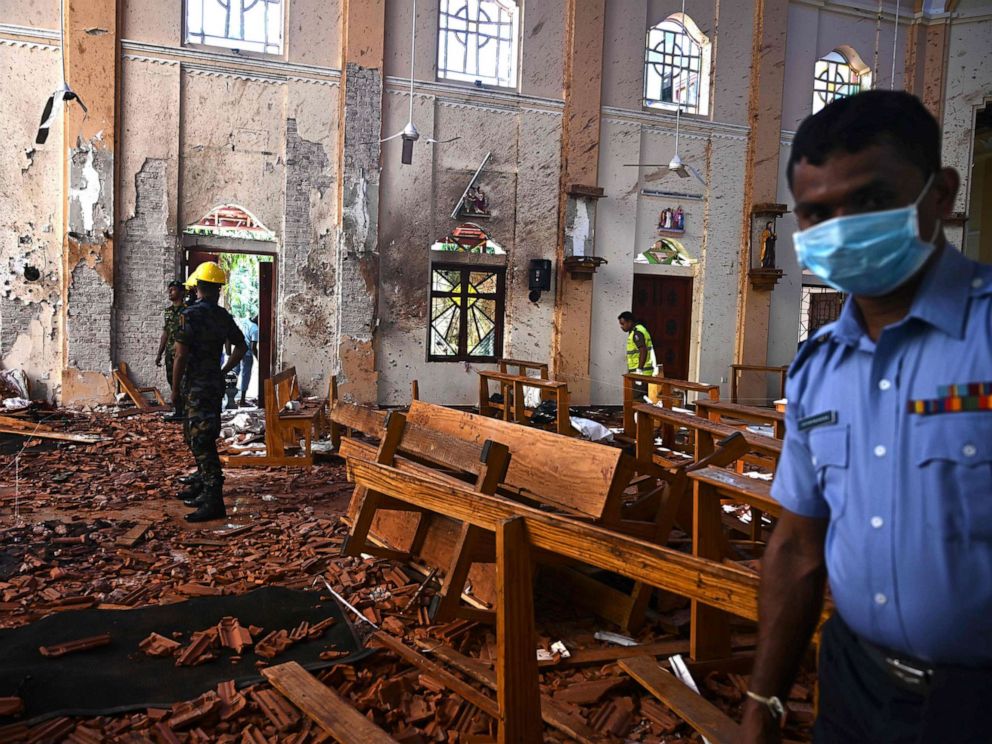
Security personnel inspect the interior of St Sebastian's Church in Negombo.
On Easter Sunday, as Christians in Sri Lanka gathered to celebrate the resurrection of Our Lord, Muslim terrorists blew up three churches, killing more than 200 Christians.[2] In March, 120 Christians were killed by Muslim militants in Nigeria.[3] In both of these cases, major news agencies, such as the BBC, and fact-checking websites like Snopes.com said that these incidents were not necessarily due to the religious persecution of Christians. Rather, the church bombings in Sri Lanka were more about terrorism to achieve political goals, and the deaths in Nigeria were because of ongoing regional conflicts. Nevertheless, the Christians in those places are dead at the hands of people who wanted them dead because of their faith in Christ. Moreover, Christians around the world are increasingly marginalized, prohibited by law in many Islamic countries from practicing their faith, and under the threat of imprisonment or death if they are discovered.[4] Hate speech laws in Great Britain and Canada threaten the free exercise of religion, jailing preachers who call homosexuality a sin.[5] Praise be to God that, for the time being, the First Amendment prohibits Congress from making any law respecting an establishment of religion, or prohibiting the free exercise thereof, or abridging the freedom of speech, hurt feelings or offended sensibilities notwithstanding. But the United States is the exception, not the rule. Christians today are in the same situation as Christians during the 1st Century.
Persecution of Christians, and the rest of the world’s disinterest/participation in it, should not surprise us. Jesus said that these things would happen at the end of the age:
“Then they will deliver you up to tribulation and kill you, and you will be hated by all nations for my name’s sake. And then many will be offended, will betray one another, and will hate one another. Then many false prophets will rise up and deceive many. And because lawlessness will abound, the love of many will grow cold. But he who endures to the end shall be saved.”[6]
But, even though the love of many grows cold in these last days, we Christians are called to love even more. We are called to love our neighbors as ourselves; we are called to love one another; we are called to love God:
Beloved, let us love one another, for love is of God; and everyone who loves is born of God and knows God. He who does not love does not know God, for God is love. In this the love of God was manifested toward us, that God has sent His only begotten Son into the world, that we might live through Him. In this is love, not that we loved God, but that He loved us and sent His Son to be the propitiation for our sins. Beloved, if God so loved us, we also ought to love one another.[7]
Not only ought we to love one another, we want to; we now have the ability to do so. Because we have put on Christ in our baptism, we have died with Him, and will be raised with Him. We are a new creation, with the Holy Spirit living in us. Our New Man desires the things that God desires, including a desire to love our neighbor as ourself.
How do we do this? We care for our neighbor and help him meet his bodily needs; we bless those who curse us; we do good to those who hate us; we pray for those who spitefully use and persecute us.[8] We proclaim to our neighbor the Gospel, the good news of how, while we were still sinners and God’s enemies, Christ died for the ungodly:[9] That Christ was born, God in human flesh; that He died, the Lamb of God who takes away the sin of the world; and that He rose again from the dead for our justification. We call sinners to repentance. We boldly and lovingly proclaim this Gospel to those in whose midsts God has put us according to our vocations. When we fall short, we repent; we confess our sins and rejoice in God’s forgiveness in Christ, and continue to struggle to put to death our flesh and it’s sinful desires.
And, when persecution comes, we do not despair. We endure it with patience; we continue to confess our faith. We follow the example of Peter and John who, when commanded by the government not to proclaim the Gospel said,
“We ought to obey God rather than men. The God of our fathers raised up Jesus whom you murdered by hanging on a tree. Him God has exalted to His right hand to be Prince and Savior, to give repentance to Israel and forgiveness of sins. And we are His witnesses to these things, and so also is the Holy Spirit whom God has given to those who obey Him.”[10]
And we do this joyfully, knowing that in the world we have trouble, but Christ has overcome the world.[11] No matter what things may look like to us now, we know that the Church, Christ’s Body, is under His protection and control.
And take they our life,
Goods, fame, child, and wife,
Though these all be gone,
Our victory has been won;
The Kingdom ours remaineth.[12]
Even if we lose everything we have on this earth, including our lives, the gates of Hell shall not prevail against Christ’s Church. On the Last Day Christ will raise me and all the dead, and give eternal life to me and all believers in Christ. This is most certainly true.


Bibliography

Blake, Heidi. "Christian Preacher Arrested for Saying Homosexuality Is a Sin." The Telegraph, May 2, 2010. Accessed June 27, 2019.
https://www.telegraph.co.uk/news/religion/7668448/Christian-preacher-arrested-for-saying-homosexuality-is-a-sin.html. Dale McAlpine was charged with causing “harassment, alarm or distress” after a homosexual police community support officer (PCSO) overheard him reciting a number of “sins” referred to in the Bible, including blasphemy, drunkenness and same sex relationships...Police officers are alleging that he made the remark in a voice loud enough to be overheard by others and have charged him with using abusive or insulting language, contrary to the Public Order Act.
"Christian Persecution Today." Open Doors USA. Accessed June 27, 2019. https://www.opendoorsusa.org/christian-persecution/.
Durrani, Temur. "Pastor Charged with Causing a Disturbance in Toronto's Gay Village." The Star, June 5, 2019. Accessed June 27, 2019. 
https://www.thestar.com/news/gta/2019/06/05/pastor-charged-with-causing-a-disturbance-in-torontos-gay-village.html. A 39-year-old pastor was charged with causing a disturbance in the city’s Gay Village, Toronto police said Wednesday, after he took to the streets to preach pro-Christian messages to passersby a day before.
Luther, Martin. “A Mighty Fortress Is Our God.” stz. 4. Lutheran Worship. St. Louis: Concordia, 1986. Hymn #298.
Smith, Samuel. "120 People Killed, 140 Homes Destroyed by Nigeria Fulani since February." The Christian Post, March 15, 2019. Accessed June 27, 2019.
"Sri Lanka Attacks: More than 200 Killed as Churches and Hotels Targeted." BBC News. April 21, 2019. Accessed June 27, 2019. https://www.bbc.com/news/world-asia-48001720.
Winsor, Morgan, and Dragana Jovanovic. "ISIS Claims Responsibility for Sri Lanka Easter Bombings That Killed over 350." ABC News. April 23, 2019. Accessed June 27, 2019. https://abcnews.go.com/International/isis-claims-responsibility-sri-lanka-easter-bombings-killed/story?id=62570339.
Wintour, Patrick. "Persecution of Christians 'coming Close to Genocide' in Middle East - Report." The Guardian, May 2, 2019. Accessed June 27, 2019. 


[1] Open Doors USA, “Christian Persecution Today,” Open Doors USA, 2019, https://www.opendoorsusa.org/christian-persecution/.
[2] BBC, “Sri Lanka Attacks: More than 200 Killed as Churches and Hotels Targeted,” BBC News, April 21, 2019. https://www.bbc.com/news/world-asia-48001720.
Morgan Winsor, and Dragana Jovanovic. "ISIS Claims Responsibility for Sri Lanka Easter Bombings That Killed over 350." ABC News. April 23, 2019. https://abcnews.go.com/International/isis-claims-responsibility-sri-lanka-easter-bombings-killed/story?id=62570339.
[3] Samuel Smith. "120 People Killed, 140 Homes Destroyed by Nigeria Fulani since February." The Christian Post, March 15, 2019. https://www.christianpost.com/news/120-people-killed-140-homes-destroyed-by-nigeria-fulani-since-february.html.
[4] Patrick Wintour, "Persecution of Christians 'coming Close to Genocide' in Middle East - Report," The Guardian, May 2, 2019. https://www.theguardian.com/world/2019/may/02/persecution-driving-christians-out-of-middle-east-report.
[5] Heidi Blake, "Christian Preacher Arrested for Saying Homosexuality Is a Sin." The Telegraph, May 2, 2010. https://www.telegraph.co.uk/news/religion/7668448/Christian-preacher-arrested-for-saying-homosexuality-is-a-sin.html.
Durrani, Temur Durrani, "Pastor Charged with Causing a Disturbance in Toronto's Gay Village." The Star, June 5, 2019. https://www.thestar.com/news/gta/2019/06/05/pastor-charged-with-causing-a-disturbance-in-torontos-gay-village.html.
[6] Matthew 24:9-13
[7] 1 John 4:7-11
[8] Matthew 5:43-48; 6:1-4
[9] Romans 5:6-11
[10] Acts 5:29-32
[11] John 16:33
[12] Martin Luther, “A Mighty Fortress,” stz. 4.

Monday, October 19, 2015

A Christian Nation

The Committee of Five:(L to R) John Adams, Roger Sherman,
Robert LivingstonThomas Jefferson, and Benjamin Franklin.
At the beginning of October conservative news outlets were bemoaning the fact that a controversial statue of the 10 Commandments was removed under cover of darkness from the Oklahoma State Capitol grounds, after the Oklahoma Supreme Court ruled that its placement was a violation of state law. On social media the story about the removal of the 10 Commandments statue was juxtaposed against a story about a statue of Baphomet being erected in Detroit (Jenkins 2015). Baphomet, for those who aren’t up on their satanic worship, is a goat-headed representation of Satan. The two stories together were meant to show the change in American culture – from a Christian to a pagan, or at least an immoral, nation.

Some lawmakers have promised to bring the issue of using public money and/or property for religious purposes to the voters (KOCO News 5 2015). These legislators have vowed to introduce such a resolution when the Legislature reconvenes in February. KOCO news in Oklahoma City reports the following:

Its placement at the Capitol prompted requests from several groups to have their own monuments installed, including a satanic church in New York that wanted to erect a 7-foot-tall statue that depicts Satan as Baphomet, a goat-headed figure with horns, wings and a long beard. A Hindu leader in Nevada, an animal rights group and the satirical Church of the Flying Spaghetti Monster also made requests (KOCO News 5 2015).

The Flying Spaghetti Monster
I am certainly no worshipper of Baphomet or the Flying Spaghetti Monster, but this time opponents of the 10 Commandments statue have a point. Either all expressions of religion should be allowed on public property supported by public money, or none should. I tend to lean toward the idea that we should keep the Left and Right hand kingdoms separate. Bruce Prescott, a Baptist minister from Norman, OK who complained the statue violated the state constitution had this to say:

Frankly, I'm glad we finally got the governor and attorney general to agree to let the monument be moved to private property, which is where I believe it's most appropriate…I'm not opposed to the Ten Commandments. The first sermon I ever preached was on the Ten Commandments. I'm just opposed to it being on public property (KOCO News 5 2015).

These cases, we are supposed to believe, illustrate just how far the Christian United States has fallen from the principles of its founding. While the Founding Fathers would certainly be shocked at our careless treatment of the Constitution, the idea that America is a Christian nation just isn't supported by the facts. Certainly Christians were involved in the founding, but so were non-Christian deists and atheists. Also, what I will call American civil religion bears no resemblance to actual Christianity, though it borrows its language and forms. I present four prominent examples from among our Founding Fathers to illustrate my point.

Much is made of the fact that Thomas Jefferson, writer of the Declaration of Independence and third President, published a New Testament. He is often said to have extolled the moral teachings of Jesus as, “…the most sublime and benevolent code of morals which has ever been offered to man” (Monticello n.d.). His work, however, often called the Jefferson Bible, is anything but orthodox. The Jefferson Bible is notable for its exclusion of all of the miracles of Jesus, or anything supernatural. Jefferson literally used a razor to cut out the moral teachings he admired, pasting them into a volume while leaving out such trifles as the Resurrection and any indication that Jesus was Divine (Monticello n.d.). It is not a work that would be accepted by any orthodox Christian body, and could arguably be called blasphemous. The words recorded in Revelation 22:18-19 come to mind[1]; Jefferson will surely have to give an account for removing and discarding God's word in such a manner.

George Washington is rightly considered Father of Our Country, as the nation looked to him to set precedent and offer guidance during the early days of the republic. Perhaps that is the beginning of the confusion and ambiguity regarding America's collective spirituality. The subject of Washington's religion is still hotly debated today. What we know for certain is that Washington was an Anglican. He served as a vestryman and as a church warden. He attended worship services regularly, but very rarely participated in Communion (Neill 1885). He believed that religion was important to public order, morality, and virtue. Washington also believed in prayer as evidenced in his writings, and his presidential executive orders. When speaking about things religious, he often referred to “God,” “heaven,” and “Providence,” but rarely to Christ, something which is also odd for a devout Christian. This is exemplified by Washington’s National Thanksgiving Proclamation on October 3, 1789:

Now therefore I do recommend and assign Thursday the 26th day of November next to be devoted by the People of these States to the service of that great and glorious Being, who is the beneficent Author of all the good that was, that is, or that will be-- That we may then all unite in rendering unto him our sincere and humble thanks--for his kind care and protection of the People of this Country previous to their becoming a Nation--for the signal and manifold mercies, and the favorable interpositions of his Providence which we experienced in the course and conclusion of the late war--for the great degree of tranquility, union, and plenty, which we have since enjoyed--for the peaceable and rational manner, in which we have been enabled to establish constitutions of government for our safety and happiness, and particularly the national One now lately instituted--for the civil and religious liberty with which we are blessed; and the means we have of acquiring and diffusing useful knowledge; and in general for all the great and various favors which he hath been pleased to confer upon us. And also that we may then unite in most humbly offering our prayers and supplications to the great Lord and Ruler of Nations and beseech him to pardon our national and other transgressions-- to enable us all, whether in public or private stations, to perform our several and relative duties properly and punctually--to render our national government a blessing to all the people, by constantly being a Government of wise, just, and constitutional laws, discreetly and faithfully executed and obeyed--to protect and guide all Sovereigns and Nations (especially such as have shewn kindness unto us) and to bless them with good government, peace, and concord--To promote the knowledge and practice of true religion and virtue, and the encrease of science among them and us--and generally to grant unto all Mankind such a degree of temporal prosperity as he alone knows to be best (Washington 1789).

Washington was also a Freemason, something which would not be tolerated, or at the very least be frowned upon, by orthodox Christian bodies today (The George Washington Masonic National Memorial Association, Inc. n.d.). Judging him by his church participation, and putting the best construction on it, Washington was perhaps a grudging Anglican, who saw religion – specifically Christianity - as a way to provide an additional layer of stability for the nation he was integral in creating.

Though he sometimes wrote and spoke in deistic terms, John Adams was a Christian, who professed that Jesus was the redeemer of mankind. He was a Congregationalist, though later in life he became a Unitarian (McCullough 2008). Confessional LCMS pastors would certainly have barred him from receiving the sacrament of the Altar but, in the context of the Founding Fathers, John Adams was a strong Protestant Christian. He argued with atheist Thomas Paine, who derided orthodox Christianity, and Adams viewed the morality of the Christian religion as important to the life of the country (Paine Relief! n.d.).

Benjamin Franklin considered himself a Christian, but stated in his autobiography that he was a deist (Franklin, Franklin's Autobiography 1916). He believed in "virtue" which, to be certain was informed by his Puritan upbringing, but he did not claim any of the spiritual aspects of the Christian faith. In fact, Franklin wrote in his autobiography that he believed the most acceptable service to God was doing good to man (Franklin, Franklin's Autobiography 1916). In 1728 Franklin published a formal statement of his religious beliefs. This statement omitted any mention of the religious dogma one would expect from even a liberal Puritan. Most conspicuous by its absence was any statement of belief in the divinity of Jesus or in the substitutionary atonement. Even a cursory reading of his statement will show that Christian theology played little part in Franklin’s thinking:

I CONCEIVE then, that the INFINITE has created many Beings or Gods, vastly superior to Man, who can better conceive his Perfections than we, and return him a more rational and glorious Praise. As among Men, the Praise of the Ignorant or of Children, is not regarded by the ingenious Painter or Architect, who is rather honour'd and pleas'd with the Approbation of Wise men and Artists. It may be that these created Gods, are immortal, or it may be that after many Ages, they are changed, and Others supply their Places. Howbeit, I conceive that each of these is exceeding wise, and good, and very powerful; and that Each has made for himself, one glorious Sun, attended with a beautiful and admirable System of Planets. It is that particular wise and good God, who is the Author and Owner of our System, that I propose for the Object of my Praise and Adoration (Franklin, Articles of Belief and Acts of Religion 1728).

Franklin, like many people in our day, wanted to claim the label of Christian while redefining Christianity to be rationalism mixed with whatever "spiritual" things tickled his fancy, as well as with a liberal helping of good works. In fact, I believe it to be true that the "Christianity" of America – American civil religion – is a religion of works.

This is not intended to be an exhaustive survey of the religious beliefs of the founders. These examples, however, show what the founders all seemed to have in common, and it wasn't Christianity; it was moralism. Moralism is not Christianity. Luther once commented:

All religions that depart from the true Christian religion are ex opere operato (by the outward act), that is, teach, 'This I will do, and that will please God.' But one must hold fast to the rule that every opus operatum (outward act...work) is idolatrous (Luther 1967).

There are really only two religions in the world - Christianity, and idolatry. Christianity is characterized by fallen, sinful human beings, who are saved by faith in the death and resurrection of Jesus Christ. Idolatry, in particular the worship of self, is characterized by man, feeling some vague need for redemption, attempting to redeem himself through some outward act, or work. This religion of virtue and good works is what united the founders, atheist, deist, and Christian. And, in terms of civil righteousness, one could say that the United States has a morality based on Judeo-Christian principles. The United States is not, however, Christian, and never has been, because Christianity is not a works-based religious system.

The Constitution is a social contract in which the rights of man, given to him by Nature and Nature’s God, are protected and enshrined. Like any other contract, the duties of the parties to that contract are enumerated. For the purpose of keeping civil order, the American civil religion of virtue is sufficient as it basically adopts the second table of the Law as its basis. Theoretically, however, any defined system of morality could be substituted for the base. It is a system which is concerned with behavior and adherence to the rules – whatever those rules might be. It is a religion devoid of Christ. It certainly does not address the primary problem of mankind, which is sin.

The perfect illustration of what I mean is the prayer of the VFW chaplain on Memorial Day, one of the American civil religion’s sacred services:

Almighty God our Heavenly Father, in Your hands are the living and the dead; we give You thanks for all those, our comrades and sisters, who have laid down their lives in the service of our Country. May they rest in peace, and may light perpetual shine upon them. May the good work of seeking justice for the oppressed and peace for all mankind be rewarded with success, that their sacrifices shall not have been in vain. And may we never fail to remember the awesome cost of the freedom which we enjoy (Veterans of Foreign Wars 2012).

Or another:

O Lord God of Hosts, as we gather to honor and pay respects to our comrades and sisters who have departed this life, it is fitting that we remember first our great Nation. You have given us a rich and beautiful land for our heritage. We humbly pray that we may always prove ourselves a people constantly aware of Your favor, and therefore anxious to demonstrate our gratitude in seeking to know and to do Your will. May our land be blessed with honest and productive industry, and a people of integrity who are anxious to learn and willing to respect one another. All this we ask of You, Almighty God, in Your Holy Name (Veterans of Foreign Wars 2012).

To whom are these prayers made? Who is the “Almighty God?” The second prayer makes its petition in “Your Holy Name.” Which name would that be? It doesn’t really matter, as long and it is sufficiently generic to allow all people to insert the god of their choice. Christianity, though, is not a generic religion. It all hinges upon the question, “Who do you say that I am?” to which Peter answered, “You are the Christ, the Son of the Living God.” The American civil religion of virtue which is practiced by well-meaning Christians in the public square does not allow its practitioners to assert Peter’s answer. If they did, they would also have to accept Baphomet and Flying Spaghetti Monster statues. Rather than allow the square to become cluttered with idols, they opt to cleanse Christianity of Christ in an effort to make it acceptable to everyone. They know that the chaplain means Jesus when he says, “…in Your name…” and that’s a work acceptable in their sight.

Christianity, contrary to the American civil religion, is the life and salvation God has given to mankind in and through Jesus Christ. It is the truth that mankind, having been plunged into sin by the disobedience of our first parents Adam and Eve, cannot please God, and are by our very nature sinful and unclean. We deserve nothing but God's wrath and eternal punishment. But God, before mankind ever did anything to merit his favor, graciously atoned for our sin by the death and resurrection of Jesus Christ, and counts as righteous all who believe in Jesus. Moreover, man cannot by his own reason or strength believe in Jesus Christ or come to him. God instead grants man repentance and faith through the working of his word.

There it is, Christianity in a nutshell: The blessed exchange of Christ's righteousness for my sin. This has nothing to do with the religion of morals and virtue to which the majority of our Founding Fathers adhered. Theirs is a religion of works, partially designed to provide stability to a government and society. It also appeals to something deeper in mankind's sinful nature, whether the founders meant to do that or not. The American civil religion of virtue and morality also appeals to our sinful spiritual desire to please God on our own terms, by our own works, rather than through faith in Christ and his work on the cross.

We should not, therefore, lament the decay of the American civil religion of virtue. We certainly should not attempt to establish, through the reimagining of history, a bastardized Christianity, devoid of Christ, as the American civil religion, pretending that our Founding Fathers were pious, churchgoing, orthodox Protestant Christians. We should instead gather regularly around Word and Sacrament. We should pray for our leaders, our nation, and our fellow man. We should deliver the Gospel to them in the context of our vocations, as Christ intends us to.

We should not spend so much time trying to “church up” the court square. Saving faith in Christ cannot come from American civil religion. Faith comes from hearing, and hearing through the word of Christ (Romans 10:17). The word of Christ has no place in American civil religion. Besides causing problems with those among whom we live, setting up a nativity scene – or a 10 Commandments statue – does little to evangelize our neighbors. I’m not saying we should retreat from the public square, just that we shouldn’t allow the Left Hand Kingdom usurp what belongs to the Right Hand Kingdom. We are, after all, free to be faithful, and we must listen to God rather than men. So, when the government attempts to infringe on our right to free expression of religion, or to redefine the meaning of the First Amendment to be freedom of worship, or force us to do something against our conscience, then we must resist. Until that time, though, we must render unto Caesar what is Caesar’s and unto God what is God’s.


Bibliography

Franklin, Benjamin. "Articles of Belief and Acts of Religion." beliefnet.com. 1728. http://www.beliefnet.com/resourcelib/docs/65/Articles_of_Belief_and_Acts_of_Religion_1.html (accessed October 16, 2015).

Franklin, Benjamin. Franklin's Autobiography. New York: Henry Holt and Company, 1916.

Jenkins, Nash. "Hundreds Gather for Unveiling of Satanic Statue in Detroit." Time. July 27, 2015. http://time.com/3972713/detroit-satanic-statue-baphomet/ (accessed October 15, 2015).

KOCO News 5. 10 Commandments Statue Removed from Oklahoma Capitol. Oklahoma City, October 6, 2015.

Luther, Martin. Table Talk. Edited by Theodore G Tappert and Helmut T Lehmann. Vol. 54. Minneapolis: Fortress Press, 1967.

McCullough, David. John Adams. New York: Simon and Schuster, 2008.

Monticello. "The Life and Morals of Jesus of Nazareth." Monticello. http://www.monticello.org/site/research-and-collections/life-and-morals-jesus-nazareth (accessed October 15, 2015).

Neill, Rev. E. D. "Washington's Religion." The New York Times, January 2, 1885.

"Paine Relief!" Classic Works of Apologetics. http://www.classicapologetics.com/special/painerelief.html (accessed October 16, 2015).

The George Washington Masonic National Memorial Association, Inc. "George Washington, The Mason." The George Washington Masonic National Memorial. http://www.gwmemorial.org/washingtonTheMason.php (accessed October 16, 2015).

Veterans of Foreign Wars. "The Chaplains Handbook." Veterans of Foreign Wars. 2012. https://www.vfw.org/OMS/Leadership/05_ChaplainHandbook/2012ChaplainsHandbook.pdf (accessed October 16, 2015).

Washington, George. "Thanksgiving Proclamation." George Washington Papers at the Library of Congress. October 3, 1789. http://memory.loc.gov/ammem/gwhtml/gw004.html (accessed October 16, 2015).


End Notes

[1] I warn everyone who hears the words of the prophecy of this book: if anyone adds to them, God will add to him the plagues described in this book, and if anyone takes away from the words of the book of this prophecy, God will take away his share in the tree of life and in the holy city, which are described in this book (Rev. 22:18-19).

Tuesday, September 1, 2015

Freedom of Worship?

"Freedom of Worship" by Norman Rockwell
And when they had brought them, they set them before the council. And the high priest questioned them, saying, “We strictly charged you not to teach in this name, yet here you have filled Jerusalem with your teaching, and you intend to bring this man’s blood upon us.” But Peter and the apostles answered, “We must obey God rather than men. The God of our fathers raised Jesus, whom you killed by hanging him on a tree. God exalted him at his right hand as Leader and Savior, to give repentance to Israel and forgiveness of sins. And we are witnesses to these things, and so is the Holy Spirit, whom God has given to those who obey him.” When they heard this, they were enraged and wanted to kill them. But a Pharisee in the council named Gamaliel, a teacher of the law held in honor by all the people, stood up and gave orders to put the men outside for a little while. And he said to them, “Men of Israel, take care what you are about to do with these men. For before these days Theudas rose up, claiming to be somebody, and a number of men, about four hundred, joined him. He was killed, and all who followed him were dispersed and came to nothing. After him Judas the Galilean rose up in the days of the census and drew away some of the people after him. He too perished, and all who followed him were scattered. So in the present case I tell you, keep away from these men and let them alone, for if this plan or this undertaking is of man, it will fail; but if it is of God, you will not be able to overthrow them. You might even be found opposing God!” So they took his advice, and when they had called in the apostles, they beat them and charged them not to speak in the name of Jesus, and let them go. Then they left the presence of the council, rejoicing that they were counted worthy to suffer dishonor for the name. And every day, in the temple and from house to house, they did not cease teaching and preaching that the Christ is Jesus (Acts 5:27-42).

The Daily Signal reported on April 30, 2015 that a Republican senator was up in arms over how the Obama Administration was misrepresenting American’s freedom of religion. Senator James Lankford (R-OK) was upset with the Department of Homeland Security’s decision to use the phrase “freedom of worship” instead of “freedom of religion” on the test immigrants take to become naturalized US citizens (Harkness 2015).

Senator Lankford isn’t alone in his concern over what he perceives to be the redefining of the First Amendment. Christian leaders are becoming increasingly concerned that those who oppose them are attempting to redefine the First Amendment’s Free Exercise Clause from an individual protection to an institutional one. Statements such as those from Democratic National Committee Chairwoman Debbie Wasserman-Schultz are cited as evidence.

In an interview with CBN News, Wasserman-Schultz said that “legitimate religious institutions” shouldn’t be forced to conduct same-sex marriages, but religious business owners should not be legally protected under the Free Exercise Clause for “turn[ing] people away based on who they are” (Howerton 2015).

“You shouldn’t be able to turn people away based on who they are. It’s important that no matter who you are, who you love, what the color of your skin is, what your national origin is, we’re a nation of laws. Yes, the marriage equality decision is settled. Love is love and now everyone in America enjoys the protection of the United States Constitution when it comes to who they choose to marry legally,” Wasserman Schultz said. “That doesn’t mean that churches and religious institutions have to conduct same sex marriages and it doesn’t mean that religious institutions aren’t able to practice their own values…But, in this country, we do not allow people to discriminate and that’s [sic] I think is where the important distinction needs to be drawn” (Howerton 2015).

In the past opponents of religion on the Left have attacked the institutional public exercise of religion, such as the erecting of nativity scenes placed on public property, by citing the “separation of church and state.” Now it appears that the tactics have changed. Some of the more smug enemies of religion, Christianity in particular, would cite Bible passages such as Matthew 6:6, “But when you pray, go into your room and shut the door and pray to your Father who is in secret. And your father who sees in secret will reward you,” as did one Facebook friend, attempting to provoke an argument. Far from proving their point, however, this passage from the Sermon on the Mount Jesus was making the point to his disciples that, if the motivation for worshiping God is to be recognized as pious by men, then there is no benefit. Jesus calls us to hide our good works, not to flaunt them for recognition. Quite to the contrary, Christians are called to be faithful witnesses to the world and to “obey God rather than men” (Acts 5:29). But, I digress…

What Wasserman-Schultz seems to be saying is, sure, the Lutheran Church – Missouri Synod doesn’t have to perform same-sex marriages. They are a legitimate religious institution protected by the First Amendment. But you, the individual parishioner, you may not live out your faith in the public square. Consequently, if your conscience will not allow you to be the wedding cake baker for a same-sex wedding celebration, too bad. Evidentially the individual is only free to exercise their religion within the walls of their house of worship. 

The US Constitution does not limit the free exercise of religion to the inside of the church building for an hour on Sunday morning. Christians, along with their fellow citizens of other faiths, have the God-given and constitutionally protected right to live out their faith in the world, conducting themselves in public as their consciences dictate, subject only to infringement under special circumstances or where the State can demonstrate a compelling interest.

Much is made of the fact that there is a “separation of church and state” built into the U.S. Constitution. This is not exactly true, at least not in the way left-wing activists believe it to be. The phrase “separation of church and state” appears nowhere in the U.S. Constitution, and this wall is certainly not one which was intended to bar individuals who practice a religious faith from entering the public square. The term is an offshoot of the phrase, "wall of separation between church and state," written by Thomas Jefferson in a now famous letter to the Danbury Baptist Association in 1802. The original text of President Jefferson’s letter reads, in part: 

"... I contemplate with sovereign reverence that act of the whole American people which declared that their legislature should 'make no law respecting an establishment of religion, or prohibiting the free exercise thereof,' thus building a wall of separation between Church and State” (Jefferson 1802). 

The Danbury Baptist Association wrote to Jefferson of their concerns regarding the lack of explicit protection of religious liberty in their own state constitution, and against a government establishment of religion (The Heritage Foundation n.d.). As a religious minority in Connecticut, the Danbury Baptists were concerned that a religious majority might establish a state religion at the cost of the liberties of religious minorities. Jefferson assured them that the U.S. Constitution would in no way permit such an establishment, and that “…religion is a matter which lies solely between Man & his God, that he owes account to none other for his faith or his worship, that the legitimate powers of government reach actions only, & not opinions…” (Jefferson 1802). This separation of church and state, as understood by Thomas Jefferson at least, had nothing whatsoever to do with public expressions of religion. To Jefferson and the Danbury Baptists, separation of church and state had everything to do with the establishment of a national/state religious body, and avoiding the national/state oppression of religious minorities.

It wasn’t until 1947 that the Supreme Court, albeit nebulously, defined just how the “wall of separation” was to be built. As a result of Everson v. Board of Education of Ewing Township, 330 U.S. 1 (1947)[1], state or local government can not: 1) set up a church, 2) pass laws that aid one religion, all religions, or favor one religion over another, 3) force a person to attend or stay away from church, or believe in any religion, 4) punish a person for holding or professing religious beliefs, 5) levy a tax, in any amount, to support any religious activities or institutions, 6) openly or secretly participate in the affairs of any religious organization, or vice-versa (Everson v. Board of Education 2015). 

Another test established by the Supreme Court, known as The Lemon Test, is based on the case Lemon v. Kurtzman 403 U.S. 602 (1971)[2]. The test consists of three parts: 1) whether the law or conduct has a secular purpose, 2) whether the law or conduct has as its primary or principle effect advancing or inhibiting religion, and 3) whether it fosters an excessive entanglement of government with religion (Lemon v. Kurtzman 2015). 

Additionally, the Court has ruled that public displays of religious symbols, such as the Christian nativity scene or the Jewish menorah, do not constitute a breach of the Establishment Clause when they are all displayed together, and along with secular holiday symbols, in celebration of the national holiday of Christmas[3]. A good example of this is the Christkindlemarkt (Christ child market) which is set up in Daley Plaza every year in Chicago. The clearly Christian event, complete with nativity scene, is set up each year without incident. Alongside the nativity scene each year is a large Jewish menorah. Any citizen or group who wishes to exercise their freedom of religious expression in this public space may do so, and the event is not in breach of the Establishment Clause. Should any religious or secular group be prohibited by government from exercising that freedom of expression at the Christkindlemarkt, it would then violate the Establishment Clause. 

To say that there is no place in American society for public displays of religion or religious symbols, strictly because they are by nature religious, is simply not justified by the U.S. Constitution, or by case law. Justice Antonin Scalia, in his dissenting opinion to the McCreary County, Kentucky, ET. Al. Petitioners v. American Civil Liberties Union of Kentucky ET. Al. case, observed that the same week Congress submitted the Establishment Clause as part of the Bill of Rights for ratification by the States, it enacted legislation providing for paid chaplains in the House and Senate. Justice Scalia goes on to remind his fellow justices that, “The same Congress also reenacted the Northwest Territory Ordinance of 1787, 1 Stat. 50, Article II of which provided: ‘Religion, morality, and knowledge, being necessary to good government and the happiness of mankind, schools and the means of education shall forever be encouraged’” (Scalia 2005). 

And, it should not be overlooked that the First Amendment itself accords religion – and no other manner of belief – special constitutional protection. I am sure that our friends on the Left would not agree that these early actions of Congress are equally valid today, since they generally consider the U.S. Constitution to be a “living, breathing document”, meaning that its interpretation changes as American society changes, and that moral values simply evolve along with society and culture and are therefore not absolute. 

The views of American citizens, however, have not changed significantly where this issue of public expression of religion is concerned. Justice Scalia rightly points out that our Presidents continue to conclude their oath of office with the words, “So help me God.” The Congress opens each session with a prayer; those prayers are lead by official congressional chaplains. The Supreme Court opens its sessions with the prayer “God save the United States and this Honorable Court”. We have the phrase “In God We Trust” on our currency. When we pledge allegiance to the flag of the United States we corporately acknowledge that we are one nation, under God. Justice Scalia finishes his thought thusly:

“As one of our Supreme Court opinions rightly observed, ‘We are a religious people whose institutions presuppose a Supreme Being.’ Zorach v. Clauson, 343 U.S. 306, 313 (1952), repeated with approval in Lynch v. Donnelly, 465 U.S. 668, 675 (1984); Marsh, 463 U.S., at 792; Abington Township, supra, at 213” (Scalia 2005).

That is all well and good for the church as an institution, but what about individual people? Traditionally, without a “compelling interest,” the free exercise of religion by individuals could not be infringed, and the Supreme Court has ruled accordingly in the past.

In, Sherbert v. Verner (1963) the Court held that states must have a "compelling interest" to refuse to accommodate religiously motivated conduct (United States Supreme Court 1963). In this case Adele Sherbert was denied unemployment benefits by South Carolina because she refused to work on Saturdays, something forbidden by her Seventh-day Adventist faith. The Court ruled that the denial of Sherbert’s unemployment benefits was an unconstitutional burden on the free exercise of her religion in a 7-2 decision. This decision resulted in what came to be known as the Sherbert Test. 

The Sherbert Test basically says that, if the government has burdened an individual’s free exercise of religion, it must have done so by confronting that person with a choice which pressures him/her to forego a religious practice by imposing a penalty or withholding a benefit etc. The State, however, may be justified in their infringement of the person’s free exercise if they can show 1) a compelling state interest that justifies the infringement, and 2) no other form of regulation can avoid the infringement and still achieve the State’s ends. The Sherbert Test has been limited and modified in recent years but is still applicable in federal statutes and certain other circumstances (Sherbert v. Verner 2015). 

Since the founding of the country, the Court has understood the free exercise of religion – like the other rights protected in the Bill of Rights – to apply to individuals. People, as individuals, do not simply have a “freedom of worship” in the cloister of their religious buildings or homes. Individuals have the right under the US Constitution to bring their religious beliefs with them into the public square as they live out their everyday lives. As Christians, however, we must be prepared to live according to our consciences even if our government ceases to protect that right, and be joyful to be counted worthy to suffer in the name of Jesus.


Works Cited

"Everson v. Board of Education." Wikipedia. January 30, 2015. https://en.wikipedia.org/wiki/Everson_v._Board_of_Education (accessed August 14, 2015).

Harkness, Kelsey. "US Immigration Exam Replaces 'Freedom of Religion' With 'Freedom of Worship'."

The Daily Signal. April 30, 2015. http://dailysignal.com/2015/04/30/republican-senator-questions-why-immigration-exam-calls-freedom-of-religion-freedom-of-worship/ (accessed August 14, 2015).

Howerton, Jason. "DNC Chair Says This 'Important Distinction' Needs to Be Drawn When It Comes to Religious Freedom." The Blaze. July 8, 2015. http://www.theblaze.com/stories/2015/07/08/dnc-chair-says-this-important-distinction-needs-to-be-drawn-when-it-comes-to-religious-freedom/ (accessed August 14, 2015).

Jefferson, Thomas. "Jefferson's Letter to the Danbury Baptists." The Heritage Foundation. January 1, 1802. http://www.heritage.org/initiatives/first-principles/primary-sources/jefferson-s-letter-to-the-danbury-baptists (accessed August 14, 2015).

"Lemon v. Kurtzman." Wikipedia. July 31, 2015. http://www.oyez.org/cases/1970-1979/1970/1970_89 (accessed August 14, 2015).

Scalia, Justice Antonin. "MCCREARY COUNTY V. AMERICAN CIVIL LIBERTIESUNION OF KY. (03-1693) 545 U.S. 844 (2005) ." Cornell University Law School. June 27, 2005. https://www.law.cornell.edu/supct/html/03-1693.ZD.html (accessed August 14, 2015).

"Sherbert v. Verner." Wikipedia. August 6, 2015. https://en.wikipedia.org/wiki/Sherbert_v._Verner (accessed August 14, 2015).

Supreme Court of the United States. "Everson v. Board of Education." Oyez. http://www.oyez.org/cases/1940-1949/1946/1946_52/ (accessed August 14, 2015).

The Heritage Foundation. "Jefferson's Letter to the Danbury Baptists." The Heritage Foundation. http://www.heritage.org/initiatives/first-principles/primary-sources/jefferson-s-letter-to-the-danbury-baptists (accessed August 2015, 2015).

The Oyez Project at IIT Chicago-Kent College of Law. "Lynch v. Donnelly." Oyez. August 9, 2015. http://www.oyez.org/cases/1980-1989/1983/1983_82_1256#chicago (accessed August 14, 2015).

United States Supreme Court. "Sherbert v. Werner." FindLaw. June 17, 1963. http://caselaw.findlaw.com/us-supreme-court/374/398.html (accessed August 14, 2015).


End Notes

[1] Supreme Court of the United States. “Everson v. Board of Education.” Oyez. http://www.oyez.org/cases/1940-1949/1946/1946_52/ (accessed August 14, 2015).

[2] Supreme Court of the United States. “Lemon v. Kurtzman.” Oyez. http://www.oyez.org/cases/1970-1979/1970/1970_89

[3] “The city of Pawtucket, Rhode Island, annually erected a Christmas display located in the city's shopping district. The display included such objects as a Santa Claus house, a Christmas tree, a banner reading ‘Seasons Greetings,’ and a nativity scene. The creche had been included in the display for over 40 years. Daniel Donnelly objected to the display and took action against Dennis Lynch, the Mayor of Pawtucket…In a 5-to-4 decision, the Court held that notwithstanding the religious significance of the creche, the city had not violated the Establishment Clause. The Court found that the display, viewed in the context of the holiday season, was not a purposeful or surreptitious effort to advocate a particular religious message. The Court found that the display merely depicted the historical origins of the Holiday and had ‘legitimate secular purposes.’ The Court held that the symbols posed no danger of establishing a state church and that it was ‘far too late in the day to impose a crabbed reading of the [Establishment] Clause on the country’" (The Oyez Project at IIT Chicago-Kent College of Law 2015).

Sunday, December 22, 2013

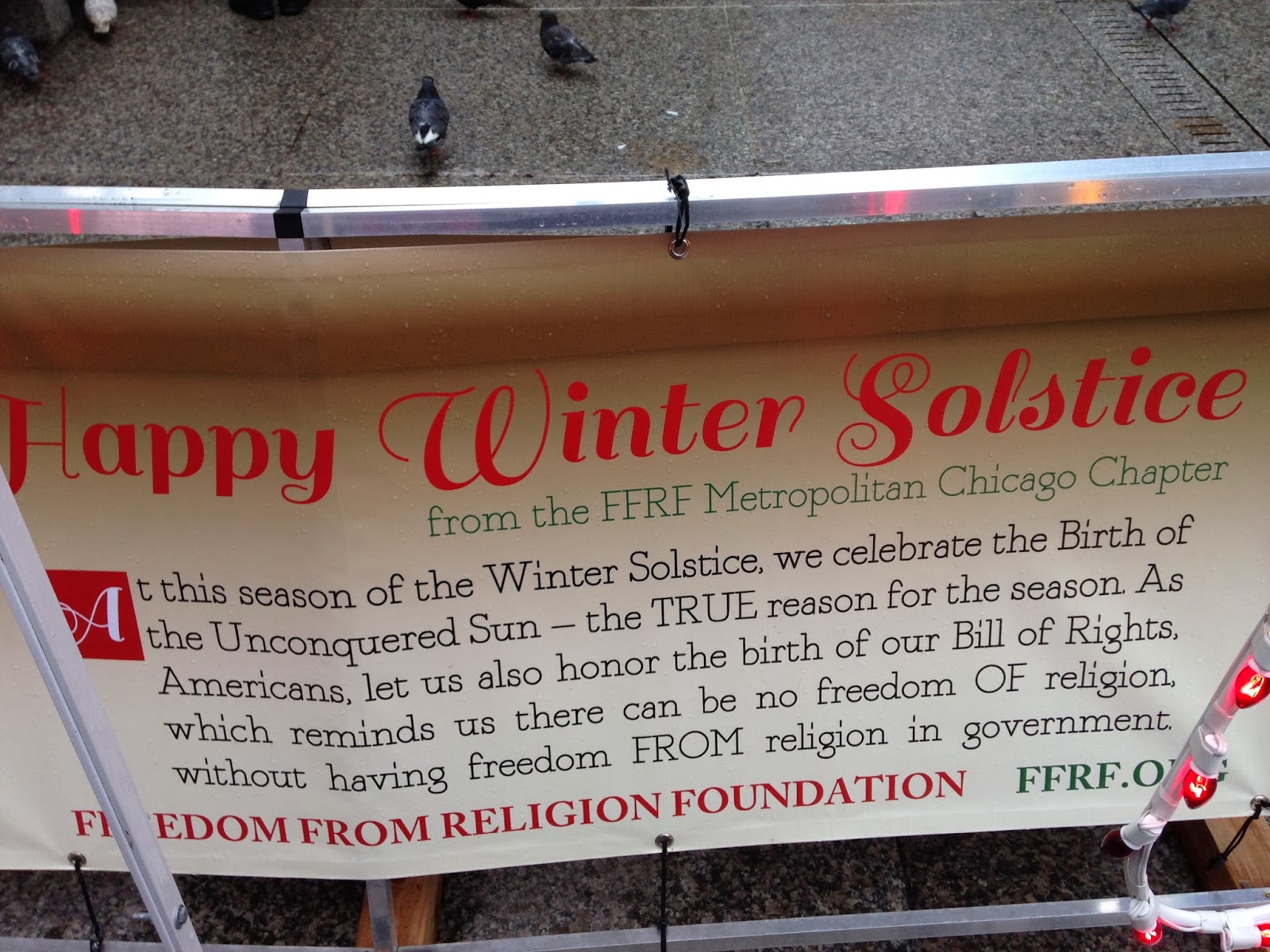
Happy Winter Solstice from the Christkindlemarkt!

So, we went to the Christkindlemarkt in Daley Plaza in downtown Chicago this afternoon after church. I was terribly disappointed, as there were so many people crammed into the plaza that no one could move. We couldn't even press our way through the crowd to get a mug of Glühwein. I was ticked off about this, and then I came across an interesting display on the east side of the plaza, near the nativity scene

It's a big wire-framed "A" lit with red "holiday" lights (calling them Christmas lights seems somewhat inappropriate). It says "Happy Winter Solstice". It says that Sol Invictus (the Unconquered Sun) is the reason for the season. The display brightened my day, even though about half of the lights were dark, and I had to take a picture of my kids in front of it.

The display was placed by the atheists of the Freedom From Religion Foundation. You can read a short news article about the "A" here. They make a big deal saying that there can be no freedom of religion until government is completely separated from religion and it's influences. I agree. Sadly, as those on the political left often do, this group attempts to equate the public expression of religion and public displays of religious symbols with the government sanction and/or establishment of religion. We Christians often try to duck this argument, opting to go along to get along. If we allow what the Establishment Clause means to be redefined, however, we will wind up without the freedom of religion or the right to express our religious beliefs publicly.

Much is made of the fact that there is a “separation of church and state” built into the U.S. Constitution. This is not exactly true, at least not in the way those on the left purport it to be. The phrase “separation of church and state” appears nowhere in the U.S. Constitution. The term is an offshoot of the phrase, "wall of separation between church and state," as written by Thomas Jefferson in a now famous letter to the Danbury Baptist Association in 1802. The original text of President Jefferson’s letter reads, in part:

"... I contemplate with sovereign reverence that act of the whole American people which declared that their legislature should 'make no law respecting an establishment of religion, or prohibiting the free exercise thereof,' thus building a wall of separation between Church and State.”
The Danbury Baptist Association wrote to Jefferson of their concerns regarding the lack of explicit protection of religious liberty in their own state constitution, and against a government establishment of religion. As a religious minority in Connecticut, the Danbury Baptists were concerned that a religious majority might establish a state religion at the cost of the liberties of religious minorities. Jefferson assured them that the U.S. Constitution would in no way permit such an establishment, and that “…religion is a matter which lies solely between Man & his God, that he owes account to none other for his faith or his worship, that the legitimate powers of government reach actions only, & not opinions…” This separation of church and state, as understood by Thomas Jefferson at least, had nothing whatsoever to do with public expressions of religion. To Jefferson and the Danbury Baptists, separation of church and state had everything to do with the establishment of a national/state religious body, and avoiding the national/state oppression of religious minorities.

It wasn't until 1947 that the Supreme Court, albeit nebulously, defined just how the “wall of separation” was to be built. As a result of Everson v. Board of Education of Ewing Township, 330 U.S. 1 (1947), Neither state or local government can: 1) set up a church, 2) pass laws that aid one religion, all religions, or favor one religion over another, 3) force a person to attend or stay away from church, or believe in any religion, 4) punish a person for holding or professing religious beliefs, 5) levy a tax, in any amount, to support any religious activities or institutions, 6) openly or secretly participate in the affairs of any religious organization, or vice-versa.

A second important test established by the Court, known as The Lemon Test, is taken from the case Lemon v. Kurtzman 403 U.S. 602 (1971). The test consists of three parts: 1) whether the law or conduct has a secular purpose, 2) whether the law or conduct has as its primary or principle effect advancing or inhibiting religion, and 3) whether it fosters an excessive entanglement of government with religion.

To the chagrin of the New Atheist movement, The Court has ruled that public displays of religious symbols, such as the Christian nativity scene or the Jewish menorah, do not constitute a breach of the Establishment Clause when they are all displayed together, and along with secular holiday symbols, in celebration of the national holiday of Christmas (yes, it is a national holiday, believe it or not).

The Christkindlemarkt (Christ child market) which is set up in Daley Plaza every year in Chicago is clearly a Christian event, complete with nativity scene. Alongside the nativity scene during Hanukkah each year is a large Jewish menorah. Any citizen or group who wishes to exercise their freedom of religious expression in this public space may do so (as the atheist group has demonstrated by the presence of their display) and the event is not in breach of the Establishment Clause. Should any religious or secular group be prohibited by government from exercising that freedom of expression at the Christkindlemarkt, however, it would then violate the Establishment Clause.

To say that there is no place in American society for public displays of religion or religious symbols, strictly because they are by nature religious (the so-called freedom "from" religion), is simply not justified by the U.S. Constitution, or by case law.

Justice Antonin Scalia, in his dissenting opinion to the McCreary County, Kentucky, ET. Al. Petitioners v. American Civil Liberties Union of Kentucky ET.Al. case, observed that the same week Congress submitted the Establishment Clause as part of the Bill of Rights for ratification by the States, it enacted legislation providing for paid chaplains in the House and Senate. Justice Scalia goes on to remind his fellow justices that, “The same Congress also reenacted the Northwest Territory Ordinance of 1787, 1 Stat. 50, Article II of which provided: ‘Religion, morality, and knowledge, being necessary to good government and the happiness of mankind, schools and the means of education shall forever be encouraged.’” And, it should not be overlooked that the First Amendment itself accords religion – and no other manner of belief – special constitutional protection. I am sure that the atheist activists at the Freedom From Religion Foundation would not agree that these early actions of Congress are equally valid today, since those on the Left generally consider the U.S. Constitution to be a “living, breathing document”, meaning that its interpretation changes as American society changes, and that moral values simply evolve along with society and culture and are therefore not absolute.

The views of American citizens, however, have not changed significantly where this issue of public expression of religion is concerned. Justice Scalia rightly points out that our Presidents continue to conclude their oath of office with the words, “So help me God.” The Congress opens each session with a prayer; those prayers are lead by official congressional chaplains. The Supreme Court opens its sessions with the prayer “God save the United States and this Honorable Court”. We have the phrase “In God We Trust” on our currency. When we pledge allegiance to the flag of the United States we corporately acknowledge that we are one nation, under God. Justice Scalia finishes his thought with these words:

“As one of our Supreme Court opinions rightly observed, ‘We are a religious people whose institutions presuppose a Supreme Being.’ Zorach v. Clauson, 343 U.S. 306, 313 (1952), repeated with approval in Lynch v. Donnelly, 465 U.S. 668, 675 (1984); Marsh, 463 U.S., at 792; Abington Township, supra, at 213.”

I have no problem with the atheists, secular humanists, and free-thinkers exercising their right to free expression. I tolerate their "A". Whether they like it or not, the atheists have to tolerate my public nativity scene. It establishes Christianity as a national religion about as much as their half-hearted display establishes Sol Invictus as America's supreme being.