Showing posts with label Christmas. Show all posts

Wednesday, January 2, 2019

Massacre of the Innocents

Then Herod, when he saw that he was deceived by the wise men, was exceedingly angry; and he sent forth and put to death all the male children who were in Bethlehem and in all its districts, from two years old and under, according to the time which he had determined from the wise men. Then was fulfilled what was spoken by Jeremiah the prophet, saying: “A voice was heard in Ramah, Lamentation, weeping, and great mourning, Rachel weeping for her children, Refusing to be comforted, Because they are no more” (Matthew 2:16-18).

Herod was the kind of the Jews, but he wasn’t a real Jew. At least, that seems to be the way that his subjects looked at him. It didn’t really matter what he said or did. Herod was an Edomite, a descendant of Esau.[1] The Jews over whom Herod ruled didn’t like being under his authority any more than they liked being ruled by the Romans. Herod, despite the fact that he used the title was, not the king of Israel. He was an Edomite vassal of the gentile pagan Romans. God promised Israel that David would have a descendant on his throne forever. This Servant of the LORD would come form David’s line and He would save His people from their sins.

Herod understood that he was an illegitimate king. This knowledge is the reason he was willing to commit infanticide. He was not righteous; morally right to Herod meant whatever benefited him was good. Based on how he governed and what he did to hold his throne he could not be called just; Herod has been described by many historians as a madman and a murderer. He murdered his own family and was “prepared to commit any crime in order to gratify his unbounded ambition.”[2] Herod was the kind of guy who wouldn’t bat an eye at murdering all the male children in Bethlehem under the age of two years, if he thought it might prevent the true King of Israel from some day deposing him.[3] That’s politics in the ancient world. At least Herod had a concrete political goal in mind when he committed his atrocity. What is our moral justification for the legalized infanticide that is abortion? Indignant, elitist bloviating about over-population or a woman’s choice hardly hold up under any serious scrutiny.

But, Herod was unsuccessful. In his murderous rage he killed the children of Bethlehem, but he missed the King of Israel, Jesus, who came to save His people from their sins. Jesus was taken to Egypt by Mary and Joseph after they were warned by God in a dream. He would, after the threat was gone, return out of Egypt. Jesus’ journey out of Egypt parallels that of the nation of Israel, which was led out of their slavery in Egypt by the LORD and into the Promised Land. He would grow, and go into the desert by the Jordan to be baptized by John: Behold! My Servant whom I uphold, My Elect One in whom My soul delights! I have put my Spirit upon Him; He will bring forth justice to the Gentiles… I, the LORD have called you in righteousness, and will hold Your hands; I will keep You and give You as a covenant to the people, as a light to the Gentiles.[4]

It isn’t simple justice which God’s Elect One, Jesus brings. He did not come simply to save the righteous and damn the wicked. He came to bring righteousness and forgiveness to the wicked. To us. He did not come to get even with the Gentiles for their sin and unbelief, but to reconcile them to God the Father, to be a light to them. Christ came to pay for the sins of all people by His death on the cross. All people includes those of Abraham’s bloodline, whether Jacob or Esau; it includes those people not physically related to Abraham at all, like the Gentiles. It includes all people who are corrupted by the sin of their earthy father Adam. God has given Jesus as a covenant to the people. We are joined to him through baptism, by faith worked in us by the Spirit. Forgiven of our sin, Jew and Gentile, male and female, slave and free are clothed with the righteousness of Christ in our baptism and made into one body.[5] It is this righteousness that He graciously and mercifully gives us which makes us able to welcome His justice.


[1] Perowne, Stewart Henry. "Herod." Encyclopædia Britannica. September 27, 2018. Accessed January 19, 2019. https://www.britannica.com/biography/Herod-king-of-Judaea.
[2] "Herod the Great." Wikipedia. January 17, 2019. Accessed January 19, 2019. https://en.m.wikipedia.org/wiki/Herod_the_Great.
[3] France, R. T. "The Gospel of Matthew (Google EBook)." Google Books. N.p., n.d. Web. 28 Dec. 2013. http://books.google.com/books?id=0ruP6J_XPCEC.
[4] Isaiah 42:1, 6
[5] Galatians 3:26-29

Sunday, December 30, 2018

Simeon Sees God's Salvation

Simeon
A light to bring revelation to the Gentiles, and the glory of Your people Israel (Luke 2:32).

But when the fullness of time had come, God sent forth His Son, born of a woman, born under the law, that we might receive the adoption as sons.[1] Mary and Joseph circumcised Jesus on the eighth day after His birth as the Law of Moses required. Having received this sign of God’s covenant with Abraham, Christ is formally brought into Israel according to the Law. Being the first born male, Mary and Joseph bring Jesus to the temple to offer the sacrifices required in the Law to consecrate Him to the LORD, and to redeem Him.[2] By this act Jesus enters into the service of God. All that Jesus did in His earthly life, or that was done to Him by His faithful earthly parents, was so that He could serve His Heavenly Father perfectly under the Law, something mankind was not capable of doing since the Fall of Adam.

At the temple, the Holy Family meets Simeon, who has been supernaturally directed to the infant Jesus by the Holy Spirit. This faithful Israelite had been waiting for the Consolation of Israel.[3] The Spirit of the Lord had told him that he would see the Messiah. When he sees Jesus Simeon sings a song of Joy. His vigil was now complete. He could go in peace, that is, he could now die, because God had fulfilled His promise. Simeon had held the Light to the Gentiles, and the Glory of Israel in his arms.

Simeon had seen the One who was the fulfillment of the covenant. This child whom he held in his arms was the one about whom Isaiah wrote: I, the LORD, have called you in righteousness and will hold Your hand; I will keep you and give You as a covenant to the people, as a light to the Gentiles, to open blind eyes, to bring out prisoners from prison, those who sit in darkness from the prison house.[4] Jesus is indeed a light to the nations. Whoever sees Jesus sees the Father who sent Him; whoever believes in Him believes in the Father and no longer abides in darkness.[5] He has freed us from the prison house of sin and made us servants of righteousness. Jesus, perfectly righteous under the Law, was rejected by His own, killed as a ransom for many on the cross, and risen from the dead on the third day.[6]

We who believe, like our brother Simeon, are also waiting for the Consolation of Israel. We await Hs return in glory, to judge the living and the dead. As we wait, we gather faithfully to eat His body and drink His blood, as He calls us to do, for the forgiveness of sins, proclaiming His death until He comes.[7] Each time we receive the gift of Jesus’ body and blood in the Sacrament of the Altar, we rejoice; we sing Simeon’s words in the Nunc Dimittis: Lord, now lettest Thou Thy servant depart in peace, according to Thy word, For mine eyes have seen Thy Salvation. By these means of Word and Sacrament Jesus gives to us Salvation – He, Himself. Like Simeon, after receiving this pledge of redemption from sin, death, and the devil, and the resurrection to life eternal, we to can proclaim that we are ready to die.


[1] Galatians 4:4-5
[2] Exodus 13:2, 11-13
[3] Luke 2:25
[4] Isaiah 42:6-7
[5] John 12:44-50
[6] Mark 8:31; John 1:11; Mark 10:45
[7] 1 Corinthians 11:10-23-26

Friday, December 28, 2018

Glory in the Highest

So it was, when the angels had gone away from them into heaven, that the shepherds said to one another, “Let us now go to Bethlehem and see this thing that has come to pass, which the Lord has made known to us.” And they came with haste and found Mary and Joseph, and the Babe lying in a manger. Now when they had seen Him, they made widely known the saying which was told them concerning this Child. And all those who heard it marveled at those things which were told them by the shepherds. But Mary kept all these things and pondered them in her heart. Then the shepherds returned, glorifying and praising God for all the things that they had heard and seen, as it was told them (Luke 2:15-20).

So, you are a shepherd, and you are out in the fields doing what shepherds do – tending sheep. And, seemingly out of nowhere, God sends a host of angels to tell you and your companions about the birth of the Savior of the word. This is probably just as unexpected and strange to you as it is to those who read the account in Holy Scripture. Being a shepherd was difficult work. It was unpleasant, at least to the other members of the community who weren’t the ones who had to do it. Shepherds had to be out in the elements, staying away for long periods keeping watch for predators, and making sure the sheep were safe. Shepherds were somewhat isolated from the larger community; the very nature of their work necessitated this, and this was just fine with everyone. Shepherds were not despised, per se, but they weren’t exalted either. Shepherds were smelly and dirty, and people looked down on them because of their vocation. Kind of the way we might think of garbage men (No offense to garbage men intended; It’s not a job I’d want to do, even if they did pay me well). So, it is somewhat surprising that God would choose to make the public proclamation of the Messiah’s birth to a group of shepherds off in some fields away from everybody.

This isn’t the kind of thing we expect. It certainly isn’t what we would do, and doesn’t make sense according to human logic. The birth of the Messiah is a royal birth. This is David’s Son whom David would call, “Lord,” by whom David’s throne would be established forever. Royal births are not announced like this. Announcing Jesus’ birth this way would be akin to the Duke and Duchess of Cambridge, in announcing the birth of Prince George, posting the customary formal bulletin at the garage where the garbage trucks are parked, rather than on an easel outside Buckingham Palace. The Magi from the East expected King Herod to know about the birth of the King of the Jews. That’s why they went to Jerusalem to Herod’s palace to find out where the child was. But God has made it clear in His Word that He doesn’t operate according to the thinking of man: For My thoughts are not your thoughts, Nor are your ways My ways,” says the LORD. “For as the heavens are higher than the earth, So are my ways higher than your ways, And My thoughts than your thoughts.”[1]

Mary probably understood this attribute of God better than anyone. She understood that God operates in a way foreign to man’s thinking. We are impressed and fearful of the proud and mighty, but God scatters them, and puts them down from their thrones. God instead exalts the lowly, fills the hungry with good things, and sends the rich away empty.[2] Scripture tells us that God has chosen the foolish things of this world to put to shame the wise, and God has chosen the weak things of the world to put to shame the things which are mighty.[3] So God announces the arrival of the Messiah to foolish shepherds, rather than to proud and mighty kings. He comes to be with us in human flesh through the womb of the humble Virgin Mary, and is born not in a palace, but in a peasant’s home, and laid in a lowly manger. All of this is to accomplish the most unexpected thing of all: This Jesus lying in a manger – who is God, with us – will defeat the proud and mighty devil, and destroy sin and death once and for all in what the world would see as the most foolish and absurd way possible. He will die on a cross as a despised criminal, bearing your sin, and mine. For God made Jesus, who knew no sin to be sin for us, that we might become the righteousness of God in Him.[4] Jesus’ death is the propitiation for our sin and the sin of the world;[5] He gave His life as a ransom for many.[6] After three days, He rose from the dead for our justification.[7] He did this for you and for me, while we were still sinners, before we had done anything to earn His favor. He did it because He loves us. How foolish! How illogical! How wonderful! Oh, the depth of the riches both of the wisdom and knowledge of God! How unsearchable are His judgments and His ways past finding out![8]


[1] Isaiah 55:8-9
[2] Luke 1:46-55
[3] 1 Corinthians 1:27
[4] 2 Corinthians 5:21
[5] 1 John 2:2
[6] Mark 10:45
[7] Romans 4:25
[8] Romans 11:33

Sunday, December 25, 2016

Pondering Glory


By Rev. Joel Brondos

The glory of the multitude of an angelic host praising God -- has any mortal flesh ever witnessed anything as magnificent as that which lowly shepherds experienced?

They then went to see Jesus as it had been told them, a babe lying in a manger, making widely known the marvels which they had seen and heard . . . and then what?

After such an astounding event, did they not expect some imminent follow-through -- some comparable fulfillment on the heels of so great a portent?

But, nothing.

Jesus grew in wisdom and stature, but it would be thirty years before anything out of the ordinary would happen again. Could they do anything more but go back to their shepherding?

Now, in 2016, Christmas has come . . . and gone. Whatever might have been glorious -- paltry in terms of what the shepherds experienced with our LED lights, glittered decorations, mail-order gifts, seasonal music and high-calorie food -- now fades in the rear-view mirror. Did it satisfy? Did it fail to live up to the hype yet another year? Do we now just go back to our daily duties, counting 364 days until the next round?

Mary had her own encounter with an angel as well as other unexpected visitors from poor shepherds to rich magi. They came with accounts of their own to confess the One born to be Savior. But after these passed, Mary, too, had to wait. There was no immediate consummation of all that she had seen and heard.

And yet, there was not just a going back to business as usual. We read that Mary treasured all these things in her heart (Luke 2:19). Couldn't these words have sustained her throughout the years and even as she stood at the foot of the cross when her soul was pierced through (Luke 2:35)?

This Christmas, with Mary, when the worldly glamour and festivities have passed, we treasure all these things in our hearts. We return to our daily chores, and from time to time we are likely to be bloodied and bruised with the cares of this life, but our hearts ponder the news first proclaimed by angels, confessed by shepherds, worshiped by wise men. 

We return to our homes, schools, and workplaces, glorifying and praising God for all that has been proclaimed to us in His Word, knowing that it may take thirty years or more, but we shall be called into that glory from whence the angels came. That glory shall not terrify us as it did the shepherds because we have been baptized and clothed in the holiness and righteousness of our Lord Jesus Christ.

In the historic Lutheran liturgy of the Divine Service, we weekly sing the message of the angelic hosts to the shepherds in the Gloria Patri. With "angels and archangels and with all the heavenly host we laud and magnify the Lord's glorious name, ever more praising Him . . ." only to return to our daily duties with joy, treasuring these things in our hearts. (1 Peter 5:4) " . . . and when the Chief Shepherd appears, you will receive the crown of glory that does not fade away."

Saturday, December 24, 2016

Christmas Eve Prayer

Christmas Eve - Prayers for the Divine Service (St. Paul's Ev. Luth. Church, Brookfield, IL)

P: Almighty and most merciful Father, we who cannot go to the manger have been drawn by Your grace and mercy to this altar to receive Him who is born to be our Savior. We who have not seen a multitude of the heavenly host, marvel at the words of the prophets and apostles by which You have declared to us where the Savior is to be found. Seeking Him where He promises to be found and finding Him where He comes according to His Word, we find also everlasting peace and joy.

Heavenly Father, we have often come to this altar to declare the complaints of our flesh – and because You have redeemed us, You answer us with grace and mercy. He have come before this altar with prayers at the birth of our children and grandchildren – and have likewise come at the death of our loved ones. At this altar You join together two as one flesh and You hear the vows of those who are confirmed, who are accepted as members, and who will serve as officers and board members. At this altar, we bring no gold, frankincense and myrrh, but our offerings that they may be used in service to Your kingdom. But over and above all things, we pray, O Lord, that Your glory may be declared and seen in Your salvation and in the fruits of righteousness. Lord, in Your mercy,
 
C: Hear our prayer.

P: O Consolation of Israel and Prince of Peace, grant Your peace which the world cannot give. When the devil seeks to rob us of our peace with his lies and accusations, when the world offers us its counterfeit peace achieved through self-centered glories and self-serving compromise, and when our own flesh feels no peace recalling its own guilt and shame, even the secrets of our heart which are known to You, grant that we would not pursue glory through worldly means or our own efforts, but may cling by faith to Your gracious work of redemption, by which we may enter into Your eternal glory. Grant us that peace which gives us courage to do and say what is right, which leads us to glorify and praise You in word and deed in our homes and communities. Give us that peace which is manifested in a sure and certain hope of Your eternal glory through Your only-begotten and beloved Son, born to be our Savior; Lord, in Your mercy,
 
C: Hear our prayer.

P: Heavenly Father, remember all of those who are called by Your name through holy Baptism and do not forsake or abandon them in the hour of their need. As they lie in hospital beds, grant them to know that You were laid in a manger to deliver them from every aspect of sin's cursed effects . . . For the sick and the needy during this blessed season, care packages of things that will break and wear out and grow old . . . Provide for their need in body and soul and preserve them through this life into that life which has been prepared for those who seek Your kingdom and righteousness in Jesus Christ alone; Lord, in Your mercy,
 
C: Hear our prayer.

P: Move the hearts of Your people to know the same joy as the shepherds to return to our homes glorifying and praising you for all that they have heard and seen in Your Word by faith as it was told to them. Hunger and thirst for righteousness as evidenced by their hunger and thirst for Your Word and Sacraments. Grant that our Bible classes and catechism classes may grow not for the sake of our congregation, but to the glory of Your holy name. Move the hearts of Your people to offer the sacrifices and offerings which are commensurate with Your grace and glory that the message of the angels may still be proclaimed in all the world. We pray especially this Christmas Eve / Day that You would grant strength and peace to missionaries who, for the sake of proclaiming Your Word, are isolated or far from home and family , who may be imprisoned or threatened for Your name's sake – and turn the hearts of Your enemies to believe, teach and confess Your truth and love . . . Lord, in Your mercy,
 
C: Hear our prayer.

P: These and whatsoever other things You would have us ask of You, O God, grant to us for the sake of the bitter sufferings and death of Jesus Christ, Your only Son, our Lord and Savior, who lives and reigns with you and the Holy Ghost, ever one God, world without end.
 
C: Amen.

Friday, December 18, 2015

Whip Nae Nae in Heavenly Peace

 For the word of the cross is folly to those who are perishing, but to us who are being saved it is the power of God (1 Corinthians 1:18).

The war on Christmas is heating up, and “Christians” are “outraged” at the latest skirmishes, which involved a beloved television Christmas special, and a nonsensical rap song.

This past Thursday Glenn Beck talked about a Kentucky elementary school that was presenting A Charlie Brown Christmas as their Christmas program. Everyone on the show was shocked and outraged because, at the climax of the program, Linus’ speech explaining the true meaning of Christmas (which was really just a passage from the Gospel of St. Luke), had been cut. In another school, the speech was removed and Silent Night was replaced with the popular, and highly annoying, “Whip Nae Nae” by Silentó 

“I would get together with parents and I would — if I knew this was coming — take the script of what Linus actually says and I would stand up as a block of parents and just stop the show and just all of us at that point, ‘Doesn’t anybody know what Christmas is all about?’ And all of the parents stand up and just start saying it, even as the play is going on,” Beck said.

I love Christmas. I love the Peanuts. I love A Charlie Brown Christmas. I love St. Luke’s Gospel. Silent Night is arguably the greatest Christmas song ever written (in the original German, of course). So, what I’m about to say will probably confuse some of my friends: I don’t care that these people changed the Christmas show to remove the Bible passage. In fact, I wouldn’t have expected them to do anything different. I would have been surprised to see them leave the speech intact and sing Silent Night at a secular public school.

“There is no violation of the so-called ‘separation of church and state’ by allowing children to learn about theater and the origins of Christmas through participating in a stage version of this beloved program that contains the same religious elements as the television version,” said ADF Senior Legal Counsel Jeremy Tedesco, as quoted from a Fox opinion article.

I agree that there is no violation of the First Amendment. However, if my children are attending a public school, I want them to learn reading, writing, and ‘rithmetic. I’ll take care of the religious education, thank you very much. That is, of course, why they don’t attend public school.

Making secular public school students do religious things is not an effective evangelism tool; it only causes strife in the community. I certainly wouldn’t want my children to participate in some school-wide Ramadan pageant. I understand that pagans don’t want their children to sing Silent Night. We shouldn’t expect those who are of the pagan secular world to think and act like Christendom. After all, the sinful mind is hostile to God, and cannot submit to God (Romans 8:6-8); The message of the cross is, after all, foolishness to those who are perishing. To the unbelieving secular world, the story of the birth of Jesus Christ from the Gospel of St. Luke makes less sense than, “Watch me whip…watch me nae nae.”

For the world, the federal holiday of Christmas is about presents, and trees, and lights, and days off from work. For Christendom it is about God taking on human flesh so that he could, before we did anything to merit his loving-kindness, keep the Law for us, bear our sin, and be our savior. I’m glad that Charles Schultz included the true meaning of Christmas in his show, but we can’t force pagans to act like Christians. Consequently, we shouldn't be outraged when they act according to their nature and reject and ridicule God’s Word. Instead of trying to glue a veneer of Christianity over the top of secular culture, the way to reach pagans is to lovingly deliver Law and Gospel to those around us according to our vocation, encouraging them to repent of their sin and gather around Word and Sacrament – and trust that the Lord’s Word will not return to him void. 


Refrences


Friday, December 26, 2014

St. Stephen - Martyr

When the members of the Sanhedrin heard this, they were furious and gnashed their teeth at him. But Stephen, full of the Holy Spirit, looked up to heaven and saw the glory of God, and Jesus standing at the right hand of God. “Look,” he said, “I see heaven open and the Son of Man standing at the right hand of God.” At this they covered their ears and, yelling at the top of their voices, they all rushed at him, dragged him out of the city and began to stone him. Meanwhile, the witnesses laid their coats at the feet of a young man named Saul. While they were stoning him, Stephen prayed, “Lord Jesus, receive my spirit.” Then he fell on his knees and cried out, “Lord, do not hold this sin against them.” When he had said this, he fell asleep (Acts 7:54-60).

I never particularly understood why St. Stephen’s day was the day after Christmas. Superficially, it seems like there must have been some leftover saints and a need to celebrate their “days” by the end of the year, sort of like getting a last minute tax deductible expenditure in before the new year. I’m sure that’s not how this happened, and there is some perfectly logical explanation of why these saints are remembered on these particular days. I have, however, neither the time nor the inclination to do the research. I am still fat and lethargic with Christmas ham.

Directly after celebrating the Savior’s birth on December 25, we celebrate the martyrdom of St. Stephen (Dec. 26), St. John the Apostle (Dec. 27), and the slaughter of the Holy Innocents (Dec. 28). December 29 is the feast day of St. Thomas Beckett, who was assassinated on the steps of Canterbury Cathedral in 1170. Saint Anysia of Salonika, a martyr of the 4th century, is remembered on December 30. Anysia’s delightful story begins with her birth to a wealthy and pious Christian family in Salonika (modern day Thessaloniki). The legend of her martyrdom states that in 304 AD, a Roman soldier apprehended her as she was on her way to services. Discovering she was a Christian, he beat her, and intended to drag her to a pagan temple to sacrifice to Roman gods. When he tore off her veil (a reminder of her vow of chastity), she spit in his face, and he murdered her. Rounding out the year we have St. Sylvester on December 31. St. Sylvester was a pope whose claim to fame is being mentioned in the forged Donation of Constantine, according to which Pope Sylvester was offered the imperial Roman crown by a grateful, newly converted Emperor Constantine, which he refused. Sylvester is credited with lots of other actual good things, which you can read about here.

I like celebrating St. Stephen in such close proximity to the birth of Our Lord Jesus though. He reminds us what the point of Jesus’ birth was, and just how hostile an unbelieving world is to the message of the Gospel. When he is taken into custody and brought before the Sanhedrin, he wastes no time arguing with his captors, or pleading for mercy. St. Stephen, when given the opportunity to speak, preaches Law and Gospel, using the condensed story of God’s salvation history given in Holy Scripture. To the stiff-necked, unrepentant people about to murder him, St. Stephen preaches law:

“You stiff-necked people, with uncircumcised hearts and ears! You are just like your fathers: You always resist the Holy Spirit! Was there ever a prophet your fathers did not persecute? The even killed those who predicted the coming of the Righteous One. And now you have betrayed and murdered him – you who have received the law that was put into effect through angels but have not obeyed it” (Acts 7:51-53).

This sermon is reminiscent of St. Peter’s address to the crowd on Pentecost. Both men are addressing Jews who have received God’s Law, but are not believers in Christ. Why does St. Peter’s sermon turn out so much differently than St. Stephen’s? Was he a better preacher? Perhaps he was able to relate to the crowd better by meeting them where they were at and not speaking in terms of antiquated doctrine or outdated worship styles. Maybe he wore hipster glasses.

What the story of St. Stephen’s martyrdom illustrates when compared with St. Peter’s Pentecost sermon is the difference between repentance and faith, and sin and unbelief. It shows us that God is responsible for saving us though the gift of faith given through the means of his word, and we are responsible for our damnation by rejecting that gift and resisting the Holy Spirit. Faith comes to us as a gift, through the means of God’s word and sacraments. Unbelief comes from us. God’s Holy Spirit works when and where he will through those means. Man’s sinful mind is hostile to God. Perishing and being dead in transgression, the message of the cross is foolishness to men. Natural man does not, and cannot, submit to God’s Law.

This should take a lot of weight off of us Christians. It is not up to us to convert people. That is God’s job. He does that though the preached word, through the waters of Baptism, and in Christ’s body and blood given to us to eat and to drink in the Lord’s Supper. God will use his means of grace to accomplish his purposes. Therefore, we can be bold like St. Stephen and simply proclaim Law and Gospel, without worrying whether or not we have packaged it effectively.


We celebrate the Christ child’s birth looking forward to his death for our sin on the cross, and his glorious resurrection. Knowing this we can, with the same faith that St. Stephen had, preach repentance and the forgiveness of sins in the name of Jesus to a fallen, sinful, and hostile world, and God will, by the power of the Holy Spirit, save sinners.

Saturday, December 28, 2013

The Holy Innocents

The Martyrdom of the Holy Innocents - Gustave Dore
When they had gone, an angel of the Lord appeared to Joseph in a dream. “Get up,” he said, “take the child and his mother and escape to Egypt. Stay there until I tell you, for Herod is going to search for the child to kill him.” So he got up, took the child and his mother during the night and left for Egypt, where he stayed until the death of Herod. And so was fulfilled what the Lord had said through the prophet: “Out of Egypt I called my son.” When Herod realized that he had been outwitted by the Magi, he was furious, and he gave orders to kill all the boys in Bethlehem and its vicinity who were two years old and under, in accordance with the time he had learned from the Magi. Then what was said through the prophet Jeremiah was fulfilled: A voice is heard in Ramah, weeping and great mourning, Rachel weeping for her children and refusing to be comforted, because they are no more" (Matthew 2:13-18).
 
The murder of the children of Bethlehem by Herod is, to be certain, a despicable and sinful act. It is usually depicted as taking place on the scale of a genocide, and we tend to get the impression that a lot more babies were murdered than probably actually were.
 
Don't misunderstand me, I am in no way going soft on infanticide. One baby-murder is too many. Liberal Bible scholars, as well as those outside of the faith who seek to diminish the credibility of Christianity, often use this story as one of their arguments. "If the madman Herod murdered all of the toddlers and babies in and around Bethlehem," they argue, "would there not be contemporary accounts of the massacre?" One would assume so, if the event happened as we often imagine it to have. And, actually, there is a reliable, contemporary account the murders - the Gospel of Matthew. Archeology has always proven itself the friend of the New Testament, and has shown it to be historically reliable, much to the annoyance of the few liberal scholars who are willing to acknowledge the evidence. That, however, is a debate to be saved for another day.
 
Herod the Great, or Herod I, has been described as a madman and a murderer, even apart from the Slaughter of the Innocents. He murdered his own family and was "prepared to commit any crime in order to gratify his unbounded ambition" (Herod the Great, 2013). He was hated and mistrusted by the Jews over whom he ruled, and he hated and mistrusted them right back. Not only was he viewed by his subjects as a collaborator with the hated Romans, from whom he received his kingdom, he was also not a "real" Jew. Herod was an Edomite, a descendant of Esau (Herod, 2013). He did all kinds of terrible things to insure his grip on power. If he thought that the rightful Jewish King of the Jews had been born sometime in the last two years near Bethlehem, and that he had to murder all the babies in that place to keep his throne, there is little doubt that he would do so (France, 2007).

The fact that a mad and murderous king committed murder was still sad, but not as shocking as it maybe should have been. It certainly wouldn't have been front-page news. This situation is akin to murders in modern American cities such as Detroit or Chicago. They are committed with chilling regularity and in such a frequency that, to cover them with the attention they deserve would be to dominate every column of every magazine and newspaper in the city every day. This is in contrast with how a murder would be treated if it happened in some affluent suburban enclave where such things rarely occur. Today a murder in Chicago, unless it was particularly gruesome or involved some high-profile person, scarcely gets more than a one-minute mention on the evening news.
 
But Bethlehem wasn't Chicago or Detroit. It was small. So small, in fact, that it was considered insignificant by worldly standards, as the writings of the prophets suggest:
 
But you, O Bethlehem Ephrathah, who are too little to be among the clans of Judah, from you shall come forth for me one who is to be ruler in Israel, whose coming forth is from of old, from ancient days (Micah 5:2).
 
Traditional Bible scholars believe that, given population density in that area during that time (all estimated, of course), no more than twenty babies and young children were made Herod's unfortunate victims (Hagner, 1993).
 
But why are they called innocents? Certainly they are not innocent, at least not in the biblical sense. They are sinful human beings, just like everyone else, with a sinful human nature, and they are subject to sin and death. I suppose that they are innocent in the sense that they received a punishment they did not deserve. The death they suffered was intended for the Christ child. In this way they could be considered martyrs as their deaths testify to the Christ, and foreshadow his own suffering and death.
 
The Holy Innocents teach us that there is no such thing as innocence before God, since the Fall of Man. All have sinned and fallen short of the glory of God. No one is righteous, not even one, all of us having been conceived in sin and brought forth in iniquity. No thing or person has escaped the corruption that entered the world through the sin of Adam. Herod demonstrates the depth of this corruption by his depraved sinful desires, his willingness to act on those sinful desires, the horrific act itself, and its intended end - the murder of God's Anointed One; the death of the Holy Innocents demonstrates that all - even "innocent" babies - are subject to sin and death, and are in desperate need of a savior. As members of the nation of Israel through circumcision, we trust God that the babies murdered by Herod were forgiven sinners because of God's promise, just as we who have been adopted into God's family through baptism are.
 
Almighty God, whose praise was proclaimed this day by the wicked death of innocent children, giving us thereby a picture of the death of your beloved Son, mortify and destroy in us all that is in conflict with you that we who have been called in faith to be your children may in life and death bear witness to your salvation; through our Lord Jesus Christ, who lives and reigns with you and the Holy Spirit, one God, now and forever. Amen (CPH, 1983).


Bibliography
 
France, R. T. "The Gospel of Matthew (Google EBook)." Google Books. N.p., n.d. Web. 28 Dec. 2013. http://books.google.com/books?id=0ruP6J_XPCEC.
 
"Herod (king of Judaea)." Encyclopedia Britannica Online. Encyclopedia Britannica, n.d. Web. 28 Dec. 2013.
 
"Herod the Great." Wikipedia. Wikimedia Foundation, 27 Dec. 2013. Web. 28 Dec. 2013. http://en.wikipedia.org/wiki/Herod_the_Great.
 
Lutheran Worship. St. Louis (3558 S. Jefferson Ave., St. Louis 63118): Concordia Pub. House, 1983. Print.
 
"Massacre of the Innocents." Wikipedia. Wikimedia Foundation, 28 Dec. 2013. Web. 28 Dec. 2013. http://en.wikipedia.org/wiki/Massacre_of_the_Innocents.

Wednesday, December 25, 2013

The True Light

The true light, which enlightens everyone, was coming into the world. He was in the world, and the world was made through him, yet the world did not know him. He came to his own and his own people did not receive him. But to all who did receive him, who believed in his name, he gave the right to become children of God, who were born not of blood nor of the will of the flesh nor of the will of man, but of God (John 1:9-13).

At the risk of stating the obvious, I'm going to go on record and say that the invention of the electric incandescent light bulb was a big deal. To be certain, mankind had means of creating light before electric lighting, but we weren't truly illuminated until Edison invented the light bulb. For all of human history mankind's productivity was governed by the natural rhythms of day and night. But, with the coming of electricity and the light bulb, man's day was expanded and, as author Mark Steyn puts it, night was abolished. Life post-light bulb would never be the same as it had been.

St. John writes that "the true light, which enlightens everyone, was coming into the world," and that is the man about whom John the Baptist testifies. From Adam's Fall through Malachi it's been all spiritual candles and gas lamps, but now, prepare yourself world, the true light is about to be revealed. In Christ Jesus man is given the spiritual equivalent of Edison's electric light bulb. Just as Edison's light had the power to "abolish night" and help to usher in a new age of productivity and human innovation and invention, so Jesus, God in human flesh, has the power to "enlighten all men," and cut through the hitherto impenetrable darkness of sin and death in which mankind was mired.

God promised that he would give this light to man all the way back when our first parents, Adam and Eve, sinned and chose darkness, and were expelled from paradise. Through Adam sin and darkness entered and corrupted all of God's perfect creation. Through Christ, however, came life which, St. John writes, was the light of men. Adam and Eve, along with all the faithful from that time until the coming of Jesus in the flesh, would live by the lamplight of faith in God's promise of a savior and redeemer. With the birth of Jesus, God fulfilled his promise to rescue mankind and to crush the serpent's head in a historical context.

Sadly, though Christ came for everyone, not everyone trusts in him. Jesus came to his own people, St. John writes, and they would not receive him as the savior promised to them and described in prophetic scripture. The world which was created by him did not know him, such is the state of rebellion in which the creation stands against it's creator. Yet Jesus, born to a virgin and laid in a manger, heralded by angels and worshiped by shepherds, would go on to atone for the sins of mankind on the cross, and open the kingdom of heaven to all those who believe in him.

Lord Jesus Christ, light of the world which no darkness can overcome, let your light scatter the darkness of sin, death, and the power of Satan by the means of your holy word, and illumine and expand your church.

Sunday, December 22, 2013

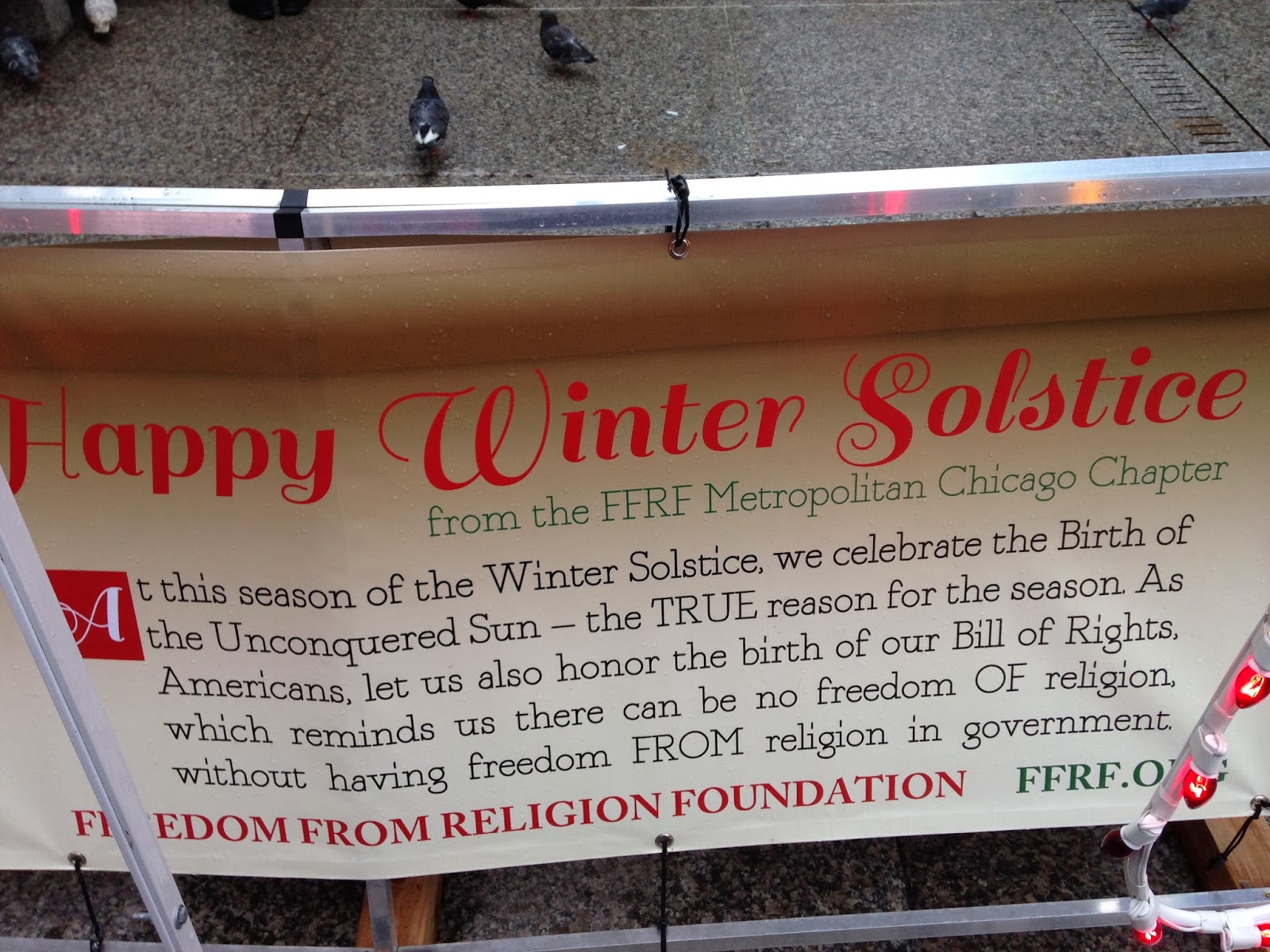
Happy Winter Solstice from the Christkindlemarkt!

So, we went to the Christkindlemarkt in Daley Plaza in downtown Chicago this afternoon after church. I was terribly disappointed, as there were so many people crammed into the plaza that no one could move. We couldn't even press our way through the crowd to get a mug of Glühwein. I was ticked off about this, and then I came across an interesting display on the east side of the plaza, near the nativity scene

It's a big wire-framed "A" lit with red "holiday" lights (calling them Christmas lights seems somewhat inappropriate). It says "Happy Winter Solstice". It says that Sol Invictus (the Unconquered Sun) is the reason for the season. The display brightened my day, even though about half of the lights were dark, and I had to take a picture of my kids in front of it.

The display was placed by the atheists of the Freedom From Religion Foundation. You can read a short news article about the "A" here. They make a big deal saying that there can be no freedom of religion until government is completely separated from religion and it's influences. I agree. Sadly, as those on the political left often do, this group attempts to equate the public expression of religion and public displays of religious symbols with the government sanction and/or establishment of religion. We Christians often try to duck this argument, opting to go along to get along. If we allow what the Establishment Clause means to be redefined, however, we will wind up without the freedom of religion or the right to express our religious beliefs publicly.

Much is made of the fact that there is a “separation of church and state” built into the U.S. Constitution. This is not exactly true, at least not in the way those on the left purport it to be. The phrase “separation of church and state” appears nowhere in the U.S. Constitution. The term is an offshoot of the phrase, "wall of separation between church and state," as written by Thomas Jefferson in a now famous letter to the Danbury Baptist Association in 1802. The original text of President Jefferson’s letter reads, in part:

"... I contemplate with sovereign reverence that act of the whole American people which declared that their legislature should 'make no law respecting an establishment of religion, or prohibiting the free exercise thereof,' thus building a wall of separation between Church and State.”
The Danbury Baptist Association wrote to Jefferson of their concerns regarding the lack of explicit protection of religious liberty in their own state constitution, and against a government establishment of religion. As a religious minority in Connecticut, the Danbury Baptists were concerned that a religious majority might establish a state religion at the cost of the liberties of religious minorities. Jefferson assured them that the U.S. Constitution would in no way permit such an establishment, and that “…religion is a matter which lies solely between Man & his God, that he owes account to none other for his faith or his worship, that the legitimate powers of government reach actions only, & not opinions…” This separation of church and state, as understood by Thomas Jefferson at least, had nothing whatsoever to do with public expressions of religion. To Jefferson and the Danbury Baptists, separation of church and state had everything to do with the establishment of a national/state religious body, and avoiding the national/state oppression of religious minorities.

It wasn't until 1947 that the Supreme Court, albeit nebulously, defined just how the “wall of separation” was to be built. As a result of Everson v. Board of Education of Ewing Township, 330 U.S. 1 (1947), Neither state or local government can: 1) set up a church, 2) pass laws that aid one religion, all religions, or favor one religion over another, 3) force a person to attend or stay away from church, or believe in any religion, 4) punish a person for holding or professing religious beliefs, 5) levy a tax, in any amount, to support any religious activities or institutions, 6) openly or secretly participate in the affairs of any religious organization, or vice-versa.

A second important test established by the Court, known as The Lemon Test, is taken from the case Lemon v. Kurtzman 403 U.S. 602 (1971). The test consists of three parts: 1) whether the law or conduct has a secular purpose, 2) whether the law or conduct has as its primary or principle effect advancing or inhibiting religion, and 3) whether it fosters an excessive entanglement of government with religion.

To the chagrin of the New Atheist movement, The Court has ruled that public displays of religious symbols, such as the Christian nativity scene or the Jewish menorah, do not constitute a breach of the Establishment Clause when they are all displayed together, and along with secular holiday symbols, in celebration of the national holiday of Christmas (yes, it is a national holiday, believe it or not).

The Christkindlemarkt (Christ child market) which is set up in Daley Plaza every year in Chicago is clearly a Christian event, complete with nativity scene. Alongside the nativity scene during Hanukkah each year is a large Jewish menorah. Any citizen or group who wishes to exercise their freedom of religious expression in this public space may do so (as the atheist group has demonstrated by the presence of their display) and the event is not in breach of the Establishment Clause. Should any religious or secular group be prohibited by government from exercising that freedom of expression at the Christkindlemarkt, however, it would then violate the Establishment Clause.

To say that there is no place in American society for public displays of religion or religious symbols, strictly because they are by nature religious (the so-called freedom "from" religion), is simply not justified by the U.S. Constitution, or by case law.

Justice Antonin Scalia, in his dissenting opinion to the McCreary County, Kentucky, ET. Al. Petitioners v. American Civil Liberties Union of Kentucky ET.Al. case, observed that the same week Congress submitted the Establishment Clause as part of the Bill of Rights for ratification by the States, it enacted legislation providing for paid chaplains in the House and Senate. Justice Scalia goes on to remind his fellow justices that, “The same Congress also reenacted the Northwest Territory Ordinance of 1787, 1 Stat. 50, Article II of which provided: ‘Religion, morality, and knowledge, being necessary to good government and the happiness of mankind, schools and the means of education shall forever be encouraged.’” And, it should not be overlooked that the First Amendment itself accords religion – and no other manner of belief – special constitutional protection. I am sure that the atheist activists at the Freedom From Religion Foundation would not agree that these early actions of Congress are equally valid today, since those on the Left generally consider the U.S. Constitution to be a “living, breathing document”, meaning that its interpretation changes as American society changes, and that moral values simply evolve along with society and culture and are therefore not absolute.

The views of American citizens, however, have not changed significantly where this issue of public expression of religion is concerned. Justice Scalia rightly points out that our Presidents continue to conclude their oath of office with the words, “So help me God.” The Congress opens each session with a prayer; those prayers are lead by official congressional chaplains. The Supreme Court opens its sessions with the prayer “God save the United States and this Honorable Court”. We have the phrase “In God We Trust” on our currency. When we pledge allegiance to the flag of the United States we corporately acknowledge that we are one nation, under God. Justice Scalia finishes his thought with these words:

“As one of our Supreme Court opinions rightly observed, ‘We are a religious people whose institutions presuppose a Supreme Being.’ Zorach v. Clauson, 343 U.S. 306, 313 (1952), repeated with approval in Lynch v. Donnelly, 465 U.S. 668, 675 (1984); Marsh, 463 U.S., at 792; Abington Township, supra, at 213.”

I have no problem with the atheists, secular humanists, and free-thinkers exercising their right to free expression. I tolerate their "A". Whether they like it or not, the atheists have to tolerate my public nativity scene. It establishes Christianity as a national religion about as much as their half-hearted display establishes Sol Invictus as America's supreme being.

Tuesday, December 25, 2012

The Birth of Jesus - God With Us

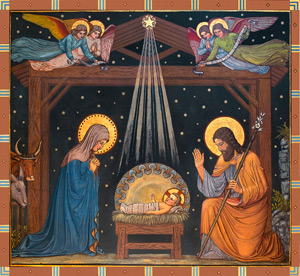
The Nativity - Lucas Cranach the Elder
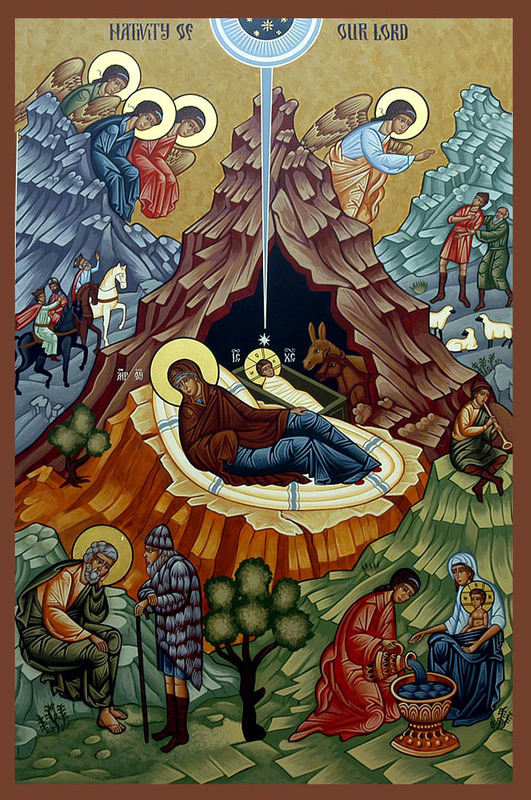
"In those days Caesar Augustus issued a decree that a census should be taken of the entire Roman world. (This was the first census that took place while Quirinius was governor of Syria.) And everyone went to their own town to register. So Joseph also went up from the town of Nazareth in Galilee to Judea, to Bethlehem the town of David, because he belonged to the house and line of David. He went there to register with Mary, who was pledged to be married to him and was expecting a child. While they were there, the time came for the baby to be born, and she gave birth to her firstborn, a son. She wrapped him in cloths and placed him in a manger, because there was no guest room available for them" (Luke 2:1-7).
 
These first several verses from the second chapter of Luke's gospel are my favorite of the Christmas season. These verses always wound up being my part in the Christmas Eve Sunday School program. It's a good thing, too, that I always seemed to get more or less the same verses every year. I wasn't then, nor am I now, one who could memorize things easily. I was always quite nervous right up through the time all of us Sunday school kids were marched up to the front of the church. I didn't like speaking in public, and it was all I could do to not flub my part. 
 
In fact, I never really liked the Children's Program when I was a child with a part to memorize. I remember spending what felt like endless hours in the sanctuary going over, and over, and over again just exactly where to stand and how to hold the microphone when we were lined up in front of the church. It was excruciatingly boring to sit in the pews waiting for our turn to line up, and nearly impossible to pay attention to anything that happened in the front after our group had finished speaking and sat back down. And, to cap it all off, when we had finished running through the entire program, we'd have to line up in the fellowship hall to march in again for another go-around. Not my idea of a good way to spend three hours, and I always enjoyed church-stuff.
 
When I look back on those times, being many years removed from them, I was a little surprised to see that two of my absolute most favorite things about Christmas come as a part of the Christmas Eve Children's Program (at least at Immanuel - Hodgkins): singing Silent Night in German by candle light, and hearing the first seven verses of Luke chapter two.
 
I didn't even realize that I still had them memorized until I started teaching at a Lutheran school and had to prepare a Christmas program myself. Then, as I looked deeper into those words which my childhood pastor and Sunday school teachers had inscribed into my brain, I became profoundly thankful that The Lord had allowed me to grow up in the way in which He did. By requiring us to memorize those gospel verses our Sunday school teachers were giving us the gift that we celebrate on Christmas - the gift of Immanuel, "God, with us".
 
Faith comes through hearing, and hearing comes through the word of Christ we are told in Holy Scripture. By having us children memorize the words of the gospel, our teachers put those faith-creating words into us. The author of Hebrews tells us that, in these last days, God has spoken to us by his Son. It is through Jesus, his Son - the Word made flesh - that God deals with mankind. He does not wish to deal with us in any other way than through his word and sacraments, which are God's word and promise coupled with a physical element of water, bread, or wine.
 
By the means of those words of the gospel the Holy Spirit worked faith in our hearts according to his good and gracious will. I am particularly thankful for the words of Scripture I was taught to memorize. Through the years since Sunday School God has continued to teach me and grow my faith through them.
 
The words recorded by Luke in the beginning of chapter two of his gospel may seem like the standard introductory passage. In television specials about the life of Jesus it usually takes up no more than a few moments of the opening credits to visually portray what Luke has written. His words, however, express something more important than just the desperate attempt to find shelter for Mary in the crowded village of Bethlehem.
 
Luke's words, "In those days," tell us that the events he relates have taken place in the midst of human history. They do not happen in his imagination, once upon a time, as though this is merely some fairy tale. The story of Jesus is a story that can be pinpointed in time. It happened "in those days", when Caesar Augustus issued his decree. Furthermore, the events of the gospel did not take place in some mythical kingdom far, far away. They happened in a real location to which one can point on a map, and even visit, if one was so inclined. Quirinius was (or was about to become) the governor of Syria. Mary and Joseph went to Bethlehem, the city of David. It was there, at that definite time and place that the Word became flesh and dwelt among us.
 
This is in contrast to other so-called mystery religions that flourished in the Middle East in the first and second centuries, and to the heretical off-shoots of Christianity that so intrigue people today, forming the basis of such popular entertainment as "The DaVinci Code". These religions were clearly built on fantastic stories written in the manner of the pagan myths of antiquity and meant to be taken as allegory.
 
For example, Mithra, god of the Roman Mithraic mysteries, is depicted as being born from a rock. He is shown as emerging from a rock, already in his youth, with a dagger in one hand and a torch in the other. He is nude, is wearing a Phrygian cap and is holding his legs together. An example from heretical Christianity is a resurrection account of Jesus from the non-canonical gospel of St. Peter which features a gigantic talking cross.
 
Jesus' birth account recorded in Holy Scripture, by contrast, is set against the backdrop of real people and places. There is, of course, debate as to exactly when Luke meant. But it is clear that he was being as precise as he possibly could be in establishing the foundation for his gospel account. While there might be some confusion as to which Quirinius Luke is referring, or which governing office he held, or which census (provincial or empire-wide) is meant, archeology has clarified and upheld Luke's Gospel consistently, and there is no reason to think it will do otherwise in the future. Luke's stated purpose for writing was to compile an orderly account of those things which he followed closely, namely the life, ministry, death, and resurrection of Jesus. Though many today would like to count Christianity simply as the mystery religion that won out in popularity and influence in the Roman Empire, it is clear to those who read its scriptures and study its history that Christianity is not merely a Mithra-clone. At the birth of Jesus we witness the God who created the universe clothing himself in human flesh and stepping into human history with the specific goal of being the sacrifice to atone for the sin of mankind in order to reconcile man to God.
 
In fact, that is what Jesus' name means. Jesus comes from the Jewish name "Yeshua", which is translated, "The Lord [YHWH] saves." Matthew records that, when the angel of The Lord appeared to Joseph to explain just who Mary was carrying in her womb and what he was to be named, this was in fulfilment of what the prophet Isaiah had written, "Behold the virgin shall conceive and bear a son, and they shall call his name Immanuel." Immanuel means, "God, with us." To put it another way, the LORD God [YHWH] who saves, is with us.

Mankind needed a savior because he, and all creation along with him, was infected with the disease of sin. Since Adam and Eve's first sin, when they disobeyed God's command not to eat of the fruit of the tree of the knowledge of Good and Evil in the Garden of Eden, sin entered creation. All people born since then are born suffering from this disease of sin. We are all born without true fear or trust in God. We are all born with the inclination toward sin, to commit actual sinful acts, and away from God. There is nothing we can do to rescue ourselves from this dreadful condition, or reconcile ourselves to God. The disease is terminal. This is why the Lord himself had to save us. This salvation he effected by taking on human flesh, being born under the law, living a sinless life, going to the cross to suffer and die as punishment for mankind's sinfulness, and rising from the dead three days later as the conqueror of sin, death and Satan.
 
After his death and resurrection, before ascending into heaven to be seated at God the Father's right hand, Jesus promised that he would be with us to the very end of the age. He is our brother, as the Lutheran Confessions declare, "and we are flesh of his flesh and bone of His bone. He has instituted His holy Supper for the certain assurance and confirmation of this, so that He will be with us, and dwell, work, and be effective in us also according to that nature from which He has flesh and blood" (FC SD VIII 79).

Jesus came to dwell among us and be the sacrifice to atone for the guilt of our sin on that first Christmas about which Luke writes. He came to us at a specific time, in a specific place. He is no fairy story, but the central focus of all of human history. He comes to us and remains with us in his holy word, preached and read, and in his holy sacraments, properly administered. What good news for fallen, sinful humanity. May it bring great joy to all who hear it. For unto us is born this day in the city of David a Savior, who is Christ the Lord.