Showing posts with label Luke. Show all posts

Friday, December 22, 2017

Real History

Gabriel Visits Zacharias
Inasmuch as many have taken in hand to set in order a narrative of those things which have been fulfilled among us, just as those who from the beginning were eyewitnesses and ministers of the word delivered them to us, it seemed good to me also, having had perfect understanding of all things from the very first, to write to you an orderly account, most excellent Theophilus, that you may know the certainty of those things in which you were instructed.

There was in the days of Herod, the king of Judea, a certain priest named Zacharias, of the division of Abijah. His wife was of the daughters of Aaron, and her name was Elizabeth. And they were both righteous before God, walking in all the commandments and ordinances of the Lord blameless. But they had no child, because Elizabeth was barren, and they were both well advanced in years.

So it was, that while he was serving as priest before God in the order of his division, according to the custom of the priesthood, his lot fell to burn incense when he went into the temple of the Lord. And the whole multitude of the people was praying outside at the hour of incense. Then an angel of the Lord appeared to him, standing on the right side of the altar of incense. And when Zacharias saw him, he was troubled, and fear fell upon him.

But the angel said to him, “Do not be afraid, Zacharias, for your prayer is heard; and your wife Elizabeth will bear you a son, and you shall call his name John. And you will have joy and gladness, and many will rejoice at his birth. For he will be great in the sight of the Lord, and shall drink neither wine nor strong drink. He will also be filled with the Holy Spirit, even from his mother’s womb. And he will turn many of the children of Israel to the Lord their God. He will also go before Him in the spirit and power of Elijah, ‘to turn the hearts of the fathers to the children,’ and the disobedient to the wisdom of the just, to make ready a people prepared for the Lord.”

And Zacharias said to the angel, “How shall I know this? For I am an old man, and my wife is well advanced in years.”

And the angel answered and said to him, “I am Gabriel, who stands in the presence of God, and was sent to speak to you and bring you these glad tidings. But behold, you will be mute and not able to speak until the day these things take place, because you did not believe my words which will be fulfilled in their own time.”

And the people waited for Zacharias, and marveled that he lingered so long in the temple. But when he came out, he could not speak to them; and they perceived that he had seen a vision in the temple, for he beckoned to them and remained speechless.

So it was, as soon as the days of his service were completed, that he departed to his own house. Now after those days his wife Elizabeth conceived; and she hid herself five months, saying, “Thus the Lord has dealt with me, in the days when He looked on me, to take away my reproach among people” (Luke 1:1-25).

Luke the Evangelist, the Greek physician, is responsible for nearly one quarter of the text of the New Testament. He tells us in the first lines of the text why. His purpose is to record an “orderly account” of the things that happened for the most excellent Theophilus. Whether this Theophilus is a real person, or he is a construct of the author to represent Christians is, in the end immaterial. Luke, by his meticulous attention to detail proves himself to be an able and detail-oriented historian. This is no fairy tale which took place ambiguously “once upon a time” in some fantasy land. Luke wanted Theophilus to know that the events being recounted were real. They happened in Bethlehem, in Judea, during the time of Caesar Augustus, while Quirinius was the governor of Syria. Real history. A real savior, come to earth to save real sinners, and destroy sin, death, and the devil once and for all.

The first thing Luke recounts to Theophilus is the birth of John the Baptist. Called John the Forerunner by the eastern churches, and John the Baptizer by the more self-conscious Lutherans, he is the fulfillment of God’s promise to send Elijah to prepare the Messiah’s way. Luke quotes from the following passage of Malachi: Behold, I will send you Elijah the prophet Before the coming of the great and dreadful day of the Lord. And he will turn The hearts of the fathers to the children, And the hearts of the children to their fathers, Lest I come and strike the earth with a curse.”[1] John the Baptist is at his work, even before his birth. He prepares the way for Jesus. His purpose is to acknowledge Christ. The angel Gabriel tells Zacharias this will be John’s work. John begins it while he is still in Elizabeth’s womb, when he leaped upon hearing the greeting of Mary, and Elizabeth was filled with the Holy Spirit.[2] He continues his work of directing people to Jesus the Christ when he preaches repentance in the wilderness,[3] when Jesus comes to be baptized,[4] and when John’s disciples are indignant that their following is becoming smaller.[5] John, however, continually exalts Christ. John knows that he must decrease, and Christ must increase. The prophet Isaiah, speaking of this says, “Of the increase of His government and peace There will be no end, Upon the throne of David and over His kingdom, To order it and establish it with judgment and justice from that time forward, even forever. The zeal of the LORD of hosts will perform this.”[6] Even now, in the pages of Holy Scripture, John the Baptist continues his work. He bids us prepare our hearts for the coming of the Lord through repentance, and to fix our eyes upon Him, Jesus, the author and finisher of our faith.[7]


[1] Malachi 4:5-6
[2] Luke 1:39-41
[3] Matthew 3:1-12; Mark 1:3-8; Luke 3:2-17
[4] Matthew 3:13-17
[5] John 3:22-36
[6] Isaiah 9:7
[7] Hebrews 12:1-3

Sunday, December 25, 2016

Pondering Glory


By Rev. Joel Brondos

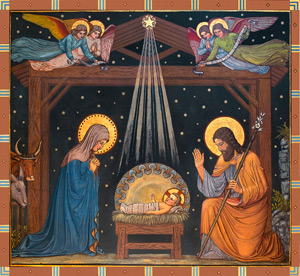
The glory of the multitude of an angelic host praising God -- has any mortal flesh ever witnessed anything as magnificent as that which lowly shepherds experienced?

They then went to see Jesus as it had been told them, a babe lying in a manger, making widely known the marvels which they had seen and heard . . . and then what?

After such an astounding event, did they not expect some imminent follow-through -- some comparable fulfillment on the heels of so great a portent?

But, nothing.

Jesus grew in wisdom and stature, but it would be thirty years before anything out of the ordinary would happen again. Could they do anything more but go back to their shepherding?

Now, in 2016, Christmas has come . . . and gone. Whatever might have been glorious -- paltry in terms of what the shepherds experienced with our LED lights, glittered decorations, mail-order gifts, seasonal music and high-calorie food -- now fades in the rear-view mirror. Did it satisfy? Did it fail to live up to the hype yet another year? Do we now just go back to our daily duties, counting 364 days until the next round?

Mary had her own encounter with an angel as well as other unexpected visitors from poor shepherds to rich magi. They came with accounts of their own to confess the One born to be Savior. But after these passed, Mary, too, had to wait. There was no immediate consummation of all that she had seen and heard.

And yet, there was not just a going back to business as usual. We read that Mary treasured all these things in her heart (Luke 2:19). Couldn't these words have sustained her throughout the years and even as she stood at the foot of the cross when her soul was pierced through (Luke 2:35)?

This Christmas, with Mary, when the worldly glamour and festivities have passed, we treasure all these things in our hearts. We return to our daily chores, and from time to time we are likely to be bloodied and bruised with the cares of this life, but our hearts ponder the news first proclaimed by angels, confessed by shepherds, worshiped by wise men. 

We return to our homes, schools, and workplaces, glorifying and praising God for all that has been proclaimed to us in His Word, knowing that it may take thirty years or more, but we shall be called into that glory from whence the angels came. That glory shall not terrify us as it did the shepherds because we have been baptized and clothed in the holiness and righteousness of our Lord Jesus Christ.

In the historic Lutheran liturgy of the Divine Service, we weekly sing the message of the angelic hosts to the shepherds in the Gloria Patri. With "angels and archangels and with all the heavenly host we laud and magnify the Lord's glorious name, ever more praising Him . . ." only to return to our daily duties with joy, treasuring these things in our hearts. (1 Peter 5:4) " . . . and when the Chief Shepherd appears, you will receive the crown of glory that does not fade away."

Monday, July 1, 2013

The Kingdom of God - Part 3

Just as it was in the days of Noah, so will it be in the days of the Son of Man. They were eating and drinking and marrying and being given in marriage, until the day when Noah entered the ark, and the flood came and destroyed them all. Likewise, just as it was in the days of Lot - they were eating and drinking, buying and selling, planting and building, but on the day when Lot went out from Sodom, fire and sulfur rained from heaven and destroyed them all - so will it be on the day when the Son of Man is revealed (Luke 17: 26-30).

As previously discussed, Jesus had told his hearers that the Kingdom of God was in their midst, referring to his rule as Messiah. Here Jesus explains how the physical manifestation of the Kingdom of God will come about at the end, on Judgment Day. On that day this present, corrupt world will pass away and Jesus will make everything new, bringing into existence a new heaven and a new earth[1]. The character of the kingdom's physical manifestation will not be gradual, and it will not involve rehabilitation of the kingdoms of this present world. Things are not going to get better, and better, and better in this world until, at some point, the Christian religion reigns over all the earth and we enter the golden age of the Millennium, as some Christian theologians teach[2]. The physical arrival of Christ and God's Kingdom will bring with it utter destruction as evidenced by the examples Jesus gives. The great flood at the time of Noah destroyed all life on earth, except that which was preserved by God in the Ark. The destruction of Sodom and Gomorrah was absolute, with no trace of the cities or survivors remaining - again, with the exception of those whom God preserved out of his grace. God's kingdom will come quickly, but with plenty of warning, just as the flood came upon the world of Noah, just as the fire rained down on Sodom and Gomorrah in the time of Lot. Kretzmann writes about how the people during the time of Noah and Lot were stubborn and, despite being given plenty of time and warning about the impending judgment, refused to repent:

The distinguishing characteristic of the time just preceding the final advent of Christ, the Son of Man, will be an indifferent carelessness. The days of Noah are an example. The warning had gone out through the mouth of this preacher of righteousness that the people should repent of their foolish ways. But they gave so little heed to the warning that they continued in all the manner of complete abandon in the desires of the flesh up to the very hour of the cataclysm: they ate, they drank, they married, they were married; men and women, the entire generation, past all hope of redemption. And then, with the sudden frightfulness that has characterized the judgments of God in similar situations, came the day on which Noah entered into the ark; then came the Flood and destroyed them all. And the days of Lot are another example of the utter, blind heedlessness of the people. In Sodom and Gomorrah the inhabitants continued in the delights of the flesh as well as in all their lines of business, work, and endeavor: they ate, they drank, they bought, they sold, they planted, they built, up to the very hour of the catastrophe that overwhelmed the cities, when it rained fire and sulphur from heaven and destroyed them all. The people of the last times will not have learned their lesson from the previous calamities; when the Son of Man will be revealed before their astonished, horrified eyes on the last day, He will find them as unprepared for His coming, as deeply steeped in the foolishness of the Noachites and of the Sodomites as any generation ever was (Kretzmann, 1921).

On that day, let the one who is on the housetop, with his goods in the house, not come down to take them away, and likewise let the one who is in the field not turn back. Remember Lot's wife. Whoever seeks to preserve his life will lose it, but whoever loses his life will keep it. I tell you, in that night there will be two in one bed. One will be taken and the other left. There will be two women grinding together. One will be taken and the other left.” And they said to him, “Where, Lord?” He said to them, “Where the corpse is, there the vultures will gather” (Luke 17:31-37).

In this passage some see evidence of the rapture, the spiriting away to heaven of all Christians from the earth either before, during, or after a period known to millennialist Christians as the Tribulation. Images of the Left Behind book series by Tim LeHaye are called to mind; images of driverless cars abandoned in the roadway and pilotless airplanes auguring into mountainsides, their Christian drivers and pilots gone on to heavenly glory without any hint or warning. This is not, however, the thing to which Jesus is referring. Dispensationalism and the doctrine of the rapture are not borne out by scripture. It is of relatively new invention, in fact, being only developed over the last 200 years or so[3]. Instead, Jesus is describing the suddenness of his coming on the Day of Judgment, and the futility of all things temporal when it comes to redemption. Just as it was too late for anyone in Noah's time to escape God's judgment by the waters of the flood after he had shut Noah, his family, and the animals inside the ark, so too will it be too late to repent when Christ appears. Likewise, Lot's wife is turned to a pillar of salt when she hesitates to trust in God's redemption and turns back to see the fate of her former home (Engelbrecht, 2009). Regarding this passage, Kretzmann writes the following:

The suddenness of the breaking of Judgment Day will take every person where he just happens to be at that time. A man will be up on the flat roof of the house. He will neither have, nor should he attempt to take, time to go down and get any instruments or possessions. A man will be out in the field. He also should not turn back behind him for anything of this world's goods that he may have valued. As when an army of the enemy makes a sudden successful assault and only precipitate flight will save the inhabitants, he that turns back for money, clothes, or other goods is lost, so the person whose mind is still attached to the things of this world on the last day is beyond hope of salvation. The example of Lot's wife should be before the minds of the believers at all times. Had she not turned behind her to satisfy her curiosity, she might have saved her soul with the rest. Her hesitation proved her destruction. Cp. Matt. 16, 25; Mark 8, 35; Luke 9, 24. He that in the last emergency will have nothing in mind but the saving of this earthly life and the goods that are necessary for its preservation, will lose forever the true life in and with God; but he whose desires are free from all love for this world and what it has to offer, that has denied himself and all that this life might have given him, he will save his life, the life in God, his soul and its eternal salvation (Kretzmann, 1921).

The Disciples, needless to say, are stunned at Jesus' teaching. As discussed earlier, they still seem to expect the same type of political Messiah as the Pharisees. They ask the question, "Where, Lord?" Jesus, as he was wont to do, answers them in enigmatic fashion. His answer is unmistakably ominous: "Where the corpse is, there the vultures will gather." This may seem like a sarcastic non-answer to the disciples' question but it does give us an idea what the world will be like by the time of the end - worthless and unclean, like a dead and rotting corpse. Kretzmann explains Jesus' words this way:

In awe and fear, they [the disciples] barely breathe the question: Where, Lord? Where will all this happen? And He told them: Where the dead body is, there will the eagles gather themselves together. The world, especially in the last days, will be, and to-day is, like a decaying carcass, whose stench rises up into the heavens. And judgment and destruction will come upon the entire spiritually dead and morally rotten human race. It is a strong, but fitting figure, revealing the world as it is, in its true condition, without a redeeming feature to recommend it in the sight of God (Kretzmann, 1921).

God is purposely ambiguous when describing for us the signs of Christ's second coming and the signs of the end of this present age. He leaves no doubt, however, that Christ will come a second time to establish the eternal kingdom. If we human beings could calculate the time of Christ's return, we would live as reprobates until the last possible moment before repenting of our sin, such is the depravity of our sinful human nature (Engelbrecht, 2009). St. Paul, in fact, warns us against living in such a way. He tells us that we should put on the new self and live as the new creation of Christ that we are, not in order to earn God’s favor, but as a response to receiving God’s undeserved mercy through Christ Jesus. St. Paul writes:

I appeal to you therefore, brothers, by the mercies of God, to present your bodies as a living sacrifice, holy and acceptable to God, which is your spiritual worship. Do not be conformed to this world, but be transformed by the renewal of your mind, that by testing you may discern what is the will of God, what is good and acceptable and perfect…If then you have been raised with Christ, seek the things that are above, where Christ is, seated at the right hand of God. Set your minds on things that are above, not on things that are on earth. For you have died, and your life is hidden with Christ in God. When Christ who is your life appears, then you also will appear with him in glory. Put to death therefore what is earthly in you: sexual immorality, impurity, passion, evil desire, and covetousness, which is idolatry. On account of these the wrath of God is coming. In these you too once walked when you were living in them. But now you must put them all away: anger, wrath, malice, slander, and obscene talk from your mouth (Romans 12:1-2; Colossians 3:1-8).

To delay repentance, to turn away from God and live according to the desires of our sinful flesh, to disregard the law's revelation of our sinful state and the call of the Holy Spirit through the Gospel is to run the risk of ending up as those who ignored God in the days of Noah and Lot.

The message of Christ's teaching here is unmistakable: today is the day of salvation and repentance must not be delayed[4]. Through the suffering, death and resurrection of Christ, sin, death, and Satan have been defeated (Luther's Small Catechism with Explanation, 1986). Christ died as the atoning sacrifice for the sins of the whole world[5]; those who repent of their sin and trust in Christ have the forgiveness and eternal life he won for mankind by Christ on the cross. Furthermore, we who trust in Christ must not live as if his return is far off and we are secure among our earthly possessions, because we are not. Our wealth, possessions, our status among men and our good works will be of no avail to us when Christ returns on the Day of the Lord to judge mankind and establish his kingdom physically. The only way we can hope to stand before God on that Day of Judgment is if we have been clothed with the robe of Christ's righteousness won for us by his death and resurrection, given to us freely, by his grace[6].


Works Cited

Commission on Theology and Church Relations of the Lutheran Church - Missouri Synod. (1989). The "End Times" - A Study on Eschatology and Millennialism. St. Louis: The Lutheran Church - Missouri Synod.

Engelbrecht, R. E. (Ed.). (2009). The Lutheran Study Bible. Saint Louis: Concordia Publishing House.

Kretzmann, P. E. (1921). Popular Commentary of the Bible: New Testament (Vol. 1). St. Louis, MO, USA: Concordia Publishing House.

Luther's Small Catechism with Explanation. (1986). Saint Louis, Missouri: Concordia Publishing House.


End Notes

[1] Revelation 21:1-8

[2] While there are numerous variations in millennialist teaching today, a fourfold categorization has been widely accepted: 1) dispensational premillennialism; (2) historic premillennialism; (3) postmillennialism, and (4) amillennialism. Of the first three categories, all of which hold to a millennium or utopian age on this earth, the most commonly held view is dispensational premillennialism…The less common postmillennial view places Christ’s second advent after (post) the millennium. Only then will the rapture, the general resurrection, the general judgment , and the eternal states occur. The millennium is not understood to involve a visible reign of Christ in the form of an earthly monarchy, nor is the millennial period to be taken literally as necessarily 1000 years long. In these respects postmillennialism corresponds closely to the amillennialist position (Commission on Theology and Church Relations of the Lutheran Church - Missouri Synod, 1989).

[3] Dispensational premillennialism, or simply dispensationalism, is a theological system having its origin among the Plymouth Brethren in Ireland and England in the early 19th century. This system’s originator was John Nelson Darby (1800-82), one of the chief founders of the Plymouth Brethren movement. Dispensationalism arose as a reaction against the Church of England and the widely held view of postmillennialism (Commission on Theology and Church Relations of the Lutheran Church - Missouri Synod, 1989).

[4] 2 Corinthians 6:2

[5] 2 Corinthians 5:15; 5:19; 5:21; Hebrews 2:17.

[6] Isaiah 61:9-11; Revelation 21:1-2

Wednesday, June 12, 2013

The Kingdom of God - Part 2

Luther Preaches Christ
And he said to the disciples, “The days are coming when you will desire to see one of the days of the Son of Man, and you will not see it. And they will say to you, ‘Look, there!’ or ‘Look, here!’ Do not go out or follow them. For as lightning flashes and lights up the sky from one side to the other, so will the Son of Man be in his day. But first he must suffer many things and be rejected by this generation” (Luke 17:22-25).

Jesus, having answered the Pharisee’s question regarding the coming of God’s kingdom in a most remarkable way, he turns to his disciples. Jesus seems to be telling his disciples that one day soon they are going to want to hear the wonderful and enigmatic things he teaches them face to face as he is now doing, but this will not be possible because he will be gone. Right now he is in the midst of them, but soon he will be seated at the right hand of God the Father. He will go from the midst of them, to the cross, to the tomb, to the resurrection, to his position of power and glory at the Father's side. And, from his position at the Father’s side, he will one day return to judge the living and the dead. There is much that must happen, however, between that day and the one during which Jesus teaches his disciples. 

Jesus makes this point to the scribes and Pharisees when they ask him why his disciples did not fast, as those of John the Baptist did. "Can you make wedding guests fast while the bridegroom is with them" Jesus asked in reply[1]? When Jesus, the bridegroom, goes away, the disciples, who are the guests in his metaphor, will most certainly fast (Engelbrecht, 2009). Jesus explains to the disciples elsewhere, however, that he is not simply planning to abandon them when he rises from the grave and ascends to heaven. He promises to send the Comforter - the Holy Spirit - to be with them, and to clothe them with power, and to recall to their minds all that he has taught them[2]. This is so that they can, in turn, record it in the pages of what we today call the New Testament scriptures.

Jesus, in the previous verses, had been addressing the Pharisees, who were questioning him about the Kingdom of God. The Pharisees' questioning of Jesus does not seem to be legitimate, but designed to get Jesus to say something that they could use to get him in trouble, as on other occasions[3]. In keeping with his method, he spoke somewhat enigmatically to the masses, and explained those sayings and parables to his disciples[4]. The 'they' to whom Jesus seems to be referring is, in the narrow context of this conversation, the Pharisees and, more broadly, all false teachers who reject the Christ. 

What is Jesus warning the disciples about when he tells them not to go out or follow the people who say, “Look, there!” and “Look, here!”? Jesus is warning them not to abandon their faith, which he has built in them by his word. Lenski writes: 

They [false teachers] will imagine that they see plain indications and signs of Christ’s immediate coming. They will pose as prophets, even as manifestations and incarnations of Christ, and call the true disciples to flock to their standards “here” or “there”. Jesus warns, “Do not go away or pursue after,” leave not your faith in the words which Jesus has spoken, do not chase after these false leaders and the promises they make. This warning has often been disregarded, will often be so, but should not be so by us (Lenski, 1946).

For as lightning flashes and lights up the sky from one side to the other, so will the Son of Man be in his day (v. 24).

When Jesus talks about the day of the Son of Man he is talking about his second coming to judge the world[5]. Lightning is a useful comparison, as Our Lord has repeatedly instructed us that his coming will be swift and sudden[6]. This is the contrast Jesus makes with the physical, political kingdom for which the Pharisees longed, and even the disciples expected the Messiah to establish. There will be no ambiguity when Christ returns. As lightning flashes and lights up the sky from one side to the other, so will the Son of Man be in his day. Kretzmann describes the second coming of Jesus in this way: 

In one moment He will shine, with all the glory of His splendor, from this quarter under heaven unto that; He will be visible to all people of the earth. But before this glorious consummation there will be a long time of waiting and watching for the believers, with a sore trial for their patience. First of all the great obligation rests upon the Lord to suffer in the great Passion, to be rejected by the present generation. Christ must bear His cross first, and His Church, the members of His kingdom, will become partakers of this suffering, before the great day of glory dawns (Kretzmann, 1921).

Lenski also writes: 

The Pharisees needed to be told that the kingdom is within, is spiritual; to this the Lord adds for the sake of his disciples that, after the spiritual work of this kingdom is done, it will come suddenly, like lightning, in judgment on the world…The visible glorious consummation of the kingdom must wait in toto until the spiritual work has been completed…his coming and the consummation of the kingdom will occur in such a manner that we need go nowhere – it will be instantaneously visible over the whole earth just as a lightning flash lightnings [sic] out of one part of heaven and shines to the other part and lights up the entire sky (Lenski, 1946).

But why did Jesus have to suffer and be rejected? This question must certainly have been going through the minds of the disciples who, at this point, still had a more Pharisaic understanding of God’s kingdom, and the work of the Messiah. 

For you know the grace of our Lord Jesus Christ, that though he was rich, yet for your sake he became poor, so that you by his poverty might become rich (2 Corinthians 8:9).

Jesus endured poverty, contempt, and persecution in his earthly life[7]. He was born in poverty[8]. The tyrant Herod tried to murder him in his infancy[9]. All throughout his earthly ministry people derided him, rejected him, tried to throw him from cliffs, and stone him[10]. Ultimately he suffered the greatest agony of body and soul under Pontius Pilate, dying on the cross[11] (Luther's Small Catechism with Explanation, 1986). 

Since therefore the children share in flesh and blood, he himself likewise partook of the same things, that through death he might destroy the one who has the power of death, that is, the devil, and deliver all those who through fear of death were subject to lifelong slavery. For surely it is not angels that he helps, but he helps the offspring of Abraham. Therefore he had to be made like his brothers in every respect, so that he might become a merciful and faithful high priest in the service of God, to make propitiation for the sins of the people (Hebrews 2:14-17).

Jesus endured suffering, humiliation, and death voluntarily for one purpose – to redeem mankind. Luther, in his explanation of the second article of the Apostle’s Creed, sums up Jesus’ purpose, and man’s relationship to him, beautifully and succinctly: 

I believe that Jesus Christ, true God, begotten of the Father from eternity, and also true man, born of the Virgin Mary, is my Lord, who has redeemed me, a lost and condemned person, purchased and won me from all sins, from death, and from the power of the devil; not with gold or silver, but with His holy, precious blood and with His innocent suffering and death, that I may be His own and live under Him in His kingdom and serve Him in everlasting righteousness, innocence, and blessedness, just as He is risen from the dead, lives and reigns to all eternity. This is most certainly true (Luther's Small Catechism with Explanation, 1986).

Jesus, the Lamb of God who takes away the sin of the world[12], laid down his life voluntarily[13], in obedience to God the Father’s will[14], so that man and God could be reconciled[15]. St. Paul writes that it was through the obedience of the one man, Christ, so that the many – mankind – were made righteous[16]. In fact, scripture tells us that Christ, the sinless one, became sin for us, so that we sinners might become the righteousness of God[17]. Christ was our substitute. He took our place under God’s judgment against sin. By paying the penalty of our guilt, Christ…made satisfaction, for our sins (Luther's Small Catechism with Explanation, 1986). 

He himself bore our sins in his body on the tree, that we might die to sin and live to righteousness. By his wounds you have been healed (1 Peter 2:24).

This is the message all mankind needs to hear, and upon which the Christian church must remain focused in this time between Christ's first and second coming. Many have gone off crying, “Look, there!” as Jesus predicted, seeking mystical experiences, secret truths, or special revelations. Jesus, the Word made flesh, directs the disciples and believers today, to the place where his promises are found – his word. Christians need to hear this word – Law and Gospel – regularly, and gather around those pledges of the forgiveness Christ has won for us – Holy Baptism and the Lord’s Supper. It is by Word and Sacrament that he works to grant us repentance[18], create faith in us, is among us, and to deliver to us the forgiveness he won for us by his death and resurrection[19].


Bibliography


Engelbrecht, R. E. (Ed.). (2009). The Lutheran Study Bible. Saint Louis: Concordia Publishing House.

Kretzmann, P. E. (1921). Popular Commentary of the Bible (Vol. 1). St. Louis, MO, USA: Concordia Publishing House.

Lenski, R. C. (1946). The Interpretation of St. Luke's Gospel. Columbus, Ohio: The Wartburg Press.

Luther's Small Catechism with Explanation. (1986). Saint Louis, Missouri: Concordia Publishing House.


End Notes

[1] Luke 5:33-35

[2] John 16:4-15

[3] Mark 8:11-13

[4] Matthew 13:34-36

[5] Matthew 25:31-32; 2 Corinthians 5:10

[6] Matthew 24:27; Acts 1:11; 2 Peter 3:10; Revelation 1:7

[7] 2 Cor. 8:9; Matthew 8:20; Isaiah 53:3; John 8:40

[8] Luke 2:7

[9] Matthew 2:13

[10] Luke 4:29; John 8:59

[11] John 19:16-18; Mark 15:21-41

[12] John 1:29

[13] John 10:17-18

[14] Luke 22:42; John 5:19

[15] Genesis 3:15; 1 John 3:8

[16] Romans 5:19

[17] 2 Corinthians 5:21

[18] 2 Timothy 2:5

[19] John 15:5; Romans 6:3-5; Titus 3:5-7; 1 Peter 3:21

Friday, May 24, 2013

The Kingdom of God

Jesus and the Pharisees
Being asked by the Pharisees when the kingdom of God would come, he answered them, "The kingdom of God is not coming with signs to be observed, nor will they say, 'Look, here it is!' or 'There!' for behold, the kingdom of God is in the midst of you" (Luke 17:20-21). 

What do the Pharisees mean when they say, "The kingdom of God"? The Pharisees of Jesus' day are descendants of the Jewish religious leaders who led Israel during the time of the Macabean revolt (Harrison, Bromiley, & Henry, 1990). After the Israelites were taken into captivity by the Babylonians, the Persians, led by Cyrus the Great, conquered Babylon. Cyrus allowed the captive Israelites to return to Jerusalem and rebuild the temple. Cyrus, and other Persian rulers, demonstrated an attitude of tolerance toward the Jews where religion was concerned. In 332 BC Alexander the Great took Judea from the Persians. Alexander was building a vast empire for himself which incorporated diverse lands, peoples, cultures, and languages. He attempted to unite his empire through what was later called "hellenization" (Alexander the Great). Alexander encouraged the spread of the Greek language and culture throughout his empire, "Hellenizing" them (the word for Greece in the Greek language is 'Hellas'). He did not, however, forcefully oppose the practice of Judaism. 

When Alexander died, his empire was divided up among four of his generals. The general Ptolemy ruled over Israel and Egypt. He continued Alexander's policy of hellenization. In 198 BC descendants of another of Alexander's generals, Seleucus, took control of Judea from the Ptolemys (Seleucid Empire). 

The Seleucid Empire, which ruled over Israel during the first century BC, oppressed the Jews and attempted to suppress their religious practices. When the Seleucid ruler Antiochus IV Epiphanies built a statue of the Greek god Zeus in the court of the temple in Jerusalem, and desecrated the temple by sacrificing a pig on the altar, faithful Jews rose against the Seleucids in revolt. The faithful Jews, lead first by a priest named Mattathias, followed by his son Judas Maccabeus, waged guerrilla warfare against their Hellenized countrymen who submitted to the Seleucid command to worship pagan gods, and against the Seleucid armies themselves. They won their independence from Seleucid rule and established an independent kingdom in 142 BC. The descendants of Mattathias, known as the Hasmonaeans, ruled the independent Israel until it was lost to the Roman general Pompey in 63 BC (Maccabean Revolt) (Engelbrecht, 2009). 

Throughout their captivity in Babylon, their return to the land and subjugation by Persia, Alexander the Great, Ptolemy, and the Seleucids, the Jews developed a nationalistic school of religious thought. From the beginning of Roman rule in 63 BC the Jews sought independence. The Pharisees were a Jewish sect that emerged in Israel during the time of Hasmonean rule. They were characterized as master interpreters of the oral traditions of the rabbis. Though they were relatively few in number, they were trusted by the masses (Packer & Tenney, 1980). In contrast to other Jewish sects of the day who espoused Greek ideas, such as the Sadducees who adopted the ideas of the Greek philosopher Epicurus, the Pharisees maintained a rigorous separation from the Hellenistic culture and fastidiously observed the Mosaic Law and the traditions of the earlier teachers (Packer & Tenney, 1980). They longed for the day when the oppressive yoke of the Romans would be cast off by the great champion of the Jews who would establish a kingdom like David's that would last forever - the Messiah (Harrison, Bromiley, & Henry, 1990). This political messiah who would establish a worldly, political kingdom was what the Pharisees were looking forward to[1]. When the Pharisees ask Jesus about when the kingdom of God would come, this is the kind of kingdom they meant. Even Jesus' own disciples were looking for a worldly kingdom to be established, as evidenced by their question to the risen Christ just prior to his ascension[2]

What does Jesus mean when he says that the kingdom of God is "in the midst of you"? He means something quite different than the earthly kingdom envisioned by the Pharisees, and some modern-day Christians, when he talks about the kingdom of God. Indeed, he says this quite plainly when he is on trial before Pontius Pilate. When asked by Pilate if he is a king, Jesus tells him that he is, but that his kingdom is not of this world[3]. Pilate's concern was the same as that of the Jewish leaders. Pilate was worried that, with Jesus, he was dealing with another revolutionary attempting to gain a following in order to throw off the Roman yoke through political upheaval. The Jewish leaders used this idea of Jesus as a revolutionary, since he calls himself a king, to leverage Pilate to give Jesus a death sentence. They remind Pilate, in a veiled threat, that they have no king but Ceaser and, if he sets Jesus free, Pilate would not be Caesar's friend[4]. This manipulation by the Pharisees puts Pilate between a rock and a hard place, as “former” friends of Caesar generally had a poor life expectancy, and makes his mind up for him. The kingdom Jesus speaks of, however, is not a matter of territory; it is in their midst. 

The kingdom of God can be discussed in different ways. Certainly God rules over the entire universe as Supreme King. In that way, God’s Kingdom is territorial. It encompasses everything, everywhere. People have also used the phrase “kingdom come” to describe the time after the resurrection, when God rules without opposition (Engelbrecht, 2009). At this time Scripture tells us that God will create a new heaven and a new earth, where resurrected believers will live, free from sin, death, and the devil, under God’s reign without opposition. This kingdom is not abstract, but will be established physically when Jesus returns in judgment. In the context of Luke 18:20-21, however, Jesus is speaking of God’s Kingdom as something intangible. He says, speaking to the Pharisees and his disciples, that the Kingdom of God is “in the midst of you”. This can also be translated as “within you” (as does the KJV Bible), or “within your grasp” (Engelbrecht, 2009). 

To speak of a kingdom is not simply to speak of a sovereign’s realm, but the reign of that sovereign. Thus, most completely understood, the Kingdom of God is God’s ruling (his reign) as sovereign over the whole universe, all believers on earth, and all the saints and angels in heaven. Martin Luther called these three aspects of God’s reign 1) the kingdom of power[5], 2) the kingdom of grace[6], and 3) the kingdom of glory[7] (Luther, 1991). John the Baptist called people to repent and be baptized. Jesus, after his baptism by John, also called people to repentance. His message, however, is slightly different than John’s message. Jesus proclaims, “The time is fulfilled, and the kingdom of God is at hand; repent and believe in the gospel[8].” John was looking forward to the coming king and establishment of the kingdom[9]. Jesus announces at the beginning of his ministry that the kingdom is now established. The king, and therefore the kingdom, is at hand. That is, they are here with Jesus’ words, and in the hearts of his subjects, all those who believe. The kingdom of God’s reign was literally among them, in their midst, within their grasp. Jesus makes plain that his baptism was a coronation of sorts when he teaches in the synagogue shortly thereafter: 

And he came to Nazareth, where he had been brought up. And as was his custom, he went to the synagogue on the Sabbath day, and he stood up to read. And the scroll of the prophet Isaiah was given to him. He unrolled the scroll and found the place where it was written, “The Spirit of the Lord is upon me because he has anointed me to proclaim good news to the poor. He has sent me to proclaim liberty to the captives and recovering of sight to the blind, to set at liberty those who are oppressed, to proclaim the year of the Lord’s favor.” And he rolled up the scroll and gave it back to the attendant and sat down. And the eyes of all in the synagogue were fixed on him. And he began to say to them, “Today this Scripture has been fulfilled in your hearing” (Luke 4:16-21). 

Jesus announced to his stunned hearers that he was the Messiah, the king who was to come. He was now present among them, to bring good news and everlasting joy to the redeemed of Israel (Engelbrecht, 2009). The kingdom he came to establish, however, would not be of the same type that they had grown to expect during all those years of waiting. 

St. Paul understands the nature of the Kingdom of God rightly. In his letter to the Romans he instructs the believers there in matters of contention regarding eating unclean foods and observing holy days. St. Paul tells the Roman Christians that they are free to eat or not to eat; to observe or not to observe. They should not, however, engage in behaviors that cause their fellow believers to stumble in the faith. These tangible things and man-made observances do not constitute God’s kingdom, so they (and we also) should not let them harm God’s reign among them. 

For if your brother is grieved by what you eat, you are no longer walking in love. By what you eat, do not destroy the one for whom Christ died. So do not let what you regard as good be spoken of as evil. For the kingdom of God is not a matter of eating and drinking but of righteousness and peace and joy in the Holy Spirit. Whoever thus serves Christ is acceptable to God and approved by men. So then let us pursue what makes for peace and for mutual upbuilding (Romans 14:15-19). 

Writing to the Colossians, St. Paul says that Christians have been rescued by Jesus from the kingdom of darkness and have been brought into his kingdom of light. The mark of our citizenship in God’s kingdom is not something physical, but rather redemption and the forgiveness of sins won for us by Christ on the cross. 

He has delivered us from the domain of darkness and transferred us to the kingdom of his beloved Son, in whom we have redemption, the forgiveness of sins (Colossians 1:13-14). 

St. Paul emphasizes that the aspect of God’s kingdom which is most important, the thing we enter into when he brings us into his kingdom through his means of grace, is justification. Through spiritual means – repentance and faith – we have access to the benefits of citizenship in God’s kingdom. 

Jesus, who had been baptized by John the Baptist, anointed by the Holy Spirit, and confirmed by the voice of God the Father, proclaims that the kingdom of God is at hand, and that he is its anointed sovereign. Jesus’ baptism is a royal coronation, of sorts. At his second coming, Jesus tells us that all things will be new again; the old heaven and earth will have passed away and been replaced by the new. Creation will be restored to its perfect condition, and sin, death, and the devil will disappear forever. In this way Christ will establish a kingdom which includes the world, newly restored[10]

Kretzmann explains the Kingdom of God in this way: 

To attempt to fix its definite position, its limits, its boundaries in the world by the application of the senses, by sight is foolish; for the kingdom of God is within, in the hearts of the believers. He that accepts the mercy of the King of grace is a member of the Kingdom of Grace, but by faith only, which is in the heart and cannot be seen by human beings. And all external signs of the presence of the Kingdom and its power in the hearts of the believers are not infallible, since these same signs may be feigned by such as are hypocrites (Kretzmann, 1921). 

Just as Jesus’ mission at his first coming was to redeem mankind, his primary mission at his second coming, however, will be to judge mankind, not to set up an earthly government: 

The one who rejects me and does not receive my words has a judge; the word that I have spoken will judge him on the last day…For we must all appear before the judgment seat of Christ so that each one may receive what is due for what he has done in the body, whether good or evil. (John 12:48; 2 Corinthians 5:10). 

The author of Hebrews writes: 

And just as it is appointed for man to die once, and after that comes judgment, so Christ, having been offered once to bear the sins of many, will appear a second time, not to deal with sin but to save those who are eagerly waiting for him (Hebrews 9:27-28). 

All Christian denominations may not agree on an interpretation of God’s word concerning exactly how he will establish – or has established – his kingdom, or how and when Christ will return. As Christians, however, we must always discuss these issues beginning from a position of love for our brothers and sisters in Christ, and loving concern for those who are not yet citizens of heaven[11] with us. We must remember that what binds the body of Christ, that is, the church, is not when Christ is coming, or how, but that he is coming. And that, if one is to appear before God to give account, as every man will, he needs to acknowledge his sin, repent, and cling to Christ before that day, if he hopes to stand. 

This is what we can all agree on concerning the end: Christ will return visibly and with great glory on the Last Day[12]. Christ will return to judge the world[13]. Christ will return on a specific day known only to God alone[14]. Before Christ returns, there will be increasing turmoil and distress for the church and the world[15]

Jesus Christ is the same yesterday and today and forever. Do not be led away by diverse and strange teachings, for it is good for the heart to be strengthened by grace, not by foods, which have not benefited those devoted to them. We have an altar from which those who serve the tent have no right to eat. For the bodies of those animals whose blood is brought into the holy places by the high priest as a sacrifice for sin are burned outside the camp. So Jesus also suffered outside the gate in order to sanctify the people through his own blood. Therefore let us go to him outside the camp and bear the reproach he endured. For here we have no lasting city, but we seek the city that is to come. Through him then let us continually offer up a sacrifice of praise to God, that is, the fruit of lips that acknowledge his name. Do not neglect to do good and to share what you have, for such sacrifices are pleasing to God (Hebrews 13:8-16). 

The return of Christ is a source of hope and joy for the Christian[16]; we are citizens of the kingdom of God by grace, through faith in Christ. Here, in this world corrupted by sin – Satan’s kingdom – we have no lasting city; we seek the city that is to come[17].


Bibliography

Alexander the Great. (n.d.). Retrieved May 23, 2013, from Wikipedia: http://en.wikipedia.org/wiki/Alexander_the_Great

Engelbrecht, R. E. (Ed.). (2009). The Lutheran Study Bible. Saint Louis: Concordia Publishing House.

Harrison, E. F., Bromiley, G. W., & Henry, C. F. (Eds.). (1990). Wycliffe Dictionary of Theology. Peabody, Massachusetts: Hendrickson Publishers, Inc. 

Kretzmann, P. E. (1921). Popular Commentary of the Bible (Vol. 1). St. Louis, MO, USA: Concordia Publishing House. 

Luther, M. (1991). Kleine Katechismus, English. (C. P. House, Trans.) Saint Louis, Missouri, USA: Concordia Publishing House. 

Maccabean Revolt. (n.d.). Retrieved May 23, 2013, from Wikipedia: http://en.wikipedia.org/wiki/Maccabean_Revolt 

Packer, J. I., & Tenney, M. C. (Eds.). (1980). Illustrated Manners and Customs of the Bible. Nashville, TN, USA: Thomas Nelson Publishers. 

Seleucid Empire. (n.d.). Retrieved May 23, 2013, from Wikipedia: http://en.wikipedia.org/wiki/Seleucid_Empire


End Notes

[1] Their messianic hope finds expression in the Psalms of Solomon (cs. 50 B.C), which contrasts the pious (Pharisees) with sinners, denounces the Hasmonaeans and hails Pompey as God’s deliverer. The pharisaic Testament of the Twelve Patriarchs (ca. 120 B.C.) portrays Messiah binding Beliar, executing judgment and establishing new Jerusalem (Harrison, Bromiley, & Henry, 1990).
[2] Acts 1:6 
[3] John 18:36
[4] John 19:15; John 19:12
[5] Psalm 103:19 
[6] John 3:5
[7] 2 Timothy 4:18
[8] Mark 1:15
[9] Acts 19:4
[10] Matthew 19:28-30; Revelation 21:1
[11] Ephesians 2:19; Philippians 3:20
[12] Matthew 24:27; Luke 21:27; Acts 1:11; 2 Peter 3:10; Revelation 1:7
[13] Matthew 25:31-32
[14] Matthew 24:44; Mark 13:32; Acts 17:31
[15] Matthew 24:7, 22; 1 Timothy 4:1
[16] Luke 21:28; Hebrews 9:28; Titus 2:13; Revelation 22:20 
[17] Hebrews 13:14