Showing posts with label Christianity. Show all posts

Friday, December 24, 2021

I Am the Alpha and the Omega

"I am the Alpha and the Omega," says the Lord God, "who is, and who was, and who is to come, the Almighty" (Revelation 1:8).

This is Jesus telling John that He is Yahweh. Yahweh, often rendered in our Bibles as the Lord, is who we encounter in Genesis 1:1: In the beginning, God made the heavens and the earth...

John already knew this, of course. John's Gospel, like the other three Gospels, is littered with accounts of Jesus confronting His people with this fact. Jesus is telling John so that John can continue to tell us.

Jesus told the Jews to whom He came that He was God in many different ways. One way Jesus does this in John's Gospel is by saying "I am". I am the true vine. I am the bread of life. I am the door. Before Abraham was, I Am. This is significant because God revealed His name to Moses as "I Am Who I Am". In other words, He is God, the self-existent one. He is the one who is, who was, and who always has been.

The Jews understood that Jesus was calling Himself God by calling Himself "I Am" and they tried to stone Him for it. That was the penalty for such blasphemy, recorded in Holy Scripture.

Except that it isn't blasphemy if Jesus claims it, because He is Immanuel, God with us. 

This is the same message Jesus and the disciples preached: God came into human flesh as a man and died on the cross for us, as the ransom for our sin, so we could have forgiveness and eternal life.

This message is what Christianity is.

That Jesus is God incarnate is the only reason what He says is binding. If He were not God, His words would have no more weight or authority than those of other teachers. If Jesus is just a man, then His commands are just opinions. You know what they say about opinions.

So, do we listen to Jesus? If He is God, we had better. Jesus' resurrection proves that He is. 

But what He tells us is not a list of rules to follow to please Him. He doesn't give us tasks to accomplish to make ourselves better, or to atone for our own sin. He tells us that He is God, and He has taken away the guilt of our sin by the shedding of His own blood. He offers that gift to us when we hear people proclaim His message, when people are baptized into Him, His death, and His resurrection, and when they eat His body and drink His blood in the Lord's Supper. He empowers us, through His Word, by the working of His Spirit, to believe it, and to turn away from our sin. He makes us who were dead in our trespasses - really and truly spiritually, damned-for-all-eternity dead - alive.

Only God can do that. ###

Tuesday, April 23, 2019

He is Risen!


Now after the Sabbath, as the first day of the week began to dawn, Mary Magdalene and the other Mary came to see the tomb. And behold, there was a great earthquake; for an angel of the Lord descended from heaven, and came and rolled back the stone from the door, and sat on it. His countenance was like lightning, and his clothing as white as snow. And the guards shook for fear of him, and became like dead men. But the angel answered and said to the women, “Do not be afraid, for I know that you seek Jesus who was crucified. He is not here; for He is risen, as He said. Come, see the place where the Lord lay. And go quickly and tell His disciples that He is risen from the dead, and indeed He is going before you into Galilee; there you will see Him. Behold, I have told you.” So they went out quickly from the tomb with fear and great joy, and ran to bring His disciples word. And as they went to tell His disciples, behold, Jesus met them, saying, “Rejoice!” So they came and held Him by the feet and worshiped Him. Then Jesus said to them, “Do not be afraid. Go and tell My brethren to go to Galilee, and there they will see Me.” Now while they were going, behold, some of the guard came into the city and reported to the chief priests all the things that had happened. When they had assembled with the elders and consulted together, they gave a large sum of money to the soldiers, saying, “Tell them, ‘His disciples came at night and stole Him away while we slept.’ And if this comes to the governor’s ears, we will appease him and make you secure.” So they took the money and did as they were instructed; and this saying is commonly reported among the Jews until this day (Matthew 28:1-15).

Christ is risen! He is risen indeed! Alleluia!

Matthew tells us that Mary Magdalene and the other Mary went to Jesus’ tomb after the Sabbath. They went to finish their work of caring for Jesus’ body, which they had cut short because of the Sabbath. To their surprise, there is an earthquake, and an angel descends from heaven. He rolls away the stone from the tomb. The guards stationed there by Pilate to satisfy the Jews were terrified, as were the women, not doubt. The angel tells the women not to be afraid; Jesus is risen. This is the Gospel. There is no need to be afraid of sin, death, and the devil anymore. Jesus has defeated them once and for all. The proof is in His resurrection. He was delivered over to death for our sins and was raised to life for our justification.[1]

St. Paul calls Jesus the first fruits: But now Christ is risen from the dead, and has become the first fruits of those who have fallen asleep... For as in Adam all die, even so in Christ shall all be made alive.[2] The resurrection is our ultimate goal. We have been united together in the likeness of Christ’s death through our baptism; we are also united together to His resurrection. Christ Himself promises, “I am the resurrection and the life. He who believes in me, though he may die, he shall live. And whoever lives and believes in Me shall never die.”[3] The unbelieving world scoffs at such a notion. How can the dead come back to life? Because science and their own personal experience tells them that it is impossible, the world rejects the testimony of the Apostles, and denies that even Jesus rose from the dead. Jesus’ resurrection, however, is the most important part of Christianity. Without it, Christianity is just another man-made philosophy, with an invented set of moral rules, designed to make ourselves feel better, despite the fact that we know something is very seriously wrong with us. It becomes for us a wax nose to twist into any shape we wish, to justify whatever deviant, sinful desires we want to do.

But Jesus’ resurrection is no fairy tale; it isn’t some kind of metaphor for some man-defined “good” overcoming “evil”. It is a fact of history. He appeared alive to hundreds of people. A great crowd saw Him ascend into heaven. If the disciples had invented Jesus’ resurrection, would they be eager to proclaim Christ as God and man, crucified and risen, even on pain of torture and death? Would Paul, formerly Saul of Tarsus, the great persecutor of the Church, reject the religion of his people, the Jews, and endure a life of hardship, persecution, and finally a gruesome death, for something he knew to be false? Without the resurrection, there is no Christianity:

Now if Christ is preached that He has been raised from the dead, how do some among you say that there is no resurrection of the dead? But if there is no resurrection of the dead, then Christ is not risen. And if Christ is not risen, then our preaching is empty and your faith is also empty. Yes, and we are found false witnesses of God because we have testified of God that He raised up Christ, whom He did not raise up - if in fact the dead do not rise. For if the dead do not rise, then Christ is not risen. And if Christ is not risen, your faith is futile; you are still in your sins! Then also those who have fallen asleep in Christ have perished. If in this life only we have hope in Christ, we are of all men most pitiable.[4]

But our hope in Christ isn’t merely for this world. It is also for the world to come. Because He lives, we will live also.[5] He will come again with glory to judge both the living and the dead: For the Lord Himself will descend from heaven, with a shout, with the voice of an archangel, and with the trumpet of God. And the dead in Christ will rise first.[6] Then those who are alive and remain shall be caught up together with them in the clouds to meet the Lord in the air. And thus we shall always be with the Lord. We will then be free from sin, free from death, free from all mourning and sorrow. All tears shall be wiped away. With a perfect resurrection body, like that of Our Lord, we will live with Him forever in the new creation.

Christ is risen! He is risen indeed! Alleluia!


[1] Romans 4:25
[2] 1 Corinthians 15:20, 22
[3] John 11:25-26
[4] 1 Corinthians 15:12-19
[5] John 14:19
[6] 1 Thessalonians 4:16

Thursday, August 18, 2016

Fundagelical Newness of Life

When I go out of town I love to read the newspaper, particularly when I’m in a small, isolated, rural community. You get a feel for the local culture. For example, when I worked for the Desplaines Valley News in Summit, IL, it was completely natural to find novenas and other Roman Catholic prayers interspersed among the advertisements. Though it is now changing, the population of the area where the paper was widely circulated was Polish, Hispanic, and Irish…and Roman Catholic. Reading the Daily Corinthian, Corinth, Mississippi, caused some religious culture shock. The predominant religious culture in northeast Mississippi is what I call American Fundagelicalism[1]. It is as ubiquitous in that area as Lutheranism and Roman Catholicism was in the area where I grew up. Reading the paper one morning, I came across an ad for a Church of Christ which, in part, read:

Once a person has been baptized for the remission of sins, he is a “new creature.” (2 Corinthians 5:17) Paul said to the saints at Rome that we have been “buried with him by baptism into death: that like as Christ was raised up from the dead by the glory of the Father, even so we should walk in newness of life.” (Romans 6:4) Baptism of the penitent believer who has confessed Jesus as God’s Son puts one into a new relationship with God. Old sins are washed away (Acts 22:16), and he or she is able to live a new and different life in Christ. What a great thought: to know that we can leave the burden, the baggage, and the condemnation of sin at the cross, and start over (Carothers 2016).
One of the reasons I like being Lutheran is that it is the practice of our theologians to speak where the Bible speaks, and to remain silent where the Bible is silent. This is tough to do since we human beings want to explain everything, and expect that everything can be understood and explained to our satisfaction. Since confessional Lutherans, however, have the Bible alone as our rule and norm for determining doctrine[2], we are obliged to confess what scripture says. In fact, the word confession means, “to say the same as.” This is why confessional Lutherans subscribe to the Book of Concord; it says the same thing as Scripture.

This also gets us into trouble. It frustrates people to hear, “The Bible doesn’t go any farther than that,” or “Scripture is silent, so we can’t say.” Moreover, people become indignant when we make concrete assertions. When we confess, for example, that Baptism saves us[3], we are called arrogant for daring to say that we understand what Scripture says, thus condemning the interpretation of others.

Many in American Fundagelicalism believe that they are literal interpreters of Scripture when, in fact, they are not. I know many personally who believe that God created the world in six literal 24-hour days, but do not believe it is possible for God to be present in the bread and wine of Holy Communion, even when a plain reading of the text leads us to that interpretation[4].

Likewise, this sermonette is a good example of how literalistic interpreters of scripture read a text and, far from taking the plain meaning of the entire passage in context, superimpose a logical human view of how the spiritual things described in the passage should work so that they make sense to our puny human minds.

What shall we say then? Shall we continue in sin that grace may abound? Certainly not! How shall we who died to sin live any longer in it? Or do you not know that as many of us as were baptized into Christ Jesus were baptized into His death? Therefore we were buried with Him through baptism into death, that just as Christ was raised from the dead by the glory of the Father, even so we also should walk in newness of life. For if we have been united together in the likeness of His death, certainly we also shall be in the likeness of His resurrection, knowing this, that our old man was crucified with Him, that the body of sin might be done away with, that we should no longer be slaves of sin. For he who has died has been freed from sin. Now if we died with Christ, we believe that we shall also live with Him, knowing that Christ, having been raised from the dead, dies no more. Death no longer has dominion over Him. For the death that He died, He died to sin once for all; but the life that He lives, He lives to God. Likewise you also, reckon yourselves to be dead indeed to sin, but alive to God in Christ Jesus our Lord. Therefore do not let sin reign in your mortal body, that you should obey it in its lusts. And do not present your members as instruments of unrighteousness to sin, but present yourselves to God as being alive from the dead, and your members as instruments of righteousness to God. For sin shall not have dominion over you, for you are not under law but under grace (Romans 6:1-14).
In Romans six Paul lays out how, through Baptism, we are made alive in Christ by being joined to his death and resurrection. Paul says, in verse four, that since we have been crucified with Christ and joined to him in this way, we are no longer alive to sin. Since we are now dead to sin and alive in Christ, we should, to quote Luther, “…by daily contrition and repentance be drowned and die with all sins and evil desires that a new man should daily emerge and arise to live before God in righteousness and purity forever” (Luther's Small Catechism with Explanation 1986). It is through our sorrow for our sins and our repentance that we resist and overcome evil desires. The thing is, repentance and faith are gifts given to us by Christ through the means of his word[5]. A person’s decision to accept Christ doesn’t put that person into a new relationship with God, as Rev. Carothers writes. Rather, God makes Christians when and where he wills, through the tools he has chosen – the means of Grace. Rev. Carothers treats the astounding thing that Paul tells us as a mere figure of speech – that our baptism unites us to Christ. The reason: to the human mind such a thing is inconceivable, so it can’t possibly mean what the plain reading in context says. Our connection to Christ, his death, and resurrection, isn’t simply a symbol in this passage, it is a spiritual fact accomplished by God’s work through our baptism; If it is not then “the likeness of His resurrection” to which we are also joined through Baptism must also be symbolic.

If you believe that Baptism is simply a symbolic act through which you demonstrate the sincerity of your commitment to Christ, then of course you wouldn’t think that it has the power to do anything. You would look at it as a human work which has no power to save. The real power, in that scenario, is in your decision to follow Christ (which is also a human work, though Fundagelicals can’t, for some reason, see this). My Fundagelical friends would disagree at this point and say that the power by which they are saved comes from their faith in Christ. Moreover, an infant, in comparison to an adult “penitent believer,” cannot believe because they don’t have the intellectual capacity to choose Christ, to believe with their heart and declare with their mouth[6]. They would be correct about the intellectual capacity thing, since the Bible says that men are saved by God’s grace, through faith in Christ. However, I would also point out that, without the working of the Holy Spirit, adults are just as incapable of faith as infants. Neither infant, nor adult can, by their own reason or strength, believe in Our Lord Jesus Christ, or come to him. To be saved by God’s grace – his undeserved good favor – means that the decision belongs to him, not to us. Emphasizing the fact that scripture says all people are spiritually dead and inclined to turn away from God, and that we are unable, in our natural state, to understand spiritual things[7], St. Paul writes this in Ephesians:

And you He made alive, who were dead in trespasses and sins, in which you once walked according to the course of this world, according to the prince of the power of the air, the spirit who now works in the sons of disobedience, among whom also we all once conducted ourselves in the lusts of our flesh, fulfilling the desires of the flesh and of the mind, and were by nature children of wrath, just as the others. But God, who is rich in mercy, because of His great love with which He loved us, even when we were dead in trespasses, made us alive together with Christ (by grace you have been saved), and raised us up together, and made us sit together in the heavenly places in Christ Jesus, that in the ages to come He might show the exceeding riches of His grace in His kindness toward us in Christ Jesus. For by grace you have been saved through faith, and that not of yourselves; it is the gift of God, not of works, lest anyone should boast. For we are His workmanship, created in Christ Jesus for good works, which God prepared beforehand that we should walk in them (Ephesians 2:1-10).
Nowhere in Scripture is Baptism tied to a decision to believe. The disciples are not commanded to baptize penitent believers. Instead, they are commanded by Christ to make disciples of all nations by baptizing and teaching. Baptism is tied to teaching[8]; it is tied to salvation, forgiveness, and repentance; it is tied to receiving the Holy Spirit[9]. If Baptism is something man does to demonstrate his obedience to God, Baptism could claim none of this. If, however, the work of Baptism belongs to God and not to man, then what we have in Baptism is undeserved gift rather than ordinance.

Faith, St. Paul says, comes though hearing and hearing comes through the word of Christ[10]. In other words, the means through which the Holy Spirit creates faith in unregenerate people is the word[11]. The sacraments of Holy Baptism and Holy Communion are ways God has given to his church to deliver that faith-creating word to people. A sacrament is nothing other than God’s word of promise connected by God to a physical element such as bread, wine, and water. An infant, for example, though considered to be innocent by the theology of much of American Fundagelicalism, is considered by God, according to Scripture, to be a lost and condemned creature that is, by nature, sinful and unclean[12]. This infant needs to receive God’s faith-creating word just as much as an unrepentant and unregenerate adult does. God has graciously given a way for that infant, who is unable to receive the preached word as an adult does, to come to faith and receive the Holy Spirit.

Those who can receive instruction are to be baptized after being instructed as the Ethiopian and the jailer were[13]. Little children, however, should be brought to baptism by those who have authority over them, just as little children under the old covenant were brought to circumcision by those who had authority over them. After all, Baptism, Paul writes, is the circumcision of Christ:

In Him you were also circumcised with the circumcision made without hands, by putting off the body of the sins of the flesh, by the circumcision of Christ, buried with Him in baptism, in which you also were raised with Him through faith in the working of God, who raised Him from the dead. And you, being dead in your trespasses and the uncircumcision of your flesh, He has made alive together with Him, having forgiven you all trespasses, having wiped out the handwriting of requirements that was against us, which was contrary to us. And He has taken it out of the way, having nailed it to the cross. Having disarmed principalities and powers, He made a public spectacle of them, triumphing over them in it (Colossians 2:11-15).
But we could argue about Baptism all day and not get anywhere. The real issue lies, again, with who is doing the work. To the author of this message, the Christian life is defined by the law and a person’s keeping of it. “Jesus requires us to live differently if we are to wear his name,” Rev. Carothers writes. Indeed. To understand the “living differently,”  however, as a precondition to entering Christianity, as this message suggests, is once again to put the emphasis in the wrong place. We don’t “live differently” in order to become Christians, to be admitted to Baptism, and be justified. We are saved by God’s unmerited favor through faith in Christ, who died on the cross as the propitiation for our sin and rose again from the dead.  Baptism unites us to Christ. Because we have been united to Christ, and his death and resurrection, through Baptism, “We too can and must daily overcome and bury [sin]” (Luther's Small Catechism with Explanation 1986). This daily struggle to mortify sin in our lives is the natural reaction of the regenerate man – he wants to fight and kill the Old Man. It is certainly not the first step down a road of obedience, at the end of which waits for us a crown of life…if we did all that we were supposed to do.


Works Cited


Andreä, Jakob, et. al. "Formula of Concord, Solid Declaration: The Comprehensive Summary, Foundation, Rule and Norm." Book of Concord. 1580. http://www.bookofconcord.org/sd-ruleandnorm.php (accessed August 17, 2016).

Anonymous. "Fundagelical." Urban Dictionary. April 21, 2005. http://www.urbandictionary.com/define.php?term=fundagelical (accessed August 17, 2016).

Carothers, Rev. Tim. "Newness of Life." The Daily Corinthian, August 11, 2016.

Issues, Etc. Encore: Reaction to the Tim LaHaye Interview on the Rapture - Dr. Kim Riddlebarger. Podcast. Lutheran Public Radio. Collinsville, IL, August 10, 2016.

Luther's Small Catechism with Explanation. Saint Louis, Missouri: Concordia Publishing House, 1986.


End Notes

[1] The secular world defines this contrived contraction of the words fundamentalist and evangelical as, “Someone who believes in a totalitarian world rule with an American Christo-theocratic party dictating legislation based on limited interpretation of scripture they consider applicable…James Dobson, Pat Robertson, and Fred Phelps are leaders in the Fundagelical movement” (Anonymous 2005). This adversarial anti-Christian definition is not the sense in which I use this term. Rather, my definition of this term is based on the actual meanings of the terms fundamentalism (a form of a religion, especially Islam or Protestant Christianity, that upholds belief in the strict, literal interpretation of scripture) and evangelical (a member of the evangelical tradition in the Christian Church). I find this term useful for differentiating confessional Lutheranism from popular and main-line American Christianity, groups with which confessional Lutheranism could not be more at odds. The first time I heard this term was on The God Whisperers podcast; if you are offended, it’s their fault.

[2] Since for thorough, permanent unity in the Church it is, above all things, necessary that we have a comprehensive, unanimously approved summary and form wherein is brought together from God's Word the common doctrine, reduced to a brief compass, which the churches that are of the true Christian religion confess, just as the ancient Church always had for this use its fixed symbols; moreover, since this [comprehensive form of doctrine] should not be based on private writings, but on such books as have been composed, approved, and received in the name of the churches which pledge themselves to one doctrine and religion, we have declared to one another with heart and mouth that we will not make or receive a separate or new confession of our faith, but confess the public common writings which always and everywhere were held and used as such symbols or common confessions in all the churches of the Augsburg Confession before the dissensions arose among those who accept the Augsburg Confession, and as long as in all articles there was on all sides a unanimous adherence to [and maintenance and use of] the pure doctrine of the divine Word, as the sainted Dr. Luther explained it. 1. First [, then, we receive and embrace with our whole heart] the Prophetic and Apostolic Scriptures of the Old and New Testaments as the pure, clear fountain of Israel, which is the only true standard by which all teachers and doctrines are to be judged (Andreä 1580).

[3] 1 Peter 3:18-22

[4] Kim Riddlebarger, one of the hosts of “The White Horse Inn” radio program, uses the term “literalistic” rather than literal to describe how Fundagelicals interpret Scripture, interpreting things such as prophecy and poetry according to a strict literal reading, and symbolizing passages where human reason says they “must” be figurative, all the while disregarding the intended meaning of such passages in proper context (Issues, Etc. 2016).

[5] 2 Timothy 2:25

[6] Romans 10:9

[7] Romans 8:7

[8] Matthew 28:18-20

[9] Acts 2:38; 22:16; Mark 16:16; Titus 3:5-7; 1 Peter 3:21

[10] Romans 10:17

[11] 1 Corinthians 1:17-18

[12] Psalm 51:5; Psalm 58:3

[13] Acts 2:41; 8:26-39; 16:25-33

Friday, December 18, 2015

Whip Nae Nae in Heavenly Peace

 For the word of the cross is folly to those who are perishing, but to us who are being saved it is the power of God (1 Corinthians 1:18).

The war on Christmas is heating up, and “Christians” are “outraged” at the latest skirmishes, which involved a beloved television Christmas special, and a nonsensical rap song.

This past Thursday Glenn Beck talked about a Kentucky elementary school that was presenting A Charlie Brown Christmas as their Christmas program. Everyone on the show was shocked and outraged because, at the climax of the program, Linus’ speech explaining the true meaning of Christmas (which was really just a passage from the Gospel of St. Luke), had been cut. In another school, the speech was removed and Silent Night was replaced with the popular, and highly annoying, “Whip Nae Nae” by Silentó 

“I would get together with parents and I would — if I knew this was coming — take the script of what Linus actually says and I would stand up as a block of parents and just stop the show and just all of us at that point, ‘Doesn’t anybody know what Christmas is all about?’ And all of the parents stand up and just start saying it, even as the play is going on,” Beck said.

I love Christmas. I love the Peanuts. I love A Charlie Brown Christmas. I love St. Luke’s Gospel. Silent Night is arguably the greatest Christmas song ever written (in the original German, of course). So, what I’m about to say will probably confuse some of my friends: I don’t care that these people changed the Christmas show to remove the Bible passage. In fact, I wouldn’t have expected them to do anything different. I would have been surprised to see them leave the speech intact and sing Silent Night at a secular public school.

“There is no violation of the so-called ‘separation of church and state’ by allowing children to learn about theater and the origins of Christmas through participating in a stage version of this beloved program that contains the same religious elements as the television version,” said ADF Senior Legal Counsel Jeremy Tedesco, as quoted from a Fox opinion article.

I agree that there is no violation of the First Amendment. However, if my children are attending a public school, I want them to learn reading, writing, and ‘rithmetic. I’ll take care of the religious education, thank you very much. That is, of course, why they don’t attend public school.

Making secular public school students do religious things is not an effective evangelism tool; it only causes strife in the community. I certainly wouldn’t want my children to participate in some school-wide Ramadan pageant. I understand that pagans don’t want their children to sing Silent Night. We shouldn’t expect those who are of the pagan secular world to think and act like Christendom. After all, the sinful mind is hostile to God, and cannot submit to God (Romans 8:6-8); The message of the cross is, after all, foolishness to those who are perishing. To the unbelieving secular world, the story of the birth of Jesus Christ from the Gospel of St. Luke makes less sense than, “Watch me whip…watch me nae nae.”

For the world, the federal holiday of Christmas is about presents, and trees, and lights, and days off from work. For Christendom it is about God taking on human flesh so that he could, before we did anything to merit his loving-kindness, keep the Law for us, bear our sin, and be our savior. I’m glad that Charles Schultz included the true meaning of Christmas in his show, but we can’t force pagans to act like Christians. Consequently, we shouldn't be outraged when they act according to their nature and reject and ridicule God’s Word. Instead of trying to glue a veneer of Christianity over the top of secular culture, the way to reach pagans is to lovingly deliver Law and Gospel to those around us according to our vocation, encouraging them to repent of their sin and gather around Word and Sacrament – and trust that the Lord’s Word will not return to him void. 


Refrences


Sunday, November 8, 2015

Americanized Christianity: What is Love?

Therefore, since we have been justified by faith, we have peace with God through our Lord Jesus Christ. Through him we have also obtained access by faith into this grace in which we stand, and we rejoice in hope of the glory of God. Not only that, but we rejoice in our sufferings, knowing that suffering produces endurance, and endurance produces character, and character produces hope, and hope does not put us to shame, because God's love has been poured into our hearts through the Holy Spirit who has been given to us. For while we were still weak, at the right time Christ died for the ungodly. For one will scarcely die for a righteous person – though perhaps for a good person one would dare even to die – but God shows his love for us in that while we were still sinners, Christ died for us. Since, therefore, we have now been justified by his blood, much more shall we be saved by him from the wrath of God. For if while we were enemies we were reconciled to God by the death of his Son, much more, now that we are reconciled, shall we be saved by his life. More than that, we also rejoice in God through our Lord Jesus Christ, through whom we have now received reconciliation (Romans 5:1-11).

While the author claims to provide a beginning point for people to dissect their Americanized Christianity, so that they might “return home to the life and message of Jesus,” reading the list of ten signs he presents might lead one to suspect that Benjamin Corey has a political agenda, rather than a religious one. I don’t want to address each point of contention I have with this article, 10 Ways To Determine If Your Christianity Has Been “Americanized,” as to do so would call for something much longer and more tedious than I have the time or inclination to undertake currently. Instead, I have chosen several sections from the article which, I believe, sum up the main ideas and where it is off-track. You can find the original piece here. Read it, it’s not that long, and is interesting, even if written in a disdainful tone. He starts right off with the whole “the early Christians were Communistic pacifists” argument:

If your primary identity is legitimately that of a Christian, you’ll be open to learning about Christianity as it was taught and lived by the earliest Christians. However, from an American mindset, original Christianity and the first Christians appear nuts: they were universally nonviolent (against capital punishment, abortion, military service and killing in self-defense), rejected individual ownership of property in order to redistribute their wealth (Acts 2:44-45, Acts 4:35), and rejected any involvement with the government. When reading about them they seem rather un-American, and this will cause frustration or disbelief among those in Americanized Christianity (Corey 2015).

While Christianity is certainly non-violent, it is not “against” such things as capital punishment, military service, and killing in self-defense. The Fifth Commandment says, “You shall not murder.” Luther’s explanation of the Fifth Commandment sums up the meaning of this commandment, in light of Christ’s words, particularly in the Sermon on the Mount:

We should fear and love God so that we do not hurt or harm our neighbor in his body, but help and support him in every bodily need (Concordia Publishing House 1991).

This, however, does not mean that no one has authority to take another person’s life. Romans 13 commands us to submit to the governing authorities:

…for he [government] is God’s servant for your good. But if you do wrong, be afraid, for he does not bear the sword in vain. For he is the servant of God, an avenger who carries out God’s wrath on the wrongdoer (Romans 13:4).

Paul acknowledges here that governments, some of which carry out capital punishment, are authorities instituted by God. As such, we are to submit to them, at least until they command and act contrary to God’s Word. This would hardly constitute Paul – an early Christian – being “against” capital punishment. Furthermore, Paul continues to write contrary to Corey’s statement that the early Christians rejected any involvement with the government.

Therefore one must be in subjection, not only to avoid God’s wrath but also for the sake of conscience. For because of this you also pay taxes, for the authorities are ministers of God, attending to this very thing. Pay to all what is owed to them: taxes to whom taxes are owed, revenue to whom revenue is owed, respect to whom respect is owed, honor to whom honor is owed (Romans 13:5-7).

The early Christians certainly may not have been in positions of authority within the government of the Roman Empire, but that does not mean they viewed governmental authority and submission to such authority and law as evil. To the contrary, we are commanded to serve the authorities instituted by God by gladly providing what they need or require (Concordia Publishing House 1991). Regarding their possessions, Acts 4:32 tells us that they (the believers) “had everything in common.” Rather than being an endorsement of communism, this scene gives us a glimpse of a restored creation.

God gives us property and resources for our neighbor’s benefit. The early Christians fully shared with one another, but not in the same way as the failed communist experiments of the twentieth century. Here there is no compulsion or involvement of the State – only believers are affected, and only goods are shared, not their production (Engelbrecht 2009).

This illustrates what is meant by a phrase popular among Confessional Lutherans, “God doesn’t need your good works. Your neighbor does.” I would also note that the believers are helping each other, not selling their property and goods to do charity work in the pagan slums.

Corey, in his second point, begins talking about love, and it is with this subject that we get to the real heart of the issue:

The chief calling of a Christ-follower is to love others. Whether a neighbor across the street, or an enemy across the world, Christ’s command is abundantly clear: we are to love one another. If your initial posture toward Muslims is that of viewing them as a threat instead of viewing them as people Jesus has commanded we radically and self-sacrificially love, then your Christianity might be Americanized (Corey 2015).

Is the chief calling of a “Christ-follower” really just to love others without condition? The chief calling of a Christian is to make disciples of all nations, baptizing them in the name of the Father and of the Son and of the Holy Spirit, teaching them to observe all that Jesus has commanded (Matthew 28:19). Love comes as a by-product of making Christians. Christians are commanded by Jesus to imitate the self-sacrificial love Christ showed by going to the cross, so that the world would recognize them as his disciples.

A new commandment I give to you, that you love one another: just as I have loved you, you also are to love one another. By this all people will know that you are my disciples, if you have love for one another (John 13:34.35).

Paul presents this teaching again in Ephesians:

Therefore be imitators of God, as beloved children. And walk in love, as Christ loved us and gave himself up for us, as a fragrant offering and sacrifice to God (Ephesians 5:1-2).

What, to borrow a question from Haddaway, is love? Reading Corey’s piece one would get the impression that real love consists of serving real people around you, unconditional tolerance and acceptance of illegal aliens, homosexuality, and support for the welfare state.

Jesus calls us to get busy serving the least of these– to get our hands dirty, to embrace the position of “servant of everyone,” and to pour ourselves out as we endeavor to change the world right where we are. America on the other hand, invites us to view political power and force of government as the solution to the world’s problems, and that’s a tempting offer for both liberals and conservatives. If you’re more focused on what they could do than what you can do, your Christianity might be Americanized…If you advocate cutting government programs for the poor but don’t actually tithe yourself…If you say “we’re a nation of laws” in reference to immigrants faster than you quote what the Bible says about immigrants…If you think Paul’s prohibition on female teachers is straightforward, but Jesus’ teaching on enemy love is somehow open to a thousand degrees of nuance…Somewhere along the line, the Americanized version of Christianity taught us that defeating gay marriage was perhaps the most pressing issue of our time. Sadly, as Americans we’re taught to be self-centered and this is an incredibly self-centered view that completely ignores the global issues of our time. It is the mistaken identity that our issues are the issues. The most pressing issues of our time? Let’s start with the fact that 750 million people around the world don’t even have access to clean water or that 805 million people are chronically malnourished (Corey 2015).

Corey raises some interesting issues. This isn’t love, though. This is an enumeration of a political platform. Our primary concern shouldn’t be about “what I can do” to “change the world.” Both Christians and non-Christians can, and do, hold positions on all of these issues. And while love does manifest itself in good works for our neighbor, focusing on these works first is to put the emphasis in the wrong place. We should hate what is evil, Paul says, and cling to what is good. As Christians, speaking in terms of our relationship with the secular world, we should live at peace with everyone, insofar as it depends on us, and serve our neighbor in our vocation.

Let love be genuine. Abhor what is evil; hold fast to what is good. Love one another with brotherly affection. Outdo one another in showing honor. Do not be slothful in zeal, be fervent in spirit, serve the Lord. Rejoice in hope, be patient in tribulation, be constant in prayer. Contribute to the needs of the saints and seek to show hospitality (Romans 12:9-13).

Well-meaning Christians who look around and see all sorts of social problems chastise their fellow believers for not loving their neighbor. You must love your neighbor! You must be loving and tolerant of homosexuals. You must care for the needy! You must show compassion to immigrants, both legal and illegal! And, if you don't do these things precisely the way I deem acceptable, I will - lovingly, tolerantly, acceptingly - call you all kinds of names like Pharisee, insult you, and say you aren't a good Christian.

The thing which people who think like this don't get, however, is from where the love to which they exhort us comes. They think it comes from us. You're a Christian? Great! Get busy loving your neighbor. The more love you exhibit (Corey calls this “getting your hands dirty…”read do good works) the more evidence that you're really a proper Christian. Except, the love Jesus describes doesn't come from us, it comes from him. He commands us to be perfect, as our Heavenly Father is perfect. That's something we cannot do. 

They also forget that Paul told us to abhor what is evil.

Rather than being intentional acts which we perform to be better Christians, our good works flow from us organically; they are products of our New Man, the new creation God has made us into. Moreover, the good works which we do don't originate with us, even though we perform them. God has prepared them for us to do (Ephesians 2:10).

It's irritating to me to hear someone admonish The Church for not being loving enough, or Christ-like enough, or "whatever" enough. I already know I'm not a good Christian. But you aren't either. The Christian church is made up of sinners. We all need to repent, and believe the Gospel, and be forgiven.

Being tolerant and accepting of homosexual behavior, or people who disregard the laws of the nation, is not loving, it's easy. It certainly isn’t Biblical. When Christians unconditionally accept unrepentant homosexuals into their fellowships, and advocate politically for illegal aliens without condition, it may seem loving to the secular world, and it may feel good to those who are doing it, but it's not love. It is simply a way of avoiding a negative reaction from the secular and politically correct society in which we live. In fact, if we treat sinners – any sinner – this way and simply tell them that we love and accept them without delivering to them Law and Gospel, we do them the worst disservice. Paul continues expounding Jesus’ command to love in Ephesians chapter five, with an important, “but…”

But sexual immorality and all impurity or covetousness must not even be named among you, as is proper among saints. Let there be no filthiness nor foolish talk nor crude joking, which are out of place, but instead let there be thanksgiving. For you may be sure of this, that everyone who is sexually immoral or impure, or who is covetous (that is, an idolater), has no inheritance in the kingdom of Christ and God (Ephesians 5:3-5).

And, Paul doesn’t speak only of homosexuality (sexual immorality) as though it is some special, more grievous sin which is unforgivable. He includes all sin when he talks about what should not be named among us, and abhorred, and will disqualify us from our inheritance:

Now the works of the flesh are evident: sexual immorality, impurity, sensuality, idolatry, sorcery, enmity, strife, jealousy, fits of anger, rivalries, dissensions, divisions, envy, drunkenness, orgies, and things like these. I warn you, as I warned you before, that those who do such things will not inherit the kingdom of God (Galatians 5:19-21).

Homosexuals, illegal aliens, adulterers, murders, liars, thieves, the self-righteous, gluttons – all people – need to hear that, though they are by nature sinful and unclean, and have sinned against God by their thoughts, word, and deeds, we have forgiveness through the holy, innocent, bitter suffering and death of God's beloved son Jesus Christ. The most loving thing in the world is for The Church to call sinners to repentance, and to believe the gospel. This is the Church's job, rather than being simply a social welfare agency, or leftist political activist group. We must be faithful to this mission and also compassionate in meeting needs. The good thing is though, when the first one happens, the second will follow.

What good is it for The Church to meet the physical needs of a suffering immigrant, if they will spend eternity in Hell because they are an unrepentant sinner? What have we done for the homosexual, if we have simply, oh so tolerantly, invited them to practice their behavior openly, but not called them to repentance? We have not done what Christ has commanded us to, that is certain. I’m not saying that we should forsake the physical needs of people who are suffering, far from it! I am saying that penitent sinners who have faith in Christ will perform good works – They can't help it. If they have a faith that is alive, good works will follow (James 2:22-23). I am also saying that a Christ-less Christianity, devoid of repentance and the forgiveness of sins as described in Corey’s article, which is really nothing more than a social welfare agency or leftist political activist group is no Christianity at all.


Works Cited

Concordia Publishing House. Luther's Small Catechism. Translated by Concordia Publishing House. Saint Louis, Missouri: Concordia Publishing House, 1991.

Corey, Benjamin L. 10 Ways to Determine If Your Christianity Has Been Americanized. Web Article. July 21, 2015.

Engelbrecht, Rev. Edward A., ed. The Lutheran Study Bible. Saint Louis: Concordia Publishing House, 2009.

Sunday, December 22, 2013

Happy Winter Solstice from the Christkindlemarkt!

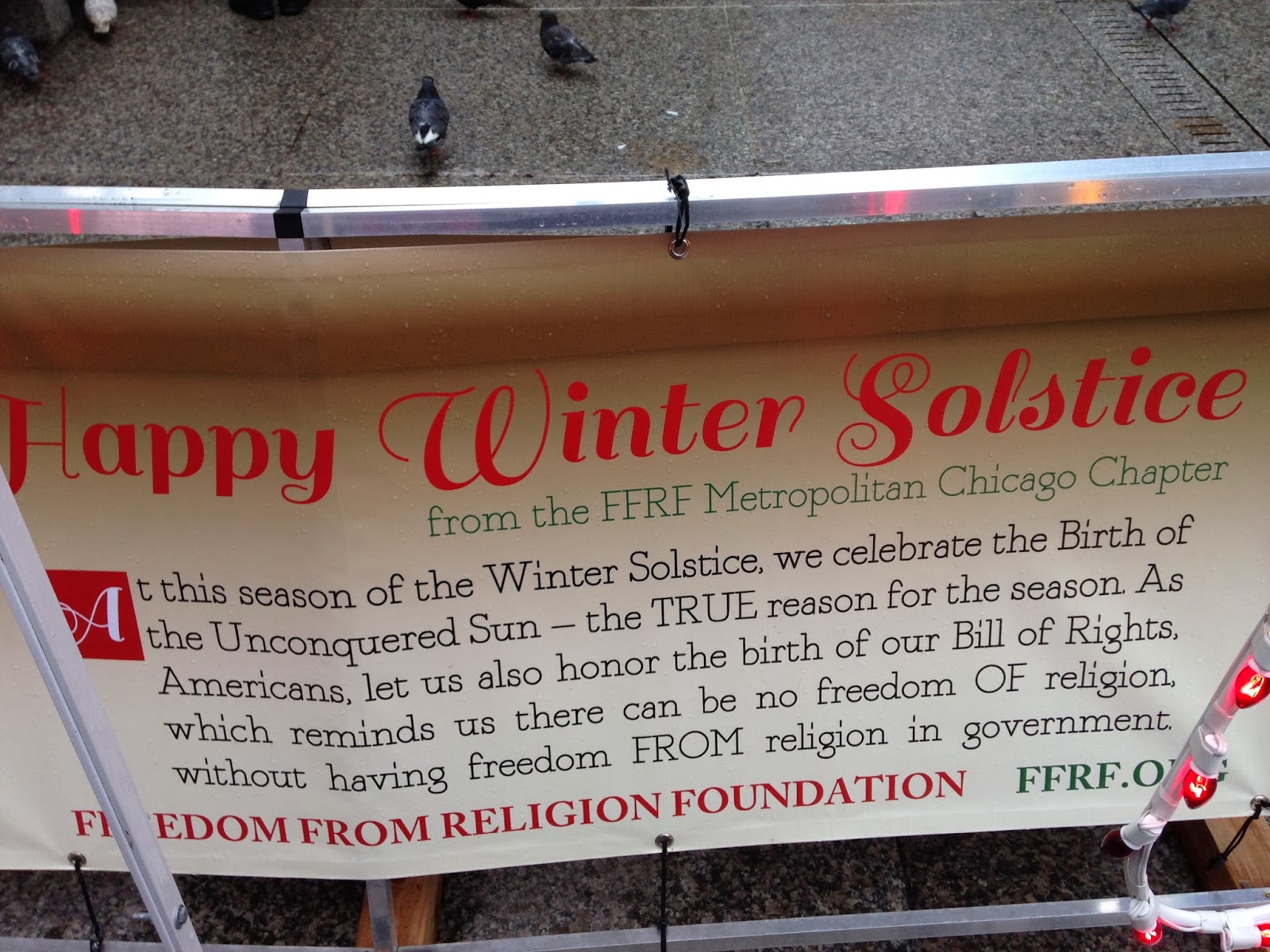
So, we went to the Christkindlemarkt in Daley Plaza in downtown Chicago this afternoon after church. I was terribly disappointed, as there were so many people crammed into the plaza that no one could move. We couldn't even press our way through the crowd to get a mug of Glühwein. I was ticked off about this, and then I came across an interesting display on the east side of the plaza, near the nativity scene

It's a big wire-framed "A" lit with red "holiday" lights (calling them Christmas lights seems somewhat inappropriate). It says "Happy Winter Solstice". It says that Sol Invictus (the Unconquered Sun) is the reason for the season. The display brightened my day, even though about half of the lights were dark, and I had to take a picture of my kids in front of it.

The display was placed by the atheists of the Freedom From Religion Foundation. You can read a short news article about the "A" here. They make a big deal saying that there can be no freedom of religion until government is completely separated from religion and it's influences. I agree. Sadly, as those on the political left often do, this group attempts to equate the public expression of religion and public displays of religious symbols with the government sanction and/or establishment of religion. We Christians often try to duck this argument, opting to go along to get along. If we allow what the Establishment Clause means to be redefined, however, we will wind up without the freedom of religion or the right to express our religious beliefs publicly.

Much is made of the fact that there is a “separation of church and state” built into the U.S. Constitution. This is not exactly true, at least not in the way those on the left purport it to be. The phrase “separation of church and state” appears nowhere in the U.S. Constitution. The term is an offshoot of the phrase, "wall of separation between church and state," as written by Thomas Jefferson in a now famous letter to the Danbury Baptist Association in 1802. The original text of President Jefferson’s letter reads, in part:

"... I contemplate with sovereign reverence that act of the whole American people which declared that their legislature should 'make no law respecting an establishment of religion, or prohibiting the free exercise thereof,' thus building a wall of separation between Church and State.”
The Danbury Baptist Association wrote to Jefferson of their concerns regarding the lack of explicit protection of religious liberty in their own state constitution, and against a government establishment of religion. As a religious minority in Connecticut, the Danbury Baptists were concerned that a religious majority might establish a state religion at the cost of the liberties of religious minorities. Jefferson assured them that the U.S. Constitution would in no way permit such an establishment, and that “…religion is a matter which lies solely between Man & his God, that he owes account to none other for his faith or his worship, that the legitimate powers of government reach actions only, & not opinions…” This separation of church and state, as understood by Thomas Jefferson at least, had nothing whatsoever to do with public expressions of religion. To Jefferson and the Danbury Baptists, separation of church and state had everything to do with the establishment of a national/state religious body, and avoiding the national/state oppression of religious minorities.

It wasn't until 1947 that the Supreme Court, albeit nebulously, defined just how the “wall of separation” was to be built. As a result of Everson v. Board of Education of Ewing Township, 330 U.S. 1 (1947), Neither state or local government can: 1) set up a church, 2) pass laws that aid one religion, all religions, or favor one religion over another, 3) force a person to attend or stay away from church, or believe in any religion, 4) punish a person for holding or professing religious beliefs, 5) levy a tax, in any amount, to support any religious activities or institutions, 6) openly or secretly participate in the affairs of any religious organization, or vice-versa.

A second important test established by the Court, known as The Lemon Test, is taken from the case Lemon v. Kurtzman 403 U.S. 602 (1971). The test consists of three parts: 1) whether the law or conduct has a secular purpose, 2) whether the law or conduct has as its primary or principle effect advancing or inhibiting religion, and 3) whether it fosters an excessive entanglement of government with religion.

To the chagrin of the New Atheist movement, The Court has ruled that public displays of religious symbols, such as the Christian nativity scene or the Jewish menorah, do not constitute a breach of the Establishment Clause when they are all displayed together, and along with secular holiday symbols, in celebration of the national holiday of Christmas (yes, it is a national holiday, believe it or not).

The Christkindlemarkt (Christ child market) which is set up in Daley Plaza every year in Chicago is clearly a Christian event, complete with nativity scene. Alongside the nativity scene during Hanukkah each year is a large Jewish menorah. Any citizen or group who wishes to exercise their freedom of religious expression in this public space may do so (as the atheist group has demonstrated by the presence of their display) and the event is not in breach of the Establishment Clause. Should any religious or secular group be prohibited by government from exercising that freedom of expression at the Christkindlemarkt, however, it would then violate the Establishment Clause.

To say that there is no place in American society for public displays of religion or religious symbols, strictly because they are by nature religious (the so-called freedom "from" religion), is simply not justified by the U.S. Constitution, or by case law.

Justice Antonin Scalia, in his dissenting opinion to the McCreary County, Kentucky, ET. Al. Petitioners v. American Civil Liberties Union of Kentucky ET.Al. case, observed that the same week Congress submitted the Establishment Clause as part of the Bill of Rights for ratification by the States, it enacted legislation providing for paid chaplains in the House and Senate. Justice Scalia goes on to remind his fellow justices that, “The same Congress also reenacted the Northwest Territory Ordinance of 1787, 1 Stat. 50, Article II of which provided: ‘Religion, morality, and knowledge, being necessary to good government and the happiness of mankind, schools and the means of education shall forever be encouraged.’” And, it should not be overlooked that the First Amendment itself accords religion – and no other manner of belief – special constitutional protection. I am sure that the atheist activists at the Freedom From Religion Foundation would not agree that these early actions of Congress are equally valid today, since those on the Left generally consider the U.S. Constitution to be a “living, breathing document”, meaning that its interpretation changes as American society changes, and that moral values simply evolve along with society and culture and are therefore not absolute.

The views of American citizens, however, have not changed significantly where this issue of public expression of religion is concerned. Justice Scalia rightly points out that our Presidents continue to conclude their oath of office with the words, “So help me God.” The Congress opens each session with a prayer; those prayers are lead by official congressional chaplains. The Supreme Court opens its sessions with the prayer “God save the United States and this Honorable Court”. We have the phrase “In God We Trust” on our currency. When we pledge allegiance to the flag of the United States we corporately acknowledge that we are one nation, under God. Justice Scalia finishes his thought with these words:

“As one of our Supreme Court opinions rightly observed, ‘We are a religious people whose institutions presuppose a Supreme Being.’ Zorach v. Clauson, 343 U.S. 306, 313 (1952), repeated with approval in Lynch v. Donnelly, 465 U.S. 668, 675 (1984); Marsh, 463 U.S., at 792; Abington Township, supra, at 213.”

I have no problem with the atheists, secular humanists, and free-thinkers exercising their right to free expression. I tolerate their "A". Whether they like it or not, the atheists have to tolerate my public nativity scene. It establishes Christianity as a national religion about as much as their half-hearted display establishes Sol Invictus as America's supreme being.