Showing posts with label John. Show all posts

Tuesday, June 18, 2019

The Name of Jesus Forbidden

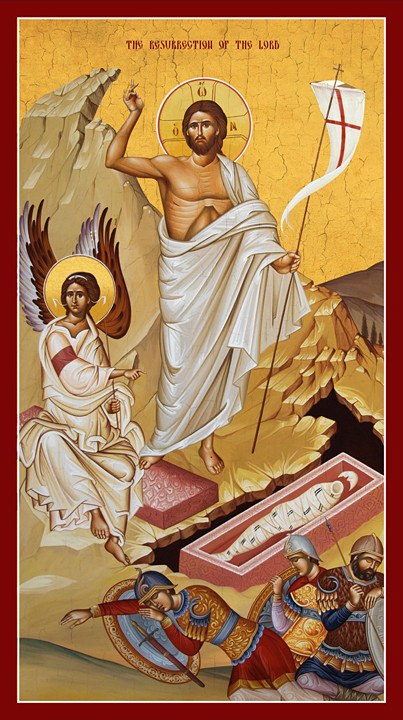
Icon of the Resurrection

June 18, 2019 - Tuesday after Trinity 

Now as they spoke to the people, the priests, the captain of the temple, and the Sadducees came upon them, being greatly disturbed that they taught the people and preached in Jesus the resurrection from the dead. And they laid hands on them, and put them in custody until the next day, for it was already evening. However, many of those who heard the word believed; and the number of the men came to be about five thousand... Now when they saw the boldness of Peter and John, and perceived that they were uneducated and untrained men, they marveled. And they realized that they had been with Jesus. And seeing the man who had been healed standing with them, they could say nothing against it... So they called them and commanded them not to speak at all nor teach in the name of Jesus. But Peter and John answered and said to them, “Whether it is right in the sight of God to listen to you more than to God, you judge. For we cannot but speak the things which we have seen and heard.” So when they had further threatened them, they let them go, finding no way of punishing them, because of the people, since they all glorified God for what had been done (Acts 4:1-4, 13-14, 18-21).


The Sadducees were offended that the Apostles were teaching the resurrection of the dead. They were the ones whom Jesus silenced, along with the Pharisees and the Scribes, the account of which is recorded in Matthew 22. The Sadducees come up with this ridiculous illustration of a married man who dies, leaving his wife to be married to his succession of brothers. The brothers also die, each leaving the woman a widow. They ask the sarcastic question,

“Therefore, in the resurrection, whose wife of the seven will she be? For they all had her.”[1]
The Sadducees didn’t believe in the resurrection, and may have even denied the immortality of the soul; unlike the Pharisees, the Sadducees only accepted the Torah (the first five books of the Bible, known as the Books of Moses) as authoritative scripture.[2] Matthew records Jesus silencing the Sadducees saying,

“You are mistaken, not knowing the Scriptures nor the power of God. For in the resurrection they neither marry nor are given in marriage, but are like the angels of God in heaven. But concerning the resurrection of the dead, have you not read what was spoken to you by God saying, ‘I am the God of Abraham, the God of Isaac, and the God of Jacob’? God is not the God of the dead, but of the living.”[3]
In arguing with Jesus about the resurrection, the Sadducees treat it as an absurd idea. Jesus, using scripture only from the Torah, interestingly enough, asserts the resurrection as a fact: God is not the God of the dead, but of the living. He quotes Moses, an authority the Sadducees recognize, to make the point that,

Though at Moses’ time the patriarchs were long dead, God identifies Himself as being their God. Only living people can have a God; therefore, if He is their God, they are alive, their souls are with Him, and their bodies will be raised.[4]
We live in the same world Peter and John lived in. We like to think ours is different and better than theirs, but it isn’t. In terms of hostility to the Gospel, things remain the same. We do not have the Sadducees to mock the resurrection, but there are plenty of others who are just as triggered by any such preaching, and forbid the name of Jesus. 

We tend to think that the ancients were less intelligent than we modern folk; if we are being charitable, we might say they were limited in their understanding of the natural world. The word primitive comes to mind. Our modern life certainly looks different from the life of the 1st Century Roman Empire; I like my air conditioning and my internet, and don’t want to trade them for life in that society. But modern technology, while it makes life more comfortable and convenient, does not change the nature of man. The Sadducees rejected the resurrection because they didn’t believe the scriptures; they rejected Christ, just like people who are faithless and resist the Holy Spirit today. Peter and John weren’t preaching the resurrection because they had a primitive understanding of science, or were superstitious, or were uneducated. They proclaimed Christ crucified and risen from the dead because they saw Him alive after He died on the cross. They knew it to be true. They knew it was true for them, and for the whole world, that Jesus paid the ransom for sin, and in Christ they would have forgiveness and eternal life. No amount of ridicule, persecution, no threat of beatings, imprisonment, or death by the most horrific means, could dissuade them from making disciples of all nations, baptizing and teaching all that Jesus commanded.

That is precisely what happened. The Apostles were all murdered for their faith, with the exception of John, who suffered imprisonment and exile. This is a profound piece of information that strengthens the credibility of Christianity. The fact that a person who believes a religion may be willing to die for that religion doesn’t prove that that religion is true. There are plenty of Muslims who are willing to seek out death for Islam. The Apostles, however, were either first-hand witnesses to the resurrection of Jesus, or perpetrators of the biggest hoax in history. I have not met the man who was willing to die for something he knew to be a lie. If the Apostles had stolen Jesus’ body and made up the resurrection, that would be them. Men have been willing to die for causes and ideas in which they believed that were later discredited, like National Socialism, or which way the toilet paper should be put on the roll (the proper way is over the front, as this link will decisively prove once and for all). I have never heard of a man who was willing to submit to a gruesome death by torture for a claim they knew to be false, rather than to renounce it and live.

The Apostles went joyfully to their beheadings, crucifixions, stoning, and burnings. They were tortured and fed to wild animals for the entertainment of the pagan masses. To avoid it, all they had to do was say they were lying, that they made it all up. Sure, they would be ridiculed and ostracized, but if this life is all that there is, wouldn’t that be preferable to a painful death? But they couldn’t deny Jesus. They saw Him, the one who lives, and was dead, and is alive forevermore, the one who has the keys of death and the grave, the Alpha and the Omega, the Beginning and the End, who is and who was and who is to come, the Almighty.[5] Jesus had conquered sin and death, and promised them eternal life. In the grand scheme of things, for the sake of eternity in a new and perfect creation without sin or death, with a new and perfect body, living in relation to God as man was intended, what is a little bodily suffering here in this veil of tears?

This is the faith created in the Apostles through the Word, by the working of the Holy Spirit. It is the same faith that lives in us by the same means. We look forward to the same things they looked forward to. They saw and believed. We have heard their account, attested to by their signs and wonders, and believed: “Blessed are those who have not seen and yet have believed.”[6]

The world is sorely grieved
Whenever it is slighted
Or when its hollow fame
And honor have been blighted.
Christ, Thy reproach I bear
Long as it pleaseth Thee;
I’m honored by my Lord - What is the world to me![7]

The world with wanton pride
Exalts its sinful pleasures
And for them foolishly
Gives up the heavenly treasures.
Let others love the world
With all its vanity;
I love the Lord, my God - What is the world to me![8]


[1] Matthew 22:28
[2] Harrison, Everett F, Geoffrey W Bromiley, and Carl F Henry,. Wycliffe Dictionary of Theology. Peabody, Massachusetts: Hendrickson Publishers, Inc., 1990.
[3] Matthew 22:29-32
[4] Engelbrecht, Rev. Edward A., ed. The Lutheran Study Bible. Saint Louis: Concordia Publishing House, 2009.
[5] Revelation 1:18, 8
[6] John 20:29
[7] Ev. Luth. Synodical Conference of North America. The Lutheran Hymnal. Saint Louis: Concordia Publishing House, 1941. Hymn #430, stz. 5
[8] Ev. Luth. Synodical Conference of North America. The Lutheran Hymnal. Saint Louis: Concordia Publishing House, 1941. Hymn #430, stz. 6

Saturday, September 26, 2015

Celebrating a Life


Patrol cars lining up outside the funeral home
in preparation for the procession.
On his arrival, Jesus found that Lazarus had already been in the tomb for four days. Now Bethany was less than two miles from Jerusalem, and many Jews had come to Martha and Mary to comfort them in the loss of their brother. When Martha heard that Jesus was coming, she went out to meet him, but Mary stayed at home. “Lord,” Martha said to Jesus, “if you had been here, my brother would not have died. But I know that even now God will give you whatever you ask.” Jesus said to her, “Your brother will rise again.” Martha answered, “I know he will rise again in the resurrection at the last day.” Jesus said to her, “I am the resurrection and the life. The one who believes in me will live, even though they die; and whoever lives by believing in me will never die. Do you believe this?” “Yes, Lord,” she replied, “I believe that you are the Messiah, the Son of God, who is to come into the world” (John 11:17-27).

As a police officer, part of my job is to sometimes attend civic functions. We are sent to Memorial Day, Veterans Day, and Fourth of July parades. A nearby town has a Pet Parade to which we always send at least one patrol car. In Hodgkins, we have a summer festival the Second weekend of September and the police spend a lot of public relations time there. I usually spend the day driving children around in our parade car, a 1929 Ford Model A Phaeton.

Then, of course, there are the things that are not as much fun to attend.

Officers assembling at the church for the
honor guard detail.
We attend a lot of funerals. This month, there were two funerals for officers who have been killed. I had the privilege of attending the funeral for Steven Smith, the Chicago Ridge police officer who was killed in a DUI car crash on I-294 on September 13. I got to be part of the funeral procession, which included dozens of squad cars from I don't know how many police agencies. I participated in the police honor guard detail at the funeral home, and at the church. We stood at attention on the street in front of Our Lady of the Ridge Roman Catholic Church, along with a detail of flawlessly dressed (and immaculately choreographed) Marines, as the Emerald Society paraded in front of the hearse playing pipes and drums. It was a moving scene, and the police officers with whom I spoke were all, without exception, moved and gratified to see the entire town of Chicago Ridge honoring officer Steven Smith. Hundreds of people lined the streets as the funeral procession passed by. They waved American flags, and blue ribbons were tied to trees and lampposts along the way. There wasn't an empty seat in the church for Mass.

As a civic ceremony, this funeral for a man who had a positive impact on the community in which he grew up and lived will remain in my memory for a long time. It was the perfect way for a community to collectively express gratitude toward one of its sons and loyal civil servants. The religious ceremony, however, disturbed me.

The Emerald Society preparing to play.
Wakes and funerals are curious things, especially the way they are done in America. Rather than being a means to help grieving friends and relatives cope with the death of a loved one, wakes and funerals oftentimes become a celebration of the very thing that took their loved one away – death. They end up, rather than comforting people, reminding them of all the good things they have lost to death. Funerals and wakes, generally and without meaning to, put on display all that the deceased was in this life. It usually happens in the form of photographs, bulletin boards, flowers and personal mementos scattered throughout the funeral parlor. All these things, in effect, tell the living who have gathered to mourn, “Look what you have lost and will never again experience”. The most heinous part of the entire wake experience is, quite possibly, the corpse itself.

The body of a deceased loved one painted and dressed; face plastered with makeup and frozen in an almost-but-not-quite serene expression, made to appear as if asleep. In the hands of the wrong funeral director, a corpse becomes morbid marionette that serves only to focus attention on the “star” of the hour – death. At a wake, what a victory death seems to have won. And, no more awkward a question has ever been asked than, “Boy, doesn’t he/she look good?”

No, they don’t look good. No one looks good lying in a casket.

The priest, in his homily, referred several times to this funeral mass as being a "celebration of life." He eulogized the officer, recounting all sorts of incidents and anecdotes from his life, talking about what a wonderful person he was to those around him. The point he made at the end was, in recalling these things and sharing them with others, we keep him alive, just as we keep Jesus alive when we recall what Jesus has done, and imitate his love for his fellow man.

This made me cringe. It almost sounded as though the priest was denying an afterlife, let alone the resurrection, and saying that the dead - including Christ - are kept alive only in spirit, through collective memory. This emphasis was confusing, particularly since he read from John 11:25:

Jesus said to her, “I am the resurrection and the life. The one who believes in me will live, even though they die;

He did say that Christ was the only way to access God. But there was no mention of sin, or its forgiveness through the atoning sacrifice of Christ's death on the cross. With a casket in the center of the church, the saccharin words about celebrating life rang somewhat hollow, and you could see it on the face of Officer Smith’s mother.

The second thing that stuck out to me was the celebration of mass. I don’t intend to get into an in-depth comparative study of the Roman and Lutheran liturgies here, or to debate transubstantiation, consubstantiation, and the Real Presence. I have attended other masses in the past, and am familiar with what goes on. I have previously watched the presentation of the gifts, the bread and the wine, and heard the priest call on God to sanctify these offerings, that they may become the Body and Blood of our Lord Jesus Christ. I have seen priests re-present this unbloody sacrifice and offer it, “in reparation for the sins of the living and the dead and to obtain spiritual or temporal benefits from God” many times in the past (Roman Catholic Church 1994). These works were performed at this funeral Mass as well. Again, when there is a casket containing the body of one of those faithful departed for whose repose the congregation is praying, it gives one a bit more perspective on what is taking place.

During all this my eye was drawn to the family of the deceased. Quite understandably, their faces were the picture of anguish and despair. The only hope which was being offered to them, however, was in the work of performing the Mass, and in praying that their son’s soul would rest in peace. Even the little bit of Gospel given to them earlier in the service during the readings was taken away during the celebration of the Mass, by the lack of certainty that he would “rest in peace.”

Therefore, since we have been justified through faith, we have peace with God through our Lord Jesus Christ, through whom we have gained access by faith into this grace in which we now stand. And we boast in the hope of the glory of God. Not only so, but we also glory in our sufferings, because we know that suffering produces perseverance; perseverance, character; and character, hope. And hope does not put us to shame, because God’s love has been poured out into our hearts through the Holy Spirit, who has been given to us. You see, at just the right time, when we were still powerless, Christ died for the ungodly. Very rarely will anyone die for a righteous person, though for a good person someone might possibly dare to die. But God demonstrates his own love for us in this: While we were still sinners, Christ died for us. Since we have now been justified by his blood, how much more shall we be saved from God’s wrath through him! For if, while we were God’s enemies, we were reconciled to him through the death of his Son, how much more, having been reconciled, shall we be saved through his life! Not only is this so, but we also boast in God through our Lord Jesus Christ, through whom we have now received reconciliation (Romans 5:1-11).

Being the obstinate and hateful Confessional Lutheran that I am, I was one of only two police officers who did not participate in the Eucharist that day. With the words of the Augsburg Confession in my head, there I sat, I could do nothing else, God help me! Amen!

Scripture teaches that we are justified before God, through faith in Christ, when we believe that our sins are forgiven for Christ’s sake. Now if the Mass takes away the sins of the living and the dead simply by performing it[1], justification comes by doing Masses, and not by faith. Scripture does not allow this (AC XXIV 28-29)[2].

Because of our disobedient first parents, we have to deal with sin and death. Sin, after the fall, became a part of the human nature. And, while it is true that everyone must die, death does not have the same meaning for those who trust in Christ. This is what all those gathered to “celebrate the life” of Officer Smith desperately needed to hear. This is what I wanted Officer Smith’s parents to hear about their son, a baptized child of God.

St. Paul writes in 1 Corinthians the following, my favorite passage of Scripture:

I declare to you, brothers, that flesh and blood cannot inherit the kingdom of God, nor does the perishable inherit the imperishable. Listen, I tell you a mystery: We will not all sleep, but we will all be changed—in a flash, in the twinkling of an eye, at the last trumpet. For the trumpet will sound, the dead will be raised imperishable, and we will be changed. For the perishable must clothe itself with the imperishable, and the mortal with immortality. When the perishable has been clothed with the imperishable, and the mortal with immortality, then the saying that is written will come true: "Death has been swallowed up in victory." "Where, O death, is your victory? Where, O death, is your sting?" The sting of death is sin, and the power of sin is the law. But thanks be to God! He gives us the victory through our Lord Jesus Christ (1 Corinthians 15:50-57).

For those who do not know Jesus Christ, who do not believe and trust in him as their redeemer, the prospect is grim. Death, for these people, remains the victor. Scripture says that they will experience eternal death. In the shadow of this prospect, the wake room and funeral service becomes an extremely cold, dark and dismal place.

...He who overcomes will inherit all this, and I will be his God and he will be my son. But the cowardly, the unbelieving, the vile, the murderers, the sexually immoral, those who practice magic arts, the idolaters and all liars—their place will be in the fiery lake of burning sulfur. This is the second death." (Revelation 21:7-8).

The Christian, however, can look death in the eye unafraid. To the Christian, death is more than a consequence of original sin and a fallen creation; more than the cessation of life. It is the portal to life everlasting and a relationship with the Creator as such a relationship was intended to be. No suffering, no pain; only eternal joy with God and all the saints forever.

And I heard a loud voice from the throne saying, "Now the dwelling of God is with men, and he will live with them. They will be his people, and God himself will be with them and be their God. He will wipe every tear from their eyes. There will be no more death or mourning or crying or pain, for the old order of things has passed away." He who was seated on the throne said, "I am making everything new!" Then he said, "Write this down, for these words are trustworthy and true" (Revelation 21:3-5).

For the unbeliever, the traditional wake is appropriate. An entire life summed up by a bulletin board full of old photographs and a coffee room filled with sad, frightened people discussing everything but that which is in the parlor. For the Christian, it is inappropriate, as they have, in their baptism, passed from death to life. By their physical death, the deceased Christian has passed from this life to life eternal. The Christian wake and funeral, though an outlet for grief and mourning is, and rightly should be, also a celebration of Christ’s victory over death and the grave by his resurrection - the anticipation that those who trust in him as the atonement for their sins will live forever as well. The Christian funeral can be called a celebration of life. It is a celebration of the life Christ has won for us on the cross, without any merit or worthiness in us.

Death is not good. God, however, has taken what is evil and turned it to our benefit, by the suffering, death and resurrection of Jesus. The resurrection of the body and life everlasting are sure and certain to those who trust in him; to those who remain faithful unto death. Therefore, for the Christian, especially when confronting death, the words of St. Paul should provide us strength, consolation and comfort:

Therefore, my dear brothers, stand firm. Let nothing move you. Always give yourselves fully to the work of the Lord, because you know that your labor in the Lord is not in vain (1 Corinthians 15:58).


Works Cited

Concordia Publishing House. Luther's Small Catechism. Translated by Concordia Publishing House. Saint Louis, Missouri: Concordia Publishing House, 1991.

McCain, Paul Timothy, Robert Cleveland Baker, Gene Edward Veith, and Edward Andrew Engelbrecht, . Concordia: The Lutheran Confessions. Translated by William Hermann Theodore Dau and Gerhard Friedrich Bente. St. Louis, MO: Concordia Publishing House, 2005.

Roman Catholic Church. Catechism of the Catholic Church. Rome: Urbi et Orbi Communications, 1994. 


End Notes

[1] Ex opere operato – by the outward act. Scripture certainly teaches that the Lord’s Supper is a means of grace and that the chief blessing of it is the forgiveness of sins, which Christ’s body and blood have won for us on the cross. Forgiveness of sin, life and salvation are certainly not given simply by the eating and drinking (the outward act), but by believing in the words, “Given and shed for you for the forgiveness of sins,” along with the eating and drinking. Whoever believes these words has exactly what they say: “forgiveness of sins” (Concordia Publishing House 1991).

[2] McCain, Paul Timothy, Robert Cleveland Baker, Gene Edward Veith, and Edward Andrew Engelbrecht, . Concordia: The Lutheran Confessions. Translated by William Hermann Theodore Dau and Gerhard Friedrich Bente. St. Louis, MO: Concordia Publishing House, 2005.

Monday, April 14, 2014

Jesus at the Feast of Booths - II

Not until halfway through the Feast did Jesus go up to the temple courts and begin to teach. The Jews were amazed and asked, "How did this man get such learning without having studied?" (John 7:14-15).

It's difficult enough these days to get a job when you have all your ducks in a row. It's nearly impossible to do so without the proper credentials. For the vast majority of high school students that involves some sort of college education. College, of course, isn't right for everyone. Some people go to technical schools to receive practical hands-on training in their chosen field. Still others, such as policemen, may not be required to have a college education by their employer. They are sent to a police academy, where they are taught the skills and learn the information vital to a successful career of doughnut-eating and vindictive ticket-writing.

The thing these examples have in common is that, before one can begin a job, one is required to demonstrate proficiency. Imagine a "doctor" practicing without a medical degree, or a lawyer practicing without having passed the bar. Today we demonstrate our proficiency through some sort of license, degree, or certification. When the patient sees the diploma on the wall of their physicians office, they understand that it represents the many years of hard work, study, and practice (not to mention money) that the doctor spent learning and honing his craft. When the citizen sees the badge on the breast of the policeman, he can reasonably trust that the officer's job proficiency, as well as his authority, are derived from more than simply watching reruns of T.J. Hooker.

Jesus, however, had no credentials. He had no "degree", and this was a serious affront to "the Jews", the religious leaders made up of the scribes, the Pharisees, and the teachers of the Law. There may not have been a system of accredited seminaries in first century Judea like we have today in the United States, but there certainly was a system. Jesus, however, had not been a part of that system and for him to teach as he did was scandalous.

It wasn't, however, only that Jesus was teaching without being properly certified. When the Jews taught, they carefully cited previous teachers and scholars of the Law. They all sought to cite their teachings in order to show that they were correct (by two or three witnesses shall testimony be established, after all) and that they had credibility. Jesus taught, as Scripture says, as one who had authority. In other words, Jesus taught the people, not by showing what those rabbis who came before him said about the Law. He taught as the one who wrote and implemented the Law. This attitude was not lost on the people and the Jews. The Bible tells us that the people marveled and openly wondered what kind of statement Jesus was trying to make:

The people were amazed at his teaching, because he taught them as one who had authority, not as the teachers of the law...The people were all so amazed that they asked each other, “What is this? A new teaching—and with authority! He even gives orders to impure spirits and they obey him,” (Mark 1:22, 27).

This also included the religious leaders:

Jesus entered the temple courts, and, while he was teaching, the chief priests and the elders of the people came to him. “By what authority are you doing these things?” they asked. “And who gave you this authority?” Jesus replied, “I will also ask you one question. If you answer me, I will tell you by what authority I am doing these things. John’s baptism—where did it come from? Was it from heaven, or of human origin?” They discussed it among themselves and said, “If we say, ‘From heaven,’ he will ask, ‘Then why didn't you believe him?’ But if we say, ‘Of human origin’—we are afraid of the people, for they all hold that John was a prophet.” So they answered Jesus, “We don’t know.” Then he said, “Neither will I tell you by what authority I am doing these things (Matthew 21:23-27).

The Jews, however, really understood that Jesus was claiming deity for himself, and that's why they plotted to kill him. Jesus could, of course, teach in this way because he is the Messiah, the divine Son of God and second person of the Trinity. He is, as Scripture calls him, the author of life, the one through whom creation came into being, the one who was the very image of God the Father.

Jesus demonstrated this authority by what he did in addition to what he said and the manner in which he taught:

Which is easier: to say, ‘Your sins are forgiven,’ or to say, ‘Get up and walk’? But I want you to know that the Son of Man has authority on earth to forgive sins.” So he said to the paralyzed man, “Get up, take your mat and go home.” Then the man got up and went home (Matthew 9:5-7).

He restored sight to the blind, opened the ears of the deaf, loosed the tongues of the dumb, raised the dead, and ultimately, rose from the dead himself. The Jews saw all these things but refused to see them for the signs they were. These things were the credentials, so to speak, that holy scripture said would accompany the Messiah. The Jews, however, demanded that Jesus "tell them plainly" who he claimed to be, and asked for a sign to prove his claims. Having ears, they did not hear; having eyes they did not see.

“ [Peter said] Therefore let all Israel be assured of this: God has made this Jesus, whom you crucified, both Lord and Messiah.” When the people heard this, they were cut to the heart and said to Peter and the other apostles, “Brothers, what shall we do?” Peter replied, “Repent and be baptized, every one of you, in the name of Jesus Christ for the forgiveness of your sins. And you will receive the gift of the Holy Spirit. The promise is for you and your children and for all who are far off—for all whom the Lord our God will call.” With many other words he warned them; and he pleaded with them, “Save yourselves from this corrupt generation.” Those who accepted his message were baptized, and about three thousand were added to their number that day (Acts 2:37-41).

So, with this picture of Jesus presented to us, we are in the same situation as the Jews to whom St. Peter preached. When we give in to our sinful nature, gratifying it's desires and falling into sin, we are just as guilty as those who sought to put Jesus to death. The devil, the world, and our own sinful nature mislead us into false belief, despair and other sin. When we, however, repent of our sin, God, who is faithful and just, forgives our sin and cleanses us from all unrighteousness. We can rest in the assurance of Jesus' authority as God to forgive our sin, and we can live with the sure and certain hope that, even though we may suffer many things on this earth - including physical death - Jesus will, on the Last Day, raise all the dead, and give eternal life to all believers in Christ. Until that time, we strive to live in accordance with the new nature we have received by the Spirit:

So I say, walk by the Spirit, and you will not gratify the desires of the flesh. For the flesh desires what is contrary to the Spirit, and the Spirit what is contrary to the flesh. They are in conflict with each other, so that you are not to do whatever you want. But if you are led by the Spirit, you are not under the law (Galatians 5:16-18).

Wednesday, December 25, 2013

The True Light

The true light, which enlightens everyone, was coming into the world. He was in the world, and the world was made through him, yet the world did not know him. He came to his own and his own people did not receive him. But to all who did receive him, who believed in his name, he gave the right to become children of God, who were born not of blood nor of the will of the flesh nor of the will of man, but of God (John 1:9-13).

At the risk of stating the obvious, I'm going to go on record and say that the invention of the electric incandescent light bulb was a big deal. To be certain, mankind had means of creating light before electric lighting, but we weren't truly illuminated until Edison invented the light bulb. For all of human history mankind's productivity was governed by the natural rhythms of day and night. But, with the coming of electricity and the light bulb, man's day was expanded and, as author Mark Steyn puts it, night was abolished. Life post-light bulb would never be the same as it had been.

St. John writes that "the true light, which enlightens everyone, was coming into the world," and that is the man about whom John the Baptist testifies. From Adam's Fall through Malachi it's been all spiritual candles and gas lamps, but now, prepare yourself world, the true light is about to be revealed. In Christ Jesus man is given the spiritual equivalent of Edison's electric light bulb. Just as Edison's light had the power to "abolish night" and help to usher in a new age of productivity and human innovation and invention, so Jesus, God in human flesh, has the power to "enlighten all men," and cut through the hitherto impenetrable darkness of sin and death in which mankind was mired.

God promised that he would give this light to man all the way back when our first parents, Adam and Eve, sinned and chose darkness, and were expelled from paradise. Through Adam sin and darkness entered and corrupted all of God's perfect creation. Through Christ, however, came life which, St. John writes, was the light of men. Adam and Eve, along with all the faithful from that time until the coming of Jesus in the flesh, would live by the lamplight of faith in God's promise of a savior and redeemer. With the birth of Jesus, God fulfilled his promise to rescue mankind and to crush the serpent's head in a historical context.

Sadly, though Christ came for everyone, not everyone trusts in him. Jesus came to his own people, St. John writes, and they would not receive him as the savior promised to them and described in prophetic scripture. The world which was created by him did not know him, such is the state of rebellion in which the creation stands against it's creator. Yet Jesus, born to a virgin and laid in a manger, heralded by angels and worshiped by shepherds, would go on to atone for the sins of mankind on the cross, and open the kingdom of heaven to all those who believe in him.

Lord Jesus Christ, light of the world which no darkness can overcome, let your light scatter the darkness of sin, death, and the power of Satan by the means of your holy word, and illumine and expand your church.

Thursday, October 6, 2011

Theos En Ho Logos


The Risen Christ

In the beginning was the Word, and the Word was with God, and the Word was God. He was in the beginning with God. All things were made through him, and without him was not anything made that was made. In him was life, and the life was the light of men. The light shines in the darkness, and the darkness has not overcome it (John 1: 1-5).

I studied this passage a lot when I was in confirmation class because Jehovah’s Witnesses used to come over to my grandfather’s house. They would come by nearly every week and we would debate doctrine and the Bible – way before I had any real understanding of either. The Jehovah’s Witnesses teach that Jesus is “the first and greatest of all of Jehovah God’s creations,” but he is not God. This introductory passage of John’s Gospel puts the lie to that statement.

Theos en ho logos – God was the Word. There is no way around the meaning of that Greek sentence. It means that the Word – whom John identifies as Jesus (v. 17) – was God. Not “a god” as the Watchtower translators wrongly interpret the passage in their New World Translation (an impossible rendering of the passage, according to renowned Greek scholar Dr. Julius Mantey). Jesus is not God’s first and greatest creation (v.2). He is God, the Son, second person of the Trinity, in whom “the whole fullness of deity dwells bodily” (Colossians 2:9). He is Immanuel, God with us.

Logos – Logos is the Greek word for “Word”. It is also the root of our modern English word “logic”. Greek philosophers, such as Plato, used the term not only to mean the spoken word but also the unspoken word still in the mind - the human power of reason. When they applied that term to larger concepts, like the Universe, “Logos” meant the rational principle governing all things. Not really God as we, or the Jews at that time, understand Him, but more like a logical set of rules that govern the how the universe, and all in it, works. Today, we might compare this Greek philosophical idea of “Logos” to the laws of physics. The Jewish teachers, on the other hand, with whom we will become better acquainted as we make our way through John’s Gospel, used the term “Logos” to refer to God. This is significant, because by its use in Scripture (this is the term used for “word” in the Septuagint) it implies that God is actively involved in the world, rather than having simply created the universe, wound it up like a big clock and let it run on its own without his involvement. John is basically saying to his readers in the first chapter of his gospel that everything the rabbis taught about the word, which God had given them in the Old Testament, was fulfilled in Jesus. To the educated Greeks – and to us “rational” Gentiles today – John is saying that Jesus is God Almighty; the rational governing force behind all things in the universe, upholding everything by his mighty word.

The phrase “word of the Lord” is used over 100 times in the Old Testament, mostly in the books of the prophets. The word is the means by which God communicates with us. John applies this title to Jesus and, by so doing, John is telling us that God’s will and words are personified in Jesus. The implication of that is that Jesus reveals the truth of God to us.

“…we cannot know God without Christ, the Word…If you want to see God, look to Jesus. If you want to come close to God, come close to Jesus. If you want to live according to God’s will, live with Jesus,” (People’s Bible Commentary – John, p. 8).

In his study, "The Gospels from a Jewish Perspective," evangelist Bob Warren describes how Jewish theologians had developed a theology concerning “Logos.” In his study Warren lists some key elements of this theology. First, the Word was a person possessing a mind, emotions, and will. The Word could be sent to accomplish a mission (PS. 147:15; Is. 9:8; 45:23; 55:10-11). The Word brought about salvation (Hosea 1:7). The Word was the agent of revelation (Gen. 15:1; Ezra 1:3). The Word was the agent of creation (Ps. 33:4-6). The Word was the avenue through which God sealed covenants (Gen. 15:1). The Word was the agent of the Old Testament theophanies - appearances of the Christ (Gen. 18). The Word was the same as God, and at other times distinct from God.

No one has ever seen God; the only God, who is at the Father’s side, he has made him known (John 1:18).

The phrase translated “the only God” in this verse comes from the Greek word “monogenes”. This, in the NIV and KJV is rendered as the more familiar “only-begotten”. “No man hath seen God at any time; the only begotten Son, which is in the bosom of the Father, he hath declared him,” (John 1:18, KJV). We say that phrase every week in the creeds, but I never thought about what it was actually declaring until I began interacting with Jehovah’s Witnesses.

To say that you were “begotten” is much different than to say that you were “created”. It is one of those wonderfully old-fashioned words which has a precise meaning, but has fallen out of regular use among the common folk. As a result, that precise meaning has become somewhat fuzzy to us. C. S. Lewis explains this in his work Mere Christianity:
We don't use the words begetting or begotten much in modern English, but everyone still knows what they mean. To beget is to become the father of: to create is to make. And the difference is this. When you beget, you beget something of the same kind as yourself. A man begets human babies, a beaver begets little beavers and a bird begets eggs which turn into little birds. But when you make, you make something of a different kind from yourself. A bird makes a nest, a beaver builds a dam, a man makes a wireless set-or he may make something more like himself than a wireless set: say, a statue. If he is a clever enough carver he may make a statue which is very like a man indeed. But, of course, it is not a real man; it only looks like one. It cannot breathe or think. It is not alive. Now that is the first thing to get clear. What God begets is God; just as what man begets is man. What God creates is not God; just as what man makes is not man. That is why men are not Sons of God in the sense that Christ is. They may be like God in certain ways, but they are not things of the same kind. They are more like statues or pictures of God. (Mere Christianity – Lewis, Chapter 23 “Making and Begetting”).

To paraphrase Lewis, to create something is to do what a sculptor does with hammer, chisel, and stone. He carves out a thing that looks like a man, but is not. It is created out of a different material, and has an altogether different existence. This is what God the Father, through “the Word” (v.3), did with us. We are created beings, as different in nature from God as the marble sculpture is in nature from the artist who created it.

To beget, however, is to call something into existence; to father something; to produce something. Remember all those “begets” in the beginning pages of the Bible? That’s what they were doing. You are of the same substance as your father; you were not created as a sculptor makes a stature out of stone. You were produced “through the will of man” (your parents) “through the will of the flesh” (sexual intercourse). So, for John to call Jesus “the only-begotten”, is a profound thing. To be clear, I don’t’ believe John is saying that the Son was produced as a result of sexual intercourse, but that the Son was produced of the same substance as the Father – both divine, almighty God. The Son is begotten of the Father – the only being who so exists. He was also, by virtue of the fact that He is deity, “with God in the beginning.” The point is that He was not a created being like we human beings. Jesus, as John tells us in v. 14, assumed the human nature in the womb of the Blessed Virgin Mary. There, in the virgin’s womb, the divine and human natures were inseparably joined in one person, Jesus, the God-man (AC III 1-2).

St. Paul expands on this in his letter to the Philippians:

Have this mind among yourselves, which is yours in Christ Jesus, who, though he was in the form of God, did not count equality with God a thing to be grasped, but made himself nothing, taking the form of a servant, being born in the likeness of men. And being found in human form, he humbled himself by becoming obedient to the point of death, even death on a cross (Philippians 2: 5-10).

What does this all mean to us?

John introduces us to Jesus, the God-man, in the first sentences of his Gospel, and in doing so, shows us a shadow of the triune nature of God. In a handful of sentences, John tells Jew and Gentile, in the beginning of his gospel, the Word came, but many, especially the Jews, rejected Him because they did not recognize Him. Jesus says of the Pharisees “You diligently study the Scriptures because you think that by them you possess eternal life. These are the Scriptures that testify about me, yet you refuse to come to me to have life” (John 5:39-40). Not only did Jesus fulfill the Old Testament messianic prophecies, which we will see as we study the Gospel of John, but he was also doing the things the Pharisees expected the Messiah to do when he came, yet they rejected Him.

Who do we say that Jesus is? Jesus asked this question of Peter and he rightly answered, “You are the Christ, the Son of the living God” (Matt. 16:16). It was on the rock of Peter’s confession that Jesus built His Church. Peter, by the Power of the Holy Spirit, could see what the Pharisees had hardened their hearts against, even though he didn’t have a full understanding of all the implications. Jesus was not a political “savior,” come to restore Israel, as the elite Jewish Pharisees and Teachers of the Law expected. He was not simply a virtuous man or good teacher. Jesus of Nazareth is the Christ – the Son of God – who fulfilled all the prophecies of scripture and, by His death and resurrection, atoned for the sin of mankind and purchased us from death and the devil by his blood on the cross.