Showing posts with label Augsburg Confession. Show all posts

Sunday, December 16, 2018

Thou Shalt Not Kill... but why not?

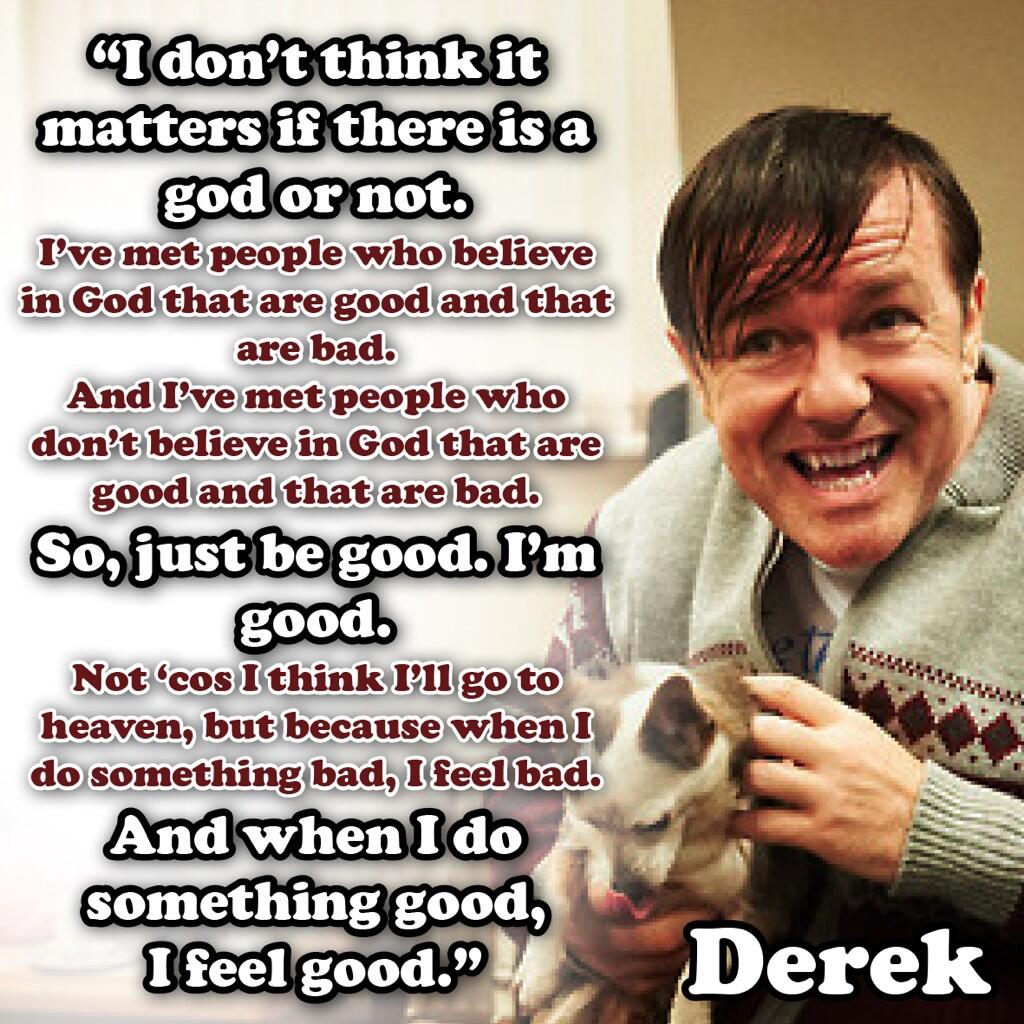
Derek was a British television series starring Ricky Gervais.
Derek says to be good, and I agree. How does one do that? By what standard does he measure his goodness?

Some New Atheists will rely on convoluted arguments to try to prove that man can have absolute morality (right and wrong) without an absolute source (God). One might suspect that the argument behind this meme is not quite so complicated. Ricky Gervais, whose character Derek gives us the sage advice to “just be good,” seems to be like so many average people who are de facto atheists; they say they don’t believe in an absolute system of right and wrong, but live as though they do. This standard of “good” which Derek calls his fellow man to live up to is supposed to be understood by all people. Indeed, I believe it is understood by all people; I simply disagree with the New Atheists regarding the reason why that is the case.

This is one of the problems with New Atheism that people don’t seem to want to acknowledge: We are supposed to accept the conflicting ideas that 1) there is no absolute truth or morality, decreed by God and built into mankind, and 2) everyone automatically knows what “good” is. For all the talk of the irresolvable paradoxes of Christianity, this problem of morality is significant for the New Atheists. If there is no absolute standard by which to judge morality, then all morality must be relative to the culture out of which it arises. Even if there are similarities between cultures, one cannot claim that there is an absolute standard. How, then, can one say that a given thought, word, or deed is good inter-culturally? How can one society apply its standard of “good” to another society, absent a universal standard? At least the Christian points to God, and says that He ultimately understands the religious paradoxes, if we cannot.

Or, looked at another way, how can we judge any given thought, word, or deed as “bad” if there is no absolute standard of morality? New Atheists like to point this out to Christians who condemn sin and call people to repentance and faith in Jesus Christ for the forgiveness of those sins; the point applies equally to them. And, contrary to how it may seem based on the circulation of internet memes, the New Atheists condemn quite a lot as bad. Christianity, for starters. Richard Dawkins believes it is child abuse to teach children the Christian faith;[1] so did the late Christopher Hitchens. In fact, they despise all religion as evil. This includes Islam.

Their hatred of religion made for some strange bedfellows during the war on terror. After the September 11th terrorist attacks on the World Trade Center some leftist atheists, like Christopher Hitchens, supported aggressive war against Muslims in Afghanistan and Iraq alongside the likes of, well, me. This was because terrorism is bad. The oppression, abuse, and subjugation of women is bad. Murdering political and religious minorities is bad. Oppressing and murdering homosexuals is bad. All these things are bad according to the New Atheists, and I agree. I must again, however, ask the question: by what standard? Clearly, the Islamic terrorists don’t think those things are bad. Why is their standard different? Where did it come from? Do they not have the innate sense of right and wrong, good and evil, which all men are supposed to have? Absent a universal standard of right and wrong, what makes them evil?

The Christian has an answer: the God who created the universe has set an immutable standard of right and wrong for mankind and expects us to keep it. We cannot. In fact, we ignore and suppress it. We turn away from God and His moral standard. We fail to keep it. And, when we do not keep it, that is called sin. And, because we cannot keep this moral standard perfectly, He took on human flesh in the person of Jesus of Nazareth, so that He could destroy sin, its inevitable result – death, and the one who brought it into the world – the devil, once and for all. He accomplished this by the death, resurrection, and ascension of Jesus Christ. He did it by living up to the standard, and dying as the sacrifice for sin on man’s behalf. Then, after dying on the cross, He rose up from the dead. We benefit from this sacrifice when we are brought to penitent faith in Christ for the forgiveness of our sins, by the power of the Holy Spirit, through the means of God’s Word and Sacraments. That is our explanation. What is theirs?

Their explanation for morality seems to be that morality has developed in man’s psyche as a product of evolution. The late Christopher Hitchens said:

I think our knowledge of right and wrong is innate in us. Religion gets its morality from humans. We know that we can’t get along if we permit perjury, theft, murder, rape. All societies at all times, well before the advent of monarchies have forbidden it. Socrates called it his daemon; it was his inner voice that stopped him when he was trying to take advantage of someone… Why don’t we just assume that we do have some internal compass?[2]

This view is almost comically simplistic. We just all should know what good is, because good comes from inside man. I see much evidence in man’s history that, far from being innately good, man is innately evil. Mr. Hitchens sets up this straw man: religion teaches that men only do good things, return lost property, give blood transfusion, etc., because they fear divine punishment and, if they didn’t have that threat hanging over them, they would act like the worst psychopathic criminal.[3] Perhaps other religions teach this idea; Christianity does not. In fact, Christianity teaches that, outwardly, and because of the conscience, men can and do live outwardly good and decent lives. Men can choose not to steal, rape, or murder their fellows, but this civil righteousness does nothing to justify a man before God. The Book of Concord has this to say on the issue:

Our churches teach that a person’s will has some freedom to choose civil righteousness and do things subject to reason. It has no power, without the Holy Spirit, to work the righteousness of God, that is spiritual righteousness… This is what Augustine says in his Hypogonosticon, Book III: We grant that all people have a free will. It is free as far as it has the judgment of reason…It is free only in works of this life, whether good or evil. Good I call those works that spring from the good in nature, such as [sic] willing to labor in the field, to eat and drink, to have a friend, to clothe oneself… For all of these things depend on the providence of God. They are from Hm and exist through Him. Works that are willing to worship an idol, to commit murder, and so forth, I call evil… Although nature is able in a certain way to do the outward work (for it is able to keep the hands from theft and murder), yet it cannot produce the inward motions, such as the fear of God, trust in God, chastity, patience, and so on.[4]

Christianity also teaches that this innate morality is objective and immutable, created by God. It is perfect, and requires perfection. And, no matter how many good deeds one may do, no matter how “good” a person may be in the eyes of the society, it is impossible to keep this moral standard perfectly, as God requires. Our relationship with God, therefore, must be repaired in some other way than by being good, or doing good deeds. On the contrary, our relationship with God is repaired by the death and resurrection of Jesus, who died as the propitiation for the sins of the world; and we receive those gifts of forgiveness and life eternal through the gift of faith, which God creates in us through the means of His word.

I see man, when left to determine what is right and wrong for himself, holding his neighbor to a separate, higher standard than the one to which he holds himself. This phenomenon manifests itself from the individual level to the societal level. The Godless [sic] principle that the strongest is always right has been openly declared as recently as the twentieth century in Mussolini’s Italy and operated in practice in Hitler’s Germany, Stalin’s Soviet Union, and many other states.[5] The evidence shows us that, unless man’s moral code is instituted by an authority higher than himself, he will, when it is advantageous to himself or his societal group, alter it. The unregenerate individual says to himself: it might be wrong when other people perjure themselves, steal, murder, or commit rape, but when I did those things, I had a good reason, and am therefore justified. Man can always reason out why their bad deed was not bad, but his neighbor’s was. Christopher’s brother Peter Hitchens, makes this point:

Left to themselves, human beings can in a matter of minutes justify the incineration of populated cities, the mass deportation – accompanied by slaughter, disease, and starvation – of inconvenient people, and the mass murder of the unborn. I have heard people who believe themselves to be good defend all these things and convince themselves as well as others. Quite often the same people will condemn similar actions committed by different countries, often with great vigor.[6]

You see, morality cannot be absolute and relative at the same time. We cannot say that the sense of good and evil it is innate in all of humanity, and at the same time, say there is no absolute source of that morality other than ourselves. If all morality is relative to the individual and to the individual’s culture, and there is no absolute standard for it set by God, the only way to determine right and wrong, good and bad, is ultimately by the sword. Might makes right, as they say. And why shouldn’t it? Why shouldn’t the unarmed give way to the lightly armed, and the lightly armed give way to the heavily armed?[7] Should not all societies, from the primitive to the advanced, decide for themselves what is right and what is wrong? Should not every individual decide for themselves their own religious beliefs (which is just another way of saying the same thing as morality)? This all sounds high minded and enlightened until you put it into practice. If what was just described was actually the type of world in which we lived, on what basis can one group of people condemn another group of people for, well, anything?

We look back at the Nazis and their systematic, state run genocide of the Jews and call it horrible. It was horrible. But on what basis can we condemn Nazi genocide of the Jews if there is no absolute truth that, “Thou shalt not kill”?[8] There is none. You may appeal to the innate sense inside of man that it is wrong to murder all you like; the Nazis would not call what they were doing murder. The only alternative that remains is that their actions were no better or worse than any other actions; we were simply stronger than they, and wanted to end their social, economic, and cultural system because it conflicted with our own, and so we did.

But it is wrong to murder people, especially on account of their race! Why? Says who?

Our culture takes a dim view of killing a person, generally speaking, unless one has a reasonable belief that one is in imminent danger of receiving great bodily harm, or death from them. In Nazi Germany, Jews were considered to be sub-humans, and therefore exempt from “normal” moral considerations. To turn a Jew in to the state, and thus mark him for persecution and death, was, in that society, to do a good work. But who are we to judge the society that has a different view of this matter? The National Socialists (Nazis) were quite deliberate in creating their society and culture, all based on the philosophical beliefs of Adolf Hitler. Are those beliefs, and the resulting consequences, not just as valid as our society’s contention that all men are created equal and endowed by their creator with inalienable rights? If you say they are not equally valid, you must answer why, and relative morality does not help your case. If you say they are equally valid, you are ignoring that impulse inside of mankind that does tell us that murdering another human being is wrong, and that we should do unto others as we would have others do unto us. It isn’t so much that religion gets it’s morality from man, as Christopher Hitchens contends; rather, the New Atheism, living as it does in the afterglow of the western Christian society, benefits from the fact that Judeo-Christian morality has served as the foundation for western society and culture and remains, for the time being, dominant and familiar to the vast majority of people.

In the afterglow of western Christian society, Peter Hitchens writes, where God’s moral standard served as the basis, it is convenient for the New Atheists to speak of an innate morality, which has its origins in man through evolutionary processes.[9] Morality is indeed imprinted on the heart of man. It is there because God put it there. It is His law, or at least a shadow of it; it convicts us of our sin when we transgress it, but it has no power to help us live up to its rigorous, unalterable standards. If we, as the New Atheists do, usurp God’s place as lawgiver, we become the one who sets the standard, if only in our own deluded mind. And, if we set the standard, we can change the standard. We can set the bar just high enough that it looks rigorous to other men. We can set the standard to define our behavior as good, and change it when we deem it expedient. We can do nothing, however, to hide our deficiency in living up to God’s moral standard from He, who is the true and only judge between right and wrong. We can only repent of our sins, because God has appointed a day on which He will judge the world in righteousness by the Man whom He has ordained. He has given assurance of this to all by raising Him from the dead.[10]


[1] Hitchens, Peter. 2010. The Rage against God: How Atheism Led Me to Faith. Grand Rapids, MI: Zondervan.
[2] “Christopher Hitchens: The Morals of an Atheist.” 2007. Broadcast. Uncommon Knowledge. PBS. https://youtu.be/b6DW0e70DF0.
[3] “Christopher Hitchens: The Morals of an Atheist.” 2007. Broadcast. Uncommon Knowledge. PBS. https://youtu.be/b6DW0e70DF0.
[4] McCain, Paul Timothy., et. al., eds. 2005. Concordia: the Lutheran Confessions: a Readers Edition of the Book of Concord. St. Louis, MO: Concordia Pub. House. AC XCIII 1-9
[5] Hitchens, Peter. 2010. The Rage against God: How Atheism Led Me to Faith. Grand Rapids, MI: Zondervan. p. 145.
[6] Hitchens, Peter. 2010. The Rage against God: How Atheism Led Me to Faith. Grand Rapids, MI: Zondervan. p. 141-142.
[7] Hitchens, Peter. 2010. The Rage against God: How Atheism Led Me to Faith. Grand Rapids, MI: Zondervan.
[8] In the Fifth Commandment, thou shalt not kill, God forbids us to take the life of another person, or our own life. This includes murder, abortion, euthanasia, and suicide.
[9] Hitchens, Peter. 2010. The Rage against God: How Atheism Led Me to Faith. Grand Rapids, MI: Zondervan.
[10] Acts 17:31-32

Saturday, September 26, 2015

Celebrating a Life


Patrol cars lining up outside the funeral home
in preparation for the procession.
On his arrival, Jesus found that Lazarus had already been in the tomb for four days. Now Bethany was less than two miles from Jerusalem, and many Jews had come to Martha and Mary to comfort them in the loss of their brother. When Martha heard that Jesus was coming, she went out to meet him, but Mary stayed at home. “Lord,” Martha said to Jesus, “if you had been here, my brother would not have died. But I know that even now God will give you whatever you ask.” Jesus said to her, “Your brother will rise again.” Martha answered, “I know he will rise again in the resurrection at the last day.” Jesus said to her, “I am the resurrection and the life. The one who believes in me will live, even though they die; and whoever lives by believing in me will never die. Do you believe this?” “Yes, Lord,” she replied, “I believe that you are the Messiah, the Son of God, who is to come into the world” (John 11:17-27).

As a police officer, part of my job is to sometimes attend civic functions. We are sent to Memorial Day, Veterans Day, and Fourth of July parades. A nearby town has a Pet Parade to which we always send at least one patrol car. In Hodgkins, we have a summer festival the Second weekend of September and the police spend a lot of public relations time there. I usually spend the day driving children around in our parade car, a 1929 Ford Model A Phaeton.

Then, of course, there are the things that are not as much fun to attend.

Officers assembling at the church for the
honor guard detail.
We attend a lot of funerals. This month, there were two funerals for officers who have been killed. I had the privilege of attending the funeral for Steven Smith, the Chicago Ridge police officer who was killed in a DUI car crash on I-294 on September 13. I got to be part of the funeral procession, which included dozens of squad cars from I don't know how many police agencies. I participated in the police honor guard detail at the funeral home, and at the church. We stood at attention on the street in front of Our Lady of the Ridge Roman Catholic Church, along with a detail of flawlessly dressed (and immaculately choreographed) Marines, as the Emerald Society paraded in front of the hearse playing pipes and drums. It was a moving scene, and the police officers with whom I spoke were all, without exception, moved and gratified to see the entire town of Chicago Ridge honoring officer Steven Smith. Hundreds of people lined the streets as the funeral procession passed by. They waved American flags, and blue ribbons were tied to trees and lampposts along the way. There wasn't an empty seat in the church for Mass.

As a civic ceremony, this funeral for a man who had a positive impact on the community in which he grew up and lived will remain in my memory for a long time. It was the perfect way for a community to collectively express gratitude toward one of its sons and loyal civil servants. The religious ceremony, however, disturbed me.

The Emerald Society preparing to play.
Wakes and funerals are curious things, especially the way they are done in America. Rather than being a means to help grieving friends and relatives cope with the death of a loved one, wakes and funerals oftentimes become a celebration of the very thing that took their loved one away – death. They end up, rather than comforting people, reminding them of all the good things they have lost to death. Funerals and wakes, generally and without meaning to, put on display all that the deceased was in this life. It usually happens in the form of photographs, bulletin boards, flowers and personal mementos scattered throughout the funeral parlor. All these things, in effect, tell the living who have gathered to mourn, “Look what you have lost and will never again experience”. The most heinous part of the entire wake experience is, quite possibly, the corpse itself.

The body of a deceased loved one painted and dressed; face plastered with makeup and frozen in an almost-but-not-quite serene expression, made to appear as if asleep. In the hands of the wrong funeral director, a corpse becomes morbid marionette that serves only to focus attention on the “star” of the hour – death. At a wake, what a victory death seems to have won. And, no more awkward a question has ever been asked than, “Boy, doesn’t he/she look good?”

No, they don’t look good. No one looks good lying in a casket.

The priest, in his homily, referred several times to this funeral mass as being a "celebration of life." He eulogized the officer, recounting all sorts of incidents and anecdotes from his life, talking about what a wonderful person he was to those around him. The point he made at the end was, in recalling these things and sharing them with others, we keep him alive, just as we keep Jesus alive when we recall what Jesus has done, and imitate his love for his fellow man.

This made me cringe. It almost sounded as though the priest was denying an afterlife, let alone the resurrection, and saying that the dead - including Christ - are kept alive only in spirit, through collective memory. This emphasis was confusing, particularly since he read from John 11:25:

Jesus said to her, “I am the resurrection and the life. The one who believes in me will live, even though they die;

He did say that Christ was the only way to access God. But there was no mention of sin, or its forgiveness through the atoning sacrifice of Christ's death on the cross. With a casket in the center of the church, the saccharin words about celebrating life rang somewhat hollow, and you could see it on the face of Officer Smith’s mother.

The second thing that stuck out to me was the celebration of mass. I don’t intend to get into an in-depth comparative study of the Roman and Lutheran liturgies here, or to debate transubstantiation, consubstantiation, and the Real Presence. I have attended other masses in the past, and am familiar with what goes on. I have previously watched the presentation of the gifts, the bread and the wine, and heard the priest call on God to sanctify these offerings, that they may become the Body and Blood of our Lord Jesus Christ. I have seen priests re-present this unbloody sacrifice and offer it, “in reparation for the sins of the living and the dead and to obtain spiritual or temporal benefits from God” many times in the past (Roman Catholic Church 1994). These works were performed at this funeral Mass as well. Again, when there is a casket containing the body of one of those faithful departed for whose repose the congregation is praying, it gives one a bit more perspective on what is taking place.

During all this my eye was drawn to the family of the deceased. Quite understandably, their faces were the picture of anguish and despair. The only hope which was being offered to them, however, was in the work of performing the Mass, and in praying that their son’s soul would rest in peace. Even the little bit of Gospel given to them earlier in the service during the readings was taken away during the celebration of the Mass, by the lack of certainty that he would “rest in peace.”

Therefore, since we have been justified through faith, we have peace with God through our Lord Jesus Christ, through whom we have gained access by faith into this grace in which we now stand. And we boast in the hope of the glory of God. Not only so, but we also glory in our sufferings, because we know that suffering produces perseverance; perseverance, character; and character, hope. And hope does not put us to shame, because God’s love has been poured out into our hearts through the Holy Spirit, who has been given to us. You see, at just the right time, when we were still powerless, Christ died for the ungodly. Very rarely will anyone die for a righteous person, though for a good person someone might possibly dare to die. But God demonstrates his own love for us in this: While we were still sinners, Christ died for us. Since we have now been justified by his blood, how much more shall we be saved from God’s wrath through him! For if, while we were God’s enemies, we were reconciled to him through the death of his Son, how much more, having been reconciled, shall we be saved through his life! Not only is this so, but we also boast in God through our Lord Jesus Christ, through whom we have now received reconciliation (Romans 5:1-11).

Being the obstinate and hateful Confessional Lutheran that I am, I was one of only two police officers who did not participate in the Eucharist that day. With the words of the Augsburg Confession in my head, there I sat, I could do nothing else, God help me! Amen!

Scripture teaches that we are justified before God, through faith in Christ, when we believe that our sins are forgiven for Christ’s sake. Now if the Mass takes away the sins of the living and the dead simply by performing it[1], justification comes by doing Masses, and not by faith. Scripture does not allow this (AC XXIV 28-29)[2].

Because of our disobedient first parents, we have to deal with sin and death. Sin, after the fall, became a part of the human nature. And, while it is true that everyone must die, death does not have the same meaning for those who trust in Christ. This is what all those gathered to “celebrate the life” of Officer Smith desperately needed to hear. This is what I wanted Officer Smith’s parents to hear about their son, a baptized child of God.

St. Paul writes in 1 Corinthians the following, my favorite passage of Scripture:

I declare to you, brothers, that flesh and blood cannot inherit the kingdom of God, nor does the perishable inherit the imperishable. Listen, I tell you a mystery: We will not all sleep, but we will all be changed—in a flash, in the twinkling of an eye, at the last trumpet. For the trumpet will sound, the dead will be raised imperishable, and we will be changed. For the perishable must clothe itself with the imperishable, and the mortal with immortality. When the perishable has been clothed with the imperishable, and the mortal with immortality, then the saying that is written will come true: "Death has been swallowed up in victory." "Where, O death, is your victory? Where, O death, is your sting?" The sting of death is sin, and the power of sin is the law. But thanks be to God! He gives us the victory through our Lord Jesus Christ (1 Corinthians 15:50-57).

For those who do not know Jesus Christ, who do not believe and trust in him as their redeemer, the prospect is grim. Death, for these people, remains the victor. Scripture says that they will experience eternal death. In the shadow of this prospect, the wake room and funeral service becomes an extremely cold, dark and dismal place.

...He who overcomes will inherit all this, and I will be his God and he will be my son. But the cowardly, the unbelieving, the vile, the murderers, the sexually immoral, those who practice magic arts, the idolaters and all liars—their place will be in the fiery lake of burning sulfur. This is the second death." (Revelation 21:7-8).

The Christian, however, can look death in the eye unafraid. To the Christian, death is more than a consequence of original sin and a fallen creation; more than the cessation of life. It is the portal to life everlasting and a relationship with the Creator as such a relationship was intended to be. No suffering, no pain; only eternal joy with God and all the saints forever.

And I heard a loud voice from the throne saying, "Now the dwelling of God is with men, and he will live with them. They will be his people, and God himself will be with them and be their God. He will wipe every tear from their eyes. There will be no more death or mourning or crying or pain, for the old order of things has passed away." He who was seated on the throne said, "I am making everything new!" Then he said, "Write this down, for these words are trustworthy and true" (Revelation 21:3-5).

For the unbeliever, the traditional wake is appropriate. An entire life summed up by a bulletin board full of old photographs and a coffee room filled with sad, frightened people discussing everything but that which is in the parlor. For the Christian, it is inappropriate, as they have, in their baptism, passed from death to life. By their physical death, the deceased Christian has passed from this life to life eternal. The Christian wake and funeral, though an outlet for grief and mourning is, and rightly should be, also a celebration of Christ’s victory over death and the grave by his resurrection - the anticipation that those who trust in him as the atonement for their sins will live forever as well. The Christian funeral can be called a celebration of life. It is a celebration of the life Christ has won for us on the cross, without any merit or worthiness in us.

Death is not good. God, however, has taken what is evil and turned it to our benefit, by the suffering, death and resurrection of Jesus. The resurrection of the body and life everlasting are sure and certain to those who trust in him; to those who remain faithful unto death. Therefore, for the Christian, especially when confronting death, the words of St. Paul should provide us strength, consolation and comfort:

Therefore, my dear brothers, stand firm. Let nothing move you. Always give yourselves fully to the work of the Lord, because you know that your labor in the Lord is not in vain (1 Corinthians 15:58).


Works Cited

Concordia Publishing House. Luther's Small Catechism. Translated by Concordia Publishing House. Saint Louis, Missouri: Concordia Publishing House, 1991.

McCain, Paul Timothy, Robert Cleveland Baker, Gene Edward Veith, and Edward Andrew Engelbrecht, . Concordia: The Lutheran Confessions. Translated by William Hermann Theodore Dau and Gerhard Friedrich Bente. St. Louis, MO: Concordia Publishing House, 2005.

Roman Catholic Church. Catechism of the Catholic Church. Rome: Urbi et Orbi Communications, 1994. 


End Notes

[1] Ex opere operato – by the outward act. Scripture certainly teaches that the Lord’s Supper is a means of grace and that the chief blessing of it is the forgiveness of sins, which Christ’s body and blood have won for us on the cross. Forgiveness of sin, life and salvation are certainly not given simply by the eating and drinking (the outward act), but by believing in the words, “Given and shed for you for the forgiveness of sins,” along with the eating and drinking. Whoever believes these words has exactly what they say: “forgiveness of sins” (Concordia Publishing House 1991).

[2] McCain, Paul Timothy, Robert Cleveland Baker, Gene Edward Veith, and Edward Andrew Engelbrecht, . Concordia: The Lutheran Confessions. Translated by William Hermann Theodore Dau and Gerhard Friedrich Bente. St. Louis, MO: Concordia Publishing House, 2005.

Wednesday, February 18, 2015

Fasting: Ashes and Ash Wednesday

When you fast, do not look somber as the hypocrites do, for they disfigure their faces to show men they are fasting. I tell you the truth, they have received their reward in full. But when you fast, put oil on your head and wash your face, so that it will not be obvious to men that you are fasting, but only to your Father, who is unseen; and your Father, who sees what is done in secret, will reward you (Matthew 6:16-18).

Ash Wednesday marks the first day of Lent. Lent is the 40 fast days before Easter. The name, as you probably figured out, comes from the practice of the ancient church of sprinkling ashes on the heads of penitents as a physical act of contrition and repentance for their sin. Ashes are a symbolic mark of humiliation, contrition, and mourning (Harrison, Bromiley and Henry 1990). During Lent, many of the faithful commit to fasting or giving up certain types of luxury as a form of penitence. Many churches strip their altars of candles, flowers, and other devotional offerings, while crucifixes, statues, and other elaborate religious gear may be veiled in violet.

I grew up in a congregation of the Lutheran Church – Missouri Synod that practiced the imposition of ashes on Ash Wednesday. That is to say, on Ash Wednesday, parishioners would line up during the worship service to have the pastor put ashes on their head. The people would approach the pastor, who was standing in the front of church. In his hand he held a silver vessel containing an unappealing black substance – the burned remnants of the palm fronds from the previous year’s Palm Sunday mixed with oil. As the people would come to the pastor, he would blacken his thumb with the ashes and make the sign of the cross on the person’s forehead. During this process he would tell each parishioner, “Remember that you are dust, and to dust you shall return.”

I never realized, however, that this was "fasting." Growing up when and where I did, I also didn’t realize that what was to me a natural part of the Ash Wednesday worship service was, in other places, quite a contentious issue.

Later, attending college in what is referred to by some as the “Bible Belt,” I met many people, Christians and non-Christians, who were shocked by the worship practice I shall refer to as the Imposition of Ashes. Lutherans were few in number in Murray, Ky. All my friends were some flavor of evangelical protestant. Knowing that I professed to be a Christian, when the inevitable discussion would arise, many would quote this passage of scripture to me. “Jesus said, ‘…do not look somber as the hypocrites do, for they disfigure their faces to show men they are fasting.’ This practice is not Biblical.” I had to admit that I had not thought about it in that way before. It certainly seemed logical, when cast in that light. My only allies on campus were the Roman Catholics, who also practiced this tradition. This only made my position worse. Most of the evangelicals thought of Lutherans, if they thought of them at all, as “Catholic light.” They tended to think of Roman Catholics as some kind of non-Christian cult.

Jesus, however, doesn’t forbid fasting. In fact, it seems as if he sort-of expects his followers to fast. Jesus begins by saying, “When you fast…” The issue with fasting is not, “Should it be practiced?” Jesus takes it for granted that his followers would fast. When Jesus was lead by the Spirit into the desert to be tempted by the devil, he himself fasted forty days and nights[1]. This issue is, rather, does our fast merely make an outward show of repentance, or do our hearts feel true sorrow and humility. In his commentary, Paul Kretzmann explains Jesus’ words this way:

Again the Lord emphasizes the contrast. A mere outward show of repentance without change of heart does not befit the followers of Jesus. Fasting they may practise [Sic.] indeed; that is a laudable custom and may be productive of good. But in doing so, all ostentation must be avoided. It is the heart that should feel the sorrow and humility, not the body. Therefore the usual daily washing and anointing should not be omitted, in order that men might not even know the conditions (Kretzmann 1921).
Fasting was an integral part of the Jewish religion. The problem Jesus had with “fasting” was not the practice, but rather that the hypocrites turned this profitable practice into a work of self-glorification. It is clear from Matthew’s Gospel that the hypocrites were neglecting their daily washing etc., in order to give the impression that the fast was taking a great toll on them.

They neglected the daily care of the face, to make the effect of the semiweekly fast appear all the more harrowing. It was an empty show in order that they might play a more important figure and get the reputation of greater holiness. They have all the reward they will ever get. They need expect nothing from the Lord (Kretzmann 1921).
Fasting, such as that undertaken by some during the Lenten season, and including the Imposition of Ashes, is neither commanded nor forbidden by Holy Scripture. The decision whether or not to do these things has been left by God to the individual Christian. This issue – what is referred to by theologians as “Adiaphora” – was important to Luther and the reformers. While they wished to see many of the historic practices of the church retained, they objected to Rome’s assertion of its authority in these matters of Adiaphora, and to require them as necessary for salvation. Luther writes the following to the congregation at Esslingen, in a letter responding to his critics when they accused him of requiring works (particularly private confession):

…Likewise I prevent no one from fasting, making a pilgrimage, eating meat, observing days, etc., if only it is done of one’s own accord, and not done as though he had to do it in conscience and as though omitting it would be a mortal sin, as the Pope with his blind leaders raves… (Pieper 1953).
In the Augsburg Confession Philipp Melanchthon writes Article 26 to address complex rules and regulations devised by the Church commanding fasting:

First, the chief part of the Gospel – the doctrine of grace and of the righteousness of faith – has been obscured by this view[2]. The Gospel should stand out as the most prominent teaching in the Church, in order that Christ’s merit may be well known and faith, which believes that sins are forgiven for Christ’s sake, be exalted far above works. Therefore, Paul also lays the greatest stress on this article, putting aside the Law and human traditions, in order to show that Christian righteousness is something other than such works (Romans 14:17). Christian righteousness is the faith that believes that sins are freely forgiven for Christ’s sake. But this doctrine of Paul has been almost completely smothered by traditions, which have produced the opinion that we must merit grace and righteousness by making distinctions in meats and similar services. When repentance was taught, there was no mention made of faith. Only works of satisfaction were set forth. And so repentance seemed to stand entirely on these works (McCain, et al. 2005).
This view of fasting and human tradition presented in the Book of Concord is distilled by Pieper in his work, “Christian Dogmatics”:

Scripture instructs Christians to regard teachers who pretend to know more than Christ’s Word contains as bloated ignoramuses (1 Tim. 6:3 ff.). And those who attempt to impose what the Word of Christ leaves free, e.g., forbidding to marry or commanding to fast and abstain from food and drink, are properly regarded by the Christians as arrogant deceivers and disseminators of doctrines of devils (1 Tim. 4:1-5; Col. 2:20-23). The Pope may impose a fast on himself, but on no one else in the world (Pieper 1953).
Working to curb one’s sinful desires through the application of bodily discipline can, at times, be appropriate and necessary (McCain, et al. 2005). It should never be taught, however, that such outward activities earn God’s favor. Only the Lord can look into people’s hearts and know if their actions stem from penitence, or if they are simply putting on a show for men. Like many other historic practices of the church, the Imposition of Ashes has been retained in the Lutheran Church because it is profitable, and not as a work to merit righteousness. It has been the Lutheran view, from the time of the Reformation until today, that the Church should not do away with good traditions and practices, but only those things that take away from the Gospel.

The Imposition of Ashes is one of those good traditions. It seems to get people’s attention, and not just because of the strange black mark on the forehead. Hearing the pastor’s reminder that you are dust – perishable – is humbling. Hearing him tell every man, woman, and child that they will return to that dust someday is sobering. As a young person I remember looking around at all my friends and neighbors, young and old, rich and poor, thinking that, no matter what our earthly differences might be, we were equal in one aspect – we would all die. We would all die, and there was nothing within our power to change that fact. We were, in fact, dead already, in our sin[3]. We could not ignore our sin.

After leaving church on Ash Wednesday, sometimes people would forget that they had a weird, nasty smear of ashes on their forehead. They would inadvertently scratch their foreheads sometime and be reminded by the residue on their finger that they were dust, and to dust they must one day return. Before going to bed, looking in the mirror, one would once again be reminded they were marked with the black stain of sin, and that they were dust, returning to the dust from whence they came.

Those ashes, however, are drawn on the forehead in the sign of a cross. Not as if the cross is some kind of magic sign to ward off evil, but also as a reminder. The cross reminds us that the guilt of mankind’s sin has been paid for by Christ’s death. The blood of Christ shed on the cross has justified us. We did not participate in Christ’s saving work at all. It happened, as St. Paul wrote, while we were still powerless:

But God demonstrates his own love for us in this: While we were still sinners, Christ died for us. Since we have now been justified by his blood, how much more shall we be saved from God’s wrath through him (Rom 5: 8-9).
Fasting can be good training for our will, but God does not command particular times, places, or forms of fasting (Luther 1991). There is nothing we have to offer, no work we can do, no ceremony we can perform, in order to merit God’s forgiveness. God has given us forgiveness as a gift, through Christ Jesus, and he sends His Holy Spirit to us to create faith in our hearts through the means of his Word and Sacraments. He enables us to do works that please him – not in order to earn his grace – but to glorify his most holy name. Fasting, and other traditions like the Imposition of Ashes, can help us to look at our sin, confess it, and acknowledge our need for a savior. These traditions, used properly, and not imposed as a law, focus us on Christ and Him crucified.


Works Cited

Harrison, Everett F, Geoffrey W Bromiley, and Carl F Henry, . Wycliffe Dictionary of Theology. Peabody, Massachusetts: Hendrickson Publishers, Inc., 1990.

Kretzmann, Paul E. Popular Commentary of the Bible: New Testament. Vol. 1. 2 vols. St. Louis, MO: Concordia Publishing House, 1921.

Luther, Martin. Luther's Small Catechism. Translated by Concordia Publishing House. Saint Louis, Missouri: Concordia Publishing House, 1991.

McCain, Paul Timothy, Robert Cleveland Baker, Gene Edward Veith, and Edward Andrew Engelbrecht, . Concordia: The Lutheran Confessions. Translated by William Hermann Theodore Dau and Gerhard Friedrich Bente. St. Louis, MO: Concordia Publishing House, 2005.

Pieper, D.D., Francis. Christian Dogmatics. Vol. 3. 3 vols. Saint Louis, Missouri: Concordia Publishing House, 1953.


End Notes


[1] Matthew 4:1-2

[2] Not only the people, but also those teaching in the churches, have generally been persuaded to believe in making distinctions between meats, and similar human traditions. They believe these are useful works for meriting grace and are able to make satisfaction for sins (AC XXVI 1).

[3] Ephesians 2:1

Thursday, April 25, 2013

Augustana

"Keep living as a man, as you certainly do, teaching the students to follow the right path. I will now offer myself as a sacrafice for you and for them, if that is God's will. In fact, I would rather die...than recant what I have said in truth..." Martin Luther, in a letter to Philipp Melanchthon on October 11, 1518.

There are two important events involving Martin Luther that took place in Augsburg. The first was that Luther was called to Augsburg in October 1518 to meet with Cardinal Thomas Cajetan and be interrogated about his teachings. This interview was followed by the 1530 Diet of Augsburg (the parliament of German Princes and Dukes), where the Augsburg Confession was presented to Emperor Charles V.

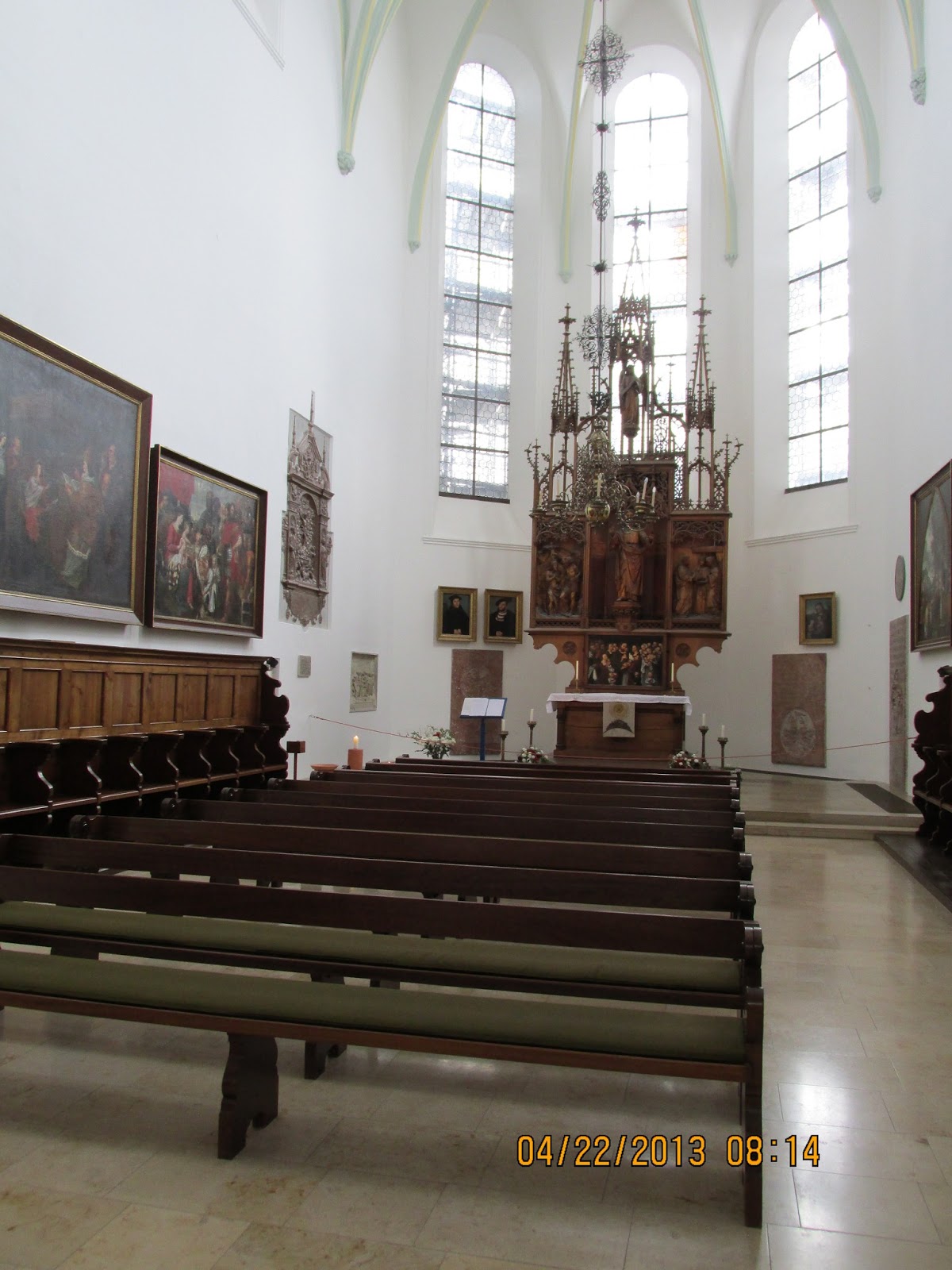
Inside the sanctuary
of St. Anne's.
When Luther came to Augsburg to meet with Cajetan, he resided at the cloister of St. Anne. The meeting was, in reality, a heresy trial where Luther was expected to recant his teaching before the papal legate. Luther was greeted as a hero in Augsburg and at St. Anne. As it became clear that Luther would not recant, Luther's friends and supporters became more concerned that he would be seized and taken to Rome. To avoid this, Luther's supporters smuggled him out of the city secretly.

Statue of Christ on the altar
raising his hands in blessing.
St Anne was built in 1321 by Carmelite monks. The Goldsmith's Chapel was added in 1420; the Fugger's Chapel in 1509. St. Anne's became an "Evangelical" (Lutheran) church in 1545. The spire was added in 1607 by Elias Holl. St. Anne's Church was intimately involved with the Thirty Years War (1618-48) and general religious turmoil of the 17th century. Evangelicals were twice barred from the church by those trying to restore Catholicism to the area (1629-32 and 1635-49); in the latter period, the congregation worshiped outside in the courtyard of St. Anne's College. The church was restored and redesigned in the Baroque and Rococo styles between 1747 and 1749.

In 1530, at the Diet of Augsburg, the Augsburg Confession - Confessio Augustana in Latin - was presented to Emperor Charles V. It was intentionally written to present a gentle, respectful, and peaceful response to the emperor. While intended to speak only for Saxony, as the various German princes read the document they began to subscribe to it as well. The Augsburg Confession was presented on June 25, 1530 as a statement of biblical truth and a proposal for true unity in the Christian faith. It has never been withdrawn.

The Hodgkins Lutheran
in Rathausplatz, Augsburg
with his Augsburg Confession.
The Augsburg Confession is the primary confession of faith of the Lutheran Church and one of the most important documents of the Lutheran Reformation. The Augsburg Confession was written in both German and Latin and was presented by a number of German rulers and free-cities at the Diet of Augsburg on June 25, 1530. The Holy Roman Emperor Charles V had called on the Princes and Free Territories in Germany to explain their religious convictions in an attempt to restore religious and political unity in the Holy Roman Empire and rally support against the Turkish invasion. It is the fourth document contained in the Lutheran Book of Concord.

A chest used to collect
money for indulgences. 
Central to the document and it's subsequent Apology is it's explanation of the Biblical doctrine of Justification. Confessional Lutherans teach forensic, or "legal", justification. This means that God declares the sinner to be "not guilty" (justified) because Christ has taken his place, living a perfect life according to God's law and suffering for his sins. For Confessional Lutherans justification is in no way dependent upon the thoughts, words, and deeds of those justified through faith alone in Christ. The new obedience that the justified sinner renders to God through sanctification follows justification as a consequence, but is not part of justification.

When a penny in the casket rings,
a soul from purgatory springs.
In 1999, St. Anne's Church was the site of the signing of the Joint Declaration on the Doctrine of Salvation by representatives of the Roman Catholic Church and the Lutheran World Federation, an effective rejection of the Augsburg Confession by the so-called Lutherans who signed it. This document states that, "a common understanding of our justification by God's grace through faith in Christ." This is flatly untrue. To the parties involved, this essentially resolves the conflict over the nature of justification which was at the root of the Protestant Reformation. Despite the claims of the Joint Declaration, however, very significant differences remain regarding how Confessional Lutherans (those who subscribe to a historial understanding of the Augsburg Confession and the Book of Concord) and Roman Catholics understand salvation, a fact that the Roman Catholic Church acknowledges.