Showing posts with label Matthew. Show all posts

Wednesday, January 30, 2019

Matthew the Tax Collector

As Jesus passed on from there, He saw a man named Matthew sitting at the tax office. And He said to him, “Follow Me.” So he arose and followed Him. Now it happened, as Jesus sat at the table in the house, that behold, many tax collectors and sinners came and sat down with Him and His disciples. And when the Pharisees saw it, they said to His disciples, “Why does your Teacher eat with tax collectors and sinners?” When Jesus heard that, He said to them, “Those who are well have no need of a physician, but those who are sick. But go and learn what this means: ‘I desire mercy and not sacrifice.’ For I did not come to call the righteous, but sinners, to repentance” (Matthew 9:9-13).

Much like the calling of the four fishermen,[1] Jesus calls Matthew. He does not, however, promise to make Matthew a “fisher of men”. This doesn’t mean Matthew is being called to a lesser Apostleship; it means that the fishing imagery, which would have been meaningful to Peter, Andrew, James, and John, doesn’t make as much sense when applied to a tax collector. Matthew, like the four fishermen, seemingly abandons his profession without any second thought or hesitation. This is not, however, the first Matthew has ever heard of Jesus. Being a follower of John the Baptist, Matthew knew, as the four fishermen did, that Jesus was the Messiah. Matthew heard John the Baptist preach that tax collectors, such as himself, should collect no more than what is appointed for,[2] and that Jesus was the Lamb of God who takes away the sin of the world. He, having heard the proclamation of God’s Word, contrite in front of the mirror of the Law, responded in faith when Jesus called Matthew into His direct service.

Jesus accompanies Matthew to his home. Matthew has a feast to which those other associates of his are invited, along with Jesus’ other disciples. Knowing that Jesus is the One promised to redeem Israel, it is only natural that Matthew would want to deliver that good news to those into whose midst God had placed him, by virtue of his vocation. No doubt Matthew had little difficulty filling his table with people. By this time, Jesus had done miracles, and preached and taught publicly. Jesus’ notoriety had spread. Most recently, Jesus had forgiven the sins of, and physically healed, a paralyzed man.[3] The multitudes following Jesus saw this, but so did The Jews – the Scribes, the Pharisees, the Sadducees, and the Teachers of the Law. By healing the paralytic, Jesus demonstrated to the Jews that He had the authority to forgive sins, something only God could do. But the very people who should’ve recognized the Messiah did not receive Him.[4] They were seeking to justify themselves by their keeping of the Law. The Jews, therefore, began looking for any type of scandal they could use to discredit Him in the eyes of the people. Associating with tax collectors, collaborating Jews who served the hated Roman government, certainly qualified as such a scandal.

The first part of Jesus’ reply to the Pharisees seems obvious. Of course a healthy person doesn’t need to be treated by a physician. Jesus is saying that those to whom He has come are sick, and He is the physician. This is most certainly true, and Jesus is indeed saying that those tax collectors and sinners are, well… sinners. The Jews, however, misunderstand Him; they recognize that the people with whom Jesus was eating were sinners, but they think they are excluded from that group. They think they are ok because of their righteous keeping of the Law. Jesus, however, came to heal all people of their terminal disease of sin, Jew and Gentile, Pharisee or tax collector. Jesus, who is Israel reduced down to one, creates a new, perfect Israel in Himself. He is the vine;[5] His Father, the Vinedresser, grafts wild olive shoots called Gentiles into Jesus; He takes the branches that were broken off, the unbelieving Jews, and grafts them into the vine again as well.[6] He unites us sinners to His death and resurrection, by His grace, through faith in Him. He creates that faith in men through His Word - proclaimed, or connected with the physical elements of water in baptism, or bread and wine by which He gives us His body and blood to eat and drink in the Lord’s Supper: Or do you not know that as many of us as were baptized into Christ Jesus were baptized into His death?[7] But when the kindness and the love of God our Savior toward man appeared, not by works of righteousness which we have done, but according to His mercy He saved us, through the washing of regeneration and renewing of the Holy Spirit, whom He poured out on us abundantly through Jesus Christ our Savior, that having been justified by His grace we should become heirs according to the hope of eternal life.[8]

Jesus quotes the prophet Hosea in response to the Pharisees: O Ephraim, what shall I do to you? O Judah, what shall I do to you? For your faithfulness is like a morning cloud, and like the early dew it goes away. Therefore I have hewn them by the prophets, I have slain them by the words of My mouth; and your judgments are like light that goes forth. For I desire mercy and not sacrifice, and the knowledge of God more than burnt offerings.[9] Jesus tells the Pharisees that their faith has disappeared like the early dew. It has evaporated. They trust in their works to make them acceptable to God. He has slain them by the words from His mouth. His proclamation of the Law exposes their sin, and that of all men; it kills them, and calls them to repentance. Jesus desires them to believe, to have faith, to be healed, rather than for them to keep every minute regulation of the Law by the outward act. He wants them, and all men, to recognize their illness and come to the only Physician who can cure it. Only after faith in Jesus is kindled within the heart by the working of the Holy Spirit through the Word, will we strive to obey God’s Law out of gratitude. We sinful human beings, like the tax collectors, like the Pharisees, like all men born since the Fall, are sick with the disease of sin which leads to death. Only the Great Physician has the cure – His own body and blood, given and shed for the remission of sins.


[1] Matthew 4:18-22
[2] Mark 2:14
[3] Matthew 9:1-8
[4] John 1:11
[5] John 15:1-8
[6] Romans 11:19-24
[7] Romans 6:3
[8] Titus 3:4-7
[9] Hosea 6:4-6

Thursday, December 24, 2015

From One Know-Nothing to Another

The Know-Nothing Party Flag

Dennis Gorecki of Orland Park, IL wrote a letter which was published in the Christmas Eve edition of the Daily Southtown newspaper (a Chicago Tribune publication). In his letter, which lists the collective sin of American racism like a litany – or an indictment – Mr. Gorecki’s calls for his “Christian brothers and sisters who support the xenophobic views of the Republican party,” to read Matthew 25:35-46. Those verses read as follows:

“For I was hungry and you gave me food, I was thirsty and you gave me drink, I was a stranger and you welcomed me, I was naked and you clothed me, I was sick and you visited me, I was in prison and you came to me.’ Then the righteous will answer him, saying, ‘Lord, when did we see you hungry and feed you, or thirsty and give you drink? And when did we see you a stranger and welcome you, or naked and clothe you? And when did we see you sick or in prison and visit you?’ And the King will answer them, ‘Truly, I say to you, as you did it to one of the least of these my brothers, you did it to me.’ Then he will say to those on his left, ‘Depart from me, you cursed, into the eternal fire prepared for the devil and his angels. For I was hungry and you gave me no food, I was thirsty and you gave me no drink, I was a stranger and you did not welcome me, naked and you did not clothe me, sick and in prison and you did not visit me.’ Then they also will answer, saying, ‘Lord, when did we see you hungry or thirsty or a stranger or naked or sick or in prison, and did not minister to you?’ Then he will answer them, saying, ‘Truly, I say to you, as you did not do it to one of the least of these, you did not do it to me.’ And these will go away into eternal punishment, but the righteous into eternal life” (Matthew 25:35-46).

He calls the Republican Party the new Know-nothings which, in many respects, is an accurate statement. The average American’s concern for the security of their country and its borders, however, does not automatically equate with xenophobia, as many leftists believe and proclaim. By citing St. Matthew’s Gospel, this implication is made all the more insulting, as Christians are painted to look like hypocritical racists. This view of Christians may fit well with the Left’s worldview, but it has little to do with reality for the majority of the faithful. Furthermore, Mr. Gorecki’s invocation of Matthew 25:35-46 as his coup de grĂ¢ce betrays his ignorance of Biblical interpretation.

Christ, telling this parable of the sheep and the goats to his disciples, says, “Truly, I say to you, as you did it to one of the least of these my brothers, you did it to me” (Matthew 25:40). Who are Jesus’ brothers? His disciples! We learn this in Matthew 12:

“While he was still speaking to the people, behold, his mother and his brothers stood outside, asking to speak to him. But he replied to the man who told him, ‘Who is my mother, and who are my brothers?’ And stretching out his hand toward his disciples, he said, ‘Here are my mother and my brothers! For whoever does the will of my Father in heaven is my brother and sister and mother’ (Matthew 12:46-50).

Again, who are those, according to Jesus, who do the will of His Father in heaven? Those who believe in him, or…His disciples! We learn this in John 6:

“Then they said to him, ‘What must we do, to be doing the works of God?’ Jesus answered them, ‘This is the work of God, that you believe in him whom he has sent’” (John 6:28-29).

So, who is Jesus calling us to feed, give drink, clothe, and visit in prison in this parable? His brothers, those who believe in him…our fellow Christians. To say that this parable mandates that Christians welcome everyone who calls themselves a refugee into their country without a second thought or question, is to profoundly misinterpret Jesus’ words here.

Certainly this is not the only sense in which the phrase “my brothers” should be understood. Since we have been adopted into God’s family, we Christians are children of God the Father, brothers and sisters of Christ, and co-heirs with Him of His Kingdom. 

This is not to say that Christians are allowed to treat those outside the family of faith badly. To the contrary, Christians are called to love their enemies, a feature of the Christian religion not universally shared by the world’s religions. We are called to pray for those who persecute us, and to live in peace with everyone, insofar as it depends on us.

Christians expressing concern about the effects and dangers of unchecked illegal immigration does not equate with the “No Irish Need Apply” attitude of the late 19th and early 20th Centuries. Supporting tighter control of the way visas are issued, or not wanting to allow tens of thousands of Muslim refugees into the country without a proper vetting when Islamic terrorists are threatening kill Americans on American soil does not equate with the exclusion of Chinese immigrants, or with any of the other incidents of racism and xenophobia which Mr. Gorecki cites. And, while there are certainly a large number of people in America who are the type of bigot Mr. Gorecki describes, this in no way negates the founding principles of our country, or the picture of America as the land of opportunity for oppressed immigrants around the world. 

Things like racism exist because human beings are sinful. Our natures are corrupt. In our natural state, we are God’s enemy. Our focus is bent inward toward ourselves. As a result, we don’t love God with our whole hearts, and we don’t love our neighbors as ourselves. For this we need to repent. We need to hear God’s forgiveness this Christmas – and every day of the year – that, despite our sinfulness we do not need to fear; that unto us is born this day in the city of David a Savior, who is Christ the Lord. This Savior is Immanuel, God with us, who came to bear our sin on the cross while we were still his enemies. Repentance and the forgiveness of sins through Christ’s blood, shed on the cross, is the only thing which will cause us to act according to the Spirit rather than according to our sinful flesh.

Thursday, July 23, 2015

Judge not...


“Judge not, that you be not judged. For with the judgment you pronounce you will be judged, and with the measure you use it will be measured to you. Why do you see the speck that is in your brother's eye, but do not notice the log that is in your own eye? Or how can you say to your brother, ‘Let me take the speck out of your eye,’ when there is the log in your own eye? You hypocrite, first take the log out of your own eye, and then you will see clearly to take the speck out of your brother's eye,” (Matthew 7:1-5).

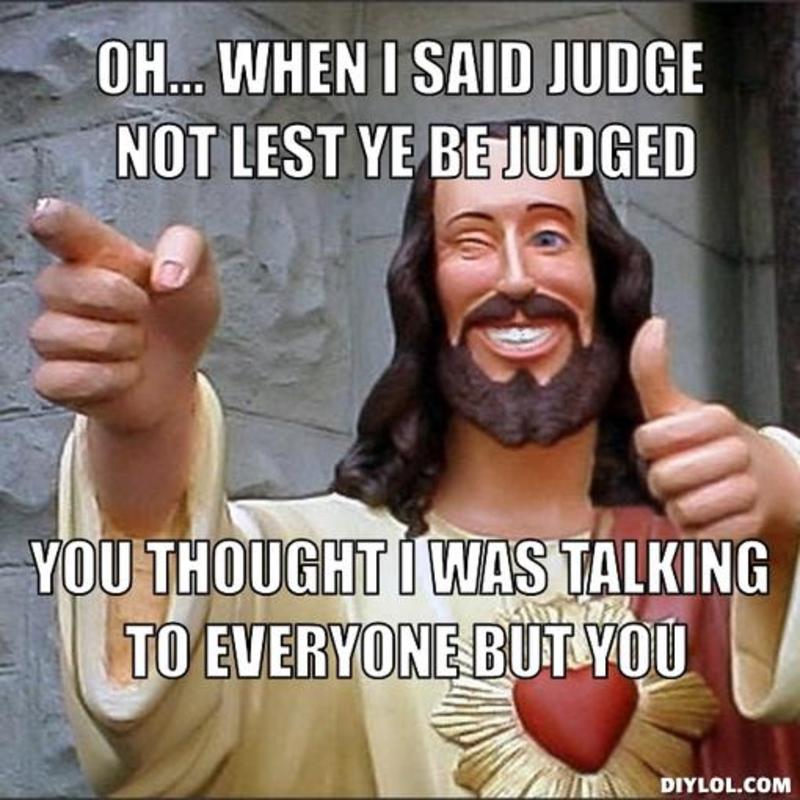
In the wake of the same-sex marriage ruling by the Supreme Court, Facebook was deluged with memes celebrating the victory. Two of the most common memes I encountered were 1) of Stephen Colbert wanting to read what Jesus said about homosexuality in the Bible, but not being able to because he never said anything about it, and 2) some clever picture of Jesus reminding Christians to, “Judge not…” Christians may have allowed the secular society to legally redefine marriage, but we should not allow the secular, unbelieving world to misuse God’s word as a weapon against his Church. After all, when Our Lord was tempted in the wilderness, and Satan attempted to use Scripture to trap Jesus, Jesus answered right back with Scripture. So, in response to the “Judge not…” meme, here is some Scripture which I hope will put the opening of Matthew chapter seven into some context.

At first glance, this opening passage of Matthew chapter seven looks like it is telling Christians never, under any circumstances, to judge anyone else, or those same standards of judgment will be applied to them. In a way that is true. Because this passage is used to bludgeon Christians into remaining silent in the face of sin, however, one must look a little deeper into the context to find out whether or not this is what Jesus was really saying. After all, this is the same Jesus who called the Pharisees vipers and turned over the money-changer’s tables in the temple. Jesus clearly teaches his disciples to judge. The issue is that we must judge properly, using God’s Word as the standard for our judgment, rather than our own personal morality or behavior. 

Generally speaking, people are only familiar with the, “Judge not, that you be not judged,” part of this passage. What people often fail to recognize is that Jesus, in the same paragraph, called his disciples to “take the log out of your own eye,” so that they could see clearly to “take the speck out of your brother’s eye.” Jesus did not forbid his followers from judging sin. He called them to judge the sin of others (the specks) in the light of their own sin (the logs), only after proper self-examination and repentance.

The “Judge not…” passage comes at the climax of what theologians have come to call the Sermon on the Mount (Matthew 5:1-7:27). Most people, even if they aren’t church-goers, are familiar with the Sermon on the Mount. It begins with the Beatitudes:

And he opened his mouth and taught them, saying: “Blessed are the poor in spirit, for theirs is the kingdom of heaven. Blessed are those who mourn, for they shall be comforted. Blessed are the meek, for they shall inherit the earth. Blessed are those who hunger and thirst for righteousness, for they shall be satisfied. Blessed are the merciful, for they shall receive mercy. Blessed are the pure in heart, for they shall see God. Blessed are the peacemakers, for they shall be called sons of God. Blessed are those who are persecuted for righteousness’ sake, for theirs is the kingdom of heaven. Blessed are you when others revile you and persecute you and utter all kinds of evil against you falsely on my account. Rejoice and be glad, for your reward is great in heaven, for so they persecuted the prophets who were before you,” (Matthew 5:2-12).

Throughout the secular world, not to mention American Evangelicalism, the Beatitudes are often understood as a quid pro quo. If you are poor in spirit, the kingdom of heaven is yours, so work really hard to be as poor in spirit as you can. If you do this, then you get that, or this thing will happen to you. Jesus, however, is not declaring here an ethical demand of his followers by laying out a law of behavior or attitude. The Beatitudes are not so much a mountain of law which one is to climb to be a better Christian, but rather it can be seen – particularly by your “old” man – as a mountain of law under which one is to be totally crushed.

Make no mistake, Jesus is certainly also assuring his disciples of God’s goodness, and the future blessings in store for them. The crushing weight of the law, however, must first bring us to see our sin and to repent of it. This repentance and forgiveness comes as the gracious gift of God through the Gospel. The Christian is simul justus et peccator – simultaneously justified and sinner. My new man hears in the Beatitudes assurance of God’s goodness and future blessing; my old man hears law and judgment. When we recognize our own spiritual poverty, when the Lord leads us to hunger and thirst for God’s righteousness, when He makes us pure in heart so that we seek to worship only the true God, then we are blessed, now and forever (Engelbrecht 2009).

Jesus goes on from here and continues with this theme. He tells his disciples that he did not come to abolish the Law or the Prophets, but to fulfill them[1]. In other words, man is still responsible for keeping the law. He tells them that unless their righteousness exceeds that of the scribes and Pharisees, they will never enter the kingdom of heaven[2]. At this point, I imagine the disciples would have been shocked. Who could be more righteous than the Pharisees? The Pharisees were the very definition of righteous. If, in order to enter the kingdom of heaven, I must be more righteous than the Pharisees, I must be utterly lost. For whom is there any hope then? I may not be perfect, but surely I’m at least a little better than people who commit all kinds of terrible sins! With that bouncing around in their heads, Jesus goes on to talk about sin.

Anger, lust, divorce, you think you know what those things are? Feeling superior to the man imprisoned for murder? You’re a murderer to, Jesus says, because, “…everyone who is angry with his brother will be liable to judgment[3];” Feeling proud that you have never committed adultery like your scum-bag neighbor down the street? Think again. Jesus says, “…everyone who looks at a woman with lustful intent has already committed adultery with her in his heart[4].” Jesus continues on, truly defining sin as God sees it, building to the climax of this section where he says we should, contrary to our feelings, love our enemies. “Love your enemies and pray for those who persecute you, so that you may be sons of your Father who is in heaven. For he makes his sun rise on the evil and on the good, and sends rain on the just and on the unjust[5].” He concludes this section with these words: “You therefore must be perfect, as your heavenly Father is perfect[6].” If there were left any doubt as to whether or not we are sinners, or whether or not we could keep the law and earn the kingdom of heaven, Jesus’ teachings here on sin should have put that doubt to bed. He has brought all of us to the same level – we are all poor, miserable sinners, condemned under the law.

In chapter six Jesus talks about good works and religious practice. He tells his disciples not to do good works as a show to earn praise from other men, but rather that good works should flow from them naturally[7]. He teaches them how to pray[8] and, not ostentatiously to be viewed and praised by others, but in secret, as an outgrowth of their faith[9]. And finally living outwardly as they have internal faith, he teaches them to entrust their daily lives to God’s care[10]. It is only after this foundation is laid that Jesus utters the phrase, “Judge not, that you be not judged.”

Far from forbidding his disciples to judge other people’s sinful acts, Jesus is telling his disciples to judge by the proper standard and not as hypocrites. Kretzmann writes that the word used by Jesus in Matthew 7:1, which we render as “judge,” in the Greek implies personal, unkind uncharitable, unauthorized, condemnatory judgment (Kretzmann 1921). Christians must practice self-examination, and use God’s standard, rather than their own to judge the words and deeds of others.

If you do not realize your own sins and faults, you cannot offer admonition to a fellow Christian. One who assumes the task of taking the speck out of his brother’s eye must do so with sincere love, deep humility, and the prayer “Forgive us our debts, as we also have forgiven our debtors[11]” (Engelbrecht 2009).

Jesus judged plenty but, being God, he did it in the proper context. In fact, the entire Sermon on the Mount is a judgment of sin, and the practices of the Pharisees. This is what he calls us to do as well. Jesus says so in as many words in the Gospel of St. John:

About the middle of the feast Jesus went up into the temple and began teaching. The Jews therefore marveled, saying, “How is it that this man has learning, when he has never studied?” So Jesus answered them, “My teaching is not mine, but his who sent me. If anyone's will is to do God's will, he will know whether the teaching is from God or whether I am speaking on my own authority. The one who speaks on his own authority seeks his own glory; but the one who seeks the glory of him who sent him is true, and in him there is no falsehood. Has not Moses given you the law? Yet none of you keeps the law. Why do you seek to kill me?” The crowd answered, “You have a demon! Who is seeking to kill you?” Jesus answered them, “I did one work, and you all marvel at it. Moses gave you circumcision (not that it is from Moses, but from the fathers), and you circumcise a man on the Sabbath. If on the Sabbath a man receives circumcision, so that the law of Moses may not be broken, are you angry with me because on the Sabbath I made a man's whole body well[12]? Do not judge by appearances, but judge with right judgment,” (John 7:14-24).

What is right judgment? What is our standard for judgment? It is God’s Word. St. Paul writes to Timothy the following, regarding the power and usefulness of Holy Scripture:

But as for you, continue in what you have learned and have firmly believed, knowing from whom you learned it and how from childhood you have been acquainted with the sacred writings, which are able to make you wise for salvation through faith in Christ Jesus. All Scripture is breathed out by God and profitable for teaching, for reproof, for correction, and for training in righteousness, that the man of God may be competent, equipped for every good work (2 Timothy 3:14-17).

To whom is this standard applied? Everyone. St. Paul, writing to the Romans has this to say regarding God’s righteous judgment, and how all men, standing on their own, would fare:

Therefore you have no excuse, O man, every one of you who judges. For in passing judgment on another you condemn yourself, because you, the judge, practice the very same things. We know that the judgment of God rightly falls on those who practice such things. Do you suppose, O man – you who judge those who practice such things and yet do them yourself – that you will escape the judgment of God? Or do you presume on the riches of his kindness and forbearance and patience, not knowing that God’s kindness is meant to lead you to repentance? But because of your hard and impenitent heart you are storing up wrath for yourself on the day of wrath when God’s righteous judgment will be revealed (Romans 2:1-5).

The secular world will always react to the judgment of its sin with hostility – just as we Christians often do when a brother rebukes us. We cannot expect the pagan world to live as though they were Christians. Moral criticism is necessary and religious teaching cannot be discarded, but it would be the height of folly to unload one’s religious beliefs and experiences, tender sentiments, and moral convictions on anyone that comes along, no matter in what condition he might be (Kretzmann 1921). We can, however, use God’s law to make men aware of their sin in all humbleness, knowing all the while that we are sinful human beings as well. We may not be guilty of some of the specific acts described by St. Paul in his build up to Romans chapter two, but we have all exchanged God’s truth for human foolishness (Engelbrecht 2009). When we see sin, whether it is the sin of another or our own, we should respond in penitent faith, confessing our sin, knowing that God is faithful and just, and that he will cleanse us from all unrighteousness through the blood of Jesus shed on the cross.


Works Cited

Engelbrecht, Rev. Edward A., ed. The Lutheran Study Bible. Saint Louis: Concordia Publishing House, 2009.

Kretzmann, Paul E. Popular Commentary of the Bible: New Testament. Vol. 1. 2 vols. St. Louis, MO: Concordia Publishing House, 1921.


End Notes

[1] Matthew 5:17 
[2] Matthew 5:20 
[3] Matthew 5:22 
[4] Matthew 5:28 
[5] Matthew 5:45 
[6] Matthew 5:48 
[7] Matthew 6:1-4 
[8] Matthew 6:5-15 
[9] Matthew 6:16-24 
[10] Matthew 6:25-34 
[11] Matthew 6:12 
[12] Jesus is here referring to his healing of an invalid at the pool of Bethesda (John 5:1-17).

Wednesday, February 18, 2015

Fasting: Ashes and Ash Wednesday

When you fast, do not look somber as the hypocrites do, for they disfigure their faces to show men they are fasting. I tell you the truth, they have received their reward in full. But when you fast, put oil on your head and wash your face, so that it will not be obvious to men that you are fasting, but only to your Father, who is unseen; and your Father, who sees what is done in secret, will reward you (Matthew 6:16-18).

Ash Wednesday marks the first day of Lent. Lent is the 40 fast days before Easter. The name, as you probably figured out, comes from the practice of the ancient church of sprinkling ashes on the heads of penitents as a physical act of contrition and repentance for their sin. Ashes are a symbolic mark of humiliation, contrition, and mourning (Harrison, Bromiley and Henry 1990). During Lent, many of the faithful commit to fasting or giving up certain types of luxury as a form of penitence. Many churches strip their altars of candles, flowers, and other devotional offerings, while crucifixes, statues, and other elaborate religious gear may be veiled in violet.

I grew up in a congregation of the Lutheran Church – Missouri Synod that practiced the imposition of ashes on Ash Wednesday. That is to say, on Ash Wednesday, parishioners would line up during the worship service to have the pastor put ashes on their head. The people would approach the pastor, who was standing in the front of church. In his hand he held a silver vessel containing an unappealing black substance – the burned remnants of the palm fronds from the previous year’s Palm Sunday mixed with oil. As the people would come to the pastor, he would blacken his thumb with the ashes and make the sign of the cross on the person’s forehead. During this process he would tell each parishioner, “Remember that you are dust, and to dust you shall return.”

I never realized, however, that this was "fasting." Growing up when and where I did, I also didn’t realize that what was to me a natural part of the Ash Wednesday worship service was, in other places, quite a contentious issue.

Later, attending college in what is referred to by some as the “Bible Belt,” I met many people, Christians and non-Christians, who were shocked by the worship practice I shall refer to as the Imposition of Ashes. Lutherans were few in number in Murray, Ky. All my friends were some flavor of evangelical protestant. Knowing that I professed to be a Christian, when the inevitable discussion would arise, many would quote this passage of scripture to me. “Jesus said, ‘…do not look somber as the hypocrites do, for they disfigure their faces to show men they are fasting.’ This practice is not Biblical.” I had to admit that I had not thought about it in that way before. It certainly seemed logical, when cast in that light. My only allies on campus were the Roman Catholics, who also practiced this tradition. This only made my position worse. Most of the evangelicals thought of Lutherans, if they thought of them at all, as “Catholic light.” They tended to think of Roman Catholics as some kind of non-Christian cult.

Jesus, however, doesn’t forbid fasting. In fact, it seems as if he sort-of expects his followers to fast. Jesus begins by saying, “When you fast…” The issue with fasting is not, “Should it be practiced?” Jesus takes it for granted that his followers would fast. When Jesus was lead by the Spirit into the desert to be tempted by the devil, he himself fasted forty days and nights[1]. This issue is, rather, does our fast merely make an outward show of repentance, or do our hearts feel true sorrow and humility. In his commentary, Paul Kretzmann explains Jesus’ words this way:

Again the Lord emphasizes the contrast. A mere outward show of repentance without change of heart does not befit the followers of Jesus. Fasting they may practise [Sic.] indeed; that is a laudable custom and may be productive of good. But in doing so, all ostentation must be avoided. It is the heart that should feel the sorrow and humility, not the body. Therefore the usual daily washing and anointing should not be omitted, in order that men might not even know the conditions (Kretzmann 1921).
Fasting was an integral part of the Jewish religion. The problem Jesus had with “fasting” was not the practice, but rather that the hypocrites turned this profitable practice into a work of self-glorification. It is clear from Matthew’s Gospel that the hypocrites were neglecting their daily washing etc., in order to give the impression that the fast was taking a great toll on them.

They neglected the daily care of the face, to make the effect of the semiweekly fast appear all the more harrowing. It was an empty show in order that they might play a more important figure and get the reputation of greater holiness. They have all the reward they will ever get. They need expect nothing from the Lord (Kretzmann 1921).
Fasting, such as that undertaken by some during the Lenten season, and including the Imposition of Ashes, is neither commanded nor forbidden by Holy Scripture. The decision whether or not to do these things has been left by God to the individual Christian. This issue – what is referred to by theologians as “Adiaphora” – was important to Luther and the reformers. While they wished to see many of the historic practices of the church retained, they objected to Rome’s assertion of its authority in these matters of Adiaphora, and to require them as necessary for salvation. Luther writes the following to the congregation at Esslingen, in a letter responding to his critics when they accused him of requiring works (particularly private confession):

…Likewise I prevent no one from fasting, making a pilgrimage, eating meat, observing days, etc., if only it is done of one’s own accord, and not done as though he had to do it in conscience and as though omitting it would be a mortal sin, as the Pope with his blind leaders raves… (Pieper 1953).
In the Augsburg Confession Philipp Melanchthon writes Article 26 to address complex rules and regulations devised by the Church commanding fasting:

First, the chief part of the Gospel – the doctrine of grace and of the righteousness of faith – has been obscured by this view[2]. The Gospel should stand out as the most prominent teaching in the Church, in order that Christ’s merit may be well known and faith, which believes that sins are forgiven for Christ’s sake, be exalted far above works. Therefore, Paul also lays the greatest stress on this article, putting aside the Law and human traditions, in order to show that Christian righteousness is something other than such works (Romans 14:17). Christian righteousness is the faith that believes that sins are freely forgiven for Christ’s sake. But this doctrine of Paul has been almost completely smothered by traditions, which have produced the opinion that we must merit grace and righteousness by making distinctions in meats and similar services. When repentance was taught, there was no mention made of faith. Only works of satisfaction were set forth. And so repentance seemed to stand entirely on these works (McCain, et al. 2005).
This view of fasting and human tradition presented in the Book of Concord is distilled by Pieper in his work, “Christian Dogmatics”:

Scripture instructs Christians to regard teachers who pretend to know more than Christ’s Word contains as bloated ignoramuses (1 Tim. 6:3 ff.). And those who attempt to impose what the Word of Christ leaves free, e.g., forbidding to marry or commanding to fast and abstain from food and drink, are properly regarded by the Christians as arrogant deceivers and disseminators of doctrines of devils (1 Tim. 4:1-5; Col. 2:20-23). The Pope may impose a fast on himself, but on no one else in the world (Pieper 1953).
Working to curb one’s sinful desires through the application of bodily discipline can, at times, be appropriate and necessary (McCain, et al. 2005). It should never be taught, however, that such outward activities earn God’s favor. Only the Lord can look into people’s hearts and know if their actions stem from penitence, or if they are simply putting on a show for men. Like many other historic practices of the church, the Imposition of Ashes has been retained in the Lutheran Church because it is profitable, and not as a work to merit righteousness. It has been the Lutheran view, from the time of the Reformation until today, that the Church should not do away with good traditions and practices, but only those things that take away from the Gospel.

The Imposition of Ashes is one of those good traditions. It seems to get people’s attention, and not just because of the strange black mark on the forehead. Hearing the pastor’s reminder that you are dust – perishable – is humbling. Hearing him tell every man, woman, and child that they will return to that dust someday is sobering. As a young person I remember looking around at all my friends and neighbors, young and old, rich and poor, thinking that, no matter what our earthly differences might be, we were equal in one aspect – we would all die. We would all die, and there was nothing within our power to change that fact. We were, in fact, dead already, in our sin[3]. We could not ignore our sin.

After leaving church on Ash Wednesday, sometimes people would forget that they had a weird, nasty smear of ashes on their forehead. They would inadvertently scratch their foreheads sometime and be reminded by the residue on their finger that they were dust, and to dust they must one day return. Before going to bed, looking in the mirror, one would once again be reminded they were marked with the black stain of sin, and that they were dust, returning to the dust from whence they came.

Those ashes, however, are drawn on the forehead in the sign of a cross. Not as if the cross is some kind of magic sign to ward off evil, but also as a reminder. The cross reminds us that the guilt of mankind’s sin has been paid for by Christ’s death. The blood of Christ shed on the cross has justified us. We did not participate in Christ’s saving work at all. It happened, as St. Paul wrote, while we were still powerless:

But God demonstrates his own love for us in this: While we were still sinners, Christ died for us. Since we have now been justified by his blood, how much more shall we be saved from God’s wrath through him (Rom 5: 8-9).
Fasting can be good training for our will, but God does not command particular times, places, or forms of fasting (Luther 1991). There is nothing we have to offer, no work we can do, no ceremony we can perform, in order to merit God’s forgiveness. God has given us forgiveness as a gift, through Christ Jesus, and he sends His Holy Spirit to us to create faith in our hearts through the means of his Word and Sacraments. He enables us to do works that please him – not in order to earn his grace – but to glorify his most holy name. Fasting, and other traditions like the Imposition of Ashes, can help us to look at our sin, confess it, and acknowledge our need for a savior. These traditions, used properly, and not imposed as a law, focus us on Christ and Him crucified.


Works Cited

Harrison, Everett F, Geoffrey W Bromiley, and Carl F Henry, . Wycliffe Dictionary of Theology. Peabody, Massachusetts: Hendrickson Publishers, Inc., 1990.

Kretzmann, Paul E. Popular Commentary of the Bible: New Testament. Vol. 1. 2 vols. St. Louis, MO: Concordia Publishing House, 1921.

Luther, Martin. Luther's Small Catechism. Translated by Concordia Publishing House. Saint Louis, Missouri: Concordia Publishing House, 1991.

McCain, Paul Timothy, Robert Cleveland Baker, Gene Edward Veith, and Edward Andrew Engelbrecht, . Concordia: The Lutheran Confessions. Translated by William Hermann Theodore Dau and Gerhard Friedrich Bente. St. Louis, MO: Concordia Publishing House, 2005.

Pieper, D.D., Francis. Christian Dogmatics. Vol. 3. 3 vols. Saint Louis, Missouri: Concordia Publishing House, 1953.


End Notes


[1] Matthew 4:1-2

[2] Not only the people, but also those teaching in the churches, have generally been persuaded to believe in making distinctions between meats, and similar human traditions. They believe these are useful works for meriting grace and are able to make satisfaction for sins (AC XXVI 1).

[3] Ephesians 2:1

Saturday, December 28, 2013

The Holy Innocents

The Martyrdom of the Holy Innocents - Gustave Dore
When they had gone, an angel of the Lord appeared to Joseph in a dream. “Get up,” he said, “take the child and his mother and escape to Egypt. Stay there until I tell you, for Herod is going to search for the child to kill him.” So he got up, took the child and his mother during the night and left for Egypt, where he stayed until the death of Herod. And so was fulfilled what the Lord had said through the prophet: “Out of Egypt I called my son.” When Herod realized that he had been outwitted by the Magi, he was furious, and he gave orders to kill all the boys in Bethlehem and its vicinity who were two years old and under, in accordance with the time he had learned from the Magi. Then what was said through the prophet Jeremiah was fulfilled: A voice is heard in Ramah, weeping and great mourning, Rachel weeping for her children and refusing to be comforted, because they are no more" (Matthew 2:13-18).
 
The murder of the children of Bethlehem by Herod is, to be certain, a despicable and sinful act. It is usually depicted as taking place on the scale of a genocide, and we tend to get the impression that a lot more babies were murdered than probably actually were.
 
Don't misunderstand me, I am in no way going soft on infanticide. One baby-murder is too many. Liberal Bible scholars, as well as those outside of the faith who seek to diminish the credibility of Christianity, often use this story as one of their arguments. "If the madman Herod murdered all of the toddlers and babies in and around Bethlehem," they argue, "would there not be contemporary accounts of the massacre?" One would assume so, if the event happened as we often imagine it to have. And, actually, there is a reliable, contemporary account the murders - the Gospel of Matthew. Archeology has always proven itself the friend of the New Testament, and has shown it to be historically reliable, much to the annoyance of the few liberal scholars who are willing to acknowledge the evidence. That, however, is a debate to be saved for another day.
 
Herod the Great, or Herod I, has been described as a madman and a murderer, even apart from the Slaughter of the Innocents. He murdered his own family and was "prepared to commit any crime in order to gratify his unbounded ambition" (Herod the Great, 2013). He was hated and mistrusted by the Jews over whom he ruled, and he hated and mistrusted them right back. Not only was he viewed by his subjects as a collaborator with the hated Romans, from whom he received his kingdom, he was also not a "real" Jew. Herod was an Edomite, a descendant of Esau (Herod, 2013). He did all kinds of terrible things to insure his grip on power. If he thought that the rightful Jewish King of the Jews had been born sometime in the last two years near Bethlehem, and that he had to murder all the babies in that place to keep his throne, there is little doubt that he would do so (France, 2007).

The fact that a mad and murderous king committed murder was still sad, but not as shocking as it maybe should have been. It certainly wouldn't have been front-page news. This situation is akin to murders in modern American cities such as Detroit or Chicago. They are committed with chilling regularity and in such a frequency that, to cover them with the attention they deserve would be to dominate every column of every magazine and newspaper in the city every day. This is in contrast with how a murder would be treated if it happened in some affluent suburban enclave where such things rarely occur. Today a murder in Chicago, unless it was particularly gruesome or involved some high-profile person, scarcely gets more than a one-minute mention on the evening news.
 
But Bethlehem wasn't Chicago or Detroit. It was small. So small, in fact, that it was considered insignificant by worldly standards, as the writings of the prophets suggest:
 
But you, O Bethlehem Ephrathah, who are too little to be among the clans of Judah, from you shall come forth for me one who is to be ruler in Israel, whose coming forth is from of old, from ancient days (Micah 5:2).
 
Traditional Bible scholars believe that, given population density in that area during that time (all estimated, of course), no more than twenty babies and young children were made Herod's unfortunate victims (Hagner, 1993).
 
But why are they called innocents? Certainly they are not innocent, at least not in the biblical sense. They are sinful human beings, just like everyone else, with a sinful human nature, and they are subject to sin and death. I suppose that they are innocent in the sense that they received a punishment they did not deserve. The death they suffered was intended for the Christ child. In this way they could be considered martyrs as their deaths testify to the Christ, and foreshadow his own suffering and death.
 
The Holy Innocents teach us that there is no such thing as innocence before God, since the Fall of Man. All have sinned and fallen short of the glory of God. No one is righteous, not even one, all of us having been conceived in sin and brought forth in iniquity. No thing or person has escaped the corruption that entered the world through the sin of Adam. Herod demonstrates the depth of this corruption by his depraved sinful desires, his willingness to act on those sinful desires, the horrific act itself, and its intended end - the murder of God's Anointed One; the death of the Holy Innocents demonstrates that all - even "innocent" babies - are subject to sin and death, and are in desperate need of a savior. As members of the nation of Israel through circumcision, we trust God that the babies murdered by Herod were forgiven sinners because of God's promise, just as we who have been adopted into God's family through baptism are.
 
Almighty God, whose praise was proclaimed this day by the wicked death of innocent children, giving us thereby a picture of the death of your beloved Son, mortify and destroy in us all that is in conflict with you that we who have been called in faith to be your children may in life and death bear witness to your salvation; through our Lord Jesus Christ, who lives and reigns with you and the Holy Spirit, one God, now and forever. Amen (CPH, 1983).


Bibliography
 
France, R. T. "The Gospel of Matthew (Google EBook)." Google Books. N.p., n.d. Web. 28 Dec. 2013. http://books.google.com/books?id=0ruP6J_XPCEC.
 
"Herod (king of Judaea)." Encyclopedia Britannica Online. Encyclopedia Britannica, n.d. Web. 28 Dec. 2013.
 
"Herod the Great." Wikipedia. Wikimedia Foundation, 27 Dec. 2013. Web. 28 Dec. 2013. http://en.wikipedia.org/wiki/Herod_the_Great.
 
Lutheran Worship. St. Louis (3558 S. Jefferson Ave., St. Louis 63118): Concordia Pub. House, 1983. Print.
 
"Massacre of the Innocents." Wikipedia. Wikimedia Foundation, 28 Dec. 2013. Web. 28 Dec. 2013. http://en.wikipedia.org/wiki/Massacre_of_the_Innocents.

Saturday, November 30, 2013

Rejoice Greatly, O Daughter of Zion

Now when they drew near to Jerusalem and came to Bethphage, to the Mount of Olives, then Jesus sent two disciples, saying to them, “Go into the village in front of you, and immediately you will find a donkey tied, and a colt with her. Untie them and bring them to me. If anyone says anything to you, you shall say, ‘The Lord needs them,’ and he will send them at once.” This took place to fulfill what was spoken by the prophet, saying, “Say to the daughter of Zion, ‘Behold, your king is coming to you, humble, and mounted on a donkey, on a colt, the foal of a beast of burden.’” The disciples went and did as Jesus had directed them. They brought the donkey and the colt and put on them their cloaks, and he sat on them. Most of the crowd spread their cloaks on the road, and others cut branches from the trees and spread them on the road. And the crowds that went before him and that followed him were shouting, “Hosanna to the Son of David! Blessed is he who comes in the name of the Lord! Hosanna in the highest!” And when he entered Jerusalem, the whole city was stirred up, saying, “Who is this?” And the crowds said, “This is the prophet Jesus, from Nazareth of Galilee” (Matthew 21:1-11).

There is a children's song sometimes used to teach Kindergartners about Advent. The children are supposed to learn the words, "Advent is the time of waiting, waiting/Advent is the time we wait for him; Advent is the time of waiting/We also have to wait for...." The children are supposed to then say something that they have to wait for. The answers I tend to get are things like "lunch" and "cupcakes". Advent, however is much more than simply a time of waiting for something trivial like a snack. It is certainly a time of waiting, but it is also a time of preparation - preparation to celebrate Jesus' first coming at Christmas, as well as his second coming at the end of the age. The word Advent comes from the Latin "adventus", which means "coming".

The text from Matthew 21 culminates with Jesus coming to Jerusalem. Jesus and his disciples begin going up to Jerusalem in Matthew 20. This is after the large crowds had followed him into the region of Judea beyond the Jordan River from Galilee[1]. The crowds had been healed and had witnessed miracles. Jesus taught them and his disciples through parables. The Pharisees disputed with him and, most significantly, Jesus had told his disciples exactly why they were going to Jerusalem:

As they were gathering in Galilee, Jesus said to them, “The Son of Man is about to be delivered into the hands of men, and they will kill him, and he will be raised on the third day.” And they were greatly distressed (Matthew 17:22).

Jesus was going up to Jerusalem to die. He and his disciples had gone up to Jerusalem to celebrate the Passover, and for other feasts, before. This time, however, Jesus was going to die. He told his disciples this and they didn't understand. They didn't understand that Jesus was the true Passover lamb for whom they had been waiting[2], and that all the Passover lambs they had eaten during their lives were shadows of Jesus[3]. They didn't yet understand that Jesus was the propitiation for their sins, and the sins of the whole world[4], foretold by the prophets of old. They didn't understand that Jesus, who was true God in human flesh, would be that propitiation for sin by dying a horrible death hanging on a Roman cross, and that he would defeat sin, death, and the devil once and for all by his resurrection from the dead[5]. They understood that they were going to Jerusalem to celebrate the Passover, as they had done before, but they did not understand that they had brought with them the true Passover lamb, for which the faithful had waited since man had been cast out of the Garden of Eden.

Matthew explains to us why the donkey is significant; it fulfills Old Testament prophecy. Zechariah wrote:

Rejoice greatly, O daughter of Zion! Shout aloud, O daughter of Jerusalem! Behold, your king is coming to you; righteous and having salvation is he, humble and mounted on a donkey, on a colt, the foal of a donkey (Zechariah 9:9).

The coming king of Zion would not enter his city as the triumphant conqueror. He would not be clad in armor, seated atop a strong and noble steed, with a mighty army at his back. Zechariah wrote that the coming king, the Messiah, who would speak peace to the nations, who would rule from sea to sea, who would set the captives free because of the blood of his covenant and save his people, would be humble and would come to his people riding on a humble donkey.

Jesus’ entry into Jerusalem claims an authority that the people of that time and place would have quickly recognized. By entering Jerusalem in this way, Jesus was recreating the kind of royal inauguration experienced by Solomon, also David’s son and king of Israel. Jesus was, by his actions here, announcing that he, the King of Israel, had arrived in Jerusalem. The crowds that were with him hailed him in the appropriate manner. Kretzmann writes the following about Jesus’ entry into Jerusalem as told by Matthew:

But the climax of the exultation was reached at the summit of the Mount of Olives. Here the ranks of the early singers were swelled by great crowds of newcomers, and while the latter turned and marched ahead, the others followed behind the Lord. And in antiphonal shouting the joyous acclaim of the people rose up to heaven as they chanted sections from the great Hallel, with the doxology used on great festivals, Ps. 118, 25. 26. They openly proclaim Him as the Son of David, as the true Messiah, they wish Him blessing and salvation from above. Far and wide, the people joined in this demonstration in honor of the lowly Nazarene (Kretzmann, 1921).

Hosanna means “help” or “save”; a plea for divine help or deliverance, found frequently in Psalms 113 – 118, that became a general acclimation (Engelbrecht, 2009). The crowds hailed Jesus as savior and king, and the Pharisees became worried that the world was going after him[6]. Unfortunately the people, like the Pharisees and even the disciples, were expecting a political savior who would establish the nation of Israel in the physical world by force, delivering them from the tyranny of the enemies around them such as Rome. This praise Jesus received from the fickle crowds would vanish. They would come to realize, as Jesus told Pilate, that his kingdom was not of this world[7], and that the prison from which he was going to free the captives would be that of sin and death, not worldly strife and hardship[8]. As Jesus entered Jerusalem, they did not understand that the blood of the covenant by which the King would save his people[9] would not be that of some sacrificed animal, but it would be Jesus’ own blood shed on the cross for the forgiveness of sins.

This Advent we prepare to celebrate the humble arrival of the Christ at Christmas, who took on human flesh and dwelt among his creation. This he did not by some spectacularly glorious process befitting the Almighty Creator of all things, but by being born of a virgin in a cattle shed. He would not be draped in royal purple and surrounded by servants, but would be lying in straw and worshiped by unclean shepherds. This seems to be how Jesus operates. He comes to his people in the time, place, and manner which he chooses, not in the ways we think he should. During this Advent we remember that this is the case not only with his coming to earth as a babe lying in a manger, or with Jesus coming to his people, entering Jerusalem riding on a donkey. We must also keep this in mind as we look forward to his coming as supreme judge of the living and the dead, whose kingdom will have no end:

Behold, he is coming with the clouds, and every eye will see him, even those who pierced him, and all tribes of the earth will wail on account of him. Even so. Amen…When the Son of Man comes in his glory, and all the angels with him, then he will sit on his glorious throne. Before him will be gathered all the nations, and he will separate people one from another as a shepherd separates the sheep from the goats…For we must all appear before the judgment seat of Christ, so that each one may receive what is due for what he has done in the body, whether good or evil (Revelation 1:7; Matthew 25:31-32; 2 Corinthians 5:10).

As we anticipate and prepare for Jesus' second coming, we can take comfort knowing that he has not left us alone as we wait. He comes to us in bread and wine in the Lord's Supper. He comes to us in water and word in Baptism. He comes to us where two or three are gathered in his name around these gifts of Word and Sacrament, the pledges he has given us, his means of coming to us, creating faith in us, and sustaining us during this time of waiting. We may not know the day or the hour of his second coming, or how it will appear to us as it happens. Still, we wait, as did the faithful of old. Even so, we who believe in him and have thus through faith been justified by his blood on the cross say Lord Jesus, quickly come![10]


Works Cited

Engelbrecht, R. E. (Ed.). (2009). The Lutheran Study Bible. Saint Louis: Concordia Publishing House.

Kretzmann, P. E. (1921). Popular Commentary of the Bible: New Testament (Vol. 1). St. Louis, MO, USA: Concordia Publishing House.


End Notes

[1] Matthew 19:1-2
[2] John 1:29-34
[3] Hebrews 8:1-7
[4] 1 John 2:1-3
[5] Philippians 2:4-11
[6] John 12:19
[7] John 18:36
[8] Isaiah 61
[9] Zechariah 9:11
[10] Romans 3:21-26; Hebrews 10:19-25; Revelation 1:4-8

Friday, October 4, 2013

The Law of Love Toward the Enemy - II

Two police recruits run through
a felony traffic stop scenario at PTI.
“You have heard that it was said, ‘You shall love your neighbor and hate your enemy.’ But I say to you, Love your enemies and pray for those who persecute you, so that you may be sons of your Father who is in heaven. For he makes his sun rise on the evil and on the good, and sends rain on the just and on the unjust” (Matthew 5:43-45).

The Pharisees grew out of the movement for independence during and after the time of the Maccabean revolt. Their faction of Judaism arose out of a reaction against Hellenism (Packer & Tenney, 1980). The Pharisees wanted to protect the Jewish culture from Greek influence. They were also profoundly concerned with rightly keeping Gods law. In an effort to be sure that they did not transgress Gods law, the Pharisees superimposed a network of regulations over the top of Gods law. The idea was that, if Gods law commanded not to take the name of The Lord your God in vain, we will teach that you just can't say Gods name. After all, if you don't say Gods name, it should be pretty hard take it in vain, right? Besides, what does it mean to take Gods name in vain anyway? Better to be on the safe side and just not say it. 

In this manner did the Pharisees build a "protective hedge" around Gods law. They told themselves that they were doing it to protect Gods commandments. In reality, they were building not a hedge to protect the law, but a wall which separated them from, and thus nullified, the law. This is the same reason that we do it - so that we are not confronted with just how inadequate we are when measured according to Gods standard. 

See, St. Paul explains that the whole point of Gods law is to show us our sin. When we look into that mirror of Gods law and see how ugly we look, it isn't easy to accept. This is just as true for us as it was for the Pharisees. Rather than building a hedge of protection around the law, they were actually replacing Gods law with man-made commandments which would a) look impressive to other men and cause them to appear "godly", and b) give them rules that they would actually be able to keep. One of the problems with this plan, though, is that the laws we construct out of our own mind bear little, if any, resemblance to the kinds of things God constructs out of His mind. 

In this last section of the Sermon on the Mount Jesus addresses one of our favorite bricks that we use in constructing our wall to trap Gods law: Love for our neighbor. Jesus begins by quoting scripture. The passage he cites comes from Leviticus:

You shall not hate your brother in your heart, but you shall reason frankly with your neighbor, lest you incur sin because of him. You shall not take vengeance or bear a grudge against the sons of your own people, but you shall love your neighbor as yourself: I am the LORD (Leviticus 19:17-18).

Right off the bat we run into one of Pharisaical bricks in the wall. The "love your neighbor" part of that sentence is part of scripture; the "hate your enemy" clause was a teaching added by the Pharisees. Kretzmann explains:

The first injunction is found in the Law, Lev. 19, 18. The second part of the sentence is an addition made by the rabbis. They understood the word "neighbor" of the members of their own nation only, arguing from the many passages of the Law in which God had commanded the children of Israel to destroy the heathen nations. But in all those instances the children of Israel were merely carrying out God's penal justice. Their argument would therefore not stand, especially in view of Ex. 22, 21; 23, 9; Lev. 19, 33; Deut. 10, 18. 19; 24, 17; 27, 19. Jesus insists that all hatred is contrary to humaneness, opposed to the spirit which He was striving to foster (Kretzmann, 1921).

The problem is that we’re really good at hatred. Not only that, it feels really good when we are immersed in it. We love giving people “a piece of our mind”, or confronting that person who has done something – whether perceived or real – to hurt or offend us. Heck, we even love telling other people, those whom we “love”, all of the hateful things our enemies have done to us behind our enemies’ back. We can totally relate to what the Pharisees were getting at when they taught, “hate your enemy.” This is our default setting. We automatically feel this way. It feels natural and right to be nice to the people who are nice to us and hate the people who treat us badly. A Pharisee from Jesus’ day might even argue that, though it is not explicitly stated, the injunction to hate one’s enemies is implied. Unfortunately, this is not the case. Even the secular world understands that these instinctual reactions must, in certain circumstances, be trained out of us.

The University of Illinois Police Training Institute was established in 1955. PTI is one of the largest and longest-serving police academies in the United States (Police Training Institute). Thousands of police officers and correctional officers have received their training from retired and active law enforcement officers at PTI since its inception. In addition to the classroom work, the physical training, the self-defense training, and the weapons training, one of the most important things to which police recruits are subjected is practical, or scenario-based training. This is where recruits are dressed up in their uniforms, given a scenario, and expected to apply all the things that they have learned to bring the scenario to the appropriate conclusion. As everyone must surely know, practical application of theory never goes as smoothly as expected, especially the first time it is applied to a real-world situation.

It is for this reason that police recruits at PTI are subjected to mock traffic stops and mock 911 calls. The instructors and role-players with whom the recruits interact attempt to recreate as closely as possible the real-world situations in which the recruits will soon find themselves. These scenarios range from the mock stolen bicycle report, to the mock active school shooter situation, complete with projectile-firing weapons. Before entering the scenarios, however, instructors attempt to instill in their students one maxim above all others – If it feels good, don’t say it. You see, the role players are instructed to take their cues throughout the scenario from the police recruit. This is to make tactically wise, safe, and legal behaviors habitual with the recruit. Consequently, if a recruit leaves himself vulnerable to attack, the role player is to exploit his advantage. It is easier, however, at least at the beginning, for a recruit to remember to protect their weapon from a potentially dangerous individual, than it is to remember to avoid getting into a shouting match with a belligerent motorist to whom he is giving a citation. It is a human’s natural reaction to argue with people, especially when we are right and they are wrong. There is so much we relish saying to them just in order to “get our digs in”. It makes us feel good. A police officer on the job, however, must act contrary to his instinct when it comes to this circumstance. If it feels good, he must not say it, but remain professional and courteous lest he escalate the situation. Some officers are more successful than others. Some Christians, are more successful at this than others as well.

Christians, being aware that we have a corrupt, sinful human nature, should all be a little wary of those things that “just feel right”. More often than not, those things that just seem right and feel natural to our flesh are contrary to the spirit of Christ living inside us, if indeed we are regenerate men. When you think about it, it is easy to see how mankind could twist God’s word that tells us to love our neighbors into an excuse to hate. 

For if you love those who love you, what reward do you have? Do not even the tax collectors do the same? And if you greet only your brothers, what more are you doing than others? Do not even the Gentiles do the same? You therefore must be perfect, as your heavenly Father is perfect (Matthew 5:46—48).

Jesus knocks down the man-made wall surrounding God’s word and reveals it to us. He tells us to love our enemies and to pray for those who persecute us; since we are his sons, we should take after our father. He tells us that God our heavenly father, in his gracious providence cares for evil people as well as good people, and that this attitude of loving only those who love you in return is a product of our sinful nature, since this is how even the hated tax collectors and Gentiles act. He commands us to be perfect.

That is, however, only part of the lesson. We know that we can’t be perfect. Jesus isn’t giving us a goal to meet so that, if we meet it, we will be “good” and therefore right with God. Quite to the contrary, he is using the law to show us our sin. He is showing us that the perfection required of us by God is impossible for us to reach. He is calling us to repent of our sin. As Martin Luther wrote regarding this, “At this point you will discover how hard it is to do the good works God commands...You will find out that you will be occupied with the practice of this work for the rest of your life” (Engelbrecht, 2009). You will also find, to finish Dr. Luther’s thought, that it is an impossible task.

We try, like the Pharisees, to set up our own moral codes to live by that we think we can keep. In the end we don’t even live up to them, so we have to keep changing our morals to fit our lives. If we do well by our own standards we pat ourselves on the back; when we fail, we console ourselves with the lie that, as long as we do the best we can, God will be happy with us. The words of Jesus, however, remain – You therefore must be perfect, as your heavenly Father is perfect.

So here we are. God commands us to love our fellow man, “friend” and “enemy” alike. We fail. We are guilty of sin, guilty of missing God’s mark, and no amount of perceived good works we do will make up for that fact. Nothing we do can offset that. We are told to feed our enemies when they are hungry and to give them drink when they are thirsty but we do not[1]. We are told to forgive those who sin against us but we do not[2]. We are told to be kind and compassionate to each other and to forgive each other, just as we have been forgiven by God through Christ but we do not[3]. No subtle rewriting of God’s word will hide our sin or assuage our guilty consciences for, if we have spent any time looking into our hearts, we know that what God’s word says of us is true. We are conceived in iniquity and born in sin[4]; the thoughts of our hearts are evil from our youth[5]; our hearts are filled with evil thoughts, murder, adultery, sexual immorality, theft, false witness, slander[6].

Left here, we would fall into despair, and rightly so. We certainly do not deserve any of God’s gifts, especially forgiveness for these sins of thought, word, and deed. Thankfully for mankind, God does not think or operate like we do. While we are sinners, God has called us to repentance and faith in Jesus through His holy word. In the Law God shows us who we are, sin and all, and we see His wrath. In the Gospel God shows us what he has done, and continues to do, for our salvation (Luther, 1991).

This is the message we have heard from him and proclaim to you, that God is light, and in him is no darkness at all. If we say we have fellowship with him while we walk in darkness, we lie and do not practice the truth. But if we walk in the light, as he is in the light, we have fellowship with one another, and the blood of Jesus his Son cleanses us from all sin. If we say we have no sin, we deceive ourselves, and the truth is not in us. If we confess our sins, he is faithful and just to forgive us our sins and to cleanse us from all unrighteousness. If we say we have not sinned, we make him a liar, and his word is not in us (1 John 1:5-10). 

Because God the Father loves mankind he sent Jesus, his one and only Son, into the world to bear our sin and to be our savior. Jesus, God in human flesh, demonstrated for us the very thing he taught in the Sermon on the Mount by his willingness to be put to death on the cross. You see, we did not do anything “good” which attracted us to Jesus and compelled him to save us. He loved us, his enemies, while we were still wretched and condemned sinners. St. Paul writes in Romans:

For while we were still weak, at the right time Christ died for the ungodly. For one will scarcely die for a righteous person—though perhaps for a good person one would dare even to die— but God shows his love for us in that while we were still sinners, Christ died for us. Since, therefore, we have now been justified by his blood, much more shall we be saved by him from the wrath of God. For if while we were enemies we were reconciled to God by the death of his Son, much more, now that we are reconciled, shall we be saved by his life. More than that, we also rejoice in God through our Lord Jesus Christ, through whom we have now received reconciliation (Roman 5:6-11).

Christ went to the cross in our place. And, because he rose from the grave, we who trust in him will also rise. This is the attitude we are to strive for when dealing with our neighbors. And, because Christ has been victorious over sin, death and the devil, he enables us to do good works – including loving our neighbor – by the power of his Holy Spirit.


Works Cited

Engelbrecht, R. E. (Ed.). (2009). The Lutheran Study Bible. Saint Louis: Concordia Publishing House.

Kretzmann, P. E. (1921). Popular Commentary of the Bible: New Testament (Vol. 1). St. Louis, MO, USA: Concordia Publishing House.

Luther, M. (1991). Luther's Small Catechism. (C. P. House, Trans.) Saint Louis, Missouri, USA: Concordia Publishing House.

Packer, J. I., & Tenney, M. C. (Eds.). (1980). Illustrated Manners and Customs of the Bible. Nashville, TN, USA: Thomas Nelson Publishers.

Police Training Institute. (n.d.). Retrieved October 4, 2013, from Police Training Institute University of Illinois at Urbana-Champaign: http://www.pti.uiuc.edu/


End Notes
[1] Romans 12:20 
[2] Matthew 6:15 
[3] Ephesians 4:32 
[4] Psalm 51:5 
[5] Genesis 8:21 
[6] Matthew 15:19