Showing posts with label Morality. Show all posts

Sunday, February 11, 2024

Thoughts on Abortion, Life, and Intrinsic Human Value

In Him was life, and that life was the light of men. (John 1:4)

We live in a culture that celebrates death. This situation is the result of our culture's improper understanding of mankind's condition; our mistaken belief that we are the masters of our ultimate fate; our rejection of the concept of humanity having intrinsic worth and rights which are inherent to it.

Leftist political candidates proudly proclaim their support for the legalization of the barbaric practice of abortion. (Davis, 2024; Dovere, 2023; Gambino, 2021) When their opponents accuse them of supporting abortion even up until the point of birth, they call it a "mischaracterization," but they refuse to draw any line. They argue that there should not be a legal line. (Kessler, 2022) Some even argue that the "line" could be drawn after birth. (Saletan, 2012)

Men on both sides of our political spectrum support a person's so-called right to die; the right to commit suicide to avoid pain and suffering. There are eleven jurisdictions in America which have legal physician-assisted suicide. (WebMD, 2024) Canada is far ahead of the United States, and the consequences of the euthanasia legislation they have enacted in the Great White North are shocking. Canada has among the most permissive euthanasia laws in the world. In Canada, physician-assisted death is not just for the terminally ill. The disabled, the chronically ill, in some cases even the mentally ill qualify for MAID, or medical assistance in dying. (AP News, 2022)

Instead of working to protect human life we, as a culture, are actively working against it. The most vulnerable humans, those in the womb, those who need care at the end of their lives, or those who are debilitated due to some injury or disease are not safe from those on the godless Marxist political Left, or the godless corporate political Right.

Philosophers like Peter Singer argue that our worth comes not from our humanity, but from our personhood. Personhood, as Dr. Singer defines it, is not something with which one is born. To men like Dr. Singer, personhood is more like self-awareness. It is something that develops. And, until it does develop, men like Dr. Singer think that human beings have no rights. (Peter Singer on Personhood) We may, as Dr. Singer explains, have protections under the law as society would decide, but we have no intrinsic right to life, liberty, property, or anything else.

Unrestricted abortion on demand threatens the unborn. Only the desire of the mother, not the fact that the baby is a living human who inherently has a right to life, protects him. In America, it often fails to protect him. And the mothers who have been deluded into killing their unborn children are further encouraged to "shout their abortions" by the radical feminists, so that the gruesome practice can be further normalized in society. (Shout Your Abortion; About)

In a relativistic moral system such as this, where right and wrong are not fixed by God, the value of a human being changes relative to that human being's ability to adapt and survive in their environment. The value of a human being is, in such a system, determined through evolutionary mechanisms. People are not valuable simply because they are people in such a system.

There can be no intrinsic value to human life if the universe came into being spontaneously, and life evolved over time without a creator, as Stephen Hawking suggests in his book, "The Grand Design." In this scenario, there can be only natural selection and survival of the fittest. Those beings/organisms with the most beneficial traits have more value since they survive to propagate their genes. (Hawking and Mlodnov, The Grand Design) But they are not valuable simply because they are alive. The same applies equally to human beings.

In a relativistic moral system, your value is always measured relative to something else. That means your value can change. A person can be considered valuable, but if their circumstances change (i.e., they experience a decline in cognitive function, a change in employment, a decline in health due to injury or advancing age) it will diminish their value and absolve society from the moral burden of caring for them.

But that which God has created has value because God created it even in its fallen state. How much more has God demonstrated how much He values mankind by redeeming it through the blood of His Son Jesus, shed on the cross for the forgiveness of sin?

The Christian Church is often accused of being anti-science because of our belief in God's creation of the universe out of nothing over the course of six days as recounted in Genesis; because we do not consider abortion of unborn babies to suit the convenience of the already-born to be women's health care. But the Church is not anti-science. We are, instead, pro-human being. The Church is pro-life and anti-death. That is more than can be said for leftist American Democrats. They support allowing unrestricted access to abortion at any time during pregnancy, right up to the moment of birth. They support universal and rationed health care. They support euthanasia. They support all sorts of measures to reduce human population growth because of their devotion to the cult of radical environmentalism.

Men like Yuval Noah Harari of the World Economic Forum claim authority to remake western society and the world on the basis of might makes right. He believes the concept of rights are a fairy tale, just like God and religion. (No God & No Human Rights | Yuval Noah Harari) If God and human rights are a fairy tale, they can be ignored. Mr. Harari and Mr. Schwab may go about teaching the governments of the world how to remake themselves in the image of Marxist environmentalism without regard for the fictions of rights or religion.

It is, after all, a vision for the greater good.

In a universe where there is no God to define right and wrong, where an organism is considered valuable relative to its ability to adapt and survive in its environment; the only viable alternative is for "might" to make "right".

How do we respond to the situation in which we find ourselves? First, unlike secular society, we are honest about our condition. We believe what God says about mankind, and the whole creation: Life is more than just being physically alive. It is unity between man and God. (Naumann, 2023) That unity with God was severed when man fell into sin. Through Adam's sin in the Garden all men became sinful; mankind became subject to death. Mankind is powerless to make the world right, despite everything the Marxists claim and promise. Through the death and resurrection of Jesus Christ, however, man's unity with God has been restored.

This is why we fight death instead of embracing it as the secular world does. Death is not something good. We should not accept it as merely a part of the "circle of life". It is our enemy. But Christ has removed the sting of death. He now works this thing which Satan meant for our destruction, for our ultimate good. It was not supposed to be. It came into the world through the working of the devil, and man's will. Death certainly is not the solution to our problems of suffering and disease. That solution is the life that comes by being baptized into Christ, into His death, and into His resurrection:

"Or don't you know that all of us who were baptized into Christ Jesus were baptized into his death? We were therefore buried with him through baptism into death in order that, just as Christ was raised from the dead through the glory of the Father, we too may live a new life. If we have been united with him like this in his death, we will certainly also be united with him in his resurrection." (Romans 6:3-5)

Even though we are all subject to physical death, for the Christian, death has been transformed into a portal through which we pass into life. The fear of God's wrath is what made death terrible. Since Christ has made atonement for sin, that fear disappears. Without having to fear God's wrath and punishment, the Christian can look at death as a slumber from which we will awaken at Christ's return and enter into eternal life. (Pieper, 1953)

---------------------------------

Bibliography

Davis, Susan. "Democratic Congressional Candidates Focus on Abortion in a Bid to Regain the House." NPR, January 22, 2024. https://www.npr.org/2024/01/22/1226160411/democratic-congressional-candidates-focus-on-abortion-in-a-bid-to-regain-the-house.

Dovere, Edward-Isaac. "Democrats Push Abortion Rights to the Ballot in 2024, Using an Old GOP Playbook | CNN Politics." CNN, April 7, 2023. https://www.cnn.com/2023/04/07/politics/democrats-abortion-ballot-measures-2024/index.html.

Gambino, Lauren. "House Democrats Vote to Establish a Federal Right to Abortion." The Guardian, September 24, 2021. https://www.theguardian.com/us-news/2021/sep/24/house-democrats-abortion-federal-right-vote.

Hawking, Stephen, Leonard Mlodnov. 2010. "The Grand Design." Audiobook. Audible.

Kessler, Glenn. "Analysis | The GOP Claim That Democrats Support Abortion 'up to Moment of Birth.'" Washington Post, September 22, 2022. https://www.washingtonpost.com/politics/2022/09/22/gop-claim-that-democrats-support-abortion-up-moment-birth/.

Naumann, Rev. Edward. "Lectures on the Gospel of John." Chapter 1. September 17, 2023. St. Paul's Ev. Luth. Church. Brookfield, IL.

Pieper, Francis. 1953. "Christian Dogmatics." Vol. 3. Temporal Death. St. Louis: Concordia Publishing House.

Saletan, William. "After-Birth Abortion: The Pro-Choice Case for Infanticide." Slate. March 12, 2012. https://slate.com/technology/2012/03/after-birth-adoption-the-pro-choice-case-for-infanticide.html.

Shout Your Abortion -- About. "Shout Your Abortion -- About". N.D. https://shoutyourabortion.com/about.

WebMD. "What to Know About Physician-Assisted Death," January 8, 2024. https://www.webmd.com/a-t-z-guides/what-to-know-physician-assisted-death.

YouTube. "No God & No Human Rights | Yuval Noah Harari," April 20, 2022. https://www.youtube.com/watch?v=G8daz1pErD8.

YouTube. "Peter Singer on Personhood," December 6, 2011. https://www.youtube.com/watch?v=eCNz95E-3Wg.

Sunday, December 16, 2018

Thou Shalt Not Kill... but why not?

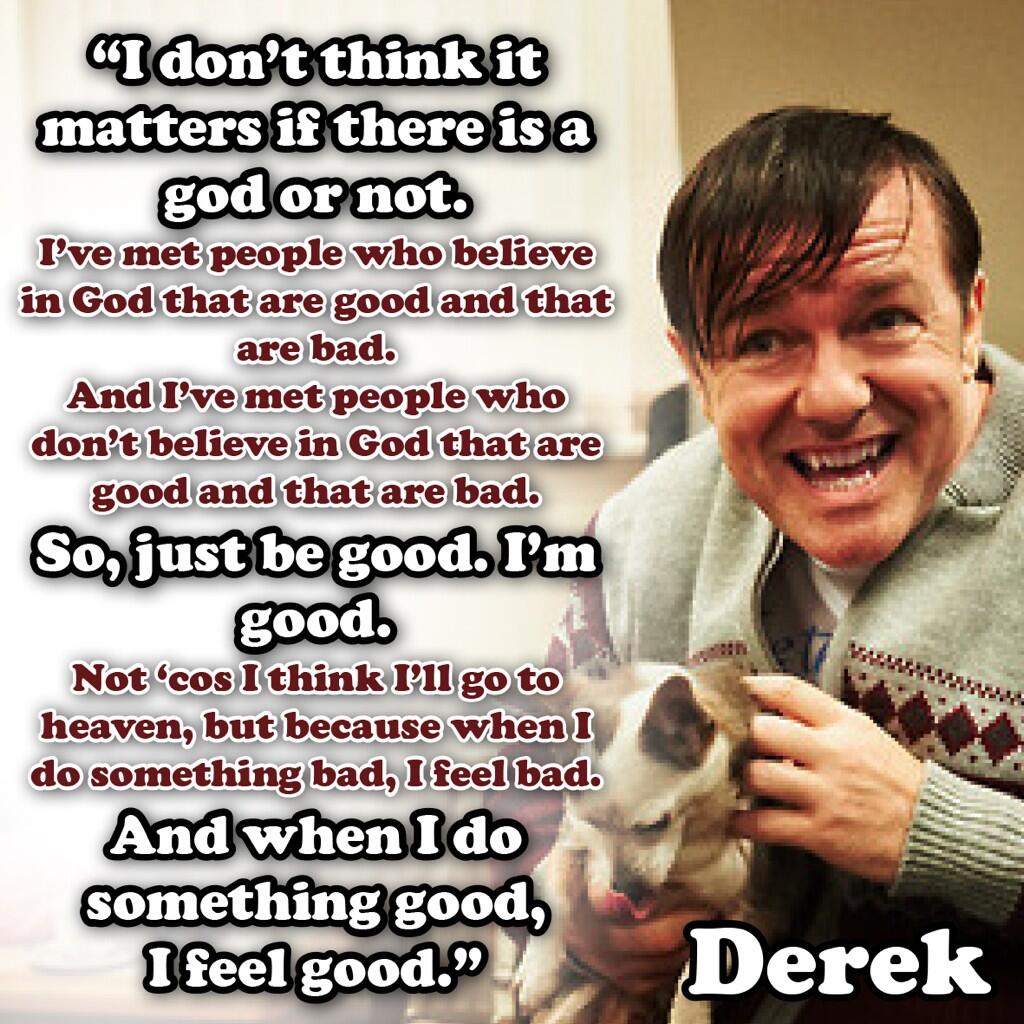
Derek was a British television series starring Ricky Gervais.
Derek says to be good, and I agree. How does one do that? By what standard does he measure his goodness?

Some New Atheists will rely on convoluted arguments to try to prove that man can have absolute morality (right and wrong) without an absolute source (God). One might suspect that the argument behind this meme is not quite so complicated. Ricky Gervais, whose character Derek gives us the sage advice to “just be good,” seems to be like so many average people who are de facto atheists; they say they don’t believe in an absolute system of right and wrong, but live as though they do. This standard of “good” which Derek calls his fellow man to live up to is supposed to be understood by all people. Indeed, I believe it is understood by all people; I simply disagree with the New Atheists regarding the reason why that is the case.

This is one of the problems with New Atheism that people don’t seem to want to acknowledge: We are supposed to accept the conflicting ideas that 1) there is no absolute truth or morality, decreed by God and built into mankind, and 2) everyone automatically knows what “good” is. For all the talk of the irresolvable paradoxes of Christianity, this problem of morality is significant for the New Atheists. If there is no absolute standard by which to judge morality, then all morality must be relative to the culture out of which it arises. Even if there are similarities between cultures, one cannot claim that there is an absolute standard. How, then, can one say that a given thought, word, or deed is good inter-culturally? How can one society apply its standard of “good” to another society, absent a universal standard? At least the Christian points to God, and says that He ultimately understands the religious paradoxes, if we cannot.

Or, looked at another way, how can we judge any given thought, word, or deed as “bad” if there is no absolute standard of morality? New Atheists like to point this out to Christians who condemn sin and call people to repentance and faith in Jesus Christ for the forgiveness of those sins; the point applies equally to them. And, contrary to how it may seem based on the circulation of internet memes, the New Atheists condemn quite a lot as bad. Christianity, for starters. Richard Dawkins believes it is child abuse to teach children the Christian faith;[1] so did the late Christopher Hitchens. In fact, they despise all religion as evil. This includes Islam.

Their hatred of religion made for some strange bedfellows during the war on terror. After the September 11th terrorist attacks on the World Trade Center some leftist atheists, like Christopher Hitchens, supported aggressive war against Muslims in Afghanistan and Iraq alongside the likes of, well, me. This was because terrorism is bad. The oppression, abuse, and subjugation of women is bad. Murdering political and religious minorities is bad. Oppressing and murdering homosexuals is bad. All these things are bad according to the New Atheists, and I agree. I must again, however, ask the question: by what standard? Clearly, the Islamic terrorists don’t think those things are bad. Why is their standard different? Where did it come from? Do they not have the innate sense of right and wrong, good and evil, which all men are supposed to have? Absent a universal standard of right and wrong, what makes them evil?

The Christian has an answer: the God who created the universe has set an immutable standard of right and wrong for mankind and expects us to keep it. We cannot. In fact, we ignore and suppress it. We turn away from God and His moral standard. We fail to keep it. And, when we do not keep it, that is called sin. And, because we cannot keep this moral standard perfectly, He took on human flesh in the person of Jesus of Nazareth, so that He could destroy sin, its inevitable result – death, and the one who brought it into the world – the devil, once and for all. He accomplished this by the death, resurrection, and ascension of Jesus Christ. He did it by living up to the standard, and dying as the sacrifice for sin on man’s behalf. Then, after dying on the cross, He rose up from the dead. We benefit from this sacrifice when we are brought to penitent faith in Christ for the forgiveness of our sins, by the power of the Holy Spirit, through the means of God’s Word and Sacraments. That is our explanation. What is theirs?

Their explanation for morality seems to be that morality has developed in man’s psyche as a product of evolution. The late Christopher Hitchens said:

I think our knowledge of right and wrong is innate in us. Religion gets its morality from humans. We know that we can’t get along if we permit perjury, theft, murder, rape. All societies at all times, well before the advent of monarchies have forbidden it. Socrates called it his daemon; it was his inner voice that stopped him when he was trying to take advantage of someone… Why don’t we just assume that we do have some internal compass?[2]

This view is almost comically simplistic. We just all should know what good is, because good comes from inside man. I see much evidence in man’s history that, far from being innately good, man is innately evil. Mr. Hitchens sets up this straw man: religion teaches that men only do good things, return lost property, give blood transfusion, etc., because they fear divine punishment and, if they didn’t have that threat hanging over them, they would act like the worst psychopathic criminal.[3] Perhaps other religions teach this idea; Christianity does not. In fact, Christianity teaches that, outwardly, and because of the conscience, men can and do live outwardly good and decent lives. Men can choose not to steal, rape, or murder their fellows, but this civil righteousness does nothing to justify a man before God. The Book of Concord has this to say on the issue:

Our churches teach that a person’s will has some freedom to choose civil righteousness and do things subject to reason. It has no power, without the Holy Spirit, to work the righteousness of God, that is spiritual righteousness… This is what Augustine says in his Hypogonosticon, Book III: We grant that all people have a free will. It is free as far as it has the judgment of reason…It is free only in works of this life, whether good or evil. Good I call those works that spring from the good in nature, such as [sic] willing to labor in the field, to eat and drink, to have a friend, to clothe oneself… For all of these things depend on the providence of God. They are from Hm and exist through Him. Works that are willing to worship an idol, to commit murder, and so forth, I call evil… Although nature is able in a certain way to do the outward work (for it is able to keep the hands from theft and murder), yet it cannot produce the inward motions, such as the fear of God, trust in God, chastity, patience, and so on.[4]

Christianity also teaches that this innate morality is objective and immutable, created by God. It is perfect, and requires perfection. And, no matter how many good deeds one may do, no matter how “good” a person may be in the eyes of the society, it is impossible to keep this moral standard perfectly, as God requires. Our relationship with God, therefore, must be repaired in some other way than by being good, or doing good deeds. On the contrary, our relationship with God is repaired by the death and resurrection of Jesus, who died as the propitiation for the sins of the world; and we receive those gifts of forgiveness and life eternal through the gift of faith, which God creates in us through the means of His word.

I see man, when left to determine what is right and wrong for himself, holding his neighbor to a separate, higher standard than the one to which he holds himself. This phenomenon manifests itself from the individual level to the societal level. The Godless [sic] principle that the strongest is always right has been openly declared as recently as the twentieth century in Mussolini’s Italy and operated in practice in Hitler’s Germany, Stalin’s Soviet Union, and many other states.[5] The evidence shows us that, unless man’s moral code is instituted by an authority higher than himself, he will, when it is advantageous to himself or his societal group, alter it. The unregenerate individual says to himself: it might be wrong when other people perjure themselves, steal, murder, or commit rape, but when I did those things, I had a good reason, and am therefore justified. Man can always reason out why their bad deed was not bad, but his neighbor’s was. Christopher’s brother Peter Hitchens, makes this point:

Left to themselves, human beings can in a matter of minutes justify the incineration of populated cities, the mass deportation – accompanied by slaughter, disease, and starvation – of inconvenient people, and the mass murder of the unborn. I have heard people who believe themselves to be good defend all these things and convince themselves as well as others. Quite often the same people will condemn similar actions committed by different countries, often with great vigor.[6]

You see, morality cannot be absolute and relative at the same time. We cannot say that the sense of good and evil it is innate in all of humanity, and at the same time, say there is no absolute source of that morality other than ourselves. If all morality is relative to the individual and to the individual’s culture, and there is no absolute standard for it set by God, the only way to determine right and wrong, good and bad, is ultimately by the sword. Might makes right, as they say. And why shouldn’t it? Why shouldn’t the unarmed give way to the lightly armed, and the lightly armed give way to the heavily armed?[7] Should not all societies, from the primitive to the advanced, decide for themselves what is right and what is wrong? Should not every individual decide for themselves their own religious beliefs (which is just another way of saying the same thing as morality)? This all sounds high minded and enlightened until you put it into practice. If what was just described was actually the type of world in which we lived, on what basis can one group of people condemn another group of people for, well, anything?

We look back at the Nazis and their systematic, state run genocide of the Jews and call it horrible. It was horrible. But on what basis can we condemn Nazi genocide of the Jews if there is no absolute truth that, “Thou shalt not kill”?[8] There is none. You may appeal to the innate sense inside of man that it is wrong to murder all you like; the Nazis would not call what they were doing murder. The only alternative that remains is that their actions were no better or worse than any other actions; we were simply stronger than they, and wanted to end their social, economic, and cultural system because it conflicted with our own, and so we did.

But it is wrong to murder people, especially on account of their race! Why? Says who?

Our culture takes a dim view of killing a person, generally speaking, unless one has a reasonable belief that one is in imminent danger of receiving great bodily harm, or death from them. In Nazi Germany, Jews were considered to be sub-humans, and therefore exempt from “normal” moral considerations. To turn a Jew in to the state, and thus mark him for persecution and death, was, in that society, to do a good work. But who are we to judge the society that has a different view of this matter? The National Socialists (Nazis) were quite deliberate in creating their society and culture, all based on the philosophical beliefs of Adolf Hitler. Are those beliefs, and the resulting consequences, not just as valid as our society’s contention that all men are created equal and endowed by their creator with inalienable rights? If you say they are not equally valid, you must answer why, and relative morality does not help your case. If you say they are equally valid, you are ignoring that impulse inside of mankind that does tell us that murdering another human being is wrong, and that we should do unto others as we would have others do unto us. It isn’t so much that religion gets it’s morality from man, as Christopher Hitchens contends; rather, the New Atheism, living as it does in the afterglow of the western Christian society, benefits from the fact that Judeo-Christian morality has served as the foundation for western society and culture and remains, for the time being, dominant and familiar to the vast majority of people.

In the afterglow of western Christian society, Peter Hitchens writes, where God’s moral standard served as the basis, it is convenient for the New Atheists to speak of an innate morality, which has its origins in man through evolutionary processes.[9] Morality is indeed imprinted on the heart of man. It is there because God put it there. It is His law, or at least a shadow of it; it convicts us of our sin when we transgress it, but it has no power to help us live up to its rigorous, unalterable standards. If we, as the New Atheists do, usurp God’s place as lawgiver, we become the one who sets the standard, if only in our own deluded mind. And, if we set the standard, we can change the standard. We can set the bar just high enough that it looks rigorous to other men. We can set the standard to define our behavior as good, and change it when we deem it expedient. We can do nothing, however, to hide our deficiency in living up to God’s moral standard from He, who is the true and only judge between right and wrong. We can only repent of our sins, because God has appointed a day on which He will judge the world in righteousness by the Man whom He has ordained. He has given assurance of this to all by raising Him from the dead.[10]


[1] Hitchens, Peter. 2010. The Rage against God: How Atheism Led Me to Faith. Grand Rapids, MI: Zondervan.
[2] “Christopher Hitchens: The Morals of an Atheist.” 2007. Broadcast. Uncommon Knowledge. PBS. https://youtu.be/b6DW0e70DF0.
[3] “Christopher Hitchens: The Morals of an Atheist.” 2007. Broadcast. Uncommon Knowledge. PBS. https://youtu.be/b6DW0e70DF0.
[4] McCain, Paul Timothy., et. al., eds. 2005. Concordia: the Lutheran Confessions: a Readers Edition of the Book of Concord. St. Louis, MO: Concordia Pub. House. AC XCIII 1-9
[5] Hitchens, Peter. 2010. The Rage against God: How Atheism Led Me to Faith. Grand Rapids, MI: Zondervan. p. 145.
[6] Hitchens, Peter. 2010. The Rage against God: How Atheism Led Me to Faith. Grand Rapids, MI: Zondervan. p. 141-142.
[7] Hitchens, Peter. 2010. The Rage against God: How Atheism Led Me to Faith. Grand Rapids, MI: Zondervan.
[8] In the Fifth Commandment, thou shalt not kill, God forbids us to take the life of another person, or our own life. This includes murder, abortion, euthanasia, and suicide.
[9] Hitchens, Peter. 2010. The Rage against God: How Atheism Led Me to Faith. Grand Rapids, MI: Zondervan.
[10] Acts 17:31-32

Friday, October 4, 2013

The Law of Love Toward the Enemy - II

Two police recruits run through
a felony traffic stop scenario at PTI.
“You have heard that it was said, ‘You shall love your neighbor and hate your enemy.’ But I say to you, Love your enemies and pray for those who persecute you, so that you may be sons of your Father who is in heaven. For he makes his sun rise on the evil and on the good, and sends rain on the just and on the unjust” (Matthew 5:43-45).

The Pharisees grew out of the movement for independence during and after the time of the Maccabean revolt. Their faction of Judaism arose out of a reaction against Hellenism (Packer & Tenney, 1980). The Pharisees wanted to protect the Jewish culture from Greek influence. They were also profoundly concerned with rightly keeping Gods law. In an effort to be sure that they did not transgress Gods law, the Pharisees superimposed a network of regulations over the top of Gods law. The idea was that, if Gods law commanded not to take the name of The Lord your God in vain, we will teach that you just can't say Gods name. After all, if you don't say Gods name, it should be pretty hard take it in vain, right? Besides, what does it mean to take Gods name in vain anyway? Better to be on the safe side and just not say it. 

In this manner did the Pharisees build a "protective hedge" around Gods law. They told themselves that they were doing it to protect Gods commandments. In reality, they were building not a hedge to protect the law, but a wall which separated them from, and thus nullified, the law. This is the same reason that we do it - so that we are not confronted with just how inadequate we are when measured according to Gods standard. 

See, St. Paul explains that the whole point of Gods law is to show us our sin. When we look into that mirror of Gods law and see how ugly we look, it isn't easy to accept. This is just as true for us as it was for the Pharisees. Rather than building a hedge of protection around the law, they were actually replacing Gods law with man-made commandments which would a) look impressive to other men and cause them to appear "godly", and b) give them rules that they would actually be able to keep. One of the problems with this plan, though, is that the laws we construct out of our own mind bear little, if any, resemblance to the kinds of things God constructs out of His mind. 

In this last section of the Sermon on the Mount Jesus addresses one of our favorite bricks that we use in constructing our wall to trap Gods law: Love for our neighbor. Jesus begins by quoting scripture. The passage he cites comes from Leviticus:

You shall not hate your brother in your heart, but you shall reason frankly with your neighbor, lest you incur sin because of him. You shall not take vengeance or bear a grudge against the sons of your own people, but you shall love your neighbor as yourself: I am the LORD (Leviticus 19:17-18).

Right off the bat we run into one of Pharisaical bricks in the wall. The "love your neighbor" part of that sentence is part of scripture; the "hate your enemy" clause was a teaching added by the Pharisees. Kretzmann explains:

The first injunction is found in the Law, Lev. 19, 18. The second part of the sentence is an addition made by the rabbis. They understood the word "neighbor" of the members of their own nation only, arguing from the many passages of the Law in which God had commanded the children of Israel to destroy the heathen nations. But in all those instances the children of Israel were merely carrying out God's penal justice. Their argument would therefore not stand, especially in view of Ex. 22, 21; 23, 9; Lev. 19, 33; Deut. 10, 18. 19; 24, 17; 27, 19. Jesus insists that all hatred is contrary to humaneness, opposed to the spirit which He was striving to foster (Kretzmann, 1921).

The problem is that we’re really good at hatred. Not only that, it feels really good when we are immersed in it. We love giving people “a piece of our mind”, or confronting that person who has done something – whether perceived or real – to hurt or offend us. Heck, we even love telling other people, those whom we “love”, all of the hateful things our enemies have done to us behind our enemies’ back. We can totally relate to what the Pharisees were getting at when they taught, “hate your enemy.” This is our default setting. We automatically feel this way. It feels natural and right to be nice to the people who are nice to us and hate the people who treat us badly. A Pharisee from Jesus’ day might even argue that, though it is not explicitly stated, the injunction to hate one’s enemies is implied. Unfortunately, this is not the case. Even the secular world understands that these instinctual reactions must, in certain circumstances, be trained out of us.

The University of Illinois Police Training Institute was established in 1955. PTI is one of the largest and longest-serving police academies in the United States (Police Training Institute). Thousands of police officers and correctional officers have received their training from retired and active law enforcement officers at PTI since its inception. In addition to the classroom work, the physical training, the self-defense training, and the weapons training, one of the most important things to which police recruits are subjected is practical, or scenario-based training. This is where recruits are dressed up in their uniforms, given a scenario, and expected to apply all the things that they have learned to bring the scenario to the appropriate conclusion. As everyone must surely know, practical application of theory never goes as smoothly as expected, especially the first time it is applied to a real-world situation.

It is for this reason that police recruits at PTI are subjected to mock traffic stops and mock 911 calls. The instructors and role-players with whom the recruits interact attempt to recreate as closely as possible the real-world situations in which the recruits will soon find themselves. These scenarios range from the mock stolen bicycle report, to the mock active school shooter situation, complete with projectile-firing weapons. Before entering the scenarios, however, instructors attempt to instill in their students one maxim above all others – If it feels good, don’t say it. You see, the role players are instructed to take their cues throughout the scenario from the police recruit. This is to make tactically wise, safe, and legal behaviors habitual with the recruit. Consequently, if a recruit leaves himself vulnerable to attack, the role player is to exploit his advantage. It is easier, however, at least at the beginning, for a recruit to remember to protect their weapon from a potentially dangerous individual, than it is to remember to avoid getting into a shouting match with a belligerent motorist to whom he is giving a citation. It is a human’s natural reaction to argue with people, especially when we are right and they are wrong. There is so much we relish saying to them just in order to “get our digs in”. It makes us feel good. A police officer on the job, however, must act contrary to his instinct when it comes to this circumstance. If it feels good, he must not say it, but remain professional and courteous lest he escalate the situation. Some officers are more successful than others. Some Christians, are more successful at this than others as well.

Christians, being aware that we have a corrupt, sinful human nature, should all be a little wary of those things that “just feel right”. More often than not, those things that just seem right and feel natural to our flesh are contrary to the spirit of Christ living inside us, if indeed we are regenerate men. When you think about it, it is easy to see how mankind could twist God’s word that tells us to love our neighbors into an excuse to hate. 

For if you love those who love you, what reward do you have? Do not even the tax collectors do the same? And if you greet only your brothers, what more are you doing than others? Do not even the Gentiles do the same? You therefore must be perfect, as your heavenly Father is perfect (Matthew 5:46—48).

Jesus knocks down the man-made wall surrounding God’s word and reveals it to us. He tells us to love our enemies and to pray for those who persecute us; since we are his sons, we should take after our father. He tells us that God our heavenly father, in his gracious providence cares for evil people as well as good people, and that this attitude of loving only those who love you in return is a product of our sinful nature, since this is how even the hated tax collectors and Gentiles act. He commands us to be perfect.

That is, however, only part of the lesson. We know that we can’t be perfect. Jesus isn’t giving us a goal to meet so that, if we meet it, we will be “good” and therefore right with God. Quite to the contrary, he is using the law to show us our sin. He is showing us that the perfection required of us by God is impossible for us to reach. He is calling us to repent of our sin. As Martin Luther wrote regarding this, “At this point you will discover how hard it is to do the good works God commands...You will find out that you will be occupied with the practice of this work for the rest of your life” (Engelbrecht, 2009). You will also find, to finish Dr. Luther’s thought, that it is an impossible task.

We try, like the Pharisees, to set up our own moral codes to live by that we think we can keep. In the end we don’t even live up to them, so we have to keep changing our morals to fit our lives. If we do well by our own standards we pat ourselves on the back; when we fail, we console ourselves with the lie that, as long as we do the best we can, God will be happy with us. The words of Jesus, however, remain – You therefore must be perfect, as your heavenly Father is perfect.

So here we are. God commands us to love our fellow man, “friend” and “enemy” alike. We fail. We are guilty of sin, guilty of missing God’s mark, and no amount of perceived good works we do will make up for that fact. Nothing we do can offset that. We are told to feed our enemies when they are hungry and to give them drink when they are thirsty but we do not[1]. We are told to forgive those who sin against us but we do not[2]. We are told to be kind and compassionate to each other and to forgive each other, just as we have been forgiven by God through Christ but we do not[3]. No subtle rewriting of God’s word will hide our sin or assuage our guilty consciences for, if we have spent any time looking into our hearts, we know that what God’s word says of us is true. We are conceived in iniquity and born in sin[4]; the thoughts of our hearts are evil from our youth[5]; our hearts are filled with evil thoughts, murder, adultery, sexual immorality, theft, false witness, slander[6].

Left here, we would fall into despair, and rightly so. We certainly do not deserve any of God’s gifts, especially forgiveness for these sins of thought, word, and deed. Thankfully for mankind, God does not think or operate like we do. While we are sinners, God has called us to repentance and faith in Jesus through His holy word. In the Law God shows us who we are, sin and all, and we see His wrath. In the Gospel God shows us what he has done, and continues to do, for our salvation (Luther, 1991).

This is the message we have heard from him and proclaim to you, that God is light, and in him is no darkness at all. If we say we have fellowship with him while we walk in darkness, we lie and do not practice the truth. But if we walk in the light, as he is in the light, we have fellowship with one another, and the blood of Jesus his Son cleanses us from all sin. If we say we have no sin, we deceive ourselves, and the truth is not in us. If we confess our sins, he is faithful and just to forgive us our sins and to cleanse us from all unrighteousness. If we say we have not sinned, we make him a liar, and his word is not in us (1 John 1:5-10). 

Because God the Father loves mankind he sent Jesus, his one and only Son, into the world to bear our sin and to be our savior. Jesus, God in human flesh, demonstrated for us the very thing he taught in the Sermon on the Mount by his willingness to be put to death on the cross. You see, we did not do anything “good” which attracted us to Jesus and compelled him to save us. He loved us, his enemies, while we were still wretched and condemned sinners. St. Paul writes in Romans:

For while we were still weak, at the right time Christ died for the ungodly. For one will scarcely die for a righteous person—though perhaps for a good person one would dare even to die— but God shows his love for us in that while we were still sinners, Christ died for us. Since, therefore, we have now been justified by his blood, much more shall we be saved by him from the wrath of God. For if while we were enemies we were reconciled to God by the death of his Son, much more, now that we are reconciled, shall we be saved by his life. More than that, we also rejoice in God through our Lord Jesus Christ, through whom we have now received reconciliation (Roman 5:6-11).

Christ went to the cross in our place. And, because he rose from the grave, we who trust in him will also rise. This is the attitude we are to strive for when dealing with our neighbors. And, because Christ has been victorious over sin, death and the devil, he enables us to do good works – including loving our neighbor – by the power of his Holy Spirit.


Works Cited

Engelbrecht, R. E. (Ed.). (2009). The Lutheran Study Bible. Saint Louis: Concordia Publishing House.

Kretzmann, P. E. (1921). Popular Commentary of the Bible: New Testament (Vol. 1). St. Louis, MO, USA: Concordia Publishing House.

Luther, M. (1991). Luther's Small Catechism. (C. P. House, Trans.) Saint Louis, Missouri, USA: Concordia Publishing House.

Packer, J. I., & Tenney, M. C. (Eds.). (1980). Illustrated Manners and Customs of the Bible. Nashville, TN, USA: Thomas Nelson Publishers.

Police Training Institute. (n.d.). Retrieved October 4, 2013, from Police Training Institute University of Illinois at Urbana-Champaign: http://www.pti.uiuc.edu/


End Notes

[1] Romans 12:20 
[2] Matthew 6:15 
[3] Ephesians 4:32 
[4] Psalm 51:5 
[5] Genesis 8:21 
[6] Matthew 15:19

Friday, August 30, 2013

The Happy Atheist...he has Issues (ETC)

Below is the text of a letter I wrote to Rev. Todd Wilken, host of Issues ETC, following the fascinating interview he conducted with P.Z. Myers, author of The Happy Atheist. To hear the interview, click on the link below. This is a great exposition of the doctrine of the "New" Atheism, in the words of one of their own:


08/29/2013

Dear Pastor Wilken,

I listened to your interview with the Happy Atheist today and am thankful that you took to time to interview him. The so-called "new" atheists have attempted to cover their hostility toward God with the veneer of reason, science, "reasonableness", glued in place with the bonding agent of elitism. I believe that your straightforward conversation with Dr. P.Z. Myers exposed that, and helped to illustrate that New Atheism is nothing new. It is the same hatred for God and defiant opposition to God's moral standard written on the very fabric of human kind that it has always been since man's fall into sin.

I realize that you had a limited time with Dr. Myer and to address specific issues would have had the potential to turn the interview into debate. That being said, a few points from the interview did stick in my mind, and I would have liked to have heard Dr. Myers' answers.

At the beginning of the interview Dr. Myers asserted that there is absolutely no historical basis for the New Testament documents. I'm sure that you had to bite your tongue to let that one go by, as we know from the very best and most recent scholarship that the New Testament documents are supremely reliable as historical record. As stated numerous times on Issues ETC, archaeology continues to support the validity of the New Testament accounts.

You asked Dr. Myers how he would react to all of the positive contributions to the world which seemed to have sprung from a Christian ethos, citing abolitionism, hospitals, orphanages, universal education, etc. Dr. Meyer said (I paraphrase) that it was a revision of history to talk about Christianity/religion as a force for good in history; He specifically attacked Christianity's role in the abolition movement and the position of slavery within the Christian worldview in general. He did not, however, answer the other examples you raised. I have seen Christian, Jewish, and Muslim hospitals, schools, and orphanages. I cannot recall seeing, or ever hearing of any such charity founded by a movement of secular humanism. I'm sure humanistic charities exist. They do not, however, exist as the norm of compassionate giving and human care and relief - they are the exception. Christian, and other religious charity, however, is the rule.

Dr. Meyer also stated, echoing the position of others within New Atheism, that there is no absolute moral authority. All morality is arbitrary, and to be based on "man's interaction with man" as man must live in community to survive. He conceded that different communities would come up with different community rules and standards, and that destructive "community moralities" (my own term) should be discouraged. Who is to determine what is destructive and what is constructive? Do opposing forces inside the community battle it out until one side or the other is dominant? The National Socialist worldview was considered constructive by those people who believed and implemented it. This worldview, justly implemented by a community of people (according to the argument made by Dr. Myers), is responsible for the destruction of millions of people considered to be sub-human, and a world war was fought to bring about it's end. Is Nazism simply wrong because the Allies were stronger than the Axis and won a war (ie a higher/stronger community standard)? Without some kind of absolute moral standard, what right did the Allied powers have to deem the Nazi's worldview as destructive and impose their own will instead. This seems to revert to the axiom, "Might Makes Right".

In the most ghastly segment about human rights and abortion, Dr. Myers stated that, "...personhood emerges gradually..." This view seems to echo that of Dr. Peter Singer, professor of Bioethics at Princeton who believes that right to life is tied to a beings capability to hold preferences, and that killing a newborn baby is not equivalent to killing a person because babies lack the essential characteristics of personhood. If "personhood" does indeed emerge gradually as Dr. Myers states: 1) Who determines when someone has achieved personhood, or when someone has lost the personhood they once possessed? 2) If a newborn baby is not immediately a person at birth (as Dr. Myers implied) but rather develops into a person at some indeterminate time during it's physical growth and cognitive development, what implications does this have for so-called women's rights? Would a mother have the right to "abort" her "non-person" newborn just as she had the right to abort her "non-person" fetus when it was in the womb? 3) Do human rights apply to human beings, or only to persons? If human rights apply only to "persons" then the application of those rights depend on whether or not that human being is a person. That determination is made according to the human beings size, level of development, environment, and/or degree of dependency and is essentially arbitrary, being totally subject to the "community", which could change its standard as it desired, unless some other "community" that developed was stronger and asserted its dominance.

Fortunately, the world does not function this way. God's law is written on our hearts. There is no one righteous, not one. What's more is that we know our state, and how helpless we are. Thanks be to God that he has provided redemption, pardon, and peace to us through the death and resurrection of his Son Jesus Christ. The Happy Atheist is nothing more than a real world example of what St. Paul writes about the depravity of unregenerate humanity in Romans:

"Furthermore, just as they did not think it worthwhile to retain the knowledge of God, so God gave them over to a depraved mind, so that they do what ought not to be done. They have become filled with every kind of wickedness, evil, greed and depravity. They are full of envy, murder, strife, deceit and malice. They are gossips, slanderers, God-haters, insolent, arrogant and boastful; they invent ways of doing evil; they disobey their parents; they have no understanding, no fidelity, no love, no mercy. Although they know God’s righteous decree that those who do such things deserve death, they not only continue to do these very things but also approve of those who practice them," (Romans 1:28-32).

Thank you for straightforwardly exposing Dr. Myers' beliefs and letting his words show the depravity of New Atheism. God bless you also for firmly confessing your faith to him toward the end of the program, and rightly proclaiming law and gospel to him as you did so.

God's Richest Blessings to You in Christ!
The Hodgkins Lutheran