Showing posts with label Lutherans. Show all posts

Saturday, June 27, 2015

Losing Faith and Falling Away

This is kind of an addendum to “Three Examples of How Lutherans Deny Justification by Faith Alone: A Response, Part Two of Two.” Here are a couple other verses I thought were good examples of how 1) conversion is entirely God’s work, 2) faith comes to us a gift from God through the Word, and 3) that faith can be lost by a person’s rejection. - THL

The apostles and the elders were gathered together to consider this matter [whether it was necessary for Gentile believers to keep the Law of Moses]. And after there had been much debate, Peter stood up and said to them, “Brothers, you know that in the early days God made a choice among you, that by my mouth the Gentiles should hear the word of the gospel and believe. And God, who knows the heart, bore witness to them, by giving them the Holy Spirit just as he did to us, and he made no distinction between us and them, having cleansed their hearts by faith. Now, therefore, why are you putting God to the test by placing a yoke on the neck of the disciples that neither our fathers nor we have been able to bear? But we believe that we will be saved through the grace of the Lord Jesus, just as they will” (Acts 15:6-11).

What do we learn from Peter’s address to the council? First, faith is created by means of the Gospel (v. 7). Second, the Holy Spirit is, “given by God,” working when and where He will, not according to the will of man (v. 8). Third, Peter says that God cleansed the hearts of the Gentile believers by faith, showing that faith is a gift from God (v. 9), rather than through works of the law (or by any other work, including “deciding” to believe by reason), which is impossible to achieve (v. 10). Fourth, this faith is given out of his unmerited good disposition toward those on whom he bestows this gift – i.e. out of his grace – and everyone who is saved, is being saved this way (v. 11). Whew!

And you [the saints and faithful brothers in Christ at Colossae], who once were alienated and hostile in mind, doing evil deeds, he has now reconciled in his body of flesh by his death, in order to present you holy and blameless and above reproach before him, if indeed you continue in the faith, stable and steadfast, not shifting from the hope of the gospel that you heard, which has been proclaimed in all creation under heaven, and of which I, Paul, became a minister (Colossians 1:21-23).

This one is pretty self-explanatory. Paul is writing to believers at Colossae. He tells these people, whom he counts as believers, that they have been reconciled in Christ’s body of flesh by his death, “…if indeed [they] continue in the faith…” He continues on, warning them not to shift from the hope of the gospel of which he was a minister, because if they shift from that hope, if they do not remain stable and steadfast in that hope, they will no longer be reconciled. They will go back to being alienated and hostile in mind, doing evil deeds. They will no longer be able to be presented as holy and blameless and above reproach before Christ because they will have no faith. They will have fallen away. Faith in Christ must continue, just as it began – by hearing the Gospel[1].


[1] Engelbrecht, Rev. Edward A., ed. The Lutheran Study Bible. Saint Louis: Concordia Publishing House, 2009. 

Saturday, June 13, 2015

Three Examples of How Lutherans Deny Justification by Faith Alone: A Response – Part One of Two

Rev. Dr. Robert Preus
This blog article, “How Lutherans Implicitly Deny Faith Alone in Christ Alone,” showed up in my Facebook news feed a couple days ago. I usually allow things like this to drift past without a second glance. This one, however, I thought merited a response because the author – whether intentionally or not – seems to be presenting a bastardized version of confessional Lutheran theology. I have no idea what “Free Grace Theology” is. I am merely a layman with no formal theological training. I have simply extracted the author’s three points and attempted to answer them from the confessional Lutheran point of view. The first two points regarding baptism are dealt with below. The third, how Lutherans deny justification by faith alone by teaching that a believer can lose their salvation will be dealt with in a separate article.

The photo of Robert Preus has been included, as the author of the offending article used it, and that irritated me. - THL

Unfortunately, unlike Free Grace theology, the Lutheran tradition has not kept to faith alone in Christ alone, despite their stated intention. Indeed, I believe the Lutheran tradition has adopted a number of doctrines in direct opposition to justification/eternal life by faith in Christ apart from works. Let me give three examples:

1) Infant baptism: The fact that Lutherans baptize infants denies justification by faith alone. Infants cannot believe and yet Lutherans claim they are justified in the act of water baptism. By baptizing people who do not have faith, the Lutheran churches effectively teach that justification is apart from faith, not by it. Some Lutherans will respond by saying that infants can believe and be justified by faith apart from works, and so are the proper subjects of baptism. If so, that leads to an obvious problem. If infants can believe, they can also disbelieve. How can you tell the difference between believing infants and non-believing infants? How can you tell a difference between infants who believe in justification by faith alone and those who believe in salvation by works? You can’t. Indeed, the whole idea is quite silly, and yet that very argument is often made by Lutherans. I have heard a Lutheran dismiss the problem as being “rationalistic,” whatever that means. In reply, it seems like special pleading of the worst kind to insist that infants can believe, but deny that we would be able to tell whether they do or not.

If Lutherans held consistently to justification by faith in Christ alone, they would not baptize infants. They would only baptize believers (however old they may be).


Response

Let’s forget for a second that infants are included in the phrase “all nations[1].” Let’s set aside for the moment that St. Peter explains that a) baptism now saves you[2] and b) is for you and for your children and all those who are far off[3]. Let’s even ignore for the moment that St. Paul equates baptism with circumcision by calling it a circumcision of the heart[4] not made by hands[5], and circumcision was mandated for infants eight days old (all those things will be dealt with in greater detail later)[6]. Leaving all that aside, let’s focus our attention on the idea that infants can’t believe. Such an idea is totally, completely, and utterly true. Infants cannot believe…and neither can adults. We are all, by nature, objects of God’s wrath. In fact, let’s take a look at St. Paul’s letter to the Ephesians. No one can explain it better than him.

And you were dead in the trespasses and sins in which you once walked, following the course of this world, following the prince of the power of the air, the spirit that is now at work in the sons of disobedience— among whom we all once lived in the passions of our flesh, carrying out the desires of the body and the mind, and were by nature children of wrath, like the rest of mankind. But God, being rich in mercy, because of the great love with which he loved us, even when we were dead in our trespasses, made us alive together with Christ—by grace you have been saved— and raised us up with him and seated us with him in the heavenly places in Christ Jesus, so that in the coming ages he might show the immeasurable riches of his grace in kindness toward us in Christ Jesus. For by grace you have been saved through faith. And this is not your own doing; it is the gift of God, not a result of works, so that no one may boast. For we are his workmanship, created in Christ Jesus for good works, which God prepared beforehand, that we should walk in them (Ephesians 2:1-10).

The message of the cross is foolishness to those who are perishing[7], the sinful mind is hostile to God[8], and we all – every single human being since The Fall – have been born dead in trespass and sin. We were all born with a mind hostile to God, and with a heart inclined to evil[9]. Left on our own to make a decision using our reason, whether or not to put our trust in Jesus, we would all choose “not Jesus” every time.

The analogy of a dead body is often used, but for good reason: Just as a corpse has no power to raise itself to life, so the spiritually dead person has no power to raise themselves to spiritual life, as St. Paul explicitly says in Ephesians 2. It is the Holy Spirit who calls people by the Gospel when and where he wills. And we know, from Christ’s institution of the Lord’s Supper and from what is normally known as “The Great Commission” – not to mention the rest of Holy Scripture – that God works through means. Christ has specifically commanded his Apostles to make disciples of all nations, baptizing them…and teaching them to observe all that he has commanded. So, it doesn’t matter if an unregenerate person is nine seconds old, nine days old, nine years old, or nine decades old because, as St. Paul writes, no one can say Jesus is Lord except by the Holy Spirit[10]. That faith by which they are saved comes from God as a gift through the Word. So, to be accurate, man is saved sola gratia, sola fide – by grace, through faith. That Word – God’s promised redemption – comes to an adult through preaching, or reading; that same word comes to an infant through the sacrament of Holy Baptism, which leads to the next point of contention.

2) Baptismal regeneration: Paul chastised the Galatians for thinking that circumcision was necessary for our salvation. And yet Lutherans insist that we must be baptized in order to be saved. Water baptism was as much a work of the Law as circumcision (Lev 16:23-24). How can Lutherans teach that making circumcision a condition of salvation is legalism but making baptism a condition of salvation is not? Some Lutherans will respond that baptism is not a work like circumcision, but the Gospel promise put into visible form. It is a work that God does to us, not something that we do for God. But this same reasoning could also apply to circumcision. Infant boys certainly don’t circumcise themselves. It is something done to them. And yet Paul denounced this practice as seeking to be justified by works of the law. What if the Galatians had said to Paul: “Paul, this isn’t legalism. It isn’t the boy’s work. This is God’s gift to the boy—a circumcised heart!” Apparently, Paul did not take that view. Adding any requirement to faith was a form of salvation by works, and another gospel.

If Lutherans held consistently to faith alone in Christ alone, they would not make baptism a condition of eternal salvation.


Response

The author of this article seems to be confused about the Lutheran position regarding baptism. He certainly doesn’t understand what St. Paul writes regarding baptism’s relationship to Old Testament circumcision. It isn’t a condition of eternal salvation in the way the author suggests. Baptism is the vehicle through which God’s promises are delivered. I guess baptism is a condition of eternal salvation in the same way that going through the front door is a condition of entering a house. You can try to crawl in through the mail slot, but the blessing is available by the means through which the homeowner has provided access. Baptism works the forgiveness of sins[11], rescues from death and the devil[12], and gives eternal salvation[13]. It is a washing of rebirth and renewal by the Holy Spirit.

Today in the United States circumcision is performed routinely in hospitals when a male child is born. The practice has little to do with religious faith, and is heavily debated between those who support the practice for medical and hygienic reasons, and those who decry the practice as mutilation and an infringement on individual liberty. The purpose of circumcision as instituted by God in the book of Genesis, however, was to be a mark of his covenant with Abraham. God had promised to send a savior to redeem mankind after The Fall, and he promised that savior would be the seed of Abraham. By the removal of the foreskin, males received a visible sign of this promise that God would send a Savior, born of a woman. No Hebrew male could live a day without being reminded of the promise God had made long before, and every conjugal act between a husband and wife would illustrate the hope that God was working to restore creation and redeem all people (Engelbrecht 2009). As a pledge, or sign, of the covenant, circumcision pointed to something greater than merely the act itself. The Word – the promise of God – not the mere removal of flesh from the body, was the chief thing in circumcision (Engelbrecht 2009).

St. Paul correlates baptism with Old Testament circumcision. As a covenant sign, circumcision physically established the covenant and pointed to what God was doing in order to redeem us to himself. In Christ, however, the purpose of the covenant with Abraham (i.e. to be a blessing to all the families of the earth) was fulfilled. The new covenant is established with a different kind of circumcision – baptism (Engelbrecht 2009).

As the Bible sees it, baptism is not primarily a sign of repentance and faith on the part of the baptized. It is not a sign of anything that we do at all. It is a covenant sign (like circumcision, but without blood-shedding), and therefore a sign of the work of God on our behalf which precedes and makes possible our own responsive movement (Harrison, Bromiley and Henry 1990).

Certainly, based on what the Bible tells us about the nature of circumcision, and St. Paul’s correlation of circumcision with baptism, one is certainly justified in concluding that there is a Biblical basis for baptizing infants. This rite was performed on infants eight days old. It would be odd to refer to Baptism as the “circumcision of Christ” if Baptism of infants was to be forbidden while circumcision was given almost exclusively to infants. However, this is by no means the only reasoning for infant baptism. Babies, even before they are born as evidenced in the case of John the Baptist, are capable of faith by the working of the Holy Spirit. The work of God’s Holy Spirit is not limited by age, or anything else. The Holy Spirit works when and where he wills.

For he [John the Baptist] will be great in the sight of the Lord; and he will drink no wine or liquor, and he will be filled with the Holy Spirit while yet in his mother's womb…When Elizabeth heard Mary's greeting, the baby leaped in her womb; and Elizabeth was filled with the Holy Spirit. And she cried out with a loud voice and said, 'Blessed are you among women, and blessed is the fruit of your womb! And how has it happened to me, that the mother of my Lord would come to me? For behold, when the sound of your greeting reached my ears, the baby leaped in my womb for joy'" (Luke 1: 15, 41-44).

Children clearly have a part in God’s kingdom, and are not merely some sort of amoral being until they reach a nebulous “age of accountability”. Being born in the flesh, children have a sinful human nature. Along with that corrupt nature comes the inclination and desire to flee from God, and they therefore need the forgiveness that Christ offers in baptism, just as an unregenerate adult does. Scripture tells us that all people are sinful from the time of their birth[14]. St. Paul tells us in Romans 3: 23-24 that all have sinned and fall short of the glory of God, and are justified freely by his grace through the redemption that came by Christ Jesus. Christ distributes this grace to us in the sacrament of baptism, by the working of the Holy Spirit, and makes it possible for us to respond to him, though feebly[15]. In this way baptism is not unlike the defibrillator used by paramedics on a person whose heart has stopped beating; such a person is technically dead, and is powerless to make themselves alive again. Someone – a paramedic – must do something to them without their help to get their heart beating again. St. Paul tells us that we are dead in our transgressions. Through baptism, God takes us who were dead in our transgressions, and makes us alive in Christ.

Additionally, there are several reports in scripture where people bring their children to Christ to have him touch and bless them. Jesus warns against the danger of offending against little ones that believe in him, and in the same context says that to be Christians we have not to become adults but to become as children (Harrison, Bromiley and Henry 1990).

One such passage is in the Gospel of St. Mark:

People were bringing little children to Jesus to have him touch them, but the disciples rebuked them. When Jesus saw this, he was indignant. He said to them, “Let the little children come to me, and do not hinder them, for the kingdom of God belongs to such as these. I tell you the truth, anyone who will not receive the kingdom of God like a little child will never enter it.” And he took the children in his arms, put his hands on them and blessed them (Mark 10: 13-16).

St. Luke also writes:

People were also bringing babies to Jesus to have him touch them (Luke 18:15).

On the contrary, there is a long tradition in the church of baptizing children, derived from Scripture, dating back to apostolic times. Infant Baptism was common practice in the early church. Scripture lends support to this when it reports that the Apostles baptized entire families – some of which, at least, would normally include children. When entire families, and all indeed who belonged to them were baptized, it is probable that if there were a number of children in these families, the Apostles did not exclude them. More importantly, the Apostles could refer Jesus’ command to “let the little children come to me,” and to the rite of circumcision from the Old Testament. The fathers of the early church certainly debated the subject of infant baptism. However, the volume of writings in favor of infant baptism far outweighs those in opposition to the practice, from the second century to the time of the Apostolic Constitutions:

He came to save all persons by means of Himself – all, I say, who through Him are born again to God – infants, children, boys, youth, and old men[16]…Even to the greatest sinners and to those who have sinned much against God, when they subsequently believe, remission of sins is granted. Nobody is hindered from baptism and from grace. How much more should we shrink from hindering an infant. For he, being lately born, has not sinned – other than, in being born after the flesh according to Adam, he has contracted the contagion of the ancient death at its earliest birth. For this reason, he more easily approaches the reception of the forgiveness of sins. For to him are remitted – not his own sins – but the sins of another. Therefore, dearest brother, this was our opinion in council that no one should be hindered by us from baptism and from the grace of God[17]…Baptize your infants also and bring them up in the nurture and admonition of God. For He says, “Allow the little children to come unto me and do not forbid them[18],” (Bercot 2002).


Baptism is not just plain water, but it is the water included in God’s command and combined with God’s word (Concordia Publishing House 1991). Through baptism, God receives people into fellowship with himself. Babies are to be baptized because they are included in the Savior’s command to baptize all nations. And, like all of mankind, a baby is, by nature, an object of wrath, prior to regeneration through faith in Christ. Thanks be to God that he has provided for mankind this means of grace by which he works forgiveness of sins, rescues from death and the devil, and gives eternal salvation to all who believe this, as the words and promises of God declare.

Stay tuned for part two.


Works Cited

Bercot, David W., ed. A Dictionary of Early Christian Beliefs. Peabody, Massachusetts: Hendrickson Publishers, Inc., 2002.

Concordia Publishing House. Luther's Small Catechism. Translated by Concordia Publishing House. Saint Louis, Missouri: Concordia Publishing House, 1991.

Engelbrecht, Rev. Edward A., ed. The Lutheran Study Bible. Saint Louis: Concordia Publishing House, 2009.

Harrison, Everett F, Geoffrey W Bromiley, and Carl F Henry, . Wycliffe Dictionary of Theology. Peabody, Massachusetts: Hendrickson Publishers, Inc., 1990.


End Notes

[1] Matthew 28:18-20
[2] 1 Peter 3:21
[3] Acts 2:38-39
[4] Romans 2:29
[5] Colossians 2:11-14
[6] Genesis 17:12
[7] 1 Corinthians 1:18
[8] Romans 8:7
[9] Genesis 6:5; Psalm 51:5
[10] 1 Corinthians 12:3
[11] Acts 2:38; 22:16
[12] Romans 6:3-5
[13] 1 Peter 3:21
[14] Psalm 51:5
[15] Galatians 3:27; Colossians 1:13-14; 1 Corinthians 6:11
[16] Irenaeus (c. 180 E/W), 1.391
[17] Cyprian (c. 250, W), 5.354
[18] Apostolic Constitutions (compiled c. 390, E) 7.457

Thursday, April 25, 2013

Augustana

"Keep living as a man, as you certainly do, teaching the students to follow the right path. I will now offer myself as a sacrafice for you and for them, if that is God's will. In fact, I would rather die...than recant what I have said in truth..." Martin Luther, in a letter to Philipp Melanchthon on October 11, 1518.

There are two important events involving Martin Luther that took place in Augsburg. The first was that Luther was called to Augsburg in October 1518 to meet with Cardinal Thomas Cajetan and be interrogated about his teachings. This interview was followed by the 1530 Diet of Augsburg (the parliament of German Princes and Dukes), where the Augsburg Confession was presented to Emperor Charles V.

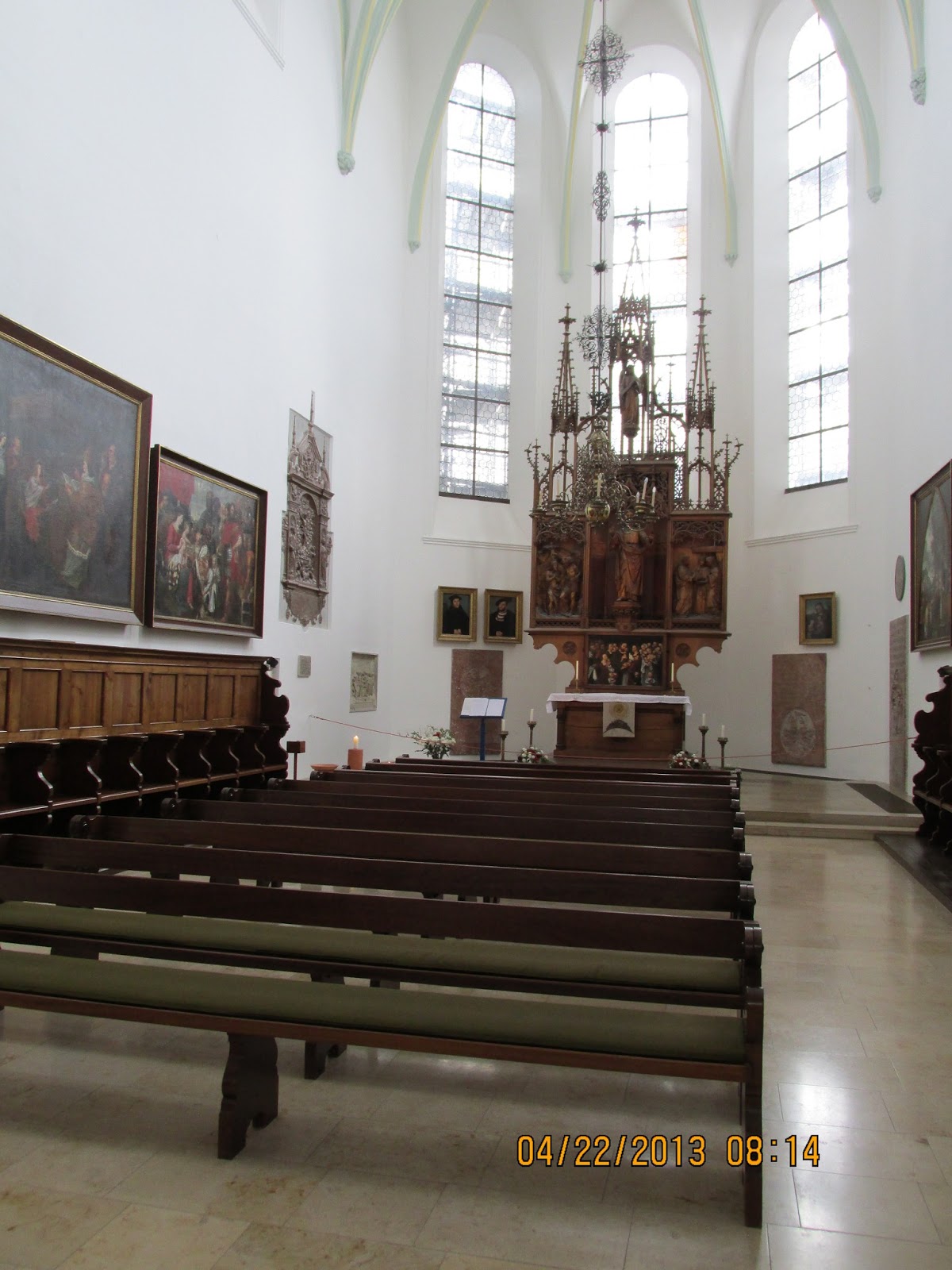
Inside the sanctuary
of St. Anne's.
When Luther came to Augsburg to meet with Cajetan, he resided at the cloister of St. Anne. The meeting was, in reality, a heresy trial where Luther was expected to recant his teaching before the papal legate. Luther was greeted as a hero in Augsburg and at St. Anne. As it became clear that Luther would not recant, Luther's friends and supporters became more concerned that he would be seized and taken to Rome. To avoid this, Luther's supporters smuggled him out of the city secretly.

Statue of Christ on the altar
raising his hands in blessing.
St Anne was built in 1321 by Carmelite monks. The Goldsmith's Chapel was added in 1420; the Fugger's Chapel in 1509. St. Anne's became an "Evangelical" (Lutheran) church in 1545. The spire was added in 1607 by Elias Holl. St. Anne's Church was intimately involved with the Thirty Years War (1618-48) and general religious turmoil of the 17th century. Evangelicals were twice barred from the church by those trying to restore Catholicism to the area (1629-32 and 1635-49); in the latter period, the congregation worshiped outside in the courtyard of St. Anne's College. The church was restored and redesigned in the Baroque and Rococo styles between 1747 and 1749.

In 1530, at the Diet of Augsburg, the Augsburg Confession - Confessio Augustana in Latin - was presented to Emperor Charles V. It was intentionally written to present a gentle, respectful, and peaceful response to the emperor. While intended to speak only for Saxony, as the various German princes read the document they began to subscribe to it as well. The Augsburg Confession was presented on June 25, 1530 as a statement of biblical truth and a proposal for true unity in the Christian faith. It has never been withdrawn.

The Hodgkins Lutheran
in Rathausplatz, Augsburg
with his Augsburg Confession.
The Augsburg Confession is the primary confession of faith of the Lutheran Church and one of the most important documents of the Lutheran Reformation. The Augsburg Confession was written in both German and Latin and was presented by a number of German rulers and free-cities at the Diet of Augsburg on June 25, 1530. The Holy Roman Emperor Charles V had called on the Princes and Free Territories in Germany to explain their religious convictions in an attempt to restore religious and political unity in the Holy Roman Empire and rally support against the Turkish invasion. It is the fourth document contained in the Lutheran Book of Concord.

A chest used to collect
money for indulgences. 
Central to the document and it's subsequent Apology is it's explanation of the Biblical doctrine of Justification. Confessional Lutherans teach forensic, or "legal", justification. This means that God declares the sinner to be "not guilty" (justified) because Christ has taken his place, living a perfect life according to God's law and suffering for his sins. For Confessional Lutherans justification is in no way dependent upon the thoughts, words, and deeds of those justified through faith alone in Christ. The new obedience that the justified sinner renders to God through sanctification follows justification as a consequence, but is not part of justification.

When a penny in the casket rings,
a soul from purgatory springs.
In 1999, St. Anne's Church was the site of the signing of the Joint Declaration on the Doctrine of Salvation by representatives of the Roman Catholic Church and the Lutheran World Federation, an effective rejection of the Augsburg Confession by the so-called Lutherans who signed it. This document states that, "a common understanding of our justification by God's grace through faith in Christ." This is flatly untrue. To the parties involved, this essentially resolves the conflict over the nature of justification which was at the root of the Protestant Reformation. Despite the claims of the Joint Declaration, however, very significant differences remain regarding how Confessional Lutherans (those who subscribe to a historial understanding of the Augsburg Confession and the Book of Concord) and Roman Catholics understand salvation, a fact that the Roman Catholic Church acknowledges.

Tuesday, June 12, 2012

I Believed, And So I Spoke


The Resurrection of Christ - Cranach

Since we have the same spirit of faith according to what has been written, “I believed, and so I spoke,” we also believe, and so we also speak, knowing that he who raised the Lord Jesus will raise us also with Jesus and bring us with you into his presence. For it is all for your sake, so that as grace extends to more and more people it may increase thanksgiving, to the glory of God. So we do not lose heart. Though our outer self is wasting away, our inner self is being renewed day by day. For this light momentary affliction is preparing for us an eternal weight of glory beyond all comparison, as we look not to the things that are seen but to the things that are unseen. For the things that are seen are transient, but the things that are unseen are eternal. For we know that if the tent that is our earthly home is destroyed, we have a building from God, a house not made with hands, eternal in the heavens (2 Corinthians 4:13 – 5:1).

You have seen Christian men and Christian churches so dispirited and discouraged that you knew at once that they could not hope for success at that rate. What a pity to work so hard for years in the kingdom of God and then to give up, just because we do not seem to be making much headway – possibly none at all. Humanly speaking, what would have become of that little band of Saxon immigrants in 1839 when their leader went wrong if Dr. C.F.W. Walther and his colleagues had given up in despair (Burgess, 1988)?

Dr. Walther, along with approximately 800 other German Lutherans left Saxony when they came to realize that they were not free to practice their Christian faith according to the Lutheran Confessions. This group of Christians found themselves increasingly at odds with the Saxon government at the time, which vigorously promoted rationalism and unionism among the Lutheran (Evangelical) and Reformed (Calvinist) churches in Saxony (Lutheran Church - Missouri Synod, 2012). Unwilling to compromise the Lutheran Confessions, this group set out to the United States in 1838. One of their ships was lost at sea; after an arduous voyage, the settlers landed in New Orleans, Louisiana. They made their way up the Mississippi River and settled in Perry County, Missouri. Soon after the immigrants were settled in the new homeland, their leader, Martin Stephan, was accused of financial and sexual misconduct and was expelled from the settlement (Concordia Historical Institute). This shook the community. The people were deeply disturbed. They were unsure whether or not they were a new church after having left the governing church authorities and church hierarchy in Germany, or if they were simply a branch of the old church in Germany. Dr. Walther eventually emerged as the leader of the community, and was able to persuade the people that they were indeed a new church body, separate from the church they left behind in the Old World (Concordia Historical Institute).

This letter was written to the church at Corinth; they seem to have been a congregation with plenty of their own troubles as well. Paul visited Corinth during his second missionary journey; he later wrote a letter to them, mentioned in 1 Corinthians 5:9, which has been lost to the ages. Paul then sent them what we today call 1 Corinthians, to which some scholars believe Paul may have referred to as the “painful letter” in 2 Corinthians 2:4 (Engelbrecht, et al., 2009). 2 Corinthians was written in approximately AD 55. The purpose of the entire letter was to show the Corinthian Christians that Paul’s work among them was truly Christ’s work (Engelbrecht, et al., 2009). He writes about the very real human problems congregations, both ancient and modern, face such as divisions, false apostles/teachers, human frailty, poverty of sin, generosity, suffering, and self-examination. He wrote directly to the Corinthians; he is, by virtue of the universality of his message, speaking to all Christians of all times. Paul quotes Psalm 116:10:

I believed, even when I spoke: “I am greatly afflicted” (Psalm 116:10).

He does so to explain his motivation for proclaiming the Gospel in the midst of suffering (Engelbrecht, et al., 2009). The psalmist writes that, even though he was greatly afflicted with terrible trials, he nevertheless believed and trusted in the Lord. St. Paul also seeks to encourage the reader to remain faithful to the Lord in the midst of trials, looking forward to the Lord’s redemption. This would be significant to the Corinthians, as they were a congregation in turmoil, and Paul has been shepherding them through their tumultuous times. They are also, as Paul writes earlier in chapter four, “jars of clay,” in which God has placed his treasure[1]. Paul wants the Corinthians, though frail, afflicted, persecuted, perplexed, and struck down, to continue speaking to the Gospel to everyone. As they continue to do so, God’s saving grace would naturally extend to more people. Such is the nature of evangelism[2]. As God’s kingdom grows, thanksgiving among his subjects would grow as well, and God would be glorified all the more among mankind.

…knowing that he who raised the Lord Jesus will raise us also with Jesus and bring us with you into his presence (2 Corinthians 4:14).

St. Paul gives the Corinthians the thing upon which they must always remain focused in verse 14 – the resurrection of Jesus. The “he” in that verse is clearly God the Father, as we are told elsewhere in the New Testament that God the Father raised Jesus from the dead[3]. This is not to be taken as some sort of evidence that Jesus is inferior to God the Father, or that he is not divine in his nature. Scripture also tells us that Jesus raised himself from the dead[4], and that Jesus was raised by the Spirit[5]. Jesus, Scripture teaches, has two natures – one human, and one divine. With respect to his human nature, Jesus was certainly subordinate to God the Father and, while he was on the earth, he had to rely on God the Father for everything. This is called Jesus being in the “state of humiliation” (Luther, 1991). The reason for this is not because Jesus was essentially less than divine. It is because he voluntarily emptied himself of his divine power and set it aside to take on human nature, in fulfillment of God the Father’s will[6]. When St. Paul speaks of the resurrection, he means the literal, bodily raising of Jesus, or another, from the dead. Paul uses lots of imagery in 2 Corinthians 4, but not where the resurrection is concerned. To Paul the literal bodily resurrection of Jesus is the most important aspect of the Christian faith[7].

Though our outer self is wasting away, our inner self is being renewed day by day. For this light momentary affliction is preparing for us an eternal weight of glory beyond all comparison, as we look not to the things that are seen but to the things that are unseen. For the things that are seen are transient, but the things that are unseen are eternal (2 Corinthians 4:16-18).

The Outer self is the physical person; the inner self is the spiritual person. The outer self experiences all of the wasting away that St. Paul describes in Chapter four because of the Fall and sin. When sin entered creation, God’s creation became totally corrupted. Sin entered God’s creation through one man, and death through sin[8]. Because the corruption of sin reaches the very nature of mankind, all people are subject to physical death. Our inner, or spiritual, self is revived by the power of God’s Holy Spirit working through his means – Word and Sacrament – as God has promised us (Luther, 1991). The Holy Spirit works a renewal of a believer’s whole life – in spirit, will, attitude, and desires[9]. This spiritual renewal manifests itself in a believer’s life as what Paul calls the fruits of the Spirit – love, joy, peace, patience, kindness, goodness, faithfulness, gentleness, and self-control[10].

What does St. Paul mean by the “light momentary affliction”, and how does that affliction prepare St. Paul’s readers for, “…an eternal weight of glory…”? He is writing about life. After sin entered the world and corrupted God’s creation, life got difficult. Man had to eat his bread by the sweat of his brow, woman had to endure pain in childbirth, our corrupt nature turned away from God and turned in toward ourselves. We became subject to sorrow, pain, and death. Paul tells us, however that this light, momentary affliction is not all that there is. Because we have been spiritually united with Christ in his resurrection through baptism, we will also be physically resurrected to eternal life, just as he was[11]. And, just as an athlete endures the pain of training so that he may bear the weight of the sport in which he competes, so we endure the affliction of a corrupt and sinful world, in anticipation of the weight of eternal glory with Christ.

Paul continues with his comparison of temporal and eternal things in verse 18. “The things that are seen” is the physical world; “the things that are unseen” is the spiritual world. The physical world is in a state of decay; the spiritual world is eternal. Paul is not a Christian Scientist; he is not saying that that humanity and the universe are spiritual rather than material (Christian Science, 2012). He does not deny that the physical world is real, as the Gnostics of his day did, and claim that it is evil, and only a projection, or shadow, of the true spiritual reality. The physical world is merely in a state of “passing away”. Even if St. Paul believed that the physical world was not real, and only the spiritual world was reality, he was reminded of the truth constantly. He could not simply project, or believe his way out of beatings, stoning, imprisonment, and ultimately, death.

For the things that are seen are transient, but the things that are unseen are eternal. For we know that if the tent that is our earthly home is destroyed, we have a building from God, a house not made with hands, eternal in the heavens (2 Corinthians 4:18 – 5:1).

Paul moves from talking about the general physical world to our individual physical bodies. Our corrupted physical body will eventually be destroyed by death. Paul refers to it as a tent, which is a temporary structure. When this happens, though, we know that, through faith in Christ, we have a building from God – a permanent structure – which will last forever. This building from God is the resurrected body promised to us by Christ, redeemed for eternity, restored and transformed by God himself (Engelbrecht, et al., 2009).

This is what we, as Christians, must focus on when times become tough for us. We may not be facing the same sort of obstacles that St. Paul and the Corinthian church faced in their everyday lives, such as violence and persecution. We do, however, face life as believing Christians in an increasingly secular world that is more hostile to the message of Christ crucified and risen every day. We may not be dealing with the trials of establishing and holding together a religious colony in a new country, trying to overcome all the obstacles that go along with such an undertaking. We are, however, a church made up of human beings, complete with sinful human natures; our human failings prove this to us, and those around us, daily. St. Paul instructs Christians to look beyond the momentary affliction to the eternal glory of salvation in Jesus (Engelbrecht, et al., 2009). We must fix our eyes on Jesus, the author and perfector of our faith. And, because we believe, we must also speak. We must speak to those around us who do not know the good news of what Jesus accomplished on the cross at Calvary. The goal of St. Paul’s ministry among the Corinthians was to reach more people with the Gospel. Our goal is the same. Our human failings, our afflictions, all those things that Satan uses to trouble and harass us, become temporary nuisances that will surely give way to the glory of life eternal with our Savior (Engelbrecht, et al., 2009).


Works Cited

Burgess, D. F. (1988). Encyclopedia of Sermon Illustrations. St. Louis, MO, USA: Concordia Publishing House.

Christian Science. (2012, June 12). Retrieved June 12, 2012, from Wikipedia: http://en.wikipedia.org/wiki/Christian_Science

Concordia Historical Institute. (n.d.). Concordia Historical Institute. Retrieved June 12, 2012, from C. F. W. Walther: http://www.lutheranhistory.org/collections/fa/m-0004.htm

Engelbrecht, E. A., Deterding, P. E., Ehlke, R. C., Joersz, J. C., Love, M. W., Mueller, S. P., et al. (Eds.). (2009). The Lutheran Study Bible. Saint Louis, Missouri, USA: Concordia Publishing House.

Luther, M. (1991). Kleine Katechismus, English. (C. P. House, Trans.) Saint Louis, Missouri, USA: Concordia Publishing House.

Lutheran Church - Missouri Synod. (2012, June 12). Retrieved June 12, 2012, from Wikipedia: http://en.wikipedia.org/wiki/Lutheran_Church%E2%80%93Missouri_Synod


End Notes

[1] 2 Corinthians 4:7
[2] Isaiah 55:11
[3] Romans 10:9
[4] John 2:19-21; 10:17-18
[5] Romans 8:11
[6] Philippians 2:5-11
[7] See 1 Corinthians 15. The resurrection of Christ is the subject for the entire 15th chapter of this book. St. Paul writes, “And if Christ has not been raised, then our preaching is in vain and your faith is in vain…And if Christ has not been raised, your faith is futile and you are still in you sins…If in Christ we have hope in this life only, we are of all people most to be pitied,” (1 Cor. 15:14, 17, 19).
[8] Romans 5:12-21
[9] Romans 8:9; 2 Corinthians 5:17
[10] Galatians 5:22-23
[11] Romans 6:3-4