Showing posts with label Bible. Show all posts

Thursday, May 16, 2024

What Do You Say Scripture Is?

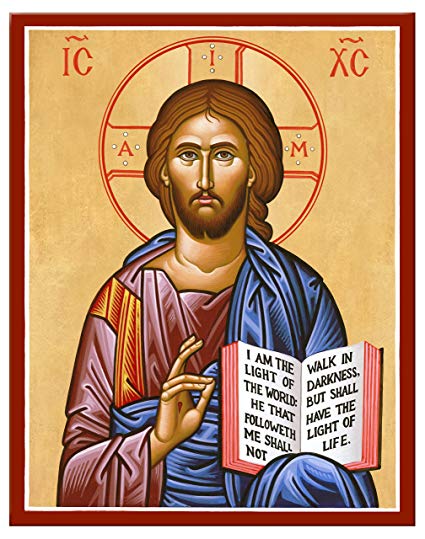
Icon of Jesus holding the Scriptures.

 I am astonished that you are so quickly deserting the one who called you by the grace of Christ and are turning to a different gospel – which is really no gospel at all. Evidently some people are throwing you into confusion and are trying to pervert the gospel of Christ. But even if we or an angel from heaven should preach a gospel other than the one we preached to you, let him be eternally condemned! As we have already said, so now I say again: If anybody is preaching to you a gospel other than what you accepted, let him be eternally condemned (Galatians 1:6-9).

All the arguments we have about Higher Criticism, about Gospel Reductionism, about Justification; they all have at their central point the same kernel: What is Scripture?

Either the Holy Scriptures are the divinely inspired and inerrant word of God, or they are corrupted. Either the Bible is the product of the omniscient God who created the universe, and spoke to mankind through men as He moved those men by His Holy Spirit, or it is just a collection of texts, created by men, out of which we might be able to extract some kind of significance if we do the right kind of mental gymnastics. Either the Holy Scriptures are the source of all Christian doctrine, and the norm for evaluating that doctrine, or they aren’t. And, if they aren’t, then the only source for doctrine is the devil and the human heart.

Those are our options, as I see it. It will do no good arguing about fine doctrinal points with someone who does not believe that the Bible is divinely inspired and inerrant. That person, even if he doesn't recognize or admit it, has no standard for doctrine. He may come up with anything he likes. The only limit to his creativity is his own intellect. Personally, that terrifies me. I think, however, that this is what is so attractive about modern theological and philosophical schools of thought. The higher critics abandoned the things that limited their thought, and they were free to search out what God really said in the human work of scripture. But that was the whole point of God giving scripture to us in the first place. It serves as an objective standard. It is supposed to be our limiting principle.

And I am at once suspicious of men who look at the word of God and ask the question, “Did God really say?”

But how do we know that scripture is divinely inspired and inerrant? Well, it tells us that it is. That isn't the simplistic argument that it seems. Scripture tells us that it is the product of God inspiring human writers to record His revelation to mankind. It records the movements of people groups; it describes wars and other events of human history. And we tend to find the archeological remnants of those people and their activities where the Bible tells us we will. Alas, secular scholars will dismiss what the Bible tells them about what they have found simply because the information comes from the Bible. But the archeological evidence, as Joel Kramer describes it, is like having five pieces of a 500 piece jigsaw puzzle. The only way to make any sense of those pieces is to look at the picture on the box. The Bible is, for us, that picture.[1]

Moreover, its revelation was accompanied by miracles to confirm the authenticity of its message. The most important proof to an old “Biblicist” such as myself is that Jesus taught the divine character and perfection of the word of God, and He proved that He was God by rising from the dead, so we should pay attention to what He said.

Jesus said that the Bible was about Him. He is the center of all Holy Scripture. After His resurrection when He taught two of His disciples on the road to Emmaus, Jesus explained this to them:

He [Jesus] said to them, “How foolish you are, and how slow of heart to believe all that the prophets have spoken! Did not the Christ have to suffer these things and then enter his glory?” And beginning with Moses and all the Prophets, he explained to them what was said in all the Scriptures concerning himself (Luke 24:25-27).

When Jesus declares to the Pharisees in John 10:25 that the Scriptures cannot be broken, he is declaring that the Scriptures are true and correct; that they are the source from which all teachings are derived. In His Sermon on the Mount, Jesus declares that He came to fulfill the Scriptures:

“Do not think that I have come to abolish the Law or the Prophets; I have not come to abolish them but to fulfill them. I tell you the truth, until heaven and earth disappear, not the smallest letter, not the least stroke of a pen, will by any means disappear from the Law until everything is accomplished. Anyone who breaks one of the least of these commandments and teaches others to do the same will be called least in the kingdom of heaven, but whoever practices and teaches these commands will be called great in the kingdom of heaven” (Matthew 5:17-19).

Jesus did not set up a new religion. From Genesis to Malachi there is one primary message: all people are sinful because of Adam and Eve’s disobedience; all deserve God’s wrath because of our corruption. But God promised to send a Savior to deliver us from sin and death. Through faith in that promise, of which Jesus is the fulfillment, people living before the time of Jesus received God’s forgiveness and salvation.

And then, Jesus showed up, said that He was God in human flesh who came to die as the atoning sacrifice for sin, and rose from the dead after He was crucified to death. I'm going to listen to what He says.

But the higher critics won’t. My argument is, to them, a quaint remnant of a less enlightened time. The mere mention of miracles, actions that defy the laws of physics, would have them laughing in my face. They subscribe to the idea that nothing supernatural can be taken at face value. That's why you see higher critical scholars trying to explain Jesus’ walking on the water of the Sea of Galilee by some anomalous weather event that caused ice to form and provide a platform for our Lord to deceive the disciples.[2]

And that means all miracles, including the resurrection of Jesus. Modern scholars will twist themselves into knots talking about a “spiritual” resurrection. They will twist the scriptures any way they have to, to deny that Jesus actually rose from the dead. With St. Paul, however, I say that if Christ is not raised from the dead our preaching is useless, our faith is useless, all the dead are lost, we are still in our sins, and we are the most pathetic people of all:

If there is no resurrection of the dead, then not even Christ has been raised. And if Christ has not been raised, our preaching is useless and so is your faith. More than that, we are then found to be false witnesses about God, for we have testified about God that he raised Christ from the dead. But he did not raise him if in fact the dead are not raised. For if the dead are not raised, then Christ has not been raised either. And if Christ has not been raised, your faith is futile; you are still in your sins. Then those also who have fallen asleep in Christ are lost. If only for this life we have hope in Christ, we are to be pitied more than all men (1 Corinthians 15:14-19).

I do not, however, believe that the ESV Bible in the pew racks at your church is the divinely inspired inerrant word of God (That would be the NIV 1984, of course.../joking). It is generally taught that the autographs, those original copies which the divinely inspired authors produced, are the inerrant copies.[3] The manuscripts copied from those autographs certainly have errors in them. They don't, however, have errors as the modernists would like you to believe.[4] They will tell you that there are thousands of discrepancies, called textual variants, found between manuscripts![5] How are we to know the truth! So many differences! This might sound impressive until you realize that those so-called variants are incredibly minor. They are things like word order and spelling differences in manuscripts. And the other thing they won't tell you is that literally none of the thousands and thousands of textual variants affects a single point of doctrine.[6]

We have thousands and thousands of manuscript copies of the New Testament going back to the first generation of the Christian Church. They all say the same things. All of them. This wasn't some cosmic game of telephone where God told one guy something, and that guy whispered it to someone else and wasn't allowed to repeat the message, causing errors to creep in, until the final message bore no resemblance to the original one.[7] No, they copied the autographs. Then they checked the copies. Then they copied the copies. Then they checked those copies against the earliest copies they had. And they continued doing this for two millennia. Even today, when someone faithfully translates the Bible into modern language, they go back to the earliest sources available to make sure they are getting it right.

That’s not even considering the Old Testament, and how its text was faithfully preserved.

So, as far as Christian doctrine is concerned, scripture must be the source of it. Francis Pieper, another “Biblicist” who repristinates “dead orthodoxy” put it like this:

“It is impossible to separate these two functions of Scripture: to be the source of the Christian doctrine and to be its norm. The Holy Scriptures are the norm of the Christian doctrine only because they are its only source” (Pieper, 1950).[8]

We read what Scripture says about creation and mankind, how we were created perfect by a gracious God, and how we rejected that perfection by disobedience to His Law. We learn from Scripture the depth of our corruption by sin; that it is complete; so complete, in fact, that while we might realize that something isn't right with us, we can't recognize the problem in its entirety, let alone solve it. We must be taught that we are sinful creatures, lost and condemned. And, to set things right, God took on human flesh, was born of a woman, lived a sinless life and died as the vicarious atonement for the sins of the world.

It is through the working of the Holy Spirit through the means of God’s word, that He creates faith in Christ in us, giving us the gifts of His forgiveness, life, and salvation.

Pieper, again, says it better than I could:

Every theologian should be able to see that we are here confronted with an [sic] aut-aut. Either we accept Scripture as God's own Word and, emphasizing it as the sole source and norm of theology, teach doctrinam divinam, or we deny that Scripture is God's infallible Word, distinguish in it between truth and error, and teach, in God's Church, the “visions of our own heart,” the doctrina humana of our Ego. The divine authority which we take away from Scripture we necessarily assign to our own human mind. We are adrift on the sea of subjectivism. Human opinion occupies the rostrum in the Church. Theology is no longer theocentric, but has become anthropocentric” (Pieper, 1950).[9]

And, if we were to do that, we would be doing the devil’s will. ###


End Notes

[1] Kramer, Joel P. 2020. “Where God Came Down: The Archaeological Evidence.” Introduction, p. 8. Brigham City: Expedition Bible (an imprint of Sourceflix Inc.).

[2] Borger, Julian. “Jesus Was Walking on Thin Ice, Claim Scientists.” the Guardian, February 22, 2017. https://www.theguardian.com/science/2006/apr/06/religion.news.

[3] Koukl, Greg. “‘Misquoting’ Jesus? Answering Bart Ehrman,” n.d. https://www.str.org/w/-misquoting-jesus-answering-bart-ehrman.

[4] Ibid.

[5] Barnett, Tim. “Textual Variants: It’s the Nature, Not the Number, That Matters,” n.d. https://www.str.org/w/textual-variants-it-s-the-nature-not-the-number-that-matters.

[6]Koukl, Greg. “‘Misquoting’ Jesus? Answering Bart Ehrman,” n.d. https://www.str.org/w/-misquoting-jesus-answering-bart-ehrman.

[7] Ibid.

[8] Pieper, Francis. 1950. “Christian Dogmatics,” vol. 1. St. Louis: Concordia Publishing House.

[9] Ibid.

Tuesday, August 20, 2019

No Creed but the Catechism

I went to mail a package the other day and wound up getting into a strange little theological conversation. It was brief. To tell the truth, I was a little surprised, and didn’t quite know how to respond to the statement that offended me. The fellow saw that I was mailing some religious books. He asked me what denomination I was. I told him I was a Missouri Synod Lutheran. He seemed to know what that was, but then told me this: “I had dinner with two Lutheran friends from out of town the other night. The one I’m not worried about. The other one… too catholic! He talked too much about the catechism.” I thought to myself that the man he was worried about and I would probably get along better than the other “Lutheran” and I would. I knew I only had a few moments to respond in some way. Rather than being confrontational, or saying something sarcastic (which is my modus operandi), I replied, “God works through His Word when and where He wills.” I got a smile of approval, finished my transaction, and left. 

This attitude among Evangelicals really does kind of bother me. It falls under the umbrella of No Creed but Christ, No Book but the Bible. This is supposed to express that the person who professes this mini man-made creed doesn’t profess man-made creeds, and that they get their doctrines from the Bible, and not man-made theology. It’s not so much because of their smug sense of superiority when expressing it, but rather that they are so certain about something that just is not so. Not only are they professing a creed that is not “Christ”, one that is far inferior to the ecumenical creeds, they often subscribe to many books other than the Bible for their theology; books that take the words of Scripture out of context and teach things foreign to it, like dispensationalism (I’m looking at you, Cyrus Scofield).
Cyrus I. Scofield, creator of the Scofield Reference Bible

Dr. Martin Luther’s Small Catechism (hereinafter referred to as The Catechism) falls into the second half of the mini-creed; it is a book other than the Bible. It must, therefore, contain the doctrines of men. After all, if it were Jesus’ catechism, it would have His name on it. There are, however, several problems: No Creed but Christ, No Book but the Bible ignores the reality of how men are converted, and how doctrine is preserved and transmitted from one generation to the next; also, my fundagelical friends have a misconception about what a catechism is. 

They don’t know what a catechism is, so they don’t know what they are missing by rejecting such a resource out-of-hand because it was “written by men”. The desire to obey God rather than men is good. We Christians should follow the example of our fathers in the faith who came before us and preached, taught, baptized, and worshiped in the face of persecution. But that is just the point: Christianity isn’t just me and my Bible, and you and yours, having personal experiences with God. Christianity is the death of Jesus as ransom for the sin of the world, and His resurrection for our justification.[1] And when a man is made a Christian by the working of the Holy Spirit through the means of the Word, he becomes a part of something bigger than himself – the body of Christ, the Church, the Communion of Saints, spread out through time and space, preserved by Him until the Last Day when Christ will come to judge the living and the dead, and establish the new creation. I don’t mean to wax metaphysical, but Christianity, rather than being a religion of “do these things in this prescribed way according to this rulebook,” is instead a religion of being. You once were dead in trespass and sin, and now you are made alive by Christ.[2] You once were dirty with the filth of your sin, and now you have been washed, you have been sanctified, you have been justified in the name of the Lord Jesus Christ and by the Spirit of our God;[3] You have been saved in the waters of Holy Baptism,[4] where you were connected to Christ, His death and resurrection, clothed with His righteousness,[5] washed clean of your sin.[6] You used to be a fallen, sinful creature; now Christ has made you a new creation, by the grace of God through faith in Him.[7] Now, be forgiven. This is a concept that the unregenerate human mind, hostile to God, cannot understand.[8] We Christians can only begin to grasp it, and struggle with sin while we live here in the flesh because of sin living in us.[9]

What does that have to do with The Catechism? Good question. I doubt that most people even understand what the word catechism means, let alone what the book actually is. Catechism means to instruct by question and answer.[10] Consequently, a book containing a summary of religious doctrine in question and answer format is called a catechism. So, is The Catechism not a summary of Luther’s teachings? If it is, then my friend is right, I follow Luther rather than Christ, and I am a filthy pagan. But is he correct? Not hardly. Dr. Luther’s catechism is an instruction in the teachings of the Christian faith, as it had been believed, taught, and confessed since ancient times, using Holy Scripture as it’s foundation. In the preface to his catechism, Luther wrote: 

The deplorable, miserable conditions which I have recently observed when visiting the parishes have constrained and pressed me to put this catechism of Christian doctrine into this brief, plain, and simple form. How pitiable, so help me God, were the things I saw: the common man, especially in the villages, knows practically nothing of Christian doctrine, and many of the pastors are almost entirely incompetent and unable to teach. Yet all the people are supposed to be Christians, have been baptized, and receive the Holy Sacrament even though they do not know the Lord’s Prayer, the Creed, or the Ten Commandments and live like poor animals of the barnyard and pigpen. What these people have mastered, however, is the fine art of tearing all Christian liberty to shreds.[11] 

The Catechism, according to Luther, is a teaching tool, designed to help instruct people in the doctrines of the Christian faith, all of which are exposed in Holy Scripture. 

If someone claims that they only need the Bible, they probably mean to express that they are faithful Christians who hold Holy Scripture in high regard, and believe what it says. But how did they hear the Gospel? Did a Bible fall from heaven, open, in front of them? Was it a Scofield Reference Bible?[12] If so, are the notes inspired Scripture as well? Did they begin reading it without human interaction, with only the odd quiver of the liver to direct them? No. They were brought to hear preaching and teaching at church, Sunday school, Bible study, and by other Christians as they encountered them in their various vocations, etc. Did these other Christians simply read to them the Gospel of John? Did they answer each question directed to them with a bare quotation of Scripture? No. They summarized and taught, and pointed to the Word as recorded in Holy Scripture, preserved and handed down through the church by the working of the Holy Spirit, to show that what they were teaching was true. 

Some do this faithfully; others do not. But we know that the Holy Spirit preserves the Church in unity, and the gates of Hell will not prevail against it.[13] This Church, made up of all the faithful of all time, we cannot see, and call the “invisible” church. We seek to remain a part of this “invisible” church, and be faithful to that “visible” church (that gathering of people around the means of grace which is made up of believers and hypocrites[14]) which teaches all of the Bible’s doctrines purely, and administers the Sacraments according to their institution.[15] Moreover, we are called to avoid false teachers, churches, cults, and all organizations that teach contrary to God’s Word.[16]

What about all those people, probably the vast majority in human history, who were too poor to own a printed book of any kind? They had no Bible. How about those people who could not read? How did God make them Christians? Faith comes by hearing and hearing by the word of Christ.[17] Anyone who became a Christian was baptized and taught, and their teacher didn’t just read Bible quotes at them. If he was a faithful teacher and preacher, all that he preached and taught had God’s Word, understood in it’s proper context, as a foundation, just as The Catechism does. I wonder how my fundagelical friend talks to people about Jesus. Does he share his testimony? Does he explain how to walk down the Roman Road? Does he follow the method of Dr. D. James Kennedy? These things are attempting to do what The Catechism does: summarize Christian doctrine and deliver the Word of Christ (Though, I would argue, these other methods are far inferior to The Catechism, and distort God’s Word by teaching it out of it’s proper context).

The human heart is, as I once heard a faithful preacher say, an idol factory. We can make anything into an idol – including Luther – as Rome did with the Pope, as cults do with their leaders, and as some do even with the Bible (KJV Only movement, anyone?).

But creeds and confessional statements, like The Catechism and the Book of Concord of which it is a part, are wonderful things. They distill the teachings of Holy Scripture into concentrated bits that the Church can learn and confess together. They serve as a check for the layman on the preaching of the pastor. If he deviates from the doctrine of Scripture as they have learned it, it is the duty of the people to call their pastor to account. Confessional statements and creeds serve as clear examples of what men are teaching as the Word of God from Holy Scripture. Those documents are the best starting point for Christians to begin talking to each other in a serious and meaningful way about what they believe, teach, and confess, and working toward true Christian unity, so that we teach all things that Christ has commanded.[18]

God works through preachers, and teachers, and the liturgy, and the catechism, and books written by Christians intended to teach, and people talking to one another, and all kinds of ways, provided that God’s Word, the Word of Christ, is being delivered. God does not want to deal with us in any other way than through the spoken Word and the Sacraments. Whatever is praised as from the Spirit – without the Word and Sacraments – is the devil himself.[19]


Bibliography


Concordia Publishing House. Luther's Small Catechism. Translated by Concordia Publishing House. Saint Louis, Missouri: Concordia Publishing House, 1991.

Got Questions. "What is the Scofield Reference Bible?" Got Questions: Your Questions, Biblical Answers. July 26, 2019. https://www.gotquestions.org/Scofield-Reference-Bible.html (accessed August 20, 2019).

McCain, Paul T, Robert C Baker, Gene E Veith, and Edward A Engelbrecht. Concordia, The Lutheran Confessions: A Reader's Edition of the Book of Concord. 1st. Saint Louis: Concordia Publishing House, 2005.

Webster's Collegiate Dictionary. Springfield: G. & C. Merriam Co., 1924.

Wikipedia. Dispensationalism. "Wikipedia https://en.wikipedia.org/wiki/Dispensationalism (accessed August 20, 2019).


[1] Mark 10:45; John 3:3-5, 10-17; Romans 3:21-26; Hebrews 2:17; 1 John 2:2; Romans 4:23-25
[2] Ephesians 2:1-10; Romans 6:11
[3] 1 Corinthians 6:9-11
[4] 1 Peter 3:18-22
[5] Romans 6:1-14; Galatians 3:27
[6] Acts 22:16
[7] 2 Corinthians 5:16-19
[8] Romans 8:7; 1 Corinthians 2:14
[9] Romans 7:13-25
[10] Webster's Collegiate Dictionary, 1924
[11] Concordia Publishing House, 1991
[12]  The Scofield Reference Bible promoted Dispensationalism, the belief that between creation and the final judgment there would be seven distinct eras of God's dealing with man and that these eras are a framework for synthesizing the message of the Bible (Got Questions 2019). It was largely through the influence of Scofield's notes that Dispensationalism grew in influence among fundamentalist Christians in the United States. (Wikipedia n.d.)
[13] Matthew 16:18
[14] Matthew 13:47-48; 22:11-12; Acts 5:1-11
[15] John 8:31-32; Acts 2:42; 1 Corinthians 1:10
[16] Matthew 7:15-16; Romans 16:17-18; Galatians 1:8; 2 Timothy 4:3; 1 John 4:1
[17] Romans 10:17
[18] Matthew 28:16-20
[19] Concordia Publishing House, 1991. SA III VII 10

Thursday, April 25, 2013

Augustana

"Keep living as a man, as you certainly do, teaching the students to follow the right path. I will now offer myself as a sacrafice for you and for them, if that is God's will. In fact, I would rather die...than recant what I have said in truth..." Martin Luther, in a letter to Philipp Melanchthon on October 11, 1518.

There are two important events involving Martin Luther that took place in Augsburg. The first was that Luther was called to Augsburg in October 1518 to meet with Cardinal Thomas Cajetan and be interrogated about his teachings. This interview was followed by the 1530 Diet of Augsburg (the parliament of German Princes and Dukes), where the Augsburg Confession was presented to Emperor Charles V.

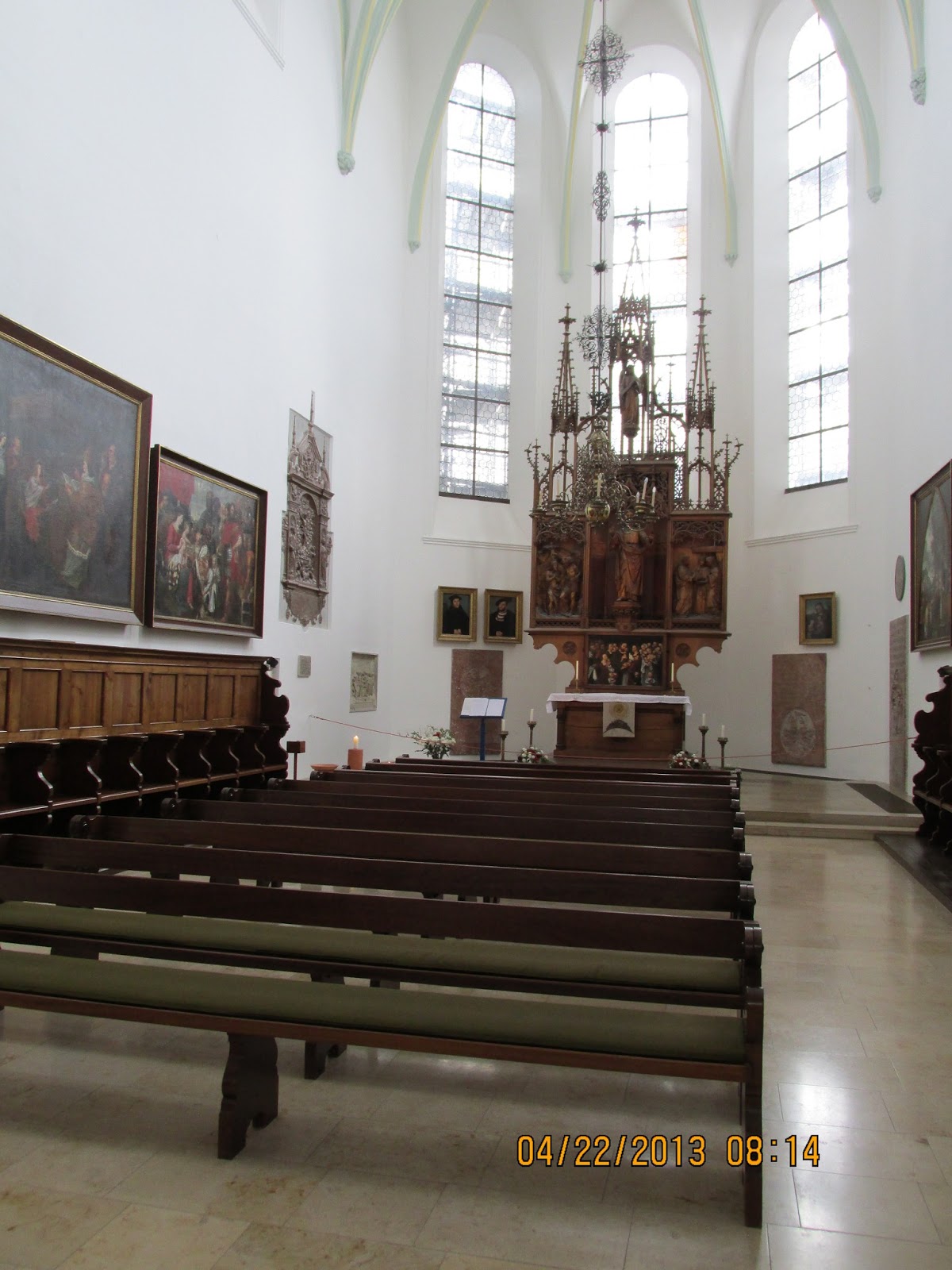
Inside the sanctuary
of St. Anne's.
When Luther came to Augsburg to meet with Cajetan, he resided at the cloister of St. Anne. The meeting was, in reality, a heresy trial where Luther was expected to recant his teaching before the papal legate. Luther was greeted as a hero in Augsburg and at St. Anne. As it became clear that Luther would not recant, Luther's friends and supporters became more concerned that he would be seized and taken to Rome. To avoid this, Luther's supporters smuggled him out of the city secretly.

Statue of Christ on the altar
raising his hands in blessing.
St Anne was built in 1321 by Carmelite monks. The Goldsmith's Chapel was added in 1420; the Fugger's Chapel in 1509. St. Anne's became an "Evangelical" (Lutheran) church in 1545. The spire was added in 1607 by Elias Holl. St. Anne's Church was intimately involved with the Thirty Years War (1618-48) and general religious turmoil of the 17th century. Evangelicals were twice barred from the church by those trying to restore Catholicism to the area (1629-32 and 1635-49); in the latter period, the congregation worshiped outside in the courtyard of St. Anne's College. The church was restored and redesigned in the Baroque and Rococo styles between 1747 and 1749.

In 1530, at the Diet of Augsburg, the Augsburg Confession - Confessio Augustana in Latin - was presented to Emperor Charles V. It was intentionally written to present a gentle, respectful, and peaceful response to the emperor. While intended to speak only for Saxony, as the various German princes read the document they began to subscribe to it as well. The Augsburg Confession was presented on June 25, 1530 as a statement of biblical truth and a proposal for true unity in the Christian faith. It has never been withdrawn.

The Hodgkins Lutheran
in Rathausplatz, Augsburg
with his Augsburg Confession.
The Augsburg Confession is the primary confession of faith of the Lutheran Church and one of the most important documents of the Lutheran Reformation. The Augsburg Confession was written in both German and Latin and was presented by a number of German rulers and free-cities at the Diet of Augsburg on June 25, 1530. The Holy Roman Emperor Charles V had called on the Princes and Free Territories in Germany to explain their religious convictions in an attempt to restore religious and political unity in the Holy Roman Empire and rally support against the Turkish invasion. It is the fourth document contained in the Lutheran Book of Concord.

A chest used to collect
money for indulgences. 
Central to the document and it's subsequent Apology is it's explanation of the Biblical doctrine of Justification. Confessional Lutherans teach forensic, or "legal", justification. This means that God declares the sinner to be "not guilty" (justified) because Christ has taken his place, living a perfect life according to God's law and suffering for his sins. For Confessional Lutherans justification is in no way dependent upon the thoughts, words, and deeds of those justified through faith alone in Christ. The new obedience that the justified sinner renders to God through sanctification follows justification as a consequence, but is not part of justification.

When a penny in the casket rings,
a soul from purgatory springs.
In 1999, St. Anne's Church was the site of the signing of the Joint Declaration on the Doctrine of Salvation by representatives of the Roman Catholic Church and the Lutheran World Federation, an effective rejection of the Augsburg Confession by the so-called Lutherans who signed it. This document states that, "a common understanding of our justification by God's grace through faith in Christ." This is flatly untrue. To the parties involved, this essentially resolves the conflict over the nature of justification which was at the root of the Protestant Reformation. Despite the claims of the Joint Declaration, however, very significant differences remain regarding how Confessional Lutherans (those who subscribe to a historial understanding of the Augsburg Confession and the Book of Concord) and Roman Catholics understand salvation, a fact that the Roman Catholic Church acknowledges.

Wednesday, March 13, 2013

His Master's Voice

But in your hearts set apart Christ as Lord. Always be prepared to give an answer to everyone who asks you to give the reason for the hope that you have. But do this with gentleness and respect, keeping a clear conscience, so that those who speak maliciously against your good behavior in Christ may be ashamed of their slander (1 Peter 3: 14-16).

Alexander the Great, also known as Alexander III, was one of the most successful military commanders in history. By the time of his death, one month shy of his 33rd birthday, Alexander managed to conquer most of the known world. He was the child of Phillip II of Macedonia, and his exploits and conquests far exceeded those of his father. He was educated by Aristotle and had a thorough grasp of science and medicine, and was a master of rhetoric and philosophy. Alexander defeated the Persian Empire and invaded India. He was courageous, compassionate to his men, loyal to his friends and ambitious. In short, Alexander truly lived up to the “Great” name ascribed to him.


How do we know all of this information? The first answer might be that some middle aged professor of world history, with tortoise shell glasses slipping off his nose, taught it to us from a 40 pound text book at eight AM while we were in college (such was the case with me). That, however, only deals with one dimension of the question. How do we collectively, as a society, know this information? Where did the pointy-headed academics find it, so that they could put it into their textbook that cost us $64.50 at the campus bookstore?


They got it from Plutarch and Arrian, the two earliest biographers of Alexander. Archeology has been used to validate their record, but everyone who has written about Alexander has used Plutarch and Arrian as their source material.


Historians consider Plutarch and Arrian to be trustworthy and we speak about Alexander the Great using definitive statements of fact. However, would it effect your perception of the facts of his life to know that Plutarch and Arrian wrote their biographies more than 400 years after Alexander’s death? These are, by no means, eyewitness accounts.


Why the history lesson? I recently caused a dear friend of mine to temporarily loose all ability to speak when I told him that, yes, I believe that Scripture is the inerrant, divinely inspired word of God. He was completely flabbergasted that I, a seemingly intelligent and college-educated individual, would ascribe truth to something as obviously unreliable as the Bible.


Many people, who have no reservation quoting Plutarch in order to give a factual account of the life of Alexander the Great, scoff at the record Holy Scripture provides us of the life of Jesus Christ. Secular scholars put just as much faith in the writers of antiquity as Christians place in the Writer of Holy Scripture – and with much less historical evidence to justify that faith – and are unapologetic. We Christians must also be bold in giving the reason for the hope we have; for proclaiming the life-giving message of Scripture: that God has redeemed fallen, sinful man as he has promised, by the work of the Messiah, Jesus Christ.

In her book, “A History of God: The 4,000-year Quest of Judaism, Christianityand Islam”, Karen Armstrong has this to say about the Gospels:


“We know very little about Jesus. The first full-length account of his life was St. Mark’s Gospel, which was not written until about the year AD 70, some forty years after his death. By that time, historical facts had been overlaid with mythical elements which expressed the meaning Jesus had acquired for his followers. It is this meaning that St. Mark primarily conveys rather than a reliable straightforward portrayal,” (Armstrong, 79).


In other words, the Gospels were written after the fact, preserve no reliable, meaningful historical information, and paint a portrait of Jesus that was a product of imposed religious belief. They do not record the true Jesus; merely Christianity’s evolved mythology of him.

Christianity teaches that Holy Scripture is the divinely inspired, inerrant word of God, written by Him through men under inspiration by the power of the Holy Spirit. Christianity teaches that the original autographs of Scripture are completely free from human error or inconsistency. Any typographical and/or copy editing errors in the manuscripts we possess today are the result of sinful, fallen man.


Let us, though, set the theological aside for a moment. Is there any reason to believe that Scripture, particularly the Gospels, is not simply a collection of mythology, or have they been hopelessly compromised and fallen victim to the ravages of time?


By the standards of a historian, there is logical reason to trust the Gospels. Compared to Plutarch, we have many more manuscripts from diverse locations that can be compared so as to find any deviation. Also, whereas Plutarch and Arrian are 400 years removed from the events they chronicle, the Gospels are dated to within 20-30 years of the crucifixion. Craig L. Bloomberg, an authority on the Gospels, concurs, in an interview recorded in the book, "The Case for Christ":

“[The Book of Acts] cannot be dated any later than AD 62…Since Acts is the second of a two part work, we know the first part – the Gospel of Luke – must have been written earlier than that. And since Luke incorporates parts of the Gospel of Mark, that means Mark is even earlier…we’re talking about a maximum gap of thirty years or so,” (Strobel, 34).


It seems as though 30 years is much smaller of a window for discrepancy to creep in, compared with 400 years. Yet, Plutarch is not questioned, St. Mark is.


Consider other works of antiquity. The more copies of a work that exists, the more opportunities there are to cross check for errors, deviation, and discrepancy. Approximately 650 Greek manuscripts of Homer’s Iliad survive, and they date from 900 to 1,000 years after the work was originally composed.

By contrast, more than 5,000 Greek copies of original manuscripts have been found dating back to about 100 – 150 AD. Among these second generation manuscripts, only a relative handful of textual discrepancies exist, none of which effect doctrinal issues. In the book “The Case For Christ”, Biblical scholar Bruce M. Metzger comments on this:

“The quantity of New Testament material is almost embarrassing in comparison with other works of antiquity…Next to the New Testament, the greatest amount of manuscript testimony is of Homer’s Iliad, which was the bible of ancient Greeks. There are fewer than 650 Greek manuscripts of it today. Some are quite fragmentary. They come down to us from the second and third century AD and following. When you consider that Homer composed his epic about 800 BC, you can see there’s a very lengthy gap,” (Strobel, 60).
 
From an historical point of view, the Holy Scriptures have a much more consistent, solid foundation on which to base claims of accuracy than the other works of antiquity. In short, we can be confident that what we have today in the Holy Gospels is what the author intended to record.


Whether or not one believes what is written, well, that is a separate issue.

 
But even if we or an angel from heaven should preach a gospel other than the one we preached to you, let him be eternally condemned! (Galatians 1:8).
 
For the Christian, the only rule and guiding principle according to which all teachings and teachers are to be evaluated and judged are the prophetic and apostolic writings of the Old and New Testaments alone. We who study Holy Scripture should not concentrate our efforts on the men God used to write His words, or how He accomplished this, but we should focus on the words and content of the Scriptures, since they are what were inspired. Peter and Paul are dead, but the Scripture God wrote through their pens is still alive and accomplishing God’s purpose perfectly. Most importantly, since God, the author of all Scripture, is without error, God’s word is also inerrant.

Lutherans, in order to discern God’s intended meaning, read the Scriptures as historical, literary documents. This method, the Historical-Grammatical approach, seeks the meaning of Scripture in the text itself, not from some special revelation or extra-biblical source. Scripture is the written word of God – not a primarily human witness to revelation, and thus not subject to human failings. Scripture, like Our Lord, has two natures – the human and the divine – and has them equally and fully.

I am reminded of the ad campaign for RCA Victor records. Their advertising icon was a little dog sitting in front of a victrola, with its head cocked to one side as though listening to a recording. The caption under the picture was, “His master’s voice”, implying that the recording was so lifelike that the dog could recognize the call of his master, even though it was artificially reproduced from scratches on wax plates.

Over time, as we all know, the stylus of the record player will scratch and pit the grooves of the record, causing static and popping noises to obscure the recording. However, through those imperfections, the pure recording still exists and can still be heard. Such is the case with Scripture. Though while in man’s stewardship, God’s record may have become slightly scratched and pitted, the original perfect recording still remains, and can still be known.

Through all the human static, we can still hear our master’s voice.