Showing posts with label conversion. Show all posts

Tuesday, June 25, 2019

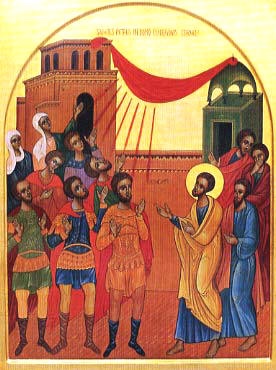
Peter Meets Cornelius

Peter meets Cornelius
Tuesday after the First Sunday after Trinity
And the following day they entered Caesarea. Now Cornelius was waiting for them, and had called together his relatives and close friends. As Peter was coming in, Cornelius met him and fell down at his feet and worshiped him. But Peter lifted him up, saying, “Stand up; I myself am also a man.” And as he talked with him, he went in and found many who had come together. Then he said to them, “You know how unlawful it is for a Jewish man to keep company with or go to one of another nation. But God has shown me that I should not call any man common or unclean. Therefore I came without objection as soon as I was sent for. I ask, then, for what reason have you sent for me?” So Cornelius said, “Four days ago I was fasting until this hour; and at the ninth hour I prayed in my house, and behold, a man stood before me in bright clothing, and said, ‘Cornelius, your prayer has been heard, and your alms are remembered in the sight of God. Send therefore to Joppa and call Simon here, whose surname is Peter. He is lodging in the house of Simon, a tanner, by the sea. When he comes, he will speak to you.’ So I sent to you immediately, and you have done well to come. Now therefore, we are all present before God, to hear all the things commanded you by God” (Acts 10:24-33).
Peter preached to the masses at Pentecost and 5,000 Christians were made. These were foreigners from many different countries, but they were all there for the feast of Pentecost; they were all Jews. Gentiles were a different story. How should they be treated? Could they jump right into the the Way, without first becoming a Jew? It shouldn’t be surprising that this issue came up. The Israelites were instructed to separate themselves from the Gentiles, or the nations, and given special laws to govern them civilly, ceremonially, and morally, to mark them as different. Paul, at one point, calls out Peter for his hypocrisy regarding interacting with Gentiles,
For before certain men came from James, he would eat with the Gentiles; but when they came, he withdrew and separated himself, fearing those who were of the circumcision.[1]
God granted a vision to both the Apostle Peter, and to Cornelius the centurion. They were, however, different visions. Peter’s was a direct prophetic revelation from God. God showed Peter a bunch of unclean animals and told him, “Kill and eat.” Upon meeting Cornelius, Peter explains that, in this vision,
“…God has shown me that I should not call any man common or unclean.”[2]
Peter is shown by God in this vision that God is the God of the gentiles as well as the Jews; In Christ there is not Jew or Gentile, slave or free, male or female for in Christ Jesus we are all one.[3]
The vision God gave to Cornelius was different. He was basically told to talk to Peter, and Peter would tell him what he needed to know. God used supernatural means to direct Cornelius to the Apostle. Why? Why not just give Cornelius the Gospel through a direct revelation? The answer is simple, if not entirely obvious: God does not wish to deal with man except through His outward Word. Jesus promised to give special revelation, and special spiritual gifts like tongue-speaking and healing, to the Apostles. He said those signs would accompany them, and act as a confirmation that the Word they proclaimed was true. He did not make such a promise to everyone. The episode of Peter and Cornelius demonstrates to us that God’s preferred method of converting men is through the means of the Word, baptizing and teaching, in no particular order.
Our Lord could have easily done to Cornelius what He did to Paul. Jesus could have appeared to Him, converted Him in a glorious and terrible flash of light, and personally taught him all the things he needed to know. He didn’t do that. That kind of communication was reserved for the Apostles, like Peter and Paul. Our Lord pointed Cornelius to Peter, a preacher of the Gospel, one of the sent-ones whose job it was to proclaim God’s Word to all people throughout the whole world.
We are not ashamed of the Gospel, for it is the power of God to salvation for all who believe, for the Jew first, then for the Gentile.[4] And we know that faith comes from the preaching, and preaching through the Word of Christ.[5]
Cornelius, living among the Jews, had heard long before about the coming Messiah, through whom he was righteous before God. In such faith, his prayers and alms were acceptable to God (since Luke calls him God-fearing). Without the Word coming first and without hearing it, he could not have believed or been righteous.[6]
After Peter preaches the Word to Cornelius and his household, a miracle happens: another Pentecost. God the Holy Spirit manifests outwardly in the speaking of tongues by those on whom He fell. Then, baptism for the whole household: “Can anyone forbid water, that these should not be baptized who have received the Holy Spirit just as we have?”[7] Baptism accompanies this preaching and teaching because, the baptizing and teaching must never be separated. They go together. They are both forms of the outward Word.
Whether it be through the proclamation of the Word in preaching, or the outward Word and promise of God of the forgiveness of sins and everlasting life in Christ’s death and resurrection joined to water, or bread and wine,
we must firmly hold that God grants His Spirit or grace to no one except through or with the preceding outward Word (Galatians 3:2, 5).[8]
The Word proclaimed by our faithful pastors from the pulpit is this same efficacious, outward Word that Peter proclaimed to Cornelius and his household. The baptism we have received, the promise that by the death and resurrection of Christ our sins have been washed away, and we have put on Christ, received the Holy Spirit, and eternal life, is the same as theirs also. Just as it did then, the outward Word creates faith in the hearts of men by the working of the Holy Spirit.
Do not despise preaching and God’s Word, but hold it sacred, and gladly hear and learn it. It is the means through which God works repentance and faith; it is the means through which He works to break our hearts and bring us to repentance for our sins, and draws us to Him through Christ, who died as the ransom for the sin of the world, and rose again. Hear the Word, repent, and believe the Gospel. Christ has redeemed you, a lost and condemned person, not with gold or silver, but with His holy, precious blood, and by His innocent suffering and death. He applies this redemption to us through the outward Word: His means of Word and Sacrament.

Bibliography

McCain, Paul T, Robert C Baker, Gene E Veith, and Edward A Engelbrecht. Concordia, The Lutheran Confessions: A Reader's Edition of the Book of Concord. 1st. Saint Louis: Concordia Publishing House, 2005.


[1] Galatians 2:11
[2] Acts 10:28
[3] Galatians 3:28
[4] Romans 1:16
[5] McCain, Paul T, Robert C Baker, Gene E Veith, and Edward A Engelbrecht, Concordia, The Lutheran Confessions: A Reader's Edition of the Book of Concord. 1st. Saint Louis: Concordia Publishing House, 2005. Romans 10:17, quoted from FC SD II, 51
[6] McCain, et. al. Concordia, The Lutheran Confessions, SA III, VIII, 8
[7] Acts 10:47
[8] McCain, et. al., Concordia, The Lutheran Confessions, SA III VIII 3

Monday, March 25, 2019

Jesus Blesses Little Children

Then they also brought infants to Him that He might touch them; but when the disciples saw it, they rebuked them. But Jesus called them to Him and said, “Let the little children come to Me, and do not forbid them; for of such is the kingdom of God. Assuredly, I say to you, whoever does not receive the kingdom of God as a little child will by no means enter it.” (Luke 18:15-17)

How does a little child receive the kingdom of God? Do they go out and look for it? Do they listen to preachers and investigate their claims? Do they study The Case for Christ and then make a rational decision to invite Jesus into their heart, based on the reasonableness of the evidence presented? No. They do none of these things. They receive the faith by having it given to them through the means of God’s Word. They are passive in their conversion. This shouldn’t really surprise us. They are passive in their conversion, just like everyone else who is converted.

This is the same way all men are converted by God, by means of His Word. That’s kind of the point Jesus is making to His disciples. The infants, as St. Luke describes the children being brought to Jesus, are in the same situation as the rest of mankind. Their age is irrelevant. They are part of the group who needs the forgiveness of sins obtained through Jesus’ death and resurrection – the world. That means everyone. There are no exceptions.[1]

The problem is, we don’t like to think of babies as sinful. Babies are cute. How could something so cute be sinful and subject to God’s judgment? How is that fair? They haven’t done anything, good or bad; they pretty much just lay there. What sin have they committed? Infants are, like we adults are, corrupted by the sin of Adam. They are born dead in trespasses and sins.[2] Their sinful minds are hostile to God.[3] Their minds do not submit to God’s law, nor can they do so: But the natural man does not receive the things of the Spirit of God, for they are foolishness to him; nor can he know them, because they are spiritually discerned.[4] Incidentally, as far as actual sinning goes, infants don’t have to be taught to be selfish. They are the definition of what the theologians called incurvatus in se - curved inward on oneself.

We were all born with a mind hostile to God, and with a heart inclined to evil, and this inclination to do evil is sin.[5] Consequently, left on our own to make a decision using our reason, whether or not to put our trust in Jesus for the forgiveness of our sins, we would all choose “not Jesus” every time. The part of mankind, infant and adult, that is needed to make a decision to believe in Jesus, the will, is the very thing that is broken. Our “chooser” doesn’t work. That is what it means to be dead in trespasses and sins.

But probably the most obvious evidence that infants are subject to sin, is the fact that they die. St. Paul says that the wages of sin is death.[6] That means that because we are corrupted by sin, we die, just like Adam in the Garden of Eden. If they were not corrupted by sin, they would not be subject to death.

So, since they are dead in sin, they need to be made alive in Christ, just like every other human being. And, since they cannot go to Christ, just like an unregenerate adult cannot go to Christ, He comes to them in His Word. He comes to them in His Word, attached to a physical element, water. Some way which we do not understand, by this washing of water and the word instituted by Christ,[7] the Holy Spirit comes to them and works faith in them. Incidentally, that’s how He brings you and me to the faith as well. He comes to us. He removes our old “chooser” that doesn’t work right and gives us a new one. He does it by water and the Word. Once we are made alive in Christ, He sustains us through that same Word, by proclaiming it to us, and feeding us with it – His real body and blood, for the forgiveness of our sins. Christ, who died to pay for the sins of the world and rose again from the dead on the third day, died and rose for you. He gives us these things He promises through His word preached, read, administered through the washing of Holy Baptism, and eaten and drunk in the bread and wine of the Lord’s Supper.

Should we be surprised that God doesn’t do things the way we think He should? Christ tells us, “The things which are impossible with men are possible with God.”[8] Praise be to Christ that they are.


[1] Romans 3:9-20
[2] Ephesians 2:1, 5
[3] Romans 8:5-7
[4] 1 Corinthians 2:14
[5] Genesis 6:5; 8:21
[6] Romans 6:23
[7] Ephesians 5:26; Matthew 28:16-20
[8] Luke 18:27

Monday, January 21, 2019

Four Fishermen Called as Disciples

And Jesus, walking by the Sea of Galilee, saw two brothers, Simon called Peter, and Andrew his brother, casting a net into the sea; for they were fishermen. Then He said to them, “Follow Me, and I will make you fishers of men.” They immediately left their nets and followed Him. Going on from there, He saw two other brothers, James the son of Zebedee, and John his brother, in the boat with Zebedee their father, mending their nets. He called them, and immediately they left the boat and their father, and followed Him (Matthew 4:18-22)

This verse can be deceptive. Upon first reading, it seems like Jesus just shows up among these fishermen and they just leave, without very much persuasion at all. This isn’t quite accurate. Peter, Andrew, James, and John were followers of John the Baptist. They knew that Jesus was the Lamb of God who takes away the sins of the world from John the Baptist. When Jesus comes to call these men into His service, they jump at the opportunity. They leave the vocation into which they had been called, by which they had been providing for their families and doing good works for their neighbors, to enter full-time service to the Lord.

Jesus will make these fishermen fishers of men. But why choose fishermen? These men were certainly not educated men; they were working men. Based on how they react to the things Jesus says and does later, we know that their understanding of Holy Scripture was faulty. Even the scribes, Pharisees, and teachers of the Law understood the prophecies pointed to Jesus; Herod’s religious authorities knew where to look for the birth of the Messiah. They just didn’t believe. Christ chooses these men to enter His service, not because they were rich, educated, or pious, but because He is gracious. He will make them fishers of men. They do not start out that way. The words that St. Paul wrote to the Corinthians come to mind: For you see your calling, brethren, that not many wise according to the flesh, not many mighty, not many noble, are called. But God has chosen the foolish things of the world to put to shame the wise, and God has chosen the weak things of the world to put to shame the things which are mighty; and the base things of the world and the things which are despised God has chosen, and the things which are not, to bring to nothing the things that are, that no flesh should glory in His presence. But of Him you are in Christ Jesus, who became for us wisdom from God—and righteousness and sanctification and redemption— that, as it is written, “He who glories, let him glory in the Lord.”[1]

Jesus will teach these men, along with the other Apostles, how to fish for men. It doesn’t take as much skill on the fisher’s part as we might expect. While in modern times, we think of fishing with a rod and reel, it was done with a net in ancient times. A round net, weighted on the edges, was cast from a boat into shallow water. Whatever was beneath it as it billowed toward the bottom like a parachute was caught. In order for the net to work it had to spread out properly. In order for it to spread out properly, it had to be thrown properly. Before one could be a successful fisherman, one needed to learn the proper way to cast the net. The net is the means by which fish are caught.

Jesus chooses these men to become His Apostles. They will be taught over the next three years of Jesus earthly ministry how to cast Christ’s net – to proclaim Law and Gospel. They will not be taught how to persuade fish to bite a lure at the end of a line. They are being taught to cast a net. The power of conversion is not in the fisherman, but in his net, the Word of God. There is no other power in the whole world that can bring sinners into Christ’s kingdom.[2] Our pastors cast God’s net each week when they proclaim God’s Holy Word, when they baptize, when they feed us Christ’s body and blood in the Lord’s Supper. And, though we seek to avoid being caught in God’s net because of our sinfulness, He is persistent. He is patient. The Lord is not slack concerning His promise, as some count slackness, but is long-suffering toward us, not willing that any should perish but that all should come to repentance.[3] All the time Christ delays His return means more time for His fishers of men to continue casting His net. Let us not despise preaching and His word, but hold it sacred, and gladly hear and learn it.


[1] 1 Corinthians 1:26-31
[2] Albrecht, G. Jerome., and Michael J. Albrecht. Matthew. St. Louis, MO: Concordia Publishing House, 1996. P. 58
[3] 2 Peter 3:9

Thursday, September 6, 2018

All You Need Is Love

One of the biggest problems in American Christianity today is free will. Many American Christians believe that human beings have it, and that is a huge problem, especially where evangelism is concerned. Perhaps you even believe that humans have free will. Well, we don’t, at least where spiritual matters are concerned. I’m not saying that we aren’t free to choose our career, which house to live in, what car to drive, or which pair of socks we want to wear on that particular day. In those matters, we are free to choose away. Nowhere does Holy Scripture tell us that we need to seek God’s hidden will in such matters. Conversely, if we do not seek His will in such everyday matters, we do not run the risk of stepping outside of God’s will by picking out the wrong color necktie. Neither does God speak to us individually regarding these things (nor, I would argue, any others). But, where faith and conversion are concerned, we have no choice.

Lutherans, as well as other flavors of Christians, have recognized this spiritual truth in scripture since the beginning. We come into this world a sinful creature. We are conceived in sin, and born in iniquity. We are spiritually blind, and dead in our trespasses from the get-go. Scripture tells us so; it is up to God to make the dead alive. It is up to Him to give sight to the blind. It is up to Him to pay for sin, destroy death, and defeat the devil. He does this by the death and resurrection of Christ for the sins of the world; and He delivers those gifts to us personally through the proclamation of Law and Gospel. The Holy Spirit, working in the word and the sacraments, converts and makes alive. Only after a person has been raised to new life through the working of the Holy Spirit through the word is man able to cooperate with God, and then, only feebly.

This comes up now because, while listening to a conservative podcast, I heard the host give some advice to which I just had to respond.[1] The person who wrote the letter said his sister came out as a trans person; he and the family don’t agree with the lifestyle morally, and think it is detrimental to his sister’s physical and spiritual health. He asked if he should continue to love and support his sister, even though this left a bad taste in his mouth, or should he tell her in a loving way that what she was doing was wrong. I agreed with the host when he said the man should express love and compassion for his sister. When he said not to preach to her, my ears perked up. To summarize the advice: We should express love for those with whom we disagree morally, and not preach repentance to them. If we express love toward them, they are far more likely to be convinced that they are wrong and come to Christ. If we preach repentance at them and call them vile sinners, we run the risk of turning them off. It’s basically the, “You catch more flies with honey than you do with vinegar” approach. And it is perfectly logical, if we are marketing a 7-Eleven, or if humans have free will in spiritual matters. The problem is, the church isn’t a 7-Eleven, and we don’t have such a will.

If it were our job as Christians to convince others to become Christians, this is the way to do it. Sell your product by advertising it well. But, if the inclinations of our heart (i.e. our will) are only evil from our youth, that means we are incapable of making such a decision. The one piece of equipment that is supposed to make the decision is broken. Our wills aren’t neutral, they’re evil. The broken piece of equipment needs to be replaced with a new one. This is what the Holy Spirit does to us through the means of word and sacrament. So, conversion isn’t so much presenting Christianity as a proposition, or a product, and trying to convince people to choose it; it is rather more like replacing the broken alternator in our car with a new one. Since the will is the thing that makes the decisions, conversion is replacing our old evil will with a new good will. And that’s not an operation we could do on ourselves. We wouldn’t even want to, since our wills are inclined toward evil and away from good.

The podcast host cited as support the fact that Jesus ate with tax collectors and sinners. But what was Jesus doing when He “hung out” with those outcasts of Jewish society, both secular and religious? Was He seeking these people out so that He could set a good example for them, and to move them to be good people by showing them the example of what it means to love one’s neighbor? Not at all, but a good chunk of American Christianity says so. In His own words, Jesus was calling those sinners to repentance.[2] He says that those who are well have no need of a doctor, but those who are sick do. He’s specifically calling those people with whom He surrounded Himself “sick”. He is the physician healing their physical, but more importantly their spiritual sickness of sin, calling them to repentance. This involves preaching the Law and showing them that they are indeed sinners, not simply “loving” them, whatever that may mean.

When Jesus meets the adulteress who is about to be stoned for her transgression, He does indeed show her love and compassion. After pointing out to the mob that, they too, were sinners condemned by the law and deserving of punishment, He proclaims to her the Gospel: “Woman, where are those accusers of yours? Has no one condemned you?” She said, “No one, Lord.” And Jesus said to her, “Neither do I condemn you; go and sin no more.”[3] He doesn’t ignore her sin; Jesus meets her repentance with forgiveness, and He tells her to sin no more. He forgives her, and tells her now to stop gratifying her sinful nature, and live in accordance with with the new creation Christ has made out of her.[4] He does not simply ignore her sin and allow His “love” and compassion to convince her to become a follower of Christ. He grants her repentance and faith, and the forgiveness or sins. He does the same for us now. Preaching the Gospel isn’t merely motivational speaking, emotional manipulation, rhetorical exercises, or self-help lectures. It is the proclamation of the Law and the Gospel, the very means through which the Holy Spirit converts people.  

The church isn’t ours. It belongs to Jesus. He is it’s foundation.[5] In Christ the whole building is joined together and rises to become a holy temple in the Lord and, in Him, we are being built together to become a dwelling in which God lives by His Spirit.[6] We can find Christ’s Church wherever the Gospel is preached in its purity and the holy sacraments are administered according to the Gospel.[7] It is easy to mistake the denominational designation on the church sign for a brand that needs to be marketed. We have to remember that the church, no matter what it looks like to us, is in Jesus’ hands, and doesn’t need the Madison Avenue treatment.

Built on the Rock the Church doth stand,
Even when steeples are falling;
Crumbled have spires in every land,
Bells still are chiming and calling,
Calling the young and old to rest,
But above all the soul distrest [sic],
Longing for rest everlasting.[8]

We are God's house of living stones,
Builded for His habitation;
He through baptismal grace us owns
Heirs of His wondrous salvation.
Were we but two His name to tell,
Yet He would deign with us to dwell,
With all His grace and His favor.[9]


[1] Andrew Klavan. "The Andrew Klavan Show, Ep. 568, No News, All Agenda." August 29, 18. Accessed August 29, 18. The “Mail Bag” segment.
[2] Mark 2:17
[3] John 8:10-11
[4] Galatians 5:16; 2 Corinthians 5:17
[5] 1 Corinthians 3:11
[6] Ephesians 2:19-22
[7] AC VII 1
[8] The Lutheran Hymnal. St. Louis, MO: Concordia Publishing House, 1941. Hymn #467, stanza 1.
[9] The Lutheran Hymnal. St. Louis, MO: Concordia Publishing House, 1941. Hymn #467, stanza 3.

Thursday, June 14, 2018

Paul Ministering in Corinth

Now the Lord spoke to Paul in the night by a vision, “Do not be afraid, but speak, and do not keep silent; for I am with you, and no one will attack you to hurt you; for I have many people in this city” (Acts 18:9-10).

Paul preaches Christ in Thessalonica. His opponents gather a mob and set the city in an uproar. They attack the house of a man named Jason, where Paul was staying. At the end of the affair it is Jason, Paul, and the other brethren who are arrested and must post bond. Paul preaches Christ in Berea. The reception is a little better there; but when the Jews from Thessalonica learned that the word of God was preached by Paul in Berea, they came there also and stirred up the crowds. Paul preaches Christ in Athens. He wasn’t physically attacked by an angry mob but, when they heard of the resurrection of the dead, some mocked, some were converted, and some said they wanted to hear more. Paul departed from among them.

In Corinth, the scene appears set to play out as it did in the other places. Paul preaches Christ in Corinth. He was compelled by the Spirit to do so, Scripture says, and he testified to the Jews that Jesus is the Christ. But when they opposed him and blasphemed, he shook his garments and said to them, “Your blood be upon your own heads; I am clean. From now on I will go to the Gentiles.” This time, however, the risen Jesus tells Paul not to be afraid. He should keep speaking, “...for I am with you, and no one will attack or hurt you; for I have many people in this city.” And Paul does, for a year and a half. And the Jews bring Paul to the judgment seat of proconsul Gallio. They hope Gallio will assume Paul is advocating illegal religion and acting treasonously by telling people to pledge their allegiance to a king other than Caesar. They charge Paul with persuading men to worship God contrary to the law. Gallio wants no part of this religious dispute. He tells them to handle it amongst themselves and clears the court. Paul is saved; the one who takes the beating is Sosthenes, the ruler of the synagogue. The church steadily grows and becomes more firmly established through the bold proclamation of Christ crucified for our sins and risen from the dead; God the Holy Spirit, working as He wills, makes Christians in the face of ferocious opposition through His means of the external word of God.

Paul wasn’t surprised or disheartened when he was mocked, beaten, stoned, and imprisoned for preaching the Gospel. Scripture tells us he was compelled to preach by the Holy Spirit. He knew what the reaction would be. We also should know what the reaction of the pagan world will be to us as well. Jesus, the Word made flesh, came to His own and His own did not receive Him. Jesus taught His disciples that He was sending them out as sheep among wolves; that they would be delivered up to councils; that they would be scourged; that they would be brought before kings and governors for His sake, as a testimony to them and to the Gentiles. Jesus’ disciples, we included, will be hated by all for His name’s sake; but he who endures to the end will be saved.[1] The world hates us because it hated Jesus before us, and no student is above his master. They hate us because of the message we proclaim: that Christ died for our sins according to the Scriptures, and that He was buried, and that He rose again the third day; that by His atoning sacrifice, Jesus purchased and won me from all sin, from death, and from the power of the devil, not with gold or silver, but with His holy, precious blood, and by His innocent suffering and death. This message is foolishness to those who are perishing. The carnal mind cannot understand spiritual things.

Being dead in our transgression, we must be made alive by the working of God, through water and the Word. Being dead we must be born from above by water and the spirit. And even though the world may mock us, reject us, and even react violently toward us, we continue to bring them the Gospel, the message of the cross. It isn’t through the elegant turning of a phrase that God makes Christians out of non-Christians, as we see from Paul’s example; Christians are made through the preaching of the Gospel. We must not be afraid to boldly proclaim that Gospel to those around us, according to our vocation. It is the power of God to salvation for everyone who believes.[2]


[1] Matthew 10:16-26
[2] Romans 1:16

Saturday, April 14, 2018

The Savior of the World

Verbum Domini Manet in Aeternum - The Word of the Lord endures forever.
And many of the Samaritans of that city believed in Him because of the word of the woman who testified, “He told me all that I ever did.” So when the Samaritans had come to Him, they urged Him to stay with them; and He stayed there two days. And many more believed because of His own word (John 4:39-41).

The Word is the thing. It is the tool God uses to create faith. Faith comes by hearing, and hearing by the word of God.[1] It was her encounter with the Incarnate Word which kindled faith in the heart of the Samaritan woman. It was the word of the Samaritan woman to her neighbors that brought them to Jesus; it was Jesus’ words, His teaching, which strengthened their faith and caused it to grow, so that they could declare that Jesus was the Savior of the world. This is the miracle: God created faith in the hearts of sinners, who were incapable of understanding the spiritual things of God, through His Word, by the working of His Holy Spirit.[2]

He works the same way with all people, including man today. Some believe a man must be convinced by logic and rational argument to believe in Christ; he must be reasoned into the faith and make a decision to follow Jesus by the power of his will. Others think, as the Pharisees did, that they can make themselves acceptable to God by following the Law, and doing good works of their own devising. Still others attempt to reach God through mystical experiences; they follow rituals and practices designed to manipulate emotions, and they look for signs and personal revelations from God. But the Word is the thing. God does not want to deal with us in any other way than through the spoken word and the Sacraments, which are God’s word and promise associated by Him with a physical element.[3]

In the past God spoke to our ancestors through the prophets at many times and in various ways, but in these last days He has spoken to us by His Son.[4] God’s communication with man has been concentrated down to Christ’s atoning death and resurrection. This message of Christ has been collected for us into the volume of Holy Scripture we call the Bible. When you read the words of the Bible, you hear God’s voice for it is God who speaks to you in the pages of Holy Scripture. When you hear faithful preaching, it is God’s voice you hear through the mouth of your faithful pastor. There is no need to search for personal revelation; God has already given you His revelation. God, however, does not use His Word only as a means of creating faith in unbelieving hearts. God has also given us the external Word so we can be certain of His promise of forgiveness and eternal life, even when we don’t feel saved. Bosoms will cease to burn. Inner illuminations will dim. Enthusiasm will wane. Our works will fail to measure up. The Word of the Lord, however, endures forever. When we remember what kind of rotten sinners we really are, we can look to God’s external Word. We find that Word in the Scriptures, in the preaching of a faithful pastor, in the Lord’s Supper or remembrance of our Baptism. By the external Word we have assurance that though we are sinners, God has forgiven us for Christ’s sake, and is faithful.[5]


[1] Romans 10:17
[2] 1 Corinthians 2:14
[3] McCain, Paul T., Robert C. Baker, Gene E. Veith, and Edward A. Engelbrecht, eds. Concordia: The Lutheran Confessions. A Reader’s Edition of the Book of Concord. St. Louis, MO: Concordia Publishing House, 2005.
SA VIII, 10
[4] Hebrews 1:1-2
[5] Klotz, Joseph D. "The External Word." The Hodgkins Lutheran. December 4, 2014. Accessed April 14, 2018. http://hodgkinslutheran.blogspot.com/2014/12/the-external-word.html.

Wednesday, June 22, 2016

Conversion and Repentance

The Good Shepherd, by Lucas Cranach the Elder
I was recently asked this most reasonable and logical question regarding our “decision” to become a Christian, in the comments section of a previous essay (In Response to Hans Bischof Regarding Decision Theology and Silly Arguments): Don’t we decide to accept the gift of salvation, or at least decide not to reject it? I’m compelled to respond because, for years, it was also my question. Well, sure, the thought goes, we don’t do the work of salvation – the dying on the cross, or works to atone for specific sins. It would surely follow, however, that if Jesus wants to give us a gift (forgiveness), we would have to decide either to accept or reject it.

The bottom line is this: Is there any part of my salvation that is left to me to do? I generally sum up this question by asking another – Who does the verbs? If there is something left for me to do to complete God’s saving work (synergism), then I must be sure to complete my  or I won’t be saved. If God does everything and leaves nothing to me (monergism), then God is the one responsible for my salvation from beginning to end. If that is the case, then I can have a solid assurance that it is finished and my salvation is secure (as secure as God’s promise, anyway). If, however, even the smallest part of my salvation is contingent upon something I must do, then in reality it is entirely dependent upon me and what I must do. Decision Theology, which portrays man’s decision to accept Christ as the work man does to complete God’s work of salvation, relegates Jesus to the role of a partner.

The Bible teaches that the work of salvation is monergistic, that is, it is God’s work from beginning to end. He converts us. He gives us repentance and faith. He keeps us in that faith. This is a hard pill to swallow for all people, but especially for the independent-minded American. Scripture, however, cannot be denied. What Luther wrote on a scrap of paper while lying on his death bed is surely true: Wir sind alle Bettler. Hoc est verum[1].

How does God complete this work? He doesn’t simply zap us with lightning bolts. He comes to us through means. Jesus is delivered to us through the external world, whether by reading, preaching, or the Sacraments, which are the word coupled with a physical element (bread, wine, water). The Holy Spirit then works faith in a person when and where He wills it. Repentance? This is also a gift given by God, and not something we do of our own will. This was the understanding St. Peter and those to whom he reported the conversion of the Gentiles in Acts 11 had:

“If then God gave the same gift to them as he gave to us when we believed in the Lord Jesus Christ, Who was I that I could stand in God’s way?” When they heard these things they fell silent. And they glorified God, saying, “Then to the Gentiles also God has granted repentance that leads to life” (Acts 11:17-18).
God converted those Gentiles through the word preached to them by Peter. God demonstrates this by granting them the gift of speaking in tongues, the same gift given to the Apostles. When Peter recounts all this to “those of the circumcision,” their conclusion is that God granted those Gentiles repentance. Or, said another way, God “repented” them.

Similarly, St. Paul also thought that repentance was a gift given to men, rather than a work to be performed:

And the Lord’s servant must not be quarrelsome but kind to everyone, able to teach, patiently enduring evil, correcting his opponents with gentleness. God may perhaps grant them repentance leading to a knowledge of the truth, and they may come to their senses and escape from the snare of the devil, after being captured by him to do his will (2 Timothy 2:24-26).
Paul instructs Timothy in the way he, the Lord’s servant, must act when teaching and dealing with others, especially his opponents. He is to be patient and kind, correcting error with gentleness. To what end? That he may reason his opponents into the faith using carefully crafted and rhetorically complex arguments? That they would, through an act of their will, intellectually agree with and voluntarily accept his teaching? No. Timothy is to deliver the word, as Paul describes elsewhere, “in season and out of season[2],” and God, the actor in terms of salvation, may grant them repentance leading to a knowledge of the truth. The Book of Concord (FCSD II 89), quoting Luther sums all this up nicely:

Luther says about conversion that a person is purely passive. This means a person does nothing at all toward conversion, but only undergoes what God works in him. Luther does not mean that conversion takes place without the preaching or hearing of God’s Word. Nor does he mean that in conversion no new emotion whatever is awakened in us by the Holy Spirit and no spiritual operation begun. But he means that a person by himself, or from his natural powers cannot do anything or help toward his conversion. Conversion is not only in part, but totally an act, gift, present, and work of the Holy Spirit alone. He accomplishes and does it by his power and might, through the Word, in a person’s intellect, will, and heart, “while the person does or works nothing, but only undergoes it.” It is not like a figure cut into stone, or a seal pressed into wax, which knows nothing about it, which neither sees him nor wills it. Rather it happens the way that has just been described and explained (McCain, et al. 2005).
Consider the example of the shepherd which Jesus uses in his Parable of the Lost Sheep in Luke 15. The shepherd and his interaction with his sheep can offer us insight into man’s role in his own conversion and repentance.

So He spoke this parable to them [Pharisees] saying: “What man of you, having a hundred sheep, if he loses one of them, does not leave the ninety-nine in the wilderness, and go after the one which is lost until he finds it? And when he has found it, he lays it on his shoulders rejoicing. And when he comes home, he calls together his friends and neighbors, saying to them, ‘Rejoice with me, for I have found my sheep which was lost!’ I say to you that likewise there will be more joy in heaven over one sinner who repents than over ninety-nine just persons [upright persons] who need no repentance” (Luke 15:3-7).
Jesus, in the parable, describes repentance as being found by the Good Shepherd and carried back to the sheep-fold by him. The sheep can take no action on his own, he is lost. He can only “be found” and rescued by the shepherd. Dr. Ken Bailey, author of “Finding the Lost: Cultural Keys to Luke 15,” explained in an Issues ETC interview that Jesus here means to impure the “Shepherds of Israel” for losing their sheep (Bailey 2015). Jesus, the Good Shepherd, had to come and do what they would not. He finds the sheep and carries it back on his shoulders. He “repents” it. This idea is not novel but, suggests Dr. Bailey; it is shown to us also in Psalm 23:

The LORD is my Shepherd; I shall not want. He makes me to lie down in green pastures; He leads me beside the still waters. He restores my soul; He leads me in the paths of righteousness for His name’s sake (Psalm 23:1-3).
This most famous and beloved of the Psalms describes the interaction of the Good Shepherd and his sheep. Again, God is doing the verbs – He makes me lie down; He leads me; He restores. The key word in this passage, however, is “restores.” I always got the image of a person weakened by hunger or thirst, who was restored to vigor again after being fed or given drink, when I read this in the past. Dr. Bailey, however, points out that the word translated “restore” is the Hebrew word Shuwb (pronounced “Shoob”) which means “to turn back,” or repent (Bailey 2015). He (God) repents, or turns back, my soul.

I disagree with Dr. Bailey’s choice of working when, at one point in the interview responding to a similar question to the topic of this essay, he says, “You make a decision to accept to be found” (Bailey 2015). We Lutherans don’t like the word “accept” because it smells of decision theology. The problem is that we are limited to nouns and verbs when attempting to express these ideas using language. On this side of eternity, we will not ever express it adequately.

Decision theology, as stated before, views man’s decision to accept Christ, to give him your heart, to make him lord of your life etc., as the completion of God’s salvation work. God’s work of salvation, to the contrary, is already finished. Or, in terms of the parable, the sheep is helpless to return to the fold of his own accord and the Shepherd retrieves him. The sheep “accepts” the rescue performed by the Shepherd. This act of acceptance, which is really not an act, but rather the sheep’s passive acceptance of an action done to it, does not complete the Shepherd’s rescue. Every part of conversion and repentance is effected upon us by God of his grace, through means of the external word, done by the power of the Holy Spirit.


Works Cited

Bailey, Dr. Ken, interview by Rev. Todd Wilken. Jesus, the Good Shepherd (May 7, 2015).

McCain, Paul Timothy, Robert Cleveland Baker, Gene Edward Veith, and Edward Andrew Engelbrecht, . Concordia: The Lutheran Confessions. Translated by William Hermann Theodore Dau and Gerhard Friedrich Bente. St. Louis, MO: Concordia Publishing House, 2005.


[1] When Martin Luther died on February 18, 1546, a scrap of paper was found in his pocket with his
final seven words, a mix of Latin and German. Wir sind alle Bettler. Hoc est verum —“We are
all beggars. This is true.”

[2] 2 Timothy 4:2