Showing posts with label Election. Show all posts

Sunday, March 24, 2024

Thoughts on the Doctrine of Election

As a Confessional Lutheran living in what some in the Lutheran blogosphere have called the "desert of American Evangelicalism," one gets accustomed to being ignored. No one quite knows what to do with Confessional Lutherans. Consequently, we usually get left out of the debates, and our doctrine is not well-known. We look like Roman Catholics, most of the time. We talk about baptism a LOT, and how salvation comes only by the grace of God through faith in Jesus Christ alone. Most American Evangelicals don't know what to do with us, if we're even on their radar at all.

Mostly, we are not.

This is evident when the discussion turns to something like the doctrine of Election. You've got your Calvinists, and you've got your Arminians; your predestination people and your free will guys. Either God has predestined everybody for where they're going or we all have to make a decision for Jesus and pray the sinners prayer.

Then there are the Lutherans. We don't fit into either of those categories.

We acknowledge that man has free will, but only in matters that do not pertain to salvation. Where conversion is concerned, we acknowledge that scripture teaches we are dead in our trespasses and sins (Ephesians 2:1ff.).

We also understand that God has predestined the elect to salvation in Christ before the foundation of the world. However, - and here's where we lose the Calvinists - we acknowledge that scripture teaches that a believer can fall away.

Calvin wrote that salvation is not preached to all people equally. The reason why, he says, is a mystery. Calvin defines predestination as the doctrine that some people are chosen by God to be saved, and others are chosen by God to be damned. This is quite different from how the doctrine of election is understood from Holy Scripture by the Lutheran reformers. Calvin admits that this teaching might sound scary and confusing at first, but it is, in fact, "useful and pleasant." (Calvin, 1526) Calvin writes that the doctrine of election shows man that salvation is truly monergistic. To him, the fact that God gives salvation to some and withholds it from others, Calvin says, simultaneously glorifies God and humbles man. (Calvin, 1526)

Calvin and the Lutheran Confessions both agree that the doctrine of election is, in Calvin's words, "useful and pleasant"; that it is intended to be a comfort, and to showcase the glory of God. But Christianity does not teach fatalism. Fatalism is the idea that nothing you do makes any difference because everything is pre-ordained. Christian faith is knowing God works all things, even the ones we think are bad, for the good of those who love Him, who are called according to His purpose in Christ. And here we come to the first and greatest difference between a Reformed and a Confessional Lutheran understanding of election: it can only be understood in Christ.

Calvin says that God reveals His will to men, and that we must not seek that which God has kept hidden. Calvin says that we find the revealed will of God in God's word. This is true, and the Lutheran Confessions agree. Calvin, however, seems to go beyond what Scripture says when he teaches that God has created some men specifically for damnation.

To Calvin, God is the cause of salvation to those who are saved; God is also the cause of damnation to those who are damned. This is what Calvin means when he writes that all are not "created on equal terms." (Calvin, 1536) In other words, Calvin teaches that God created some people specifically to be saved, and other specifically to be damned. Those so created have no chance either to fall if they are the elect, or to be saved if they are the reprobate.

Calvin cites Deuteronomy 32:8-9 to show that God does not reveal the reason He saves certain people and damns others. As God declared to the Israelites through Moses, Calvin says, God chose the Israelites because He wanted to; it was not because of anything God saw in them, or that they merited God's favor. Calvin says that here God keeps the reason the elect are chosen a secret, but this isn't entirely true. God does indeed reveal how and why the elect are saved: they are saved by God's grace through faith in Christ alone.

Moreover, scripture also declares that the lost are damned because of their lack of faith, not because God predestined them to be lost and condemned.

When discussing eternal election, the Lutheran reformers make a distinction between God's eternal election and God's eternal foreknowledge. God's foreknowledge means simply that God sees and knows all things before they happen. Foreknowledge applies to all creatures. Election does not apply to all creatures. Election only applies to those people who are in Christ. (McCain, 2005)

God's eternal election simply means those whom God has predestined to salvation in Christ from before the foundation of the world. Election, therefore, does not include the wicked. On the contrary, it only includes the godly, i.e. those people who have faith in Christ. Those who are predestined to salvation are those who are in Christ.

Here we enter the territory of another fundamental difference between Reformed and Confessional Lutheran theology: paradox. Confessional Lutheran theologians do not feel the need to resolve paradox when it is found it Holy Scripture. Reformed theologians make the rational argument that if God chose one group of men to be saved, then that means he chose the remaining group of men to be damned by default. That is not, however, what the Bible says. In short, Scripture teaches the following paradox: 1) God wants all men to be saved and come to a knowledge of the truth; 2) God is completely responsible for working repentance and faith in men by the means of His word; 3) Some men reject God's gracious gift and are not saved; 4) Those men who are lost are responsible for their own damnation, not God.

Part of the problem is that Calvin does not seem to recognize that the lost are lost because of their own sin; because of their own failure to believe in Christ, and not because God decreed them to be reprobate. Consider the fact that Non-Israelites could become a part of the nation of Israel. People like Rahab the prostitute were accepted as part of God's chosen people, not because of their bloodline, but because of their faith. Again, consider Saul. He was the annointed king of Israel, yet he was rejected by God  because he was unfaithful.

Calvin sees the choosing of Israel by God as a sort of general election. The explanation he gives for why most of Israel fell away even though they were part of the elect nation and only a remnant remained is troubling. Calvin explains that, while God did elect the entire body of Jacob's descendants, He did not immediately give all of them the Holy Spirit. According to Calvin, this withholding of the Spirit is why most of elect Israel fell away and only a remnant was caused to persevere. (Calvin, 1536) 

Where Calvin found such a horrifying notion is anyone's guess. It does not come from Scripture.

But Calvin continues, asserting that God is not unjust to choose some men to reprobation. Indeed, He would not be unjust if that were the case. All men are, after all, in a fallen state. God would have been justified in destroying the entire fallen creation, and starting over again. But Calvin also ascribes man's corrupt and fallen state to God's will. (Calvin, 1536)

Scripture tells us that isn't the case. God is not the source of evil, nor is God the cause of sin. Rather, Adam's will and the will of the devil are the cause of mankinds fall, and the introduction of sin and death into creation.

God may not be the cause of man's fall into sin as Calvin says. God did, however, allow the Fall to happen. And, along with everything else, God works those things to the good of those elect in Christ.

Calvin says that God issues His call to faith by the preaching of the Gospel. According to Calvin, however, though the Gospel goes out to the elect and to the reprobate alike, God only makes it effectual in those whom He has elected. Those who are reprobate, therefore, do not have the opportunity or the ability to believe; God, according to His will, has rendered the power of the Gospel ineffective in them. (Calvin, 1536)

Predestination is not a trick. God does not say outwardly that salvation is for all people, but secretly not mean it. This would mean that God had two contradictory wills, which cannot be because Scripture tells us so. (McCain, 2005) God punishes such duplicity. He does not reward it.

God would indeed be a liar and a hypocrate if His invitation was extended to all people through His word, but secretly in His heart He knew there were some people He would damn anyway, no matter what. God condemns this type of wickedness (Psalm 5:9; 12:2-4). Man is, on the contrary, responsible for his own damnation by resisting and rejecting the Holy Spirit as He works through God's word.

God reveals His will by His call to preach the Gospel to all people. He works through that word to enlighten, convert, and save. The Gospel is the power of God for salvation; God wants men to receive, believe, and obey His word. Christ merited the redemption of the entire human race on the cross. Through word and sacrament Christ gives us the benefits of what He has merited. That is to say that the Holy Spirit working through those means works conversion; works repentance and faith in Christ for the forgiveness of sins in us. Moreover, the Spirit will justify, sanctify, and protect those in whom He has done such work if we do not abandon Christ and His Word. (McCain, 2005)

He will save eternally at the Resurrection on the Last Day those who persevere. ###


---


Works Cited

Calvin, John. 1536. "Institutes of the Christian Religion." Chapters 21-24. Christian Classics Ethereal Library. 
https://ccel.org/ccel/calvin/institutes/institutes.v.xxii.html.

McCain, Paul T., et. al., eds. 2005. "Concordia: The Lutheran Confessions. A Reader's Edition of the Book of Concord." First Edition. Formula of Concord, Solid Declaration XI. St. Louis: Concordia Publishing House.

Thursday, July 6, 2023

The Paradox of Perseverance and Apostasy

Verbum Domini Manet in Aeternum
The Word of the Lord Endures Forever
The concept of justification by God’s grace through faith in Christ is central to Christian theology. Paul’s writings emphasize that believers are considered righteous by God through Christ’s sacrifice, despite their inherent sinfulness. This righteousness is imputed to believers through faith, a truth echoed in the faith of Old Testament saints like Abraham. At the same time, God’s word also teaches two paradoxical ideas: 1) that a person who is a believer in Christ can forfeit, or lose that faith, and 2) that God who works faith in men by means of God’s word will cause men to persevere in that faith.

According to Paul’s writings in Romans and Galatians, God justifies believers by reckoning or counting them as righteous, even though they are not inherently righteous.1 God does this not because of anything we do; his favor is unmerited. We are saved by God’s grace through faith in Christ because of His death and resurrection.2 God sees believers through the lens of Christ’s righteousness, despite the fact that we are sinful.3 The believer is called to actively strive against the sinful flesh,4 considering it as good as dead because of Christ’s crucifixion.5 This concept of justification through faith finds its foundation not only in the New Testament but also in the experiences of Old Testament believers. Consider Abraham: scripture affirms that Abraham believed God, and it was credited to him as righteousness.6 Like Abraham, we believe, and God counts us righteous because of our faith. We are considered Abraham’s children by faith.7 Thus, the nature of justification highlights how God’s reckoning of righteousness extends to both old and new testament believers, demonstrating His consistent faithfulness throughout all times. He deals with all mankind in the same way.

While believers are justified and counted righteous through faith in Christ, they are not exempt from the ongoing struggle with their sinful flesh. Paul describes this battle against the power of sin in Romans Chapter 7. He describes the tension of having “sin living in me,” acknowledging the coexistence of the redeemed inner man and the lingering influence of sin.8 The sinful flesh is not eradicated; rather, we can consider it dead and defeated because of Christ’s work on the cross.9 Believers are called to actively starve their flesh and not gratify its desires.10 This duality within the Christian experience reveals that while the inner man delights in God’s law, believers must persistently strive to overcome their sinful inclinations. It is an ongoing journey of sanctification where the inner transformation by the Spirit is met with the arduous task of mortifying the flesh. This tension between righteousness and sinfulness in the life of a believer is often referred to as “simul justus et peccator” in Lutheran theology, which means “simultaneously justified and sinner.” This concept underscores the paradoxical nature of the Christian’s state, being both declared righteous through faith and yet still struggling with the effects of sin. In the words of the Formula of Concord, Epitome:

“We believe, teach, and confess that original sin is not a minor corruption. It is so deep a corruption of human nature that nothing healthy or uncorrupt remains in man’s body or soul, in his inward or outward powers11...This damage cannot be fully described.12 It cannot be understood by reason, but only from God’s Word. We affirm that no one but God alone can separate human nature and this corruption of human nature from each other. This will fully come to pass through death, in the blessed resurrection. At that time, our nature, which we now bear, will rise and live eternally without original sin and be separated and divided from it13 (FC Ep. I, 8-10).”

Yet, though we were by nature children of wrath, God graciously saved us and made us alive in Christ.14

As there is a paradoxical element in the Christian’s nature, so too there is a paradox that must be acknowledged when discussing the faith of the Christian and the possibility of falling away from it. This is more commonly known as election or predestination. The concept of election or predestination is the understanding that God, in His sovereign will, chooses people for salvation in Christ.15 Scripture also teaches, however, that man is entirely responsible for his damnation. In the words of the Solid Declaration, “Few receive the word and follow it. Most despise the word and will not come to the wedding.16 The cause for this contempt for the word is not God’s foreknowledge but the perverse human will (FCSD XI, 41).” Consequently, Holy Scripture is littered with calls to repent, and to guard against falling away.

These biblical teachings reflect a tension between divine sovereignty and human responsibility. On one hand, it affirms that salvation is entirely the work of God, as He alone is responsible for granting faith and securing the believer’s eternal destiny. This aligns with passages such as John 10:27-28, Romans 8:28, and Ephesians 1:3-6, which emphasize God’s role in choosing, protecting, and preserving His people. On the other hand, scripture recognizes the reality of human accountability and the potential for falling away. The paradox lies in holding these truths in tension, affirming both the divine initiative in salvation and the necessity of human response and perseverance.

The language of “losing salvation” can be misleading, as it implies misplacement rather than a deliberate choice (Cooper, 2018). It seems to suggest that it is something that happens to you rather than something for which you are responsible. While no external force can pluck believers from Christ’s hand, individuals can reject Christ and willfully apostatize themselves. Jesus lamented over Jerusalem, the Jews who were not willing to be gathered together by Christ as a hen gathers her chicks under her wing.17 As he faces death by stoning, Stephen calls his murderers stiff-necked people with uncircumcised hearts, who always resist the Holy Spirit,18 which is the cause of their faithlessness. Living in unrepentant sin can lead to the forfeiture of faith, as sin destroys faith (Cooper, 2018).19 This tension between the possibility of falling away and God’s perseverance of His people is a paradox and cannot be resolved by human reason. Neither element should be ignored in favor of the other; neither scriptural truth should be used to cancel the other out (Cooper, 2018).

The author of the letter to the Hebrews warns against falling away from the faith, emphasizing the danger of a hardened heart and turning away from God.20 He gives the examples of Israel’s rebellion and unbelief as a caution.21 Similarly, Paul warns against falling away as Hymenaeus and Alexander did.22 He warns the Galatians who were trying to be justified by the law after having believed the Gospel preached to them had fallen from grace and were cut off from Christ.23 Peter describes false teachers who lead others astray and who are destined for destruction.24 Peter affirms that both the false teachers and those led astray have fallen from the faith;25 he does not say that they did not have genuine faith to begin with.

Paul and Peter probably learned this from Jesus Himself. Peter’s epistle echoes what Jesus teaches in the parable of the sower. In Matthew 13:18-23, Jesus explains the meaning of the parable, which depicts different types of soil representing the condition of people’s hearts in receiving the Word of God. The seed that falls on rocky ground and among thorns symbolizes those who initially receive the Word with joy but later fall away due to persecution or the cares of the world. This parable illustrates that genuine believers can face obstacles or temptations that lead them astray from their faith. Paul’s language of being cut off from Christ reminds us of Jesus’ teaching that He is the vine and we Christians are the branches.26 He urges the disciples to remain in Him, lest they become like branches that have been cut off from the vine which are gathered up and thrown into the fire.

Cooper points out that the reception of the Word and the participation in the sacraments are the means by which God works in us, nurturing and sustaining our faith (Cooper, 2018). This makes sense, particularly in light of John 15. Jesus calls His disciples to remain in Him. He repeats the admonition several times. How are we to remain in Jesus? By eating His body and blood, which is real food and real drink:

“Whoever eats my flesh and drinks my blood remains in me, and I in them. Just as the living Father sent me and I live because of the Father, so the one who feeds on me will live because of me.27”

Through means of grace, and particularly the Sacrament of the Altar, Jesus “perseveres” His Christians, guards them against falling away, and empowers them to remain steadfast.

The Solid Declaration reflects the paradoxical nature of the biblical teaching on election and does not speculate beyond what scripture says (FCSD XI 53, 64). It acknowledges that the doctrine of election is both mysterious and profound, encompassing the tension of divine sovereignty and human responsibility. It confesses God’s choice of individuals for salvation in Christ is an act of His pure grace, independent of any merit on our part. It affirms the nature of salvation, emphasizing that God alone is responsible for granting eternal life to believers, and that this teaching about election should be a comfort to Christians (FCSD XI 45-49). At the same time, the Solid Declaration recognizes the reality of human accountability, as individuals bear responsibility for their own rejection of God’s saving grace and their resulting damnation (FCSD, XI). This understanding aligns with the paradoxical nature of election presented throughout Scripture, affirming both the sovereignty of God and the human response to His grace. From the Solid Declaration, we learn that matters such as how election works from God’s perspective should not be investigated beyond what scripture tells us, and that the teaching about election should not be considered apart from Christ:

“We neither can nor should investigate and fathom everything in this article, the great apostle Paul declares. After having argued much about this article from God’s revealed word, as soon as he comes to the point where he shows what God has reserved for His hidden wisdom about this mystery, he suppresses and cuts it off with the following words, ‘Oh, the depth of the riches and wisdom and knowledge of God! How unsearchable are His judgments and how inscrutable His ways! For who has known the mind of the Lord?’28 In other words, we cannot know about matters outside of and beyond what God has revealed in His word. This eternal election of God is to be considered in Christ, and not outside of or without Christ29 (FCSD XI 64-65).”

In conclusion, the doctrine of justification by God’s grace through faith is foundational to Christianity. Christians, though justified and regarded as righteous through Christ, continue to wrestle with their sinful flesh. The admonitions against falling away serve as sober reminders of the significance of perseverance and the perils of unrepentant sin. It is essential to embrace these paradoxical truths, recognizing the danger of apostasy while concurrently relying on God’s ongoing work of preservation through His means of grace, His Word and sacraments. The Holy Spirit works through His means of grace to strengthen and sustain the Christian in the faith. Through God’s Word by the working of the Holy Spirit, believers find assurance and steadfastness in Christ. ###


End Notes

1. Romans 3:24
2. Ephesians 2:1-10
3. Galatians 3:27
4. Galatians 5:16-17
5. Romans 6:5-10
6. Romans 4:3; Galatians 3:6
7. Galatians 3:7-9
8. Romans 7:17-25
9. Romans 6:11
10. Galatians 5:16
11. Romans 3:10-12
12. Psalm 19:12
13. Job 19:26-27; 1 Corinthians 15:53
14. Ephesians 2:3-5
15. Ephesians 1:4-5; John 10:28
16. Matthew 22:3-6
17. Matthew 23:37
18. Acts 7:51
19. 1 John 1:8-10; 3:7-10
20. Hebrews 3:12-14
21. Hebrews 6:4-6
22. 1 Timothy 1:19-20
23. Galatians 5:4
24. 2 Peter 2
25. 2 Peter 2:18, 20-22
26. John 15:1-8
27. John 6:56-57
28. Romans 11:33-34
29 Matthew 11:28; 17:5; John 10:9; 14:6; 16:14; Ephesians 1:4-6


Works Cited

McCain, P. T. (Ed.). (2005). Concordia: The Lutheran Confessions: A Reader’s Edition of the Book of Concord (Pocket Edition). Formula of Concord - Solid Declaration, XI (Election). Concordia Publishing House. https://bookofconcord.org/solid-declaration/election/

Cooper. (2018, January 31). Can a True Christian Fall Away From the Faith? Just and Sinner. Retrieved June 15, 2023, from https://youtu.be/qbty10eg0y

Sunday, December 11, 2022

Rocky Places: Thoughts on Election, and Falling Away

My sheep listen to my voice; I know them, and they follow me. I give them eternal life and they shall never perish; no one can snatch them out of my hand. My Father, who has given them to me, is greater than all; no one can snatch them out of my Father’s hand. I and the Father are one,” (John 10:27-30).

In John 10, Jesus explains to the people that He is the Christ. He says,

“...but you did not believe me because you are not my sheep. My sheep listen to my voice; I know them, and they follow me. I give them eternal life, and they shall never perish; no one can snatch them out of my hand.”
We can, however, walk away. We can follow false teachers. We can reject the truth and make shipwreck of our faith. God’s word tells us plainly that we can fall away from the faith.

Jesus gives us the most compelling reason to believe that believers can fall away from the faith. He says it in two very important places: His explanation of His parable of the sower, and just before He goes off to the garden of Gethsemane to be arrested.

Some fell on rocky places, where it did not have much soil. It sprang up quickly, because the soil was shallow. But when the sun came up, the plants were scorched, and they withered because they had no root...Listen then to what the parable of the sower means...The one who received the seed that fell on rocky places is the man who hears the word and at once receives it with joy. But since he has no root, he lasts only a short time. When trouble or persecution comes because of the word, he quickly falls away (Matthew 13:5-6; 18, 20-21).

In His parable of the sower, Jesus describes the different places where the farmer scattered his seed. The farmer scatters seed all over the place: on the path, on the rocky places, among the thorns, and on good soil. The first instance of the seed on the path cannot refer to believers. Indeed, Jesus says that this is a picture of what happens when a person hears the word but does not understand it. The devil snatches away what was sown in that person’s heart. The seed sown among the rocky places, however, grows. It produces fruit. Jesus says this is the man who hears the word and receives it with joy. This person has faith. As soon as the going gets a bit rough, he abandons it. Jesus says that he falls away. It is indeed possible to receive the message of the Gospel at first with joy, but to then later fall away from that faith. You can’t fall out of something you are not in.

Then Jesus told them, “This very night you will all fall away on account of me, for it is written: “I will strike the shepherd, and the sheep of the flock will be scattered,” (Matthew 26:31).

Just before Jesus was arrested, He told His disciples that they would all fall away. Peter and the others deny this, of course. They are, after all, His disciples, the ones who believe in Him. They are the ones who confessed Him as the Christ, the Son of the living God. After all the others abandoned Jesus because of what He said about eating His body and drinking His blood, they are the ones who remained. They are the ones who said that Jesus has the words of eternal life and believed that He was the Holy One of God (see John 6). In Matthew 36:31-35, we have two choices: either the disciples weren’t really believers at that time, contrary to what scripture presents, and Jesus said something He didn’t really mean; or Jesus’ statement about His closest followers falling away should be understood according to its plain meaning.

But what about baptism? Baptism seals us in the faith and sets us apart (Ephesians 5:26; 2:3). The Bible says baptism connects us to Christ, and to His death, and resurrection (Romans 6:3-5). In our baptism God washes away all our sins and saves us (Acts 2:38-40; Titus 3:5-8; 1 Peter 3:18-21). The food of our Lord’s body and blood feeds and sustains our faith as we grow in the grace and knowledge of Christ. Surely if God does this work in a man through these means of water, bread, and wine connected to His promise of life and forgiveness, it must be effective. It is certainly effective. Baptism, however, is always presented alongside teaching, and that is important to remember.

At the end of Matthew’s gospel Jesus sends out His disciples saying:

Therefore go and make disciples of all nations, baptizing them in the name of the Father and of the Son and of the Holy Spirit, and teaching them to obey everything I have commanded you (Matthew 28:19-20a).
When the Bible presents the stories of Jesus’ disciples carrying out His great commission, baptizing and teaching always go together. The newly baptized are not left to find their own way after being baptized; those who are taught first, like the Ethiopian eunuch, desire to be baptized after they are taught, because of the working of the Holy Spirit on their hearts. The point is that there is no static position in Christianity. There is either a progressing forward, growing in the grace and knowledge of our Lord Jesus, or a gradual hardening of the heart. A man who is baptized into Christ but is neither taught to love Him nor fed by His word will eventually starve and die. He will fall away.

Both Sts. Peter and Paul use the picture of an infant growing and maturing to describe a Christian growing and maturing in the faith. The implication is that if one stops growing, he may be in danger of falling away entirely. Peter compares us to newborn babies “who crave pure spiritual milk to sustain them and help them grow” (1 Peter 2:2). If we don’t get that pure spiritual milk by gathering around God’s word and sacraments, and gladly hearing and learning His word, we will starve. We certainly will not grow into more mature Christians who can eat and digest the solid food of more sophisticated theology.

St. Paul scolds the Corinthians for being worldly, but he counts them as Christians. They are concerned with divisions, and with quarrelling with one another over which teacher is the best to follow. Paul says he had to give them milk rather than solid food because they were infants (1 Corinthians 3:2). He means that he has to once again teach them elementary truths of the faith. They are infants in that they still need this remedial lesson. They are still drinking milk. He wants to give them meat. He wants them to progress in the faith so that they can distinguish good and evil for themselves. The point is that, though the Corinthians are infants indeed, they were still a part of the body of Christ. They were believers, even if they were immature. If, however, they continue along their present path, Paul implies, they will spiritually die and fall away from the faith.

Therefore let us leave the elementary teachings about Christ and go on to maturity, not laying again the foundation of repentance from acts that lead to death, and of faith in God, instruction about baptisms, and the laying on of hands, the resurrection of the dead, and eternal judgment. And God permitting, we will do so. It is impossible for those who have once been enlightened, who have tasted the heavenly gift, who have shared in the Holy Spirit, who have tasted the goodness of the word of God and the powers of the coming age, if they fall away, to be brought back to repentance, because to their loss they are crucifying the Son of God all over again and subjecting him to public disgrace (Hebrews 6:1-6).

The author of the letter to the Hebrews explains that someone who believes and falls away won’t be brought back to repentance. He is describing a Christian in danger of becoming apostate. He is describing a man who wilfully rejects the faith. It is the equivalent of not acknowledging one’s sin. If we say we have no sin we deceive ourselves and the truth is not in us. Someone who won’t acknowledge their sin and repent continues to reject God’s gift. Moreover, that man hasn’t been snatched out of Jesus’ hand. He crawled out of Jesus’ hand willingly. He left under his own steam.

If, when we read these texts, we are concerned about where we stand it would be good to consider some other words that Jesus said: But unless you repent, you too will perish (Luke 13:1-9). Then, we should remember that while we were God’s enemies, we were reconciled to him through the death of Jesus (Romans 5:10); when we were dead in our trespasses and sins, Jesus made us alive in Him by our baptism (Ephesians 2:1-10; Romans 6: 3-5).

The question, however remains: If God is working in us to will and to do, as Paul says, how is it possible that anyone in whom God does such work could either resist it, or fall away? If God does a thing, how could He not be successful? This is just another variation of a thing called the theologian’s cross (or Crux Theologorum). Why are some saved, but not others? The short answer is: We don’t know because God hasn’t told us. That may seem like a cop-out, but it really isn’t. We can only safely confess what God has revealed to us, and no more. Everything we come up with regarding “why some and not others” is speculation into God’s hidden will. That’s a dangerous no-no.

One of the themes of the Lutheran Confessions is saying only what God has revealed to us in His word. We are to speak where scripture speaks. We are to remain silent where scripture is silent. There is no use or benefit in investigating God’s “secret counsels”, particularly in these matters of election or predestination. God’s word teaches us that all men, in our natural state, are fallen and lost. We are by nature objects of wrath (Ephesians 2:3). We have been consigned to disobedience, so that God could have mercy on us all in Christ (Romans 11:32). God the Father calls all sinners to Him in Christ (John 12:32). He wants all men to be saved and come to a knowledge of the truth (1 Timothy 2:1-3). He doesn’t want men to despise preaching and His word. The fact is that some men do despise it. They plug their ears and refuse to take it seriously. They reject God’s gift in Christ. How this works on the cosmic scale, God does not explain to us. It remains a mystery.

Praise be to the God and Father of our Lord Jesus Christ, who has blessed us in the heavenly realms with every spiritual blessing in Christ. For he chose us in him before the creation of the world to be holy and blameless in his sight. In love he predestined us to be adopted as his sons through Jesus Christ, in accordance with his pleasure and will - to the praise of his glorious grace, which he has freely given us in the One he loves (Ephesians 1:3-6).

Again, the key to all this is the phrase, in Christ. Those who are in Christ are secure. The idea of eternal election in Christ should be a comfort tot he Christian, not something that causes confusion or worse yet, fear or despair. Jesus promises that no one can snatch those who are His out of His hand. As long as we remain in Him, He will not abandon us. And, when we abandon Him by our sin, He calls us to repentance and will restore us, just like He did with Peter. Because, if we confess our sins, God who is faithful and just, will forgive our sins and cleanse us from unrighteousness.

The wondrous thing isn’t that believers can fall away from the faith. The wondrous thing is that Jesus comes to us and restores us to life and faith when we fall, just as Peter and the other disciples were restored.

The bottom line of all this is that, ultimately, we must trust in the mercy of Jesus. We are beggars relying on the mercy of God. We can do nothing to earn the gift we seek, nor are we worthy of it. We must rely on the goodness and faithfulness of the giver. ###

Sunday, June 21, 2020

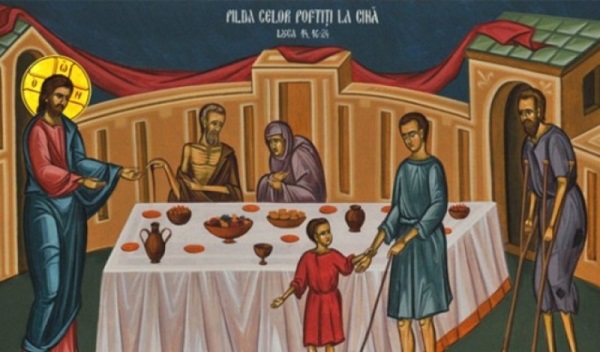
The Great Banquet


Second Sunday after Trinity

“Then the master told his servant, ‘Go out to the roads and country lanes and make them come in, so that my house will be full. I tell you, not one of those men who were invited will get a taste of my banquet’” (Luke 14:23-24).

In ancient times, it was common practice to send an invitation to a banquet such as the one described in the parable Jesus tells, followed by a summons when the time for the gathering arrived (Concordia Publishing House 2009). It would certainly be considered rude to receive the first invitation, and to reject the second call (Kretzmann 1921). The servant in the parable is delivering the second call, or summons.

In the parable of the Great Banquet, God invites His people, the Jews, to the banquet and they refuse the invitation. The people who receive the invitation in the parable are preoccupied with their sin. They persevere in sins without repentance, and they reject the gracious invitation (McCain 2005). The excuses given by the invited guests for why they were rejecting the invitation all involve worldly concerns. They are concerned with their immediate circumstances and happiness. They are fixated on finding happiness, fulfillment, or salvation in their businesses, their property, and their familial relationships. They should instead be looking forward to the joys of the banquet to which they had been invited (Kretzmann 1921). The fact that the excuses of the invited guests are all temporal in nature implies that Israel, as a group, was focused on earthly things. They were looking for a political fulfillment of God’s promise to raise up David’s fallen tent.[1] They expected the Messiah to build an earthly kingdom, and to redeem Israel in a political way by making them a great nation as they were under King David (Kretzmann 1921).

God, the master in this parable, sent the invitation to His great banquet to His chosen guests through Moses and the prophets. John the Baptist came as the herald announcing that the time had come. The kingdom of God, which is the preaching of Christ, was at hand. All the invited guests should come to the banquet (Kretzmann 1921). But Israel, as a whole, rejected the invitation. Jesus turns from the Jews, though He longed to gather them as a hen gathers her chicks, because they refused to be so gathered.[2] He invites the spiritually blind, poor, and lame: tax collectors and sinners, and gentiles. They will fill his house.

No one can come to the banquet without an invitation. God, however, has invited all people through His word. He who remains outside of the banquet only has himself to blame (Prange 1988). God would indeed be a liar and a hypocrite if His invitation were extended to all people through His word, but secretly in His heart He knew there were some people He would damn anyway, no matter what. God condemns this type of wickedness.[3] Man is, however, responsible for his own damnation by resisting and rejecting the Holy Spirit as He works through God’s word (McCain 2005). Since man cannot desire what is spiritually good because of his corrupt nature, man must be compelled by the preaching of the Law to know his helplessness. When this work of showing man his sin, and his need for a Savior is done, he is given the good news of the Gospel: that at just the right time, while we were still sinners and enemies of God, Christ died as the atonement for our sins, and the sins of the whole world; and that Jesus rose from the dead for our justification. God drives and gathers His elect together in this way (Kretzmann 1921). Those people who despise God’s call through the preaching of the Law and Gospel are barred from God’s house, and the wedding feast of the Lamb, by their own fault (Kretzmann 1921).

The parable of the Great Banquet shows that multitudes of people will enter the kingdom of heaven, though Jesus doesn’t give a specific number (Prange 1988). This filling of the house for the great banquet should call to mind the vision of John recorded in Revelation 7: John heard the number of the Elect – 144,000. But when he looked, he saw many more people than that specific number. He saw a great multitude that no one could count, from every nation, tribe, people, and language before the throne and in front of the Lamb.[4] God does not desire the death of the wicked, but that he would turn from his evil ways and live.[5] The guests who refuse the invitation to the banquet are the Jews. Those brought into the banquet in their stead are the gentiles. The point is, God prepares the banquet, makes the invitation, brings in the guests, and even provides the proper clothing to His guests.[6] No one can force his way into the banquet; he can only refuse to come. And Jesus warns Jew and gentile alike that God’s judgment will fall on all those who show contempt for His word. ###


Bibliography

Concordia Publishing House. The Lutheran Study Bible. Edited by Edward A Engelbrecht, et al. Saint Louis, MO: Concordia Publishing House, 2009.

Kretzmann, Paul E. Popular Commentary of the Bible: New Testament. Vol. 1. 2 vols. St. Louis: Concordia Publishing House, 1921.

McCain, Paul T., et. al., ed. Concordia: The Lutheran Confessions. A reader's edition of the Book of Concord. 1st. St. Louis: Concordia Publishing House, 2005.

Pieper, Francis. Christian Dogmatics. Vol. 1. ebook. St. Louis, 1950.

Prange, Victor H. The People's Bible Commentary: Luke. Milwaukee: Northwestern Publishing House, 1988.


[1] Amos 9:11; Acts 15:14-19
[2] Matthew 23:37
[3] Psalm 5:9; 12:2-4
[4] Revelation 7:4, 9
[5] Ezekiel 18:30-32; 33:19; 2 Peter 3:9
[6] Matthew 22:1-14

Monday, November 12, 2018

Israel's Rejection Not Final

Concerning the gospel they [the Jews] are enemies for your sake, but concerning the election they are beloved for the sake of the fathers. For the gifts and the calling of God are irrevocable. For as you were once disobedient to God, yet have now obtained mercy through their disobedience, even so these also have now been disobedient, that through the mercy shown you they also may obtain mercy. For God has committed them all to disobedience, that He might have mercy on all. Oh, the depth of the riches both of the wisdom and knowledge of God! How unsearchable are His judgments and His ways past finding out! (Romans 11:28-33).


No one was ever saved by virtue of their physical, genetic connection to Abraham. God has always considered those to be children of Abraham – Israel, God’s chosen people – who were Abraham’s children by faith. Jesus makes this case to the Pharisees in chapter eight of St. John’s Gospel.[1] Jesus says that the Pharisees, because of their unbelief, are not children of Abraham, but of the devil, because Abraham believed God, and it was credited to him as righteousness.[2] God cultivated the nation of Israel to bring forth Jesus, the Seed. He is truly Abraham’s offspring, the promised Seed, true Israel.[3] And we know that Scripture has confined all, Jew and Gentile, under sin, that the promise of redemption might be given to all who believe.[4] It is therefore also accurate to say, as St. Paul does, that God has committed them all (the Jews) to disobedience, that He might have mercy on all.[5] This does not guarantee that all Jews, because they are Jewish, will either come to faith in Christ, or be saved according to some other plan apart from Christ. As St. Paul says elsewhere, the veil of Moses remains unlifted in the reading of the Old Testament among the Jews, because the veil is taken away in Christ.[6]

St. Paul quotes the prophet Jeremiah prophesying about the nation of Israel and their spiritual adultery, to show that not all of Israel according to the flesh (indeed, rather only a small portion of it) would come to faith in Christ and be saved. St. Paul compares the situation to that of Elijah hiding in the cave afraid for his life. Elijah laments to God that the whole of Israel has turned against God and was seeking to kill him. But God tells Elijah that God had reserved to Himself a remnant, 7,000 men who had not bowed the knee to Baal.[7] God will save the Jews, as He saved St. Paul, as He saved all of faithful Israel, as he saves Jew and Gentile today – through faith in the promised Seed, Christ.

St. Paul likens the falling away of his fellow Israelites in the flesh to branches being broken off an olive tree. Dead branches were broken off, and wild olive branches were grafted in. It is no accident that St. Paul writes this way. God called Israel, “Green Olive Tree, Lovely and of Good Fruit”.[8] But, because they broke the covenant by worshipping false gods, God, through the prophet Jeremiah, proclaimed the following: With the noise of a great tumult He has kindled fire on it, And its branches are broken.[9] But Jesus, the Seed of Abraham, the Righteous Branch, is Israel reduced to one. He did all the things Israel could not do. He kept the Law perfectly. He died as the atoning sacrifice for the sin of the world.[10] He rose from the dead. Christ conquered sin, death, and the devil; He gives us the gifts of forgiveness and eternal life that He won for us, by His grace, through faith in Him.

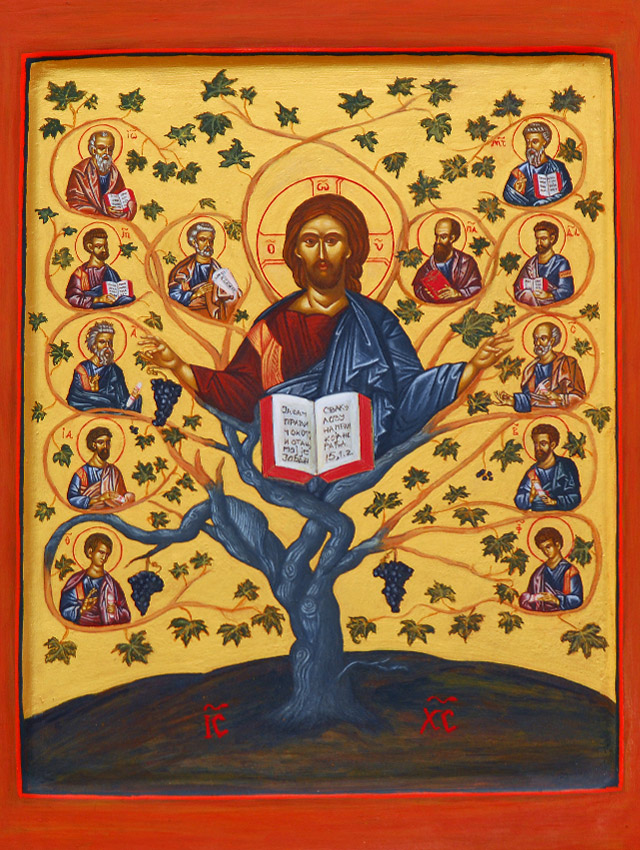
Jesus describes Himself as the True Vine, and He calls those who believe in Him branches: I am the vine, you are the branches. He who abides in Me, and I in him, bears much fruit; for without Me you can do nothing. If anyone does not abide in Me, he is cast out as a branch and is withered; and they gather them and throw them into the fire, and they are burned.[11] We are connected to Christ, the True Vine, to His death and resurrection, through baptism.[12] We are nourished through the life-giving sap of Word and Sacrament. We are fed by Christ’s true body and blood given us to eat and to drink in the Sacrament of the Altar, the Lord’s Supper. We are fed when we do not despise preaching and God’s Word, but rather hold it sacred, and gladly hear and learn it. And, as we are nourished by the True Vine, we branches bear much fruit. Cutting ourselves off from these things is to cut one’s self off from the True Vine. A severed branch remains green and supple for a short time after it is cut, but is soon dry and dead. Such is the risk we run when we neglect the assembling of ourselves together.[13]

All Israel will indeed be saved. True Israel, those connected to the True Vine, do not reject the call of repentance, and the gift of forgiveness of sins and eternal life which God gives us in Christ, through faith in Him. They, who sleep in the dust of the earth, shall awake to everlasting life on the Last Day.[14] This is the will of the Father, that everyone who sees the Son and believes in Him may have everlasting life, and be raised up at the last day.[15]


[1] John 8:37-40
[2] Galatians 3:6
[3] Genesis 22:18; Galatians 3:16
[4] Galatians 3:22
[5] Romans 11:32
[6] 2 Corinthinas 3:16
[7] 1 Kings 19:18; Romans 11:4
[8] Jeremiah 11:16
[9] Ibid.
[10] 1 John 4:10
[11] John 15:5-6
[12] Romans 6:3-5
[13] Hebrews 10:25
[14] Daniel 12:1-3;
[15] John 6:39-40

Wednesday, June 22, 2016

Conversion and Repentance

The Good Shepherd, by Lucas Cranach the Elder
I was recently asked this most reasonable and logical question regarding our “decision” to become a Christian, in the comments section of a previous essay (In Response to Hans Bischof Regarding Decision Theology and Silly Arguments): Don’t we decide to accept the gift of salvation, or at least decide not to reject it? I’m compelled to respond because, for years, it was also my question. Well, sure, the thought goes, we don’t do the work of salvation – the dying on the cross, or works to atone for specific sins. It would surely follow, however, that if Jesus wants to give us a gift (forgiveness), we would have to decide either to accept or reject it.

The bottom line is this: Is there any part of my salvation that is left to me to do? I generally sum up this question by asking another – Who does the verbs? If there is something left for me to do to complete God’s saving work (synergism), then I must be sure to complete my  or I won’t be saved. If God does everything and leaves nothing to me (monergism), then God is the one responsible for my salvation from beginning to end. If that is the case, then I can have a solid assurance that it is finished and my salvation is secure (as secure as God’s promise, anyway). If, however, even the smallest part of my salvation is contingent upon something I must do, then in reality it is entirely dependent upon me and what I must do. Decision Theology, which portrays man’s decision to accept Christ as the work man does to complete God’s work of salvation, relegates Jesus to the role of a partner.

The Bible teaches that the work of salvation is monergistic, that is, it is God’s work from beginning to end. He converts us. He gives us repentance and faith. He keeps us in that faith. This is a hard pill to swallow for all people, but especially for the independent-minded American. Scripture, however, cannot be denied. What Luther wrote on a scrap of paper while lying on his death bed is surely true: Wir sind alle Bettler. Hoc est verum[1].

How does God complete this work? He doesn’t simply zap us with lightning bolts. He comes to us through means. Jesus is delivered to us through the external world, whether by reading, preaching, or the Sacraments, which are the word coupled with a physical element (bread, wine, water). The Holy Spirit then works faith in a person when and where He wills it. Repentance? This is also a gift given by God, and not something we do of our own will. This was the understanding St. Peter and those to whom he reported the conversion of the Gentiles in Acts 11 had:

“If then God gave the same gift to them as he gave to us when we believed in the Lord Jesus Christ, Who was I that I could stand in God’s way?” When they heard these things they fell silent. And they glorified God, saying, “Then to the Gentiles also God has granted repentance that leads to life” (Acts 11:17-18).
God converted those Gentiles through the word preached to them by Peter. God demonstrates this by granting them the gift of speaking in tongues, the same gift given to the Apostles. When Peter recounts all this to “those of the circumcision,” their conclusion is that God granted those Gentiles repentance. Or, said another way, God “repented” them.

Similarly, St. Paul also thought that repentance was a gift given to men, rather than a work to be performed:

And the Lord’s servant must not be quarrelsome but kind to everyone, able to teach, patiently enduring evil, correcting his opponents with gentleness. God may perhaps grant them repentance leading to a knowledge of the truth, and they may come to their senses and escape from the snare of the devil, after being captured by him to do his will (2 Timothy 2:24-26).
Paul instructs Timothy in the way he, the Lord’s servant, must act when teaching and dealing with others, especially his opponents. He is to be patient and kind, correcting error with gentleness. To what end? That he may reason his opponents into the faith using carefully crafted and rhetorically complex arguments? That they would, through an act of their will, intellectually agree with and voluntarily accept his teaching? No. Timothy is to deliver the word, as Paul describes elsewhere, “in season and out of season[2],” and God, the actor in terms of salvation, may grant them repentance leading to a knowledge of the truth. The Book of Concord (FCSD II 89), quoting Luther sums all this up nicely:

Luther says about conversion that a person is purely passive. This means a person does nothing at all toward conversion, but only undergoes what God works in him. Luther does not mean that conversion takes place without the preaching or hearing of God’s Word. Nor does he mean that in conversion no new emotion whatever is awakened in us by the Holy Spirit and no spiritual operation begun. But he means that a person by himself, or from his natural powers cannot do anything or help toward his conversion. Conversion is not only in part, but totally an act, gift, present, and work of the Holy Spirit alone. He accomplishes and does it by his power and might, through the Word, in a person’s intellect, will, and heart, “while the person does or works nothing, but only undergoes it.” It is not like a figure cut into stone, or a seal pressed into wax, which knows nothing about it, which neither sees him nor wills it. Rather it happens the way that has just been described and explained (McCain, et al. 2005).
Consider the example of the shepherd which Jesus uses in his Parable of the Lost Sheep in Luke 15. The shepherd and his interaction with his sheep can offer us insight into man’s role in his own conversion and repentance.

So He spoke this parable to them [Pharisees] saying: “What man of you, having a hundred sheep, if he loses one of them, does not leave the ninety-nine in the wilderness, and go after the one which is lost until he finds it? And when he has found it, he lays it on his shoulders rejoicing. And when he comes home, he calls together his friends and neighbors, saying to them, ‘Rejoice with me, for I have found my sheep which was lost!’ I say to you that likewise there will be more joy in heaven over one sinner who repents than over ninety-nine just persons [upright persons] who need no repentance” (Luke 15:3-7).
Jesus, in the parable, describes repentance as being found by the Good Shepherd and carried back to the sheep-fold by him. The sheep can take no action on his own, he is lost. He can only “be found” and rescued by the shepherd. Dr. Ken Bailey, author of “Finding the Lost: Cultural Keys to Luke 15,” explained in an Issues ETC interview that Jesus here means to impure the “Shepherds of Israel” for losing their sheep (Bailey 2015). Jesus, the Good Shepherd, had to come and do what they would not. He finds the sheep and carries it back on his shoulders. He “repents” it. This idea is not novel but, suggests Dr. Bailey; it is shown to us also in Psalm 23:

The LORD is my Shepherd; I shall not want. He makes me to lie down in green pastures; He leads me beside the still waters. He restores my soul; He leads me in the paths of righteousness for His name’s sake (Psalm 23:1-3).
This most famous and beloved of the Psalms describes the interaction of the Good Shepherd and his sheep. Again, God is doing the verbs – He makes me lie down; He leads me; He restores. The key word in this passage, however, is “restores.” I always got the image of a person weakened by hunger or thirst, who was restored to vigor again after being fed or given drink, when I read this in the past. Dr. Bailey, however, points out that the word translated “restore” is the Hebrew word Shuwb (pronounced “Shoob”) which means “to turn back,” or repent (Bailey 2015). He (God) repents, or turns back, my soul.

I disagree with Dr. Bailey’s choice of working when, at one point in the interview responding to a similar question to the topic of this essay, he says, “You make a decision to accept to be found” (Bailey 2015). We Lutherans don’t like the word “accept” because it smells of decision theology. The problem is that we are limited to nouns and verbs when attempting to express these ideas using language. On this side of eternity, we will not ever express it adequately.

Decision theology, as stated before, views man’s decision to accept Christ, to give him your heart, to make him lord of your life etc., as the completion of God’s salvation work. God’s work of salvation, to the contrary, is already finished. Or, in terms of the parable, the sheep is helpless to return to the fold of his own accord and the Shepherd retrieves him. The sheep “accepts” the rescue performed by the Shepherd. This act of acceptance, which is really not an act, but rather the sheep’s passive acceptance of an action done to it, does not complete the Shepherd’s rescue. Every part of conversion and repentance is effected upon us by God of his grace, through means of the external word, done by the power of the Holy Spirit.


Works Cited

Bailey, Dr. Ken, interview by Rev. Todd Wilken. Jesus, the Good Shepherd (May 7, 2015).

McCain, Paul Timothy, Robert Cleveland Baker, Gene Edward Veith, and Edward Andrew Engelbrecht, . Concordia: The Lutheran Confessions. Translated by William Hermann Theodore Dau and Gerhard Friedrich Bente. St. Louis, MO: Concordia Publishing House, 2005.


[1] When Martin Luther died on February 18, 1546, a scrap of paper was found in his pocket with his
final seven words, a mix of Latin and German. Wir sind alle Bettler. Hoc est verum —“We are
all beggars. This is true.”

[2] 2 Timothy 4:2