Concerning the gospel they [the Jews] are enemies for your sake, but concerning the election they are beloved for the sake of the fathers. For the gifts and the calling of God are irrevocable. For as you were once disobedient to God, yet have now obtained mercy through their disobedience, even so these also have now been disobedient, that through the mercy shown you they also may obtain mercy. For God has committed them all to disobedience, that He might have mercy on all. Oh, the depth of the riches both of the wisdom and knowledge of God! How unsearchable are His judgments and His ways past finding out! (Romans 11:28-33).
No one was ever saved by virtue of their physical, genetic connection to Abraham. God has always considered those to be children of Abraham – Israel, God’s chosen people – who were Abraham’s children by faith. Jesus makes this case to the Pharisees in chapter eight of St. John’s Gospel.[1] Jesus says that the Pharisees, because of their unbelief, are not children of Abraham, but of the devil, because Abraham believed God, and it was credited to him as righteousness.[2] God cultivated the nation of Israel to bring forth Jesus, the Seed. He is truly Abraham’s offspring, the promised Seed, true Israel.[3] And we know that Scripture has confined all, Jew and Gentile, under sin, that the promise of redemption might be given to all who believe.[4] It is therefore also accurate to say, as St. Paul does, that God has committed them all (the Jews) to disobedience, that He might have mercy on all.[5] This does not guarantee that all Jews, because they are Jewish, will either come to faith in Christ, or be saved according to some other plan apart from Christ. As St. Paul says elsewhere, the veil of Moses remains unlifted in the reading of the Old Testament among the Jews, because the veil is taken away in Christ.[6]
St. Paul quotes the prophet Jeremiah prophesying about the nation of Israel and their spiritual adultery, to show that not all of Israel according to the flesh (indeed, rather only a small portion of it) would come to faith in Christ and be saved. St. Paul compares the situation to that of Elijah hiding in the cave afraid for his life. Elijah laments to God that the whole of Israel has turned against God and was seeking to kill him. But God tells Elijah that God had reserved to Himself a remnant, 7,000 men who had not bowed the knee to Baal.[7] God will save the Jews, as He saved St. Paul, as He saved all of faithful Israel, as he saves Jew and Gentile today – through faith in the promised Seed, Christ.
St. Paul likens the falling away of his fellow Israelites in the flesh to branches being broken off an olive tree. Dead branches were broken off, and wild olive branches were grafted in. It is no accident that St. Paul writes this way. God called Israel, “Green Olive Tree, Lovely and of Good Fruit”.[8] But, because they broke the covenant by worshipping false gods, God, through the prophet Jeremiah, proclaimed the following: With the noise of a great tumult He has kindled fire on it, And its branches are broken.[9] But Jesus, the Seed of Abraham, the Righteous Branch, is Israel reduced to one. He did all the things Israel could not do. He kept the Law perfectly. He died as the atoning sacrifice for the sin of the world.[10] He rose from the dead. Christ conquered sin, death, and the devil; He gives us the gifts of forgiveness and eternal life that He won for us, by His grace, through faith in Him.
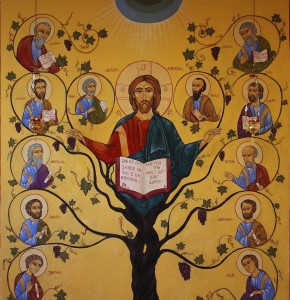
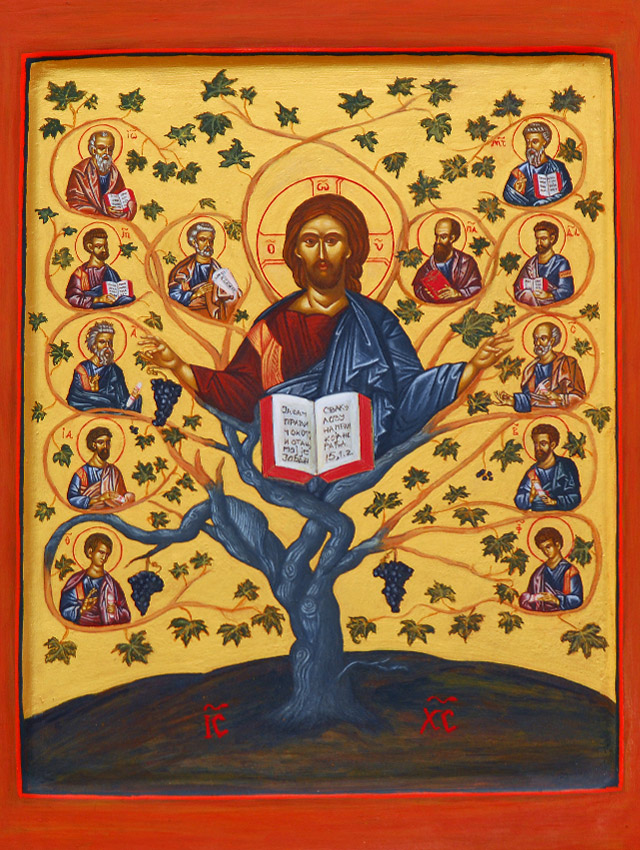
Jesus describes Himself as the True Vine, and He calls those who believe in Him branches: I am the vine, you are the branches. He who abides in Me, and I in him, bears much fruit; for without Me you can do nothing. If anyone does not abide in Me, he is cast out as a branch and is withered; and they gather them and throw them into the fire, and they are burned.[11] We are connected to Christ, the True Vine, to His death and resurrection, through baptism.[12] We are nourished through the life-giving sap of Word and Sacrament. We are fed by Christ’s true body and blood given us to eat and to drink in the Sacrament of the Altar, the Lord’s Supper. We are fed when we do not despise preaching and God’s Word, but rather hold it sacred, and gladly hear and learn it. And, as we are nourished by the True Vine, we branches bear much fruit. Cutting ourselves off from these things is to cut one’s self off from the True Vine. A severed branch remains green and supple for a short time after it is cut, but is soon dry and dead. Such is the risk we run when we neglect the assembling of ourselves together.[13]
All Israel will indeed be saved. True Israel, those connected to the True Vine, do not reject the call of repentance, and the gift of forgiveness of sins and eternal life which God gives us in Christ, through faith in Him. They, who sleep in the dust of the earth, shall awake to everlasting life on the Last Day.[14] This is the will of the Father, that everyone who sees the Son and believes in Him may have everlasting life, and be raised up at the last day.[15]