Showing posts with label Peter. Show all posts

Tuesday, June 25, 2019

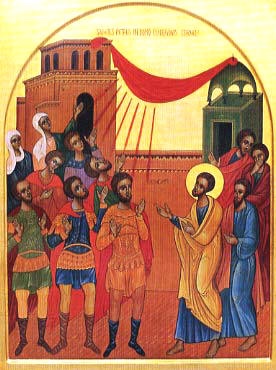
Peter Meets Cornelius

Peter meets Cornelius
Tuesday after the First Sunday after Trinity
And the following day they entered Caesarea. Now Cornelius was waiting for them, and had called together his relatives and close friends. As Peter was coming in, Cornelius met him and fell down at his feet and worshiped him. But Peter lifted him up, saying, “Stand up; I myself am also a man.” And as he talked with him, he went in and found many who had come together. Then he said to them, “You know how unlawful it is for a Jewish man to keep company with or go to one of another nation. But God has shown me that I should not call any man common or unclean. Therefore I came without objection as soon as I was sent for. I ask, then, for what reason have you sent for me?” So Cornelius said, “Four days ago I was fasting until this hour; and at the ninth hour I prayed in my house, and behold, a man stood before me in bright clothing, and said, ‘Cornelius, your prayer has been heard, and your alms are remembered in the sight of God. Send therefore to Joppa and call Simon here, whose surname is Peter. He is lodging in the house of Simon, a tanner, by the sea. When he comes, he will speak to you.’ So I sent to you immediately, and you have done well to come. Now therefore, we are all present before God, to hear all the things commanded you by God” (Acts 10:24-33).
Peter preached to the masses at Pentecost and 5,000 Christians were made. These were foreigners from many different countries, but they were all there for the feast of Pentecost; they were all Jews. Gentiles were a different story. How should they be treated? Could they jump right into the the Way, without first becoming a Jew? It shouldn’t be surprising that this issue came up. The Israelites were instructed to separate themselves from the Gentiles, or the nations, and given special laws to govern them civilly, ceremonially, and morally, to mark them as different. Paul, at one point, calls out Peter for his hypocrisy regarding interacting with Gentiles,
For before certain men came from James, he would eat with the Gentiles; but when they came, he withdrew and separated himself, fearing those who were of the circumcision.[1]
God granted a vision to both the Apostle Peter, and to Cornelius the centurion. They were, however, different visions. Peter’s was a direct prophetic revelation from God. God showed Peter a bunch of unclean animals and told him, “Kill and eat.” Upon meeting Cornelius, Peter explains that, in this vision,
“…God has shown me that I should not call any man common or unclean.”[2]
Peter is shown by God in this vision that God is the God of the gentiles as well as the Jews; In Christ there is not Jew or Gentile, slave or free, male or female for in Christ Jesus we are all one.[3]
The vision God gave to Cornelius was different. He was basically told to talk to Peter, and Peter would tell him what he needed to know. God used supernatural means to direct Cornelius to the Apostle. Why? Why not just give Cornelius the Gospel through a direct revelation? The answer is simple, if not entirely obvious: God does not wish to deal with man except through His outward Word. Jesus promised to give special revelation, and special spiritual gifts like tongue-speaking and healing, to the Apostles. He said those signs would accompany them, and act as a confirmation that the Word they proclaimed was true. He did not make such a promise to everyone. The episode of Peter and Cornelius demonstrates to us that God’s preferred method of converting men is through the means of the Word, baptizing and teaching, in no particular order.
Our Lord could have easily done to Cornelius what He did to Paul. Jesus could have appeared to Him, converted Him in a glorious and terrible flash of light, and personally taught him all the things he needed to know. He didn’t do that. That kind of communication was reserved for the Apostles, like Peter and Paul. Our Lord pointed Cornelius to Peter, a preacher of the Gospel, one of the sent-ones whose job it was to proclaim God’s Word to all people throughout the whole world.
We are not ashamed of the Gospel, for it is the power of God to salvation for all who believe, for the Jew first, then for the Gentile.[4] And we know that faith comes from the preaching, and preaching through the Word of Christ.[5]
Cornelius, living among the Jews, had heard long before about the coming Messiah, through whom he was righteous before God. In such faith, his prayers and alms were acceptable to God (since Luke calls him God-fearing). Without the Word coming first and without hearing it, he could not have believed or been righteous.[6]
After Peter preaches the Word to Cornelius and his household, a miracle happens: another Pentecost. God the Holy Spirit manifests outwardly in the speaking of tongues by those on whom He fell. Then, baptism for the whole household: “Can anyone forbid water, that these should not be baptized who have received the Holy Spirit just as we have?”[7] Baptism accompanies this preaching and teaching because, the baptizing and teaching must never be separated. They go together. They are both forms of the outward Word.
Whether it be through the proclamation of the Word in preaching, or the outward Word and promise of God of the forgiveness of sins and everlasting life in Christ’s death and resurrection joined to water, or bread and wine,
we must firmly hold that God grants His Spirit or grace to no one except through or with the preceding outward Word (Galatians 3:2, 5).[8]
The Word proclaimed by our faithful pastors from the pulpit is this same efficacious, outward Word that Peter proclaimed to Cornelius and his household. The baptism we have received, the promise that by the death and resurrection of Christ our sins have been washed away, and we have put on Christ, received the Holy Spirit, and eternal life, is the same as theirs also. Just as it did then, the outward Word creates faith in the hearts of men by the working of the Holy Spirit.
Do not despise preaching and God’s Word, but hold it sacred, and gladly hear and learn it. It is the means through which God works repentance and faith; it is the means through which He works to break our hearts and bring us to repentance for our sins, and draws us to Him through Christ, who died as the ransom for the sin of the world, and rose again. Hear the Word, repent, and believe the Gospel. Christ has redeemed you, a lost and condemned person, not with gold or silver, but with His holy, precious blood, and by His innocent suffering and death. He applies this redemption to us through the outward Word: His means of Word and Sacrament.

Bibliography

McCain, Paul T, Robert C Baker, Gene E Veith, and Edward A Engelbrecht. Concordia, The Lutheran Confessions: A Reader's Edition of the Book of Concord. 1st. Saint Louis: Concordia Publishing House, 2005.


[1] Galatians 2:11
[2] Acts 10:28
[3] Galatians 3:28
[4] Romans 1:16
[5] McCain, Paul T, Robert C Baker, Gene E Veith, and Edward A Engelbrecht, Concordia, The Lutheran Confessions: A Reader's Edition of the Book of Concord. 1st. Saint Louis: Concordia Publishing House, 2005. Romans 10:17, quoted from FC SD II, 51
[6] McCain, et. al. Concordia, The Lutheran Confessions, SA III, VIII, 8
[7] Acts 10:47
[8] McCain, et. al., Concordia, The Lutheran Confessions, SA III VIII 3

Tuesday, June 18, 2019

The Name of Jesus Forbidden

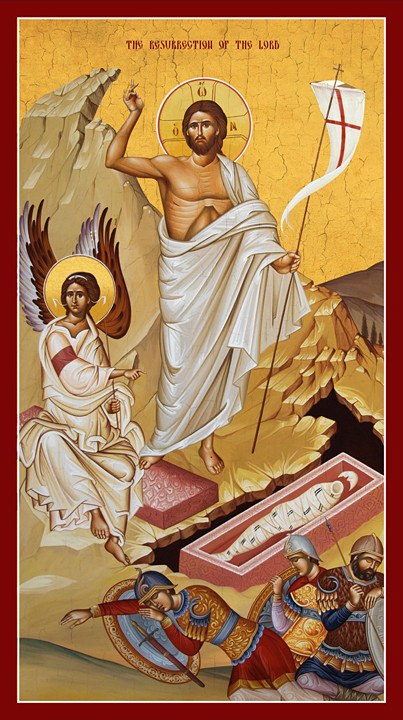
Icon of the Resurrection

June 18, 2019 - Tuesday after Trinity 

Now as they spoke to the people, the priests, the captain of the temple, and the Sadducees came upon them, being greatly disturbed that they taught the people and preached in Jesus the resurrection from the dead. And they laid hands on them, and put them in custody until the next day, for it was already evening. However, many of those who heard the word believed; and the number of the men came to be about five thousand... Now when they saw the boldness of Peter and John, and perceived that they were uneducated and untrained men, they marveled. And they realized that they had been with Jesus. And seeing the man who had been healed standing with them, they could say nothing against it... So they called them and commanded them not to speak at all nor teach in the name of Jesus. But Peter and John answered and said to them, “Whether it is right in the sight of God to listen to you more than to God, you judge. For we cannot but speak the things which we have seen and heard.” So when they had further threatened them, they let them go, finding no way of punishing them, because of the people, since they all glorified God for what had been done (Acts 4:1-4, 13-14, 18-21).


The Sadducees were offended that the Apostles were teaching the resurrection of the dead. They were the ones whom Jesus silenced, along with the Pharisees and the Scribes, the account of which is recorded in Matthew 22. The Sadducees come up with this ridiculous illustration of a married man who dies, leaving his wife to be married to his succession of brothers. The brothers also die, each leaving the woman a widow. They ask the sarcastic question,

“Therefore, in the resurrection, whose wife of the seven will she be? For they all had her.”[1]
The Sadducees didn’t believe in the resurrection, and may have even denied the immortality of the soul; unlike the Pharisees, the Sadducees only accepted the Torah (the first five books of the Bible, known as the Books of Moses) as authoritative scripture.[2] Matthew records Jesus silencing the Sadducees saying,

“You are mistaken, not knowing the Scriptures nor the power of God. For in the resurrection they neither marry nor are given in marriage, but are like the angels of God in heaven. But concerning the resurrection of the dead, have you not read what was spoken to you by God saying, ‘I am the God of Abraham, the God of Isaac, and the God of Jacob’? God is not the God of the dead, but of the living.”[3]
In arguing with Jesus about the resurrection, the Sadducees treat it as an absurd idea. Jesus, using scripture only from the Torah, interestingly enough, asserts the resurrection as a fact: God is not the God of the dead, but of the living. He quotes Moses, an authority the Sadducees recognize, to make the point that,

Though at Moses’ time the patriarchs were long dead, God identifies Himself as being their God. Only living people can have a God; therefore, if He is their God, they are alive, their souls are with Him, and their bodies will be raised.[4]
We live in the same world Peter and John lived in. We like to think ours is different and better than theirs, but it isn’t. In terms of hostility to the Gospel, things remain the same. We do not have the Sadducees to mock the resurrection, but there are plenty of others who are just as triggered by any such preaching, and forbid the name of Jesus. 

We tend to think that the ancients were less intelligent than we modern folk; if we are being charitable, we might say they were limited in their understanding of the natural world. The word primitive comes to mind. Our modern life certainly looks different from the life of the 1st Century Roman Empire; I like my air conditioning and my internet, and don’t want to trade them for life in that society. But modern technology, while it makes life more comfortable and convenient, does not change the nature of man. The Sadducees rejected the resurrection because they didn’t believe the scriptures; they rejected Christ, just like people who are faithless and resist the Holy Spirit today. Peter and John weren’t preaching the resurrection because they had a primitive understanding of science, or were superstitious, or were uneducated. They proclaimed Christ crucified and risen from the dead because they saw Him alive after He died on the cross. They knew it to be true. They knew it was true for them, and for the whole world, that Jesus paid the ransom for sin, and in Christ they would have forgiveness and eternal life. No amount of ridicule, persecution, no threat of beatings, imprisonment, or death by the most horrific means, could dissuade them from making disciples of all nations, baptizing and teaching all that Jesus commanded.

That is precisely what happened. The Apostles were all murdered for their faith, with the exception of John, who suffered imprisonment and exile. This is a profound piece of information that strengthens the credibility of Christianity. The fact that a person who believes a religion may be willing to die for that religion doesn’t prove that that religion is true. There are plenty of Muslims who are willing to seek out death for Islam. The Apostles, however, were either first-hand witnesses to the resurrection of Jesus, or perpetrators of the biggest hoax in history. I have not met the man who was willing to die for something he knew to be a lie. If the Apostles had stolen Jesus’ body and made up the resurrection, that would be them. Men have been willing to die for causes and ideas in which they believed that were later discredited, like National Socialism, or which way the toilet paper should be put on the roll (the proper way is over the front, as this link will decisively prove once and for all). I have never heard of a man who was willing to submit to a gruesome death by torture for a claim they knew to be false, rather than to renounce it and live.

The Apostles went joyfully to their beheadings, crucifixions, stoning, and burnings. They were tortured and fed to wild animals for the entertainment of the pagan masses. To avoid it, all they had to do was say they were lying, that they made it all up. Sure, they would be ridiculed and ostracized, but if this life is all that there is, wouldn’t that be preferable to a painful death? But they couldn’t deny Jesus. They saw Him, the one who lives, and was dead, and is alive forevermore, the one who has the keys of death and the grave, the Alpha and the Omega, the Beginning and the End, who is and who was and who is to come, the Almighty.[5] Jesus had conquered sin and death, and promised them eternal life. In the grand scheme of things, for the sake of eternity in a new and perfect creation without sin or death, with a new and perfect body, living in relation to God as man was intended, what is a little bodily suffering here in this veil of tears?

This is the faith created in the Apostles through the Word, by the working of the Holy Spirit. It is the same faith that lives in us by the same means. We look forward to the same things they looked forward to. They saw and believed. We have heard their account, attested to by their signs and wonders, and believed: “Blessed are those who have not seen and yet have believed.”[6]

The world is sorely grieved
Whenever it is slighted
Or when its hollow fame
And honor have been blighted.
Christ, Thy reproach I bear
Long as it pleaseth Thee;
I’m honored by my Lord - What is the world to me![7]

The world with wanton pride
Exalts its sinful pleasures
And for them foolishly
Gives up the heavenly treasures.
Let others love the world
With all its vanity;
I love the Lord, my God - What is the world to me![8]


[1] Matthew 22:28
[2] Harrison, Everett F, Geoffrey W Bromiley, and Carl F Henry,. Wycliffe Dictionary of Theology. Peabody, Massachusetts: Hendrickson Publishers, Inc., 1990.
[3] Matthew 22:29-32
[4] Engelbrecht, Rev. Edward A., ed. The Lutheran Study Bible. Saint Louis: Concordia Publishing House, 2009.
[5] Revelation 1:18, 8
[6] John 20:29
[7] Ev. Luth. Synodical Conference of North America. The Lutheran Hymnal. Saint Louis: Concordia Publishing House, 1941. Hymn #430, stz. 5
[8] Ev. Luth. Synodical Conference of North America. The Lutheran Hymnal. Saint Louis: Concordia Publishing House, 1941. Hymn #430, stz. 6

Sunday, August 4, 2013

The Law of Love Toward the Enemy - I

“You have heard that it was said, ‘An eye for an eye and a tooth for a tooth.’ But I say to you, Do not resist the one who is evil. But if anyone slaps you on the right cheek, turn to him the other also. And if anyone would sue you and take your tunic, let him have your cloak as well. And if anyone forces you to go one mile, go with him two miles. Give to the one who begs from you, and do not refuse the one who would borrow from you (Matthew 5:38-42).

Nearly everyone has heard the phrase, "An eye for an eye." People, however, often have a mistaken notion of what it means. Gandhi is famously, even if probably erroneously, credited with saying, "An eye for an eye will make the world blind," as an argument for pacifism. This jejune use of the phrase "an eye for an eye" demonstrates the worldly misunderstanding of what it actually means in context. This phrase "an eye for an eye" is often used by people to justify retaliation against another person to get even for some wrong that was done to them. After all, the Bible says, "An eye for an eye and a tooth for a tooth." But that isn't really what that phrase means at all. Jesus, in Matthew chapter five, is referring back to what is written in Exodus 21 before making his point:

When men strive together and hit a pregnant woman, so that her children come out, but there is no harm, the one who hit her shall surely be fined as the woman's husband shall impose on him, and he shall pay as the judges determine. But if there is harm, then you shall pay life for life, eye for eye, tooth for tooth, hand for hand, foot for foot, burn for burn, wound for wound, and stripe for stripe (Exodus 21:22-25).

This passage, far from being an authorization to exact revenge on those who wrong you like some kind of Biblically sanctioned Beatrix Kiddo, comes from Israelite civil law. The government has this authority from God, through his law, to punish wrongdoing and exact retribution. In this passage from Exodus we see the guide which the civil authorities were to follow - "An eye for an eye." Or, as we might say today, "The punishment must fit the crime." The Pharisees interpreted this passage in the selfish and individualistic way common wisdom prods us all to - that each individual has the right to take revenge and to exact compensation for himself (Kretzmann, 1921). Jesus, however, brings us back to the proper perspective. It is not the duty, or even the right, of an individual to exact revenge for himself. To the contrary, Jesus' explanation of how individuals are to act toward each other provides the basis for another familiar saying - "turn the other cheek". Jesus' interpretation is supported by the Word of God as recorded in Leviticus:

You shall not hate your brother in your heart, but you shall reason frankly with your neighbor, lest you incur sin because of him. You shall not take vengeance or bear a grudge against the sons of your own people, but you shall love your neighbor as yourself: I am the LORD (Leviticus 19:17-18).

Rather than being a pronouncement of civil law dealing with how individuals relate to each other in the civil realm and mediated by the civil authorities, this passage from Leviticus governs the attitude individuals are to have toward one another as, well, individuals. God explains that he his holy and that he wants his holiness to be reflected in the lives and conduct of his people. God pays back evildoers, so thoughts of personal revenge and violence are prohibited (The Lutheran Study Bible, 2008):

The LORD is a God who avenges. O God who avenges, shine forth...The LORD is a jealous and avenging God; the LORD takes vengeance and is filled with wrath. The LORD takes vengeance on his foes and vents his wrath against his enemies (Psalm 94:1; Nahum 1:2). 

Kretzmann provides the following explanation:

There is a climax in the examples chosen by Christ; injury goes from bad to worse. There will be times and circumstances when love will be ready patiently to suffer the repetition of the same injury: the disgrace of being struck with the palm of the open hand, the humiliation of giving up the more costly mantle or toga together with the tunic or undergarment, the demand and even the compulsion, coming probably from a soldier, to accompany him for some distance and assist him with his baggage. A Christian will, so far as his person alone is concerned, render such exacted service cheerfully and do more than is asked, rather than submit to the inevitable in a sullen manner. On the other hand, of course, such passive behavior must cease as soon as it comes into conflict with the law of love. A disciple of Christ has duties toward his family, his community, his country, which will sometimes compel him to protect and defend them against injustice and insult. But for the individual it is true: he that magnanimously bears, overcomes. Rather than harbor evil, vengeful thoughts and desires, the Christian will be ready to render assistance whenever this is needed (Kretzmann, 1921).

This attitude of Christ, however, goes against every instinct we have as human beings. This should not surprise us, though, since our instincts, just like every other part of us, is corrupt and sinful. We are not supposed to retaliate against our neighbor for the wrongs committed against us, but we do. Rather than fighting with the one who would argue, we should settle out disagreements, even when that means giving up more of what is rightfully ours. When people say things about us that are not true in an attempt to hurt our reputation, or they tell us lies, it is our natural instinct to respond in kind - to "tell them off" or start airing their secret sins as well in order to hurt or embarrass them. When they are hurting the way we are hurt because of what they have done to us, then we will feel good. We will be vindicated. It feels so good, at least to our flesh - to our sinful and depraved human nature - which should be our first clue to stop and think about our reaction. This is not how Jesus reacted to those who persecuted him. St. Peter writes:

He committed no sin, neither was deceit found in his mouth. When he was reviled, he did not revile in return; when he suffered, he did not threaten, but continued trusting himself to him who judges justly (1 Peter 2:22-10-23).

If anyone has a case for retaliation because of wrong-doing, it is Jesus. The Scriptures tell us that he, Jesus - God in human flesh - committed no sin. Not only did he suffer the injustice of being falsely accused, tried, and punished by men, the sinless son of God was made to be sin so that we could escape God's wrath. Though he was mocked by his lying accusers, Jesus never responded in kind. Instead he relied on God the Father who will justly punish the wicked and reward the righteous (The Lutheran Study Bible, 2008). The sinless Jesus bore the sin of the world and suffered the punishment that rightly should belong to us sinners on the cross, as the wages of sin is death. St. Peter continues:

He himself bore our sins in his body on the tree, that we might die to sin and live to righteousness. By his wounds you have been healed. For you were straying like sheep, but have now returned to the Shepherd and Overseer of your souls (1 Peter 2:24-25).

No one in this sinful, fallen world is immune from suffering, and Christians especially are not. Jesus, while he was on earth, suffered unjustly; we may also face unjust suffering and death (The Lutheran Study Bible, 2008). But, "Vengeance is mine...", as the saying goes. The thing is, we must remember that it was God who said it. Contrary to exacting vengeance upon those who sin against us, we are called to repent of our sin and be forgiven by the grace of God, through faith in the person and work of Jesus Christ. We are called to love our neighbor as ourselves and, by the working of the Holy Spirit within us, turn away from sin and the works of the flesh, and produce the fruit of the Spirit:

But I say, walk by the Spirit, and you will not gratify the desires of the flesh. For the desires of the flesh are against the Spirit, and the desires of the Spirit are against the flesh, for these are opposed to each other, to keep you from doing the things you want to do. But if you are led by the Spirit, you are not under the law. Now the works of the flesh are evident: sexual immorality, impurity, sensuality, idolatry, sorcery, enmity, strife, jealousy, fits of anger, rivalries, dissensions, divisions, envy, drunkenness, orgies, and things like these. I warn you, as I warned you before, that those who do such things will not inherit the kingdom of God. But the fruit of the Spirit is love, joy, peace, patience, kindness, goodness, faithfulness, gentleness, self-control; against such things there is no law. And those who belong to Christ Jesus have crucified the flesh with its passions and desires. If we live by the Spirit, let us also keep in step with the Spirit (Galatians 5:16-25).


Works Cited

Engelbrecht, R. E. (Ed.). (2009). The Lutheran Study Bible. Saint Louis: Concordia Publishing House.

Kretzmann, P. E. (1921). Popular Commentary of the Bible: New Testament (Vol. 1). St. Louis, MO, USA: Concordia Publishing House.