Showing posts with label Abraham. Show all posts

Friday, November 16, 2018

Faithful Abraham

By faith Abraham obeyed when he was called to go out to the place which he would receive as an inheritance. And he went out, not knowing where he was going. By faith he dwelt in the land of promise as in a foreign country, dwelling in tents with Isaac and Jacob, the heirs with him of the same promise; for he waited for the city which has foundations, whose builder and maker is God. By faith Sarah herself also received strength to conceive seed, and she bore a child when she was past the age, because she judged Him faithful who had promised. Therefore from one man, and him as good as dead, were born as many as the stars of the sky in multitude—innumerable as the sand which is by the seashore. These all died in faith, not having received the promises, but having seen them afar off were assured of them, embraced them and confessed that they were strangers and pilgrims on the earth (Hebrews 11:8-13).

The author of the letter to the Hebrews is trying to convince his readers not to abandon the faith. The Jews who left Judaism to follow Christ were being persecuted. Rather than turn back, the author urges them to go on to perfection.[1] He makes the case that what they have as Christians is better than what they would have if they returned to Judaism. The sacrifice Christ made outside the camp was better than the now empty sacrifice being offered in the temple. The only things that waited for them there were the imperfect sacrifices, which were types and shadows of the one perfect atoning sacrifice for sin – that of Christ on the cross. The Mosaic covenant was made obsolete by Christ. Jesus is better than what He replaced. I’m sure that, in the face of persecution and death, having faith in Jesus didn’t feel better. That’s why the recipients of this letter were considering abandoning it, and returning to Judaism, going back “inside the camp”, so to speak. But the author makes the case that “Christ is better than the angels, for they worship Him. He is better than Moses, for He created him. He is better than the Aaronic priesthood for His sacrifice was once for all time. He is better than the law, for He mediates a better covenant. In short, there is more to be gained in Christ than to be lost in Judaism.”[2]

The author of the letter to the Hebrews uses many Old Testament figures as examples for his readers of what it means to be in the faith. He writes, “Now faith is the substance of things hoped for, the evidence of things not seen.”[3] But he doesn’t mean hope, as we might normally think of the word. He is not talking simply about a strong desire for a thing to happen, as we may hope the Chicago Cubs will (or, perhaps, will not, depending on your geographic location) win another World Series next year. Here the word hope means something more like a feeling of trust, or an expectation that isn’t in doubt. Though the Cub’s prospects for a World Series next year may be bright, they are anything but assured. One of the examples the author gives is Abraham. Abraham lived the life of a wandering nomad. He did not live to see his descendants become as numerous as sand on the seashore, in the Promised Land flowing with milk and honey. But, in spite of this, and all the hardships that made Abraham’s life difficult, he had faith in God’s Word of promise. When Sarah died, he bought a piece of property on which to bury her in the land of Canaan, because he believed God’s word that it would one day belong to his seed. Through faith, it was his already, though Abraham acknowledged, at the present, he was a sojourner: I am a foreigner and a visitor among you.[4]

We, and the people to whom the author of this letter wrote, have seen the fulfillment of God’s promise. Christ, the promised Seed of Abraham, was born in the flesh; He died for our sins according to the Scriptures. He was buried, and He rose again on the third day according to the Scriptures. And, though we who are living today are not eyewitnesses of Jesus’ death and resurrection, we have the reliable testimony of those who saw the risen Jesus with their own eyes, in the pages of Holy Scripture. Jesus told the Pharisees, “Your father Abraham rejoiced to see My day, and he saw it, and was glad.”[5] Abraham saw Jesus’ day through the eyes of faith, just as we do. And, just as Abraham was glad, we also can be glad. It may not feel like it to us at the moment, but we have all of what God the Father promises us in Christ Jesus. His gifts of forgiveness and eternal life belong to us right now. They are our present possession, through faith in Jesus. As we live out our lives, serving others according to our vocation, waiting for Christ to return on the Last Day to make all things new, we acknowledge the same reality that Abraham acknowledged when he bought that piece of land in Canaan: We are, until Christ returns, foreigners here. Therefore let us go forth to Jesus, outside the camp, bearing His reproach. For here we have no continuing city, but we seek the one to come.[6]


[1] Hebrews 6:1
[2] The Holy Bible, New King James Version, Reference Edition. Nashville, TN: Thomas Nelson, 2010. Text taken from the introduction of the Epistle to the Hebrews.
[3] Hebrews 11:1
[4] Genesis 23:4
[5] John 8:56
[6] Hebrews 13:13-14

Monday, November 12, 2018

Israel's Rejection Not Final

Concerning the gospel they [the Jews] are enemies for your sake, but concerning the election they are beloved for the sake of the fathers. For the gifts and the calling of God are irrevocable. For as you were once disobedient to God, yet have now obtained mercy through their disobedience, even so these also have now been disobedient, that through the mercy shown you they also may obtain mercy. For God has committed them all to disobedience, that He might have mercy on all. Oh, the depth of the riches both of the wisdom and knowledge of God! How unsearchable are His judgments and His ways past finding out! (Romans 11:28-33).


No one was ever saved by virtue of their physical, genetic connection to Abraham. God has always considered those to be children of Abraham – Israel, God’s chosen people – who were Abraham’s children by faith. Jesus makes this case to the Pharisees in chapter eight of St. John’s Gospel.[1] Jesus says that the Pharisees, because of their unbelief, are not children of Abraham, but of the devil, because Abraham believed God, and it was credited to him as righteousness.[2] God cultivated the nation of Israel to bring forth Jesus, the Seed. He is truly Abraham’s offspring, the promised Seed, true Israel.[3] And we know that Scripture has confined all, Jew and Gentile, under sin, that the promise of redemption might be given to all who believe.[4] It is therefore also accurate to say, as St. Paul does, that God has committed them all (the Jews) to disobedience, that He might have mercy on all.[5] This does not guarantee that all Jews, because they are Jewish, will either come to faith in Christ, or be saved according to some other plan apart from Christ. As St. Paul says elsewhere, the veil of Moses remains unlifted in the reading of the Old Testament among the Jews, because the veil is taken away in Christ.[6]

St. Paul quotes the prophet Jeremiah prophesying about the nation of Israel and their spiritual adultery, to show that not all of Israel according to the flesh (indeed, rather only a small portion of it) would come to faith in Christ and be saved. St. Paul compares the situation to that of Elijah hiding in the cave afraid for his life. Elijah laments to God that the whole of Israel has turned against God and was seeking to kill him. But God tells Elijah that God had reserved to Himself a remnant, 7,000 men who had not bowed the knee to Baal.[7] God will save the Jews, as He saved St. Paul, as He saved all of faithful Israel, as he saves Jew and Gentile today – through faith in the promised Seed, Christ.

St. Paul likens the falling away of his fellow Israelites in the flesh to branches being broken off an olive tree. Dead branches were broken off, and wild olive branches were grafted in. It is no accident that St. Paul writes this way. God called Israel, “Green Olive Tree, Lovely and of Good Fruit”.[8] But, because they broke the covenant by worshipping false gods, God, through the prophet Jeremiah, proclaimed the following: With the noise of a great tumult He has kindled fire on it, And its branches are broken.[9] But Jesus, the Seed of Abraham, the Righteous Branch, is Israel reduced to one. He did all the things Israel could not do. He kept the Law perfectly. He died as the atoning sacrifice for the sin of the world.[10] He rose from the dead. Christ conquered sin, death, and the devil; He gives us the gifts of forgiveness and eternal life that He won for us, by His grace, through faith in Him.

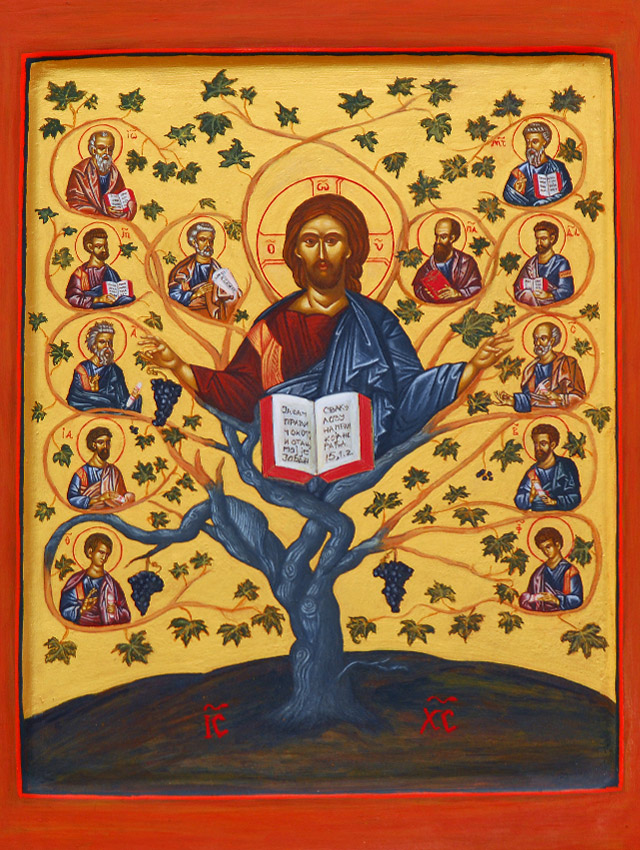
Jesus describes Himself as the True Vine, and He calls those who believe in Him branches: I am the vine, you are the branches. He who abides in Me, and I in him, bears much fruit; for without Me you can do nothing. If anyone does not abide in Me, he is cast out as a branch and is withered; and they gather them and throw them into the fire, and they are burned.[11] We are connected to Christ, the True Vine, to His death and resurrection, through baptism.[12] We are nourished through the life-giving sap of Word and Sacrament. We are fed by Christ’s true body and blood given us to eat and to drink in the Sacrament of the Altar, the Lord’s Supper. We are fed when we do not despise preaching and God’s Word, but rather hold it sacred, and gladly hear and learn it. And, as we are nourished by the True Vine, we branches bear much fruit. Cutting ourselves off from these things is to cut one’s self off from the True Vine. A severed branch remains green and supple for a short time after it is cut, but is soon dry and dead. Such is the risk we run when we neglect the assembling of ourselves together.[13]

All Israel will indeed be saved. True Israel, those connected to the True Vine, do not reject the call of repentance, and the gift of forgiveness of sins and eternal life which God gives us in Christ, through faith in Him. They, who sleep in the dust of the earth, shall awake to everlasting life on the Last Day.[14] This is the will of the Father, that everyone who sees the Son and believes in Him may have everlasting life, and be raised up at the last day.[15]


[1] John 8:37-40
[2] Galatians 3:6
[3] Genesis 22:18; Galatians 3:16
[4] Galatians 3:22
[5] Romans 11:32
[6] 2 Corinthinas 3:16
[7] 1 Kings 19:18; Romans 11:4
[8] Jeremiah 11:16
[9] Ibid.
[10] 1 John 4:10
[11] John 15:5-6
[12] Romans 6:3-5
[13] Hebrews 10:25
[14] Daniel 12:1-3;
[15] John 6:39-40

Tuesday, August 7, 2018

Righteous Israel Shall Live By Faith

O foolish Galatians! Who has bewitched you that you should not obey the truth, before whose eyes Jesus Christ was clearly portrayed among you as crucified? This only I want to learn from you: Did you receive the Spirit by the works of the law, or by the hearing of faith? Are you so foolish? Having begun in the Spirit, are you now being made perfect by the flesh? Have you suffered so many things in vain—if indeed it was in vain? Therefore He who supplies the Spirit to you and works miracles among you, does He do it by the works of the law, or by the hearing of faith?— just as Abraham “believed God, and it was accounted to him for righteousness.” Therefore know that only those who are of faith are sons of Abraham. And the Scripture, foreseeing that God would justify the Gentiles by faith, preached the gospel to Abraham beforehand, saying, “In you all the nations shall be blessed.” So then those who are of faith are blessed with believing Abraham. For as many as are of the works of the law are under the curse; for it is written, “Cursed is everyone who does not continue in all things which are written in the book of the law, to do them.” But that no one is justified by the law in the sight of God is evident, for “the just shall live by faith.” Yet the law is not of faith, but “the man who does them shall live by them.”Christ has redeemed us from the curse of the law, having become a curse for us (for it is written, “Cursed is everyone who hangs on a tree”), that the blessing of Abraham might come upon the Gentiles in Christ Jesus, that we might receive the promise of the Spirit through faith (Galatians 3:1-14).

The Jews were proud of the fact that Abraham was their flesh and blood ancestor. And, because of their connection to Abraham, they were special. God says as much; God says that Abraham’s descendants would be more numerous than the stars in heaven.[1] Abraham believed the LORD and the LORD accounted Abraham’s faith in the LORD’s promise for righteousness. After the Children of Israel, the descendants of Abraham, were rescued from bondage in Egypt and were preparing to enter the Promised Land, God calls these people holy; they were chosen by God to be a people for Himself, a special treasure above all the peoples on the face of the earth.[2] God did not choose them, however, because of anything they had done; He didn’t choose them because they were more numerous than other nations; He didn’t choose them because of their wealth or military might: But because the LORD loves you, and because He would keep the oath which He swore to your fathers, the LORD has brought you out with a mighty hand, and redeemed you from the house of bondage, from the hand of Pharaoh king of Egypt.[3]

So, the physical connection to Abraham was important to the Jews, particularly the Pharisees. They thought of their ancestry in terms American Express would appreciate: Membership has its privileges. They thought that by their physical connection to Abraham they enjoyed special status with God. What they did not understand was it wasn’t any work or physical characteristic that set Israel apart. It was faith in God’s promised redemption and in His Promised Redeemer. Abraham was justified before he received the sign of circumcision, by faith.[4] The promise that Abraham would be heir to the world was not to him or his seed through the law, but through the righteousness of faith.[5] So the important connection with Abraham was not with him physically, having his blood running through your veins, but rather having the same faith in you, taking hold of those same promises of God. This is why John the Baptist would see the Pharisees and say: “Brood of vipers! Who warned you to flee from the wrath to come? Therefore bear fruits worthy of repentance, and do not say to yourselves, ‘We have Abraham as our father.’ For I say to you that God is able to raise up children to Abraham from these stones.[6] They had the same blood as Abraham, but not the same faith, and so they were not children of Abraham.

Jesus says the same thing. He shows up doing things only God can do; He forgives sins. He tells people that He is the Messiah and demonstrates the proof of His claim through Holy Scripture and by performing miracles that the Jews expected the Messiah, who was the fulfillment of all of God’s promises, to do. He teaches in the synagogues, pointing to messianic scriptures and applying them to Himself, like when He read the scroll of Isaiah and was rejected at Nazareth. Their response to Jesus proclaiming the year of the LORD’s favor was to try and throw Him off a cliff.[7] Jesus is consistently rejected by the leaders of the Jewish nation, the very people who were supposed to recognize Him, but instead gloried in their own works and flesh. “You search the scriptures,” Jesus says to the Pharisees, “for in them you think you have eternal life; and these are they which testify of Me. But you are not willing to come to Me that you may have life. [8]“ Because they rejected Him, because they did not have faith in God’s Word and promise, they were no longer children of Abraham. They were children of their father, the devil.[9] They were branches, broken off the True Vine, withered and unable to bear any fruit, fit only to be gathered into the fire and burned;[10] Their physical lineage doesn’t matter. It doesn’t matter that they are related to Abraham by blood; the righteous shall live by faith. And, as many as walk according to this rule, that of boasting not in the flesh but in the cross of Our Lord Jesus Christ, by which the world has been crucified to them, peace be upon them, and upon the Israel of God – all believers in Christ, regardless of their physical ancestry; This is the new, or more accurately, the true Israel of God, the household of faith.[11]


[1] Genesis 15:4-5
[2] Deuteronomy 7:6
[3] Deuteronomy 7:8
[4] Romans 4:9-12
[5] Romans 4:13-18
[6] Matthew 3:7-9
[7] Luke 4:16-30
[8] John 5:39-40
[9] John 8:39-47
[10] John 15:1-8
[11] Galatians 6:10

Wednesday, August 5, 2015

Replacement Theology

The altar intended for use in a rebuilt Jewish temple.
Photo credit: The Temple Institute.
“Consider Abraham: ‘He believed God, and it was credited to him as righteousness.’ Understand, then, that those who believe are children of Abraham. The Scripture foresaw that God would justify the Gentiles by faith, and announced the gospel in advance to Abraham: ‘All nations will be blessed through you." So those who have faith are blessed along with Abraham, the man of faith’ (Galatians 3:6-9).

In March 2015 a website called Breaking Israel News reported that construction of a stone altar which would berequired for renewed sacrificial service in a rebuilt Jewish temple had been completed. The altar was built by The Temple Institute, a non-profit organization in Jerusalem founded in 1987, “…dedicated to every aspect of the Biblical commandment to build the Holy Temple of G-d on Mount Moriah in Jerusalem (The Temple Institute n.d.).” Currently, the Al Aqsa mosque and the Dome of the Rock, Islamic holy sites, occupy the Temple Mount, where Jews and some Evangelical Christians envision a rebuilt Jewish temple. The Temple Institute, however, has accounted for this by designing the new altar so that it can be taken apart and reassembled, “when circumstances become favorable.”

“One thing that makes this altar unique is that it was designed to be disassembled and quickly reassembled in its correct position on the Temple Mount. According to the Temple Institute, ‘The people of Israel are required to build an altar exclusively on the site of the original altar on Mount Moriah, the Temple Mount. When circumstances become favorable, this new altar can be quickly re-assembled on the proper location, enabling the Divine service to be resumed without delay (Balofsky 2015).’”

The Divine Service mentioned in the Temple Institute’s statement is not the communion service with which Confessional Lutherans are familiar. Rather, the phrase refers to the animal sacrifices prescribed in the Old Testament.

“The base of the altar contains two portals for collecting the blood poured during animal sacrifices, in accordance with the Torah. It is also crowned with four raised corners, called horns by the Torah (Balofsky 2015).”

Religious Jews are not the only ones working toward the goal of a rebuilt temple on the Temple Mount. Evangelical Dispensational Christians such as Tim LaHaye believe that a rebuilt temple and the physical nation of Israel are integral to the plot of End-Times prophecy. Dispensationalists such as LaHaye believe that “God’s plan for history demands a consistent distinction between national Israel and the church which includes an ongoing plan for national, ethnic Israel that culminates in Christ’s millennial kingdom (Tim LaHaye Ministries n.d.).”

These Christians believe that New Testament prophecies associated with the Jewish Temple, such as Matthew 24–25 and 2 Thessalonians 2:1–12, were not completely fulfilled in 70 AD, when Jerusalem was razed by the Romans. This view is a core part of Dispensationalism, which teaches that the Jews remain God's chosen people. Dispensationalist theologians, such as LaHaye, teach that the Third Temple will be rebuilt when the Antichrist makes peace between the modern nation of Israel and its neighbors after a world war. The Antichrist is often identified as the political leader of a world-wide national alliance, often identified by leaders in the dispensational movement as the European Union or the United Nations. The Antichrist will proclaim himself to be God at the rebuilt temple and demand worship. At some point before, during, or possibly after these events, Christians will be raptured off the earth by Christ. There will be a great tribulation culminating in the battle of Armageddon, the final return of Christ, and the inauguration of the Millennial Kingdom on earth (though not necessarily in that order). At some point during these events the physical nation of Israel will be saved – converted to Christ – en masse.

The future salvation of the national Israel will result in much greater blessings to the Gentiles. It is called "life from the dead" (v. 15). This phrase is interpreted in three different ways. First, it can be seen as a literal resurrection, that is, a general resurrection from the dead leading to blessed eternal life. In other words, the conversion of Israel will signal the resurrection of the last day. The restoration of the Jews at once will bring on the end. The dead will be raised and the Messiah's kingdom will be set up glorious and incorruptible. Professor Ernst Käsemann says, "The conversion of Israel is . . . also the last act of salvation history" (Matthew 2011).

This article isn’t meant to be a survey of Dispensational teachings, though it is helpful to be familiar with the landscape of Dispensationalism when navigating through the wilderness of American Evangelicalism. The focus of this article is to examine what popular Evangelical teachers, such as Tim LaHaye, teach about Israel in relation to what the Bible says about Israel. American Evangelicals who are of a Dispensationalist flavor often accuse other confessional Christians of engaging in “replacement” theology. Replacement theology is popularly defined as the teaching that the Christian Church has replaced the Israelites as God's chosen people, and that the Mosaic covenant has been replaced or superseded by the New Covenant (Supersessionism 2015). Opponents of this Replacement Theology charge that this view leads to persecution of Jews by Christians, as they are no longer seen as favored by God. Attempts to cast so-called Replacement Theology in an unflattering light notwithstanding, it is taught in Holy Scripture and stands in direct opposition to what is taught by much of the Christian church in America today.

In Chapters 9-11 in the Book of Romans, St. Paul writes about his anguish concerning his countrymen – his people according to the flesh. St. Paul makes a distinction between the Israel of the flesh, and the Israel of God. Rather than teaching that there are two separate peoples with whom God deals differently and apart from one another, however, St. Paul laments that one group (physical Israel) is lost while the other (spiritual Israel, or the Israel of God) is redeemed through Christ.

I speak the truth in Christ—I am not lying, my conscience confirms it through the Holy Spirit— I have great sorrow and unceasing anguish in my heart. For I could wish that I myself were cursed and cut off from Christ for the sake of my people, those of my own race, the people of Israel. Theirs is the adoption to sonship; theirs the divine glory, the covenants, the receiving of the law, the temple worship and the promises. Theirs are the patriarchs, and from them is traced the human ancestry of the Messiah, who is God over all, forever praised! Amen. It is not as though God’s word had failed. For not all who are descended from Israel are Israel. Nor because they are his descendants are they all Abraham’s children. On the contrary, “It is through Isaac that your offspring will be reckoned.” In other words, it is not the children by physical descent who are God’s children, but it is the children of the promise who are regarded as Abraham’s offspring. For this was how the promise was stated: “At the appointed time I will return, and Sarah will have a son” (Romans 9:1-9).

Lenski writes the following, regarding verse 6:

He [Paul] is clearing up what may cause a difficulty for earnest Christians when they look at the position assigned to Israel in God’s Word and yet see that Israel is lost. They may think that the Word of God has dropped away, that the outcome with regard to Israel proves it to be unreliable, non-dependable. Such would be mistaken regarding Israel and regarding the Word: regarding Israel because it does not include all the physical descendants of Abraham; regarding the Word because this is promise and itself excludes unbelief and unbelievers. Not the Word has fallen by the way, ‘it liveth and abideth forever’ (I Peter 1:23); but these Israelites, despite the Word and the promises which they had, have fallen by the way (Lenski 1945).

St. Paul cites all the things God has raised up for the salvation of men through the nation of Israel – the sonship, the divine glory, the covenants, the receiving of the law, the temple worship, the promises – culminating in the very Messiah himself. But then he goes on to say that, “Not all who are descended from Israel are Israel.” In other words, not every Jew can claim to be an Israelite simply because he is a Jew. St. Paul emphasizes here, as he does in Galatians, that faith in Christ is what saves a person, not their physical lineage. Despite all of the things St. Paul mentions here, because they rejected Christ, they did not belong to God. Jesus makes this point to the Pharisees in a rather more pointed way:

[speaking to the Jews...the Pharisees], "If you were Abraham's children," said Jesus, "then you would do the things Abraham did. As it is you are determined to kill me, a man who has told you the truth that I heard from God. Abraham did not do such things. You are doing the things your own father does." "We are not illegitimate children," they protested. "The only Father we have is God himself." Jesus said to them, "If God were your Father, you would love me, for I came from God and now am here. I have not come on my own; but he sent me. Why is my language not clear to you? Because you are unable to hear what I say. You belong to your father, the devil, and you want to carry out your father's desire. He was a murderer from the beginning, not holding to the truth, for there is no truth in him. When he lies, he speaks his native language, for he is a liar and the father of lies. Yet because I tell the truth, you do not believe me! Can any of you prove me guilty of sin? If I am telling the truth, why don't you believe me? He who belongs to God hears what God says. The reason you do not hear is that you do not belong to God" (John 8:39-47).

The Pharisees are not Abraham’s offspring because they do not have faith in Christ. They have the physical blood line, but they reject the promise. This is what St. Paul is grieving in the opening verses of Romans chapter nine. St. Paul, who loves his fellow Israelites-by-blood, laments the fact that they are lost – cut off from Israel – because they reject God’s promised Messiah and do not repent of their sin.

Israel is the name God gave to Jacob in Genesis 32. This name later expanded from Jacob to all the 12 tribes of people who descended from him. Rev. Alexander Lange, preaching on Jesus’ baptism by John the Baptist, explains that God shows his love for his people Israel by calling them his “firstborn son” (Exodus 4:22). Jesus, the Son of God, however, is Israel reduced to one. Israel was to be a light to the nations by living in a special relationship to God. He would be their savior and they would be faithful and obedient. Israel, however, was not faithful and obedient to God and needed a substitute:

John [the Baptist] was calling Israel to repentance. Then God sent Jesus to John with a very special mission — Jesus would become Israel’s substitute. He would become Israel Reduced to One. He would be the Israel that Israel never could be. Jesus would succeed where Israel had failed. Just look at our text and see how Jesus reenacted Israel’s life (Matthew 3:13-17). Like Israel, Jesus passed through water. Having been baptized, he was anointed by the Holy Spirit, just like Israel. God announced that this man is his beloved, firstborn Son, just as he once did with Israel. After his baptism, Jesus wandered in the wilderness...just like Israel. He was tested...just like Israel. Unlike Israel, Jesus withstood all temptations. He did not whine when he grew hungry or worship false gods. He did not grieve God’s Spirit. Unlike Israel, Jesus was a faithful, obedient Son. Jesus carried out God’s mission perfectly. He was the Light of the Word. He drew people to himself and told people about God’s wonderful works and steadfast love. Jesus was the perfect fulfillment of Israel (Lange 2014).

St. Paul expressly teaches that there are not two peoples, Jew and Gentile, with whom God deals separately from one another. On the contrary, Israel is the Body of Christ – all those, Jew or Gentile, who have been brought to penitent faith in Christ Jesus for the forgiveness of their sins. Jew and Greek, slave and free, male and female are all one through faith in Christ. To be in Christ is to be a part of Israel.

Now before faith came, we were held captive under the law, imprisoned until the coming faith would be revealed. So then, the law was our guardian until Christ came, in order that we might be justified by faith. But now that faith has come, we are no longer under a guardian, for in Christ Jesus you are all sons of God, through faith. For as many of you as were baptized into Christ have put on Christ. There is neither Jew nor Greek, there is neither slave nor free, there is no male and female, for you are all one in Christ Jesus. And if you are Christ's, then you are Abraham's offspring, heirs according to promise (Galatians 3:24-29).

St. Paul explains that, those who have been connected to Christ through baptism have been connected to his death, and will also be connected to his resurrection.

Do you not know that all of us who have been baptized into Christ Jesus were baptized into his death? We were buried therefore with him by baptism into death, in order that, just as Christ was raised from the dead by the glory of the Father, we too might walk in newness of life. For if we have been united with him in a death like his, we shall certainly be united with him in a resurrection like his. We know that our old self was crucified with him in order that the body of sin might be brought to nothing, so that we would no longer be enslaved to sin (Romans 6:3-6).

Finally, Pieper has this to say regarding the physical nation of Israel:

It is the express declaration of the Apostle that the present state of Israel is not one of hardening of the heart, but there is a hardening only of a part of Israel, and Paul’s words (Rom. 11:32): ‘God hath concluded them all in unbelief that He might have mercy upon all,’ apply to the Jews till the end of the world. Walther says well: ‘True though it be that the Jews have crucified and rejected their own Messiah, still, according to the mystery unfolded by the Apostle, Jews shall be converted as long as Gentiles are converted. Not only will the door of grace remain open till the end, but there shall always be a number of both who actually enter the Kingdom of God’ (Pieper 1953).


Works Cited


Balofsky, Ahuva. "New Details Emerge on Rebuilt Altar of Jewish Temple." Breaking Israel News. March 23, 2015. http://www.breakingisraelnews.com/33583/new-details-emerge-rebuilt-holy-temple-jewish-world/#GuKaMp3WphwdHsCh.97 (accessed July 24, 2015).

Lange, Rev. Alexander J. "Israel Reduced to One." St. John's Lutheran Church - East Moline, IL. January 12, 2014. www.stjohnsem.org/TextSermons/.../Israel%20Reduced%20to%20One.rtf (accessed July 27, 2015).

Lenski, Dr. Richard C. H. The Interpretation of St. Paul's Epistle to the Romans. Columbus, Ohio: Wartburg Press, 1945.

Matthew, Rev. P. G. "The Salvation of the Jews." Grace Valley Christian Center. May 29, 2011. http://www.gracevalley.org/sermon_trans/2011/Salvation_of_Jews.html#f1 (accessed July 27, 2015).

Pieper, D.D., Francis. Christian Dogmatics. Vol. III. IV vols. Saint Louis: Concordia Publishing House, 1953.

"Supersessionism." Wikipedia. June 23, 2015. https://en.wikipedia.org/wiki/Supersessionism (accessed July 24, 2015).

The Temple Institute. "About The Temple Institute." The Temple Institute. https://www.templeinstitute.org/about.htm (accessed July 24, 2015).

Tim LaHaye Ministries. "Pre-Trib Doctrinal Statement." Tim LaHaye Ministries. https://www.timlahaye.com/Home/Content/517 (accessed July 24, 2015).