Friday, November 23, 2018

Make Your Calling and Election Sure

The Death of Capt. John H. Miller - Saving Private Ryan
Therefore, brethren, be even more diligent to make your call and election sure, for if you do these things you will never stumble; for so an entrance will be supplied to you abundantly into the everlasting kingdom of our Lord and Savior Jesus Christ (2 Peter 1:10-11).

It sure sounds like Peter is saying here that, in order to keep your salvation, you must do good works. In the verses immediately preceding 2 Peter 1:10, he gives us a list of things to do so we can make our calling and election sure: Add to your faith virtue… knowledge… self-control… perseverance… godliness… brotherly kindness… love.[1] Do these things and your election will be sure; stop doing them, and it won’t be. Doing this list of good works will earn you the pardon Christ has won for you. It’s like the end of the movie “Saving Private Ryan”, when Tom Hanks’ character, dying, having secured the salvation of the aforementioned Private Ryan, looks into his eyes and, with his dying breath says, “Earn this.”[2] This is the way the theologians of the Roman church in Luther’s day certainly thought about good works.

When Rome responded to the Augsburg Confession in a document called the Roman Confutation, they rejected the Lutheran insistence that the forgiveness of sins is not merited by doing good works.[3] One of the scripture texts they used to try to support their argument was 2 Peter 1:10. But, as Philip Melanchthon replied in the Apology to the Augsburg Confession: If the promise were to depend upon our works it would not be sure. If forgiveness of sins were to be given because of our works, when would we know that we had received it?[4] That’s sort of the whole idea upon which the system of indulgences that developed in the medieval church was built; You can’t be sure you’ve given enough money, or done enough good, to insure your salvation, so you’d better give and do just a little bit more. This idea of making your calling and election sure, that Peter writes about here, is often misunderstood this way by Roman Catholic and Protestant alike. Peter, however, is actually instructing us to cultivate the good works, which flow naturally out of us because of our faith in Christ, rather than doing those good works to turn us into, or insure that we remain, Christians.

James also gives this same type of exhortation. In chapter two of his letter, James says that faith without works is dead: But someone will say, “You have faith, and I have works.” Show me your faith without your works, and I will show you my faith by my works. You believe that there is one God? You do well. Even the demons believe – and tremble.[5] James is not teaching contrary to Christ, or Peter, or most notably Paul, who constantly writes that it is by grace you are saved, and not by works. To the contrary, James’ words here enhance those of Paul; James is explaining the same idea as Paul and Peter, but coming from the opposite direction. What that means is this: Paul begins by telling us that we are saved by God’s grace alone through faith in Christ, and not by works. After explaining that, Paul then exhorts the Christians who have been saved by grace through faith, to then do good works. He tells us to act like the Christians God has made us into. We are to cultivate the good works, which naturally come forth from our new nature, and we are to resist and deny the impulses and desires of the flesh: And those who are Christ’s have crucified the flesh with it’s passions and desires. If we live in the Spirit, let us also walk in the Spirit. Let us not become conceited, provoking one another, envying one another.[6] And later: For he who sows to the flesh will of the flesh reap corruption, but he who sows to the Spirit will of the Spirit reap everlasting life. And let us not grow weary while doing good, for in due season we shall reap if we do not lose heart. Therefore, as we have opportunity, let us do good to all, especially to those who are of the household of faith.[7] These exhortations come only after Paul expounds on how man is justified by faith, how the law brings a curse and it’s purpose is to show us our sin, and that we are all heirs to God’s promise in Christ.

Paul explains that, since we are baptized into Christ’s death and resurrection, we should not let sin reign in our mortal bodies. We should not obey sin’s lusts. We should not present our members as instruments of unrighteousness to sin.[8] This is also what the apostle John teaches when he writes: By this we know love, because He laid down His life for us. And we also ought to lay down our lives for the brethren. But whoever has this world’s goods, and sees his brother in need, and shuts up his heart from him, how does the love of God abide in him? My little children, let us not love in word or in tongue, but in deed and in truth.[9] This teaching, however, is no innovation of Peter, Paul, James, or John; it comes from Christ. This is what Christ is saying when He instructs the now forgiven woman caught in adultery to go forth and sin no more.[10] This is the meaning of the exhortation of both Christ and John the Baptist to bear fruit in keeping with repentance. We are forgiven, set free from sin, and bondservants to Christ; we should not waste our freedom, time, and energy pursuing opportunities to sin. We have been called to follow Christ.[11]

Melanchthon, responding to the Roman theologians, explains the folly of trying to make one’s calling sure by good works in the way they wrongly understood Peter’s words: Now you see, reader that our adversaries have not wasted any effort in learning logic, but have the art of concluding whatever pleases them from the Scriptures. For they conclude, “Make your calling sure by good works.” Therefore, they think that works merit the forgiveness of sins. This is a very nice way of thinking, if one would argue this way about a person who’s death sentence had been pardoned. “The judge commands that from now on you stop stealing for others. Therefore, you have earned the pardon from the punishment, because you no longer steal from others.” To argue in this way makes a cause out of no cause. Peter speaks of works following the forgiveness of sins and teaches why they should be done…Do good works in order that you may persevere in your calling, in order that you do not lose the gifts of your calling. They were given to you before, and not because of works that follow, which now are kept through faith.[12]

You can’t earn a gift. You can only be grateful for it. Christ has died as the atonement for the sins of the world; He rose from the grave as the conqueror or death. He gives us this gift through His Word because He loves us; we take hold of it by faith, created in us by the working of the Holy Spirit. He joins us to Him, to His death and resurrection, and gives us the Holy Spirit, in our baptism. He nourishes us, as sap flowing through a tree feeds all it’s branches, when we eat His body and drink His blood in the Lord’s Supper as He commanded. Because He has made us a new creature, He calls us to live according to the nature of that new creature, and not according to the impulses of the sinful flesh with which we must still contend, all the days of our lives. Our works are evidence of our faith.


[1] 2 Peter 1:5-7
[2] Saving Private Ryan. Directed by Steven Spielberg. Performed by Tom Hanks, Edward Burns, Tom Sizemore, Jeremy Davies, and Vin Diesel. USA: DreamWorks, 1998. https://youtu.be/Lv-67DFlOsM
[3] "The Confutatio Pontificia." The Roman Confutation 1530. Accessed November 25, 2018. http://bookofconcord.org/confutatio.php. In the twentieth article, which does not contain so much the confession of the princes and cities as the defense of the preachers, there is only one thing that pertains to the princes and cities - viz. concerning good works, that they do not merit the remission of sins, which, as it has been rejected and disapproved before, is also rejected and disapproved now.
[4] Ap. XX 87
[5] James 2:17-18
[6] Galatians 5:24-26
[7] Galatians 6:8-10
[8] Romans 6:12-13
[9] 1 John 3:16-18
[10] John 8:11
[11] Engelbrecht, Edward, et. al., eds. The Lutheran Study Bible: English Standard Version. Saint Louis: Concordia Pub. House, 2009.
[12] Ap. XX 89-90

Friday, November 16, 2018

Faithful Abraham

By faith Abraham obeyed when he was called to go out to the place which he would receive as an inheritance. And he went out, not knowing where he was going. By faith he dwelt in the land of promise as in a foreign country, dwelling in tents with Isaac and Jacob, the heirs with him of the same promise; for he waited for the city which has foundations, whose builder and maker is God. By faith Sarah herself also received strength to conceive seed, and she bore a child when she was past the age, because she judged Him faithful who had promised. Therefore from one man, and him as good as dead, were born as many as the stars of the sky in multitude—innumerable as the sand which is by the seashore. These all died in faith, not having received the promises, but having seen them afar off were assured of them, embraced them and confessed that they were strangers and pilgrims on the earth (Hebrews 11:8-13).

The author of the letter to the Hebrews is trying to convince his readers not to abandon the faith. The Jews who left Judaism to follow Christ were being persecuted. Rather than turn back, the author urges them to go on to perfection.[1] He makes the case that what they have as Christians is better than what they would have if they returned to Judaism. The sacrifice Christ made outside the camp was better than the now empty sacrifice being offered in the temple. The only things that waited for them there were the imperfect sacrifices, which were types and shadows of the one perfect atoning sacrifice for sin – that of Christ on the cross. The Mosaic covenant was made obsolete by Christ. Jesus is better than what He replaced. I’m sure that, in the face of persecution and death, having faith in Jesus didn’t feel better. That’s why the recipients of this letter were considering abandoning it, and returning to Judaism, going back “inside the camp”, so to speak. But the author makes the case that “Christ is better than the angels, for they worship Him. He is better than Moses, for He created him. He is better than the Aaronic priesthood for His sacrifice was once for all time. He is better than the law, for He mediates a better covenant. In short, there is more to be gained in Christ than to be lost in Judaism.”[2]

The author of the letter to the Hebrews uses many Old Testament figures as examples for his readers of what it means to be in the faith. He writes, “Now faith is the substance of things hoped for, the evidence of things not seen.”[3] But he doesn’t mean hope, as we might normally think of the word. He is not talking simply about a strong desire for a thing to happen, as we may hope the Chicago Cubs will (or, perhaps, will not, depending on your geographic location) win another World Series next year. Here the word hope means something more like a feeling of trust, or an expectation that isn’t in doubt. Though the Cub’s prospects for a World Series next year may be bright, they are anything but assured. One of the examples the author gives is Abraham. Abraham lived the life of a wandering nomad. He did not live to see his descendants become as numerous as sand on the seashore, in the Promised Land flowing with milk and honey. But, in spite of this, and all the hardships that made Abraham’s life difficult, he had faith in God’s Word of promise. When Sarah died, he bought a piece of property on which to bury her in the land of Canaan, because he believed God’s word that it would one day belong to his seed. Through faith, it was his already, though Abraham acknowledged, at the present, he was a sojourner: I am a foreigner and a visitor among you.[4]

We, and the people to whom the author of this letter wrote, have seen the fulfillment of God’s promise. Christ, the promised Seed of Abraham, was born in the flesh; He died for our sins according to the Scriptures. He was buried, and He rose again on the third day according to the Scriptures. And, though we who are living today are not eyewitnesses of Jesus’ death and resurrection, we have the reliable testimony of those who saw the risen Jesus with their own eyes, in the pages of Holy Scripture. Jesus told the Pharisees, “Your father Abraham rejoiced to see My day, and he saw it, and was glad.”[5] Abraham saw Jesus’ day through the eyes of faith, just as we do. And, just as Abraham was glad, we also can be glad. It may not feel like it to us at the moment, but we have all of what God the Father promises us in Christ Jesus. His gifts of forgiveness and eternal life belong to us right now. They are our present possession, through faith in Jesus. As we live out our lives, serving others according to our vocation, waiting for Christ to return on the Last Day to make all things new, we acknowledge the same reality that Abraham acknowledged when he bought that piece of land in Canaan: We are, until Christ returns, foreigners here. Therefore let us go forth to Jesus, outside the camp, bearing His reproach. For here we have no continuing city, but we seek the one to come.[6]


[1] Hebrews 6:1
[2] The Holy Bible, New King James Version, Reference Edition. Nashville, TN: Thomas Nelson, 2010. Text taken from the introduction of the Epistle to the Hebrews.
[3] Hebrews 11:1
[4] Genesis 23:4
[5] John 8:56
[6] Hebrews 13:13-14

Monday, November 12, 2018

Israel's Rejection Not Final

Concerning the gospel they [the Jews] are enemies for your sake, but concerning the election they are beloved for the sake of the fathers. For the gifts and the calling of God are irrevocable. For as you were once disobedient to God, yet have now obtained mercy through their disobedience, even so these also have now been disobedient, that through the mercy shown you they also may obtain mercy. For God has committed them all to disobedience, that He might have mercy on all. Oh, the depth of the riches both of the wisdom and knowledge of God! How unsearchable are His judgments and His ways past finding out! (Romans 11:28-33).


No one was ever saved by virtue of their physical, genetic connection to Abraham. God has always considered those to be children of Abraham – Israel, God’s chosen people – who were Abraham’s children by faith. Jesus makes this case to the Pharisees in chapter eight of St. John’s Gospel.[1] Jesus says that the Pharisees, because of their unbelief, are not children of Abraham, but of the devil, because Abraham believed God, and it was credited to him as righteousness.[2] God cultivated the nation of Israel to bring forth Jesus, the Seed. He is truly Abraham’s offspring, the promised Seed, true Israel.[3] And we know that Scripture has confined all, Jew and Gentile, under sin, that the promise of redemption might be given to all who believe.[4] It is therefore also accurate to say, as St. Paul does, that God has committed them all (the Jews) to disobedience, that He might have mercy on all.[5] This does not guarantee that all Jews, because they are Jewish, will either come to faith in Christ, or be saved according to some other plan apart from Christ. As St. Paul says elsewhere, the veil of Moses remains unlifted in the reading of the Old Testament among the Jews, because the veil is taken away in Christ.[6]

St. Paul quotes the prophet Jeremiah prophesying about the nation of Israel and their spiritual adultery, to show that not all of Israel according to the flesh (indeed, rather only a small portion of it) would come to faith in Christ and be saved. St. Paul compares the situation to that of Elijah hiding in the cave afraid for his life. Elijah laments to God that the whole of Israel has turned against God and was seeking to kill him. But God tells Elijah that God had reserved to Himself a remnant, 7,000 men who had not bowed the knee to Baal.[7] God will save the Jews, as He saved St. Paul, as He saved all of faithful Israel, as he saves Jew and Gentile today – through faith in the promised Seed, Christ.

St. Paul likens the falling away of his fellow Israelites in the flesh to branches being broken off an olive tree. Dead branches were broken off, and wild olive branches were grafted in. It is no accident that St. Paul writes this way. God called Israel, “Green Olive Tree, Lovely and of Good Fruit”.[8] But, because they broke the covenant by worshipping false gods, God, through the prophet Jeremiah, proclaimed the following: With the noise of a great tumult He has kindled fire on it, And its branches are broken.[9] But Jesus, the Seed of Abraham, the Righteous Branch, is Israel reduced to one. He did all the things Israel could not do. He kept the Law perfectly. He died as the atoning sacrifice for the sin of the world.[10] He rose from the dead. Christ conquered sin, death, and the devil; He gives us the gifts of forgiveness and eternal life that He won for us, by His grace, through faith in Him.

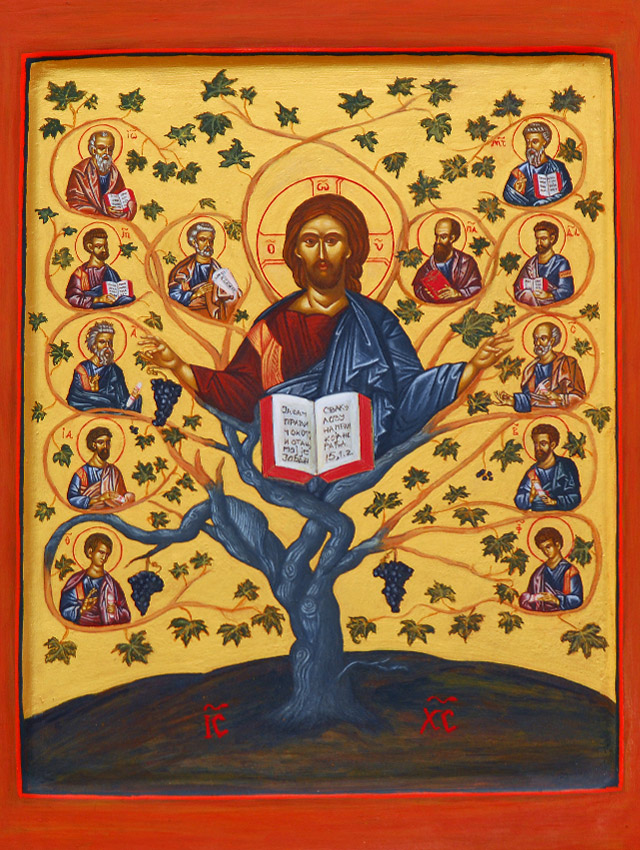
Jesus describes Himself as the True Vine, and He calls those who believe in Him branches: I am the vine, you are the branches. He who abides in Me, and I in him, bears much fruit; for without Me you can do nothing. If anyone does not abide in Me, he is cast out as a branch and is withered; and they gather them and throw them into the fire, and they are burned.[11] We are connected to Christ, the True Vine, to His death and resurrection, through baptism.[12] We are nourished through the life-giving sap of Word and Sacrament. We are fed by Christ’s true body and blood given us to eat and to drink in the Sacrament of the Altar, the Lord’s Supper. We are fed when we do not despise preaching and God’s Word, but rather hold it sacred, and gladly hear and learn it. And, as we are nourished by the True Vine, we branches bear much fruit. Cutting ourselves off from these things is to cut one’s self off from the True Vine. A severed branch remains green and supple for a short time after it is cut, but is soon dry and dead. Such is the risk we run when we neglect the assembling of ourselves together.[13]

All Israel will indeed be saved. True Israel, those connected to the True Vine, do not reject the call of repentance, and the gift of forgiveness of sins and eternal life which God gives us in Christ, through faith in Him. They, who sleep in the dust of the earth, shall awake to everlasting life on the Last Day.[14] This is the will of the Father, that everyone who sees the Son and believes in Him may have everlasting life, and be raised up at the last day.[15]


[1] John 8:37-40
[2] Galatians 3:6
[3] Genesis 22:18; Galatians 3:16
[4] Galatians 3:22
[5] Romans 11:32
[6] 2 Corinthinas 3:16
[7] 1 Kings 19:18; Romans 11:4
[8] Jeremiah 11:16
[9] Ibid.
[10] 1 John 4:10
[11] John 15:5-6
[12] Romans 6:3-5
[13] Hebrews 10:25
[14] Daniel 12:1-3;
[15] John 6:39-40

Wednesday, November 7, 2018

Signs of the End of the Age

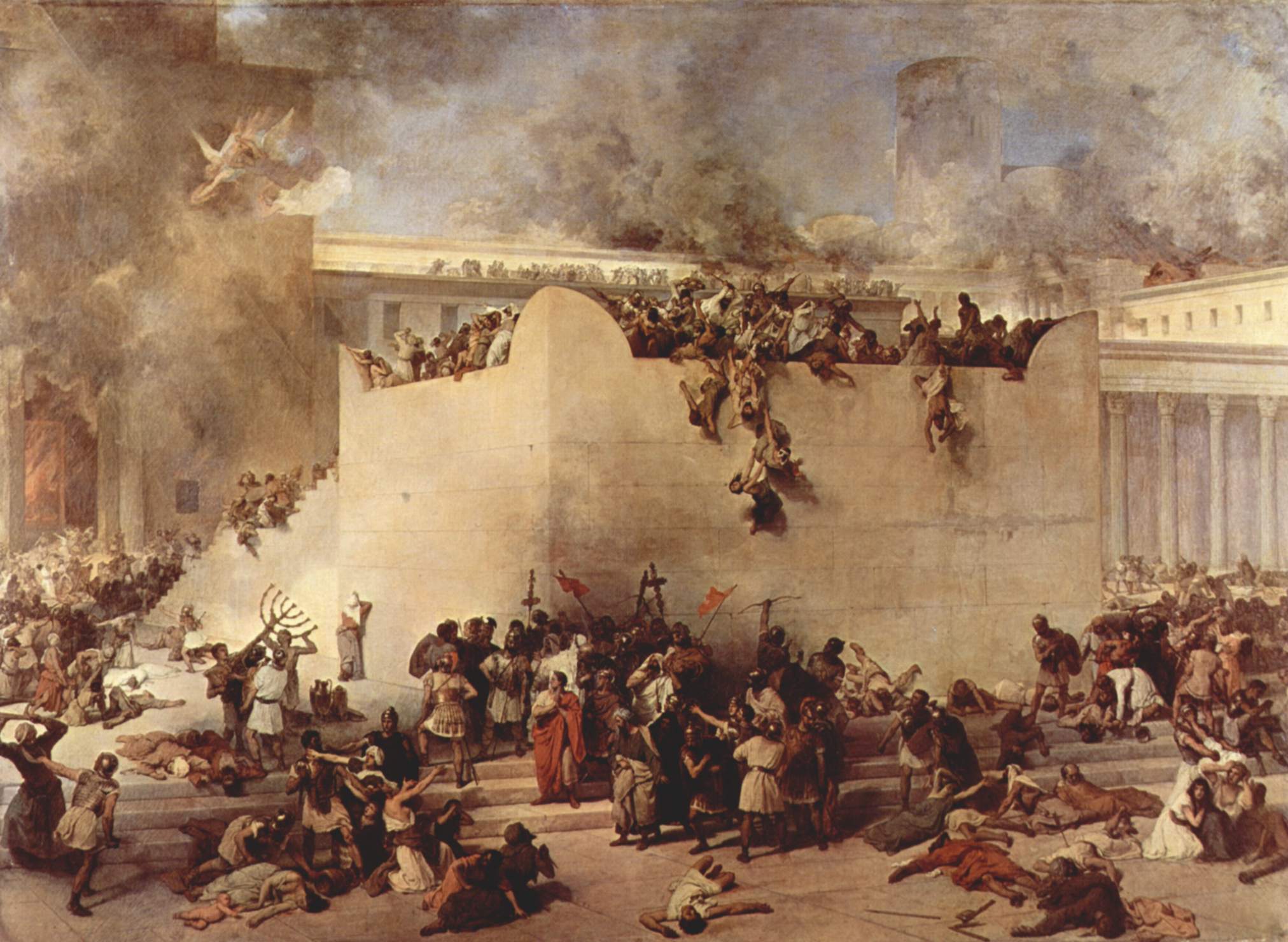
As Jesus was leaving the temple, one of his disciples said to him, “Look, Teacher! What massive stones! What magnificent buildings!” “Do you see all these great buildings?” replied Jesus. “Not one stone here will be left on another; every one will be thrown down.” As Jesus was sitting on the Mount of Olives opposite the temple, Peter, James, John and Andrew asked him privately, “Tell us, when will these things happen? And what will be the sign that they are all about to be fulfilled?” (Mark 13:1-4)

Are the disciples marveling at the sheer massiveness of the construction project that was the rebuilding of the temple? Are they imagining their reigning with Jesus over a restored kingdom of Israel from those magnificent buildings? Both possibilities have been suggested. Regardless of the motivation for their wonder, Jesus would stun His disciples with His reply: Not one stone here will be left on another; every one will be thrown down. Naturally, the disciples are disturbed. The temple was the center of Israel’s civic and religious life. It was where the sacrifice was made to atone for sin. It was the most important place in the world. For the temple to be destroyed must certainly mean the end of the world. They can’t conceive of a world without the temple. When will these things happen?

Jesus does not answer their question as they, or we, would like Him to. It would have been much less frustrating if He would simply have said something like, “Titus will destroy the temple in August, in the year 70.” But He doesn’t say that, or anything remotely like that. The first thing Jesus does is to give a warning against false doctrine: Watch out that no one deceives you. Many will come in my name, claiming, ‘I am he,’ and will deceive many. Then rather than telling them what to look for to know when the end is to come, He tells them things that are not signs of the coming destruction – wars and rumors of wars…but the end is not yet. The temple is no longer important. It is no longer the center of religious life. Jesus, the Word made flesh, through whom creation was created, came to His own and His own rejected Him.[1] The one who is the image of the invisible God,[2] in whom all the fullness of the godhead dwells bodily,[3] came to His temple, His dwelling place in Zion. He came as a sacrifice for sin.[4] He was oppressed, and He was afflicted, yet He opened not His mouth; and the LORD hath laid on Him the iniquity of us all. As Jesus left His Father’s house for the last time, He knew that His sacrifice on the cross to atone for the sins of the world would make the sacrifices at the temple obsolete. Paying attention to this building and it’s demise is not important; paying attention to, and having faith in, the one who is the completion of the temple and it’s sacrifices, the true Christ, is. Jesus calls us to repent of our sin, to have faith in Him, and to keep His word.

Jesus tells His disciples, and everyone, to watch. “When you see ‘the abomination that causes desolation’ standing where it does not belong…then let those who are in Judaea flee to the mountains.” The Christians living in Jerusalem at the time of the siege in 70 AD remembered what Jesus said and did just that. In the time preceding the destruction of Jerusalem and the temple, a sort of dress rehearsal for the Last Judgment, they also kept Jesus’ other words, His doctrines, which simply means “teachings”. They remembered not to be distressed by wars and rumors of wars; they did not believe the false Christs and false prophets who came performing signs and miracles to try and deceive them; they preached the Gospel to all nations; and they stood firm to the end in the face of the persecution, division, and death brought against them because of that Gospel. In the words of St. Paul, writing to Timothy, they watched their life and doctrine closely. We are called to watch as well. We watch for the owner of the house to return, for He comes at an hour we do not know; we also watch our life and doctrine closely, for by it, as St. Paul says, we will save ourselves and those who hear us.[5]


[1] John 1:1, 3, 10-11, 14
[2] Colossians 1:15
[3] Colossians 2:9
[4] Romans 5:6; John 1:29; 1 John 2:2
[5] 1 Timothy 4:16

Thursday, November 1, 2018

Rejoice and be Exceedingly Glad

Blessed are you when they revile and persecute you, and say all kinds of evil against you falsely for My sake. Rejoice and be exceedingly glad, for great is your reward in heaven, for so they persecuted the prophets who were before you (Matthew 5:11-12).

At the end of what has come to be called the Beatitudes, in what we have come to call the Sermon on the Mount, Jesus tells us that we are blessed when we are reviled and persecuted for His name’s sake. We should be glad and rejoice when we are so treated, because we are in the company of the prophets and Apostles, who were persecuted and martyred for the name of Christ before us.

Coptic Christians beheaded by ISIS in 2015 for their faith.
Jesus spends a lot of time talking about how the world will hate Him, His Word, and those who confess it. Jesus says: If you were of the world, the world would love its own. Yet because you are not of the world, but I chose you out of the world, therefore the world hates you.[1] He tells His disciples that there will come a time that whoever kills them will think that he offers God a service.[2] All of the Apostles, except for John, saw that time and were martyred for the name of Jesus. The continued persecution of Christians, and their gruesome beheading at the hands of men shouting “god is great”, testifies that we are still in that time. It shall remain so until Christ returns to judge the living and the dead.

So, how can we rejoice in the face of such a dismal prognosis? Peter tells us: Rejoice to the extent that you partake of Christ’s sufferings, that when His glory is revealed, you may also be glad with exceeding joy.[3] Our reproach is to Christ’s glory. We must understand, as those who have gone before us certainly did, that here we have no continuing city, but we seek the one that is to come.[4] Remembering this we can, as the author of the letter to the Hebrews directs, continually offer the sacrifice of praise to God, that is, the fruit of our lips, giving thanks to His name, not forgetting to do good.[5]

The Beatitudes are not a quid pro quo that we must do in order to get the blessings Jesus describes. We understand, rather, that the blessings Jesus describes belong to His disciples already through faith in him, according to our new nature. We were washed, we were sanctified, we were justified in the name of the Lord Jesus Christ and by the Spirit of our God.[6] This is how we can rejoice in the face of suffering, persecution, and death because of the name of Jesus that we bear through our Baptism. We have as our present possession, through faith in Christ, the forgiveness of sins and everlasting life. And we have for our examples in that faith all those brothers and sisters in Christ who have endured persecution and suffering to the end, and have fallen asleep in Jesus. And, if Our Lord should tarry, we will also go to our rest in Christ to await the resurrection of the body, and life everlasting in the new heavens and the new earth.

Despised and scorned, they sojourned here;
But now, how glorious they appear!
Those martyrs stand a priestly band,
God’s throne forever near.

So oft, in troubled days gone by,
In anguish they would weep and sigh.
At home above the God of Love
For aye their tears shall dry.

They now enjoy their Sabbath rest,
The paschal banquet of the blest;
The Lamb, their Lord, at festal board
Himself is Host and Guest.[7]


[1] John 15:19
[2] John 16:2
[3] 1 Peter 4:13
[4] Hebrews 13:14
[5] Hebrews 13:15-16
[6] 1 Corinthians 6:11
[7] The Lutheran Hymnal. St. Louis, MO: Concordia Publishing House, 1941. Hymn #656, “Behold a Host, Arrayed in White”, stanza 2.

Monday, October 29, 2018

Who is the Greatest?

At that time the disciples came to Jesus, saying, “Who then is greatest in the kingdom of heaven?” Then Jesus called a little child to Him, set him in the midst of them, and said, “Assuredly, I say to you, unless you are converted and become as little children, you will by no means enter the kingdom of heaven. Therefore whoever humbles himself as this little child is the greatest in the kingdom of heaven. Whoever receives one little child like this in My name receives Me. But whoever causes one of these little ones who believe in Me to sin, it would be better for him if a millstone were hung around his neck, and he were drowned in the depth of the sea. Woe to the world because of offenses! For offenses must come, but woe to that man by whom the offense comes! If your hand or foot causes you to sin, cut it off and cast it from you. It is better for you to enter into life lame or maimed, rather than having two hands or two feet, to be cast into the everlasting fire. And if your eye causes you to sin, pluck it out and cast it from you. It is better for you to enter into life with one eye, rather than having two eyes, to be cast into hell fire” (Matthew 18:1-9).

The disciples are clearly looking forward to the coming of Jesus’ kingdom, and their very prestigious places in it. They want to know who will be the greatest. Jesus tells them: Whoever humbles himself as this little child is the greatest in the kingdom of heaven. This answer is consistent with Jesus’ teachings about greatness. Whoever desires to be first among you, let him be your slave; he who is greatest among you shall be your servant. This is the way God works. He has put down the mighty from their thrones and exalted the lowly. The first will be last and the last, first.

Children, especially in ancient times, can be viewed more as a liability and an asset. They cost money to feed and care for. They know nothing. They own nothing. Until they are of a certain age, they can do no productive work. All they can do is receive what is given them. This is what Jesus tells His disciples here. They are to be humble, not seeking to be exalted, receiving His gifts of repentance, faith, and forgiveness of sins as a child. We are called to do the same. He goes further. Woe to the world because of offenses! For offenses must come, but woe to that man by whom the offense comes. Jesus tells us that it would be better for a man to die a violent death than to cause “one of these little ones who believe in Me” – a brother or sister in the faith – to sin. To illustrate this more clearly, Jesus uses an example He used to talk about sexual sin in the Sermon on the Mount: If your hand or foot causes you to sin, cut it off and cast it from you. It is better for you to enter life lame or maimed, rather than having two hands or two feet, to be cast into the everlasting fire.

Of course, Jesus is showing us that it isn’t our hand, foot, or eye which causes us to sin, or causes us to harm our brother, but rather our heart. That which comes out of a man, out of his heart, is what makes him unclean. We are not made sinners because we committed sins, we sin because we are sinners; it is who we are according to our old, corrupt, fallen human nature. The only remedy is repentance, and child-like faith in Christ. He has purchased and won me from sin, from death, and from the power of the devil, not with gold or silver, but with His holy, precious blood, and by His innocent suffering and death. If anyone is in Christ, he is a new creation. The old has passed away; the new has come. And, like little children, we receive this gift, not because we deserve it, but because God loves us. He gives it to us in the preaching of His Word of Law and Gospel. He washes our sins away and connects us to Christ’s death and resurrection in Holy Baptism. He nourishes us and sustains our faith when we humbly gather, as He invites us, to eat His body and drink His blood in the Lord’s Supper. And we live our lives in godliness, looking for and hastening the coming of the day of God, sowing the seed of Christ’s Gospel to all those among whom He has placed us, according to our vocations, knowing that His Word will not return to Him void, but will accomplish what He pleases.

Wednesday, October 10, 2018

Obedience by Faith

Whoever believes that Jesus is the Christ is born of God, and everyone who loves Him who begot also loves him who is begotten of Him. By this we know that we love the children of God, when we love God and keep His commandments. For this is the love of God, that we keep His commandments. And His commandments are not burdensome (1 John 5:1-3).

John continues the same theme with which he began his letter. There is a danger, however, of hearing what John is saying in a damaging, legalistic way. We could use John’s words in Chapter one, and here, to tell ourselves to get to work being good so that we can be Christians. If we want to know that we love the children of God, get busy loving God and keeping His commandments. There is a danger of hearing these words as commands and thinking we are capable of doing something which we are not: not sinning, and keeping His commandments. It is easy to hear John’s words of comfort here in a thoroughly discomfiting way: If we say we are Christians, but act like non-Christians, we are not Christians. If it were true that acting like non-Christians (sinning) while claiming to be believers meant that we weren’t really Christians, there would be no Christians.

It isn’t possible for us not to sin. It isn’t possible for us to act in a God-pleasing way perfectly, which is what He requires. John is talking about those who practice sin. John is talking about those who say their sinfulness isn’t sinful; he’s talking about those people who ignore God’s call to repent. He’s talking about people who, rather than turning away from their sin, embrace and celebrate it. This is much different from the Christian who hates his sin, repents of it, and then continues to struggle with those sinful desires. The Christian’s struggle with sin is an ever-present one, and even when we try to please God in our thoughts, words, and deeds, we fail. The Christian knows, however, that there is now no condemnation for those who are in Christ Jesus. Having been washed by water and the word, we have been baptized into Christ’s death and resurrection. He has taken our sin and given us His righteousness in exchange. The non-Christian doesn’t have the promise, and must seek to justify himself. We don’t need to justify ourselves. We have been justified by faith, and have peace with God through Our Lord Jesus Christ. So, when John tells us that the love of God is that we keep His commandments, John is talking about doing, or keeping God’s commands, not as one who does an act in order to earn something, but rather as a tree bears fruit. A tree doesn’t decide to bear fruit; it doesn’t decide what type of fruit it will bear. An apple tree bears apples because it is an apple tree. That is it’s nature. It cannot do otherwise. Men, likewise, bear fruit according to their nature. We sin because we are sinners; committing sins does not turn us into sinners.


God, through our Baptism, has made we who believe in Christ, into new creatures. We have new natures now. Our old man, our old sinful nature, has been drowned in the waters of Baptism. So, like the apple tree, we bear fruit according to our new nature, not to become forgiven, but because God has forgiven us because of Jesus. We still have to contend with sin because, though I delight in the law of God according to the inward man, the new creature, there is another law in my members, warring against the law of my mind, and bringing me into captivity to the law of sin which is in my members. O wretched man that I am! Who will deliver me from this body of death? I thank God – through Jesus Christ our Lord!